Autotransfusion System
Cell Saver · Cell-Saver · Cell Salvage System · Intraoperative Blood Salvage Unit · Blood Recovery System · Autotransfusion Unit
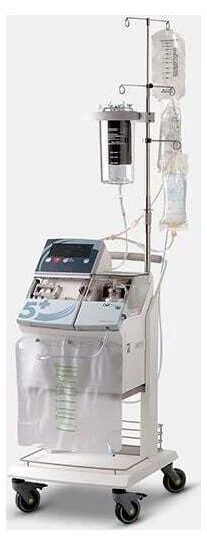
A wheeled unit with a control panel, a centrifuge and pumps in the base, a clear collection reservoirREZ-er-vwarA place where germs live and multiply, such as a person, animal, water or soil.Full entry , and an IV pole holding bags. A suction line and tubing set run from the field to the reservoir.
On the table
What it does, the lengths it comes in and what experienced techs know about it.
What it’s for
Collects the patient's own blood from the surgical field by suction, filters and processes it, and returns it to the patient (intraoperativein-truh-OP-er-uh-tivHappening during surgery, from when the client is brought into the operating room until they are moved to recovery.intra- within, duringoperative of surgeryFull entry cell salvage or autotransfusion). Used when heavy blood loss is expected, such as cardiac, vascular, spine and some trauma, abdominal and orthopedicor-thuh-PEE-dikHaving to do with the bones, joints, muscles, ligaments and tendons, and the branch of medicine that treats them.orth/o straightped/o child (the field began with straightening children's bones)-ic relating toFull entry cases, and can be started in an emergency.
Lengths and variants
The Cell Saver (Haemonetics) was the prototype system; other systems have since been developed.
What experienced techs know
What techs who reach for it every day know about it.Pro
Through the case
In the order you meet it: before, during and after the case.
- During the case
Caution
What not to do with it, and why.Pro
Know it on sight.
With Pro, for every instrument in the library. Cancel any time.
Or scrub in free: 5 questions a day.
On 28 setups
Every setup it is laid out on.
Every setup this instrument is laid out on, with photos of each table.
See ProKnow this instrument?
Send a clearer photo, another name it goes by, or a fix for this page.
5 sources
- Fuller JK. Surgical Technology: Principles and Practice. 8th ed. Chapter 13 (Anesthesia, Physiological Monitoring, and Postanesthesia Recovery), p. 275
- Rothrock JC. Alexander's Care of the Patient in Surgery. 17th ed. Chapter 21 (Neurosurgery), p. 780
- Rothrock JC. Alexander's Care of the Patient in Surgery. 17th ed. Chapter 25 (Cardiac Surgery), p. 927
- Goldman MA. Pocket Guide to the Operating Room. 3rd ed. Chapter 16 (Abdominal Extraintestinal Surgery), p. 169
- Goldman MA. Pocket Guide to the Operating Room. 3rd ed. Chapter 23 (Orthopedic Surgery), p. 635
The rest of this card is Pro.
The photos, the description, the uses and the lengths stay free. Pro opens the rest on every instrument: the 3D model, the notes from the table, where it is kept, every setup it is on, and practice.
Free, for good. No card.
- All 3,323 instrument cards
- Every General setup in full
- 5 exam questions a day
- Your own preference cards
Pass your exam. Know every case.
Everything in Free, plus:
- All 298 setups in every specialty: back table, Mayo and every step
- Practice that never runs out and full timed exams for the CST, TS-C, CRCST, CSPDT and CSFA, with the why behind every answer
- Flashcards on any tray, timed to come back before you forget
- Every instrument card in full: the 3D model, cautions, inspection, how to pass it
Cancel any time from your account. Not worth it? Email us within 30 days of a charge for a refund, one per customer. Refund policy
Pro is also in the CSTSetup app, on the same account. Already have Pro? Log in
Send a photo or a fix
A photo of it on your tray, a name your OR calls it, or anything wrong on this page. Your email is only used to credit you. Submissions stay private and are reviewed by our team; accepted ones earn a Contributor credit here.