Skin Graft Carrier
Dermacarrier · Dermacarrier II · Skin Graft Carrier Plate · Carrier Plate · Mesher Carrier · V-Carrier
A thin, flexible, clear or white plastic board about 3 to 4 inches (7.6 to 10 cm) wide and 8 to 16 inches long. One side is grooved and the other is smooth. It comes sterile in a peel pouch marked with its expansion ratio.
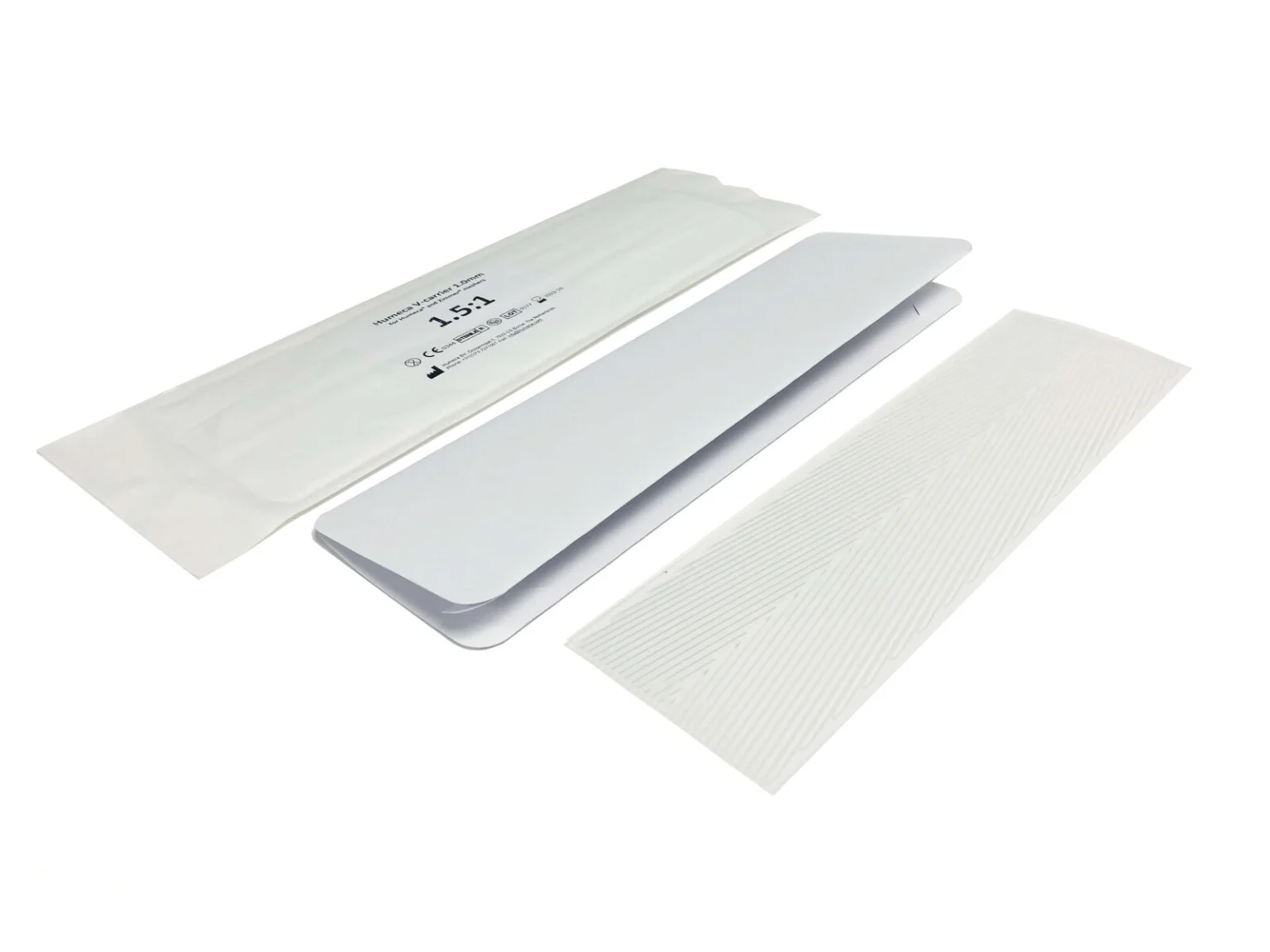
On the table
What it does, the lengths it comes in and what experienced techs know about it.
What it’s for
The split-thickness skin graftGRAFTTissue or a man-made material moved into place in surgery to replace or repair a damaged part.Full entry is spread flat on the carrier, and the carrier carries it through the skin graft mesher. On grooved carriers the pattern of grooves decides how far the meshed graft will stretch. It is then used to move the meshed graft from the mesher to the wound.
Lengths and variants
Ratios include 1:1 (perforates only, for drainage), 1.5:1, 2:1, 3:1, 6:1 and 9:1, depending on the maker. Carriers are made to fit a certain mesher (for example Zimmer MeshGraft II or Aesculap/B. Braun) and are not interchangeable. Zimmer's cutter-type Skin graftGRAFTTissue or a man-made material moved into place in surgery to replace or repair a damaged part.Full entry Mesher uses plain carriers in 8 and 16 inch lengths because the cutter sets the ratio. The pictured carrier is a Humeca V-carrier, 1.5:1, shown with its pouch.
What experienced techs know
What techs who reach for it every day know about it.Pro
Through the case
In the order you meet it: before, during and after the case.
- Before the case
Inspection and testing
What to check before it reaches the field.Pro
- During the case
Caution
What not to do with it, and why.Pro
- After the case
Care and reprocessing
How it is cleaned, checked and sent back to sterile.Pro
Know it on sight.
With Pro, for every instrument in the library. Cancel any time.
Or scrub in free: 5 questions a day.
On 2 setups
Every setup it is laid out on.
Every setup this instrument is laid out on, with photos of each table.
See ProKnow this instrument?
Send a clearer photo, another name it goes by, or a fix for this page.
9 sources
- Rothrock JC. Alexander's Care of the Patient in Surgery. 17th ed. Chapter 22 (Reconstructive and Aesthetic Plastic Surgery), p. 812
- Fuller JK. Surgical Technology: Principles and Practice. 8th ed. Chapter 28 (Plastic and Reconstructive Surgery), p. 732, 735 (Fig. 28.12)
- Semer NB. Practical Plastic Surgery for Nonsurgeons. Chapter 12 (Skin Grafts), p. 103-104
- Nemitz R. Surgical Instrumentation: An Interactive Approach. 3rd ed. p. 369
- zimmerbiomet.com
- zimmerbiomet.com
- humeca.com
- humeca.com
- accessgudid.nlm.nih.gov
The rest of this card is Pro.
The photos, the description, the uses and the lengths stay free. Pro opens the rest on every instrument: the 3D model, the notes from the table, where it is kept, every setup it is on, and practice.
Free, for good. No card.
- All 3,323 instrument cards
- Every General setup in full
- 5 exam questions a day
- Your own preference cards
Pass your exam. Know every case.
Everything in Free, plus:
- All 298 setups in every specialty: back table, Mayo and every step
- Practice that never runs out and full timed exams for the CST, TS-C, CRCST, CSPDT and CSFA, with the why behind every answer
- Flashcards on any tray, timed to come back before you forget
- Every instrument card in full: the 3D model, cautions, inspection, how to pass it
Cancel any time from your account. Not worth it? Email us within 30 days of a charge for a refund, one per customer. Refund policy
Pro is also in the CSTSetup app, on the same account. Already have Pro? Log in
Send a photo or a fix
A photo of it on your tray, a name your OR calls it, or anything wrong on this page. Your email is only used to credit you. Submissions stay private and are reviewed by our team; accepted ones earn a Contributor credit here.