Smoke Evacuator
Smoke Evacuation System · Plume Evacuator · Smoke Evac
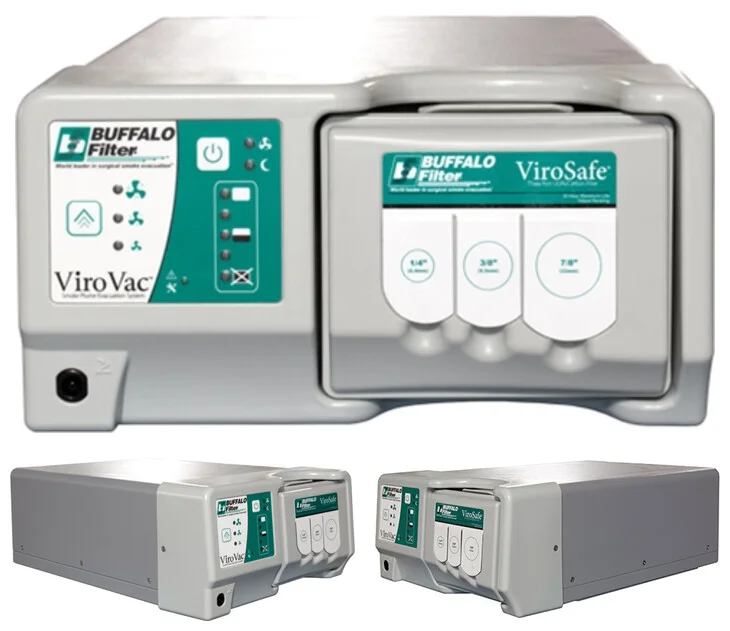
A boxy machine with a vacuum pump and filters, connected by tubing to a wand, a pencil-mounted nozzle or a trocarTROH-karA sharp or bladed instrument inside a tube (cannula), used to pierce a body wall and leave the tube in place as a port.Full entry port at the surgical site. A replaceable filter cartridge, often with ports for different tubing sizes, sits in the front.
On the table
What it does, the lengths it comes in and what experienced techs know about it.
What it’s for
Pulls surgical smoke (plume) away from the field when the electrosurgeryee-LEK-troh-SUR-jer-eeUsing high-frequency electric current through a handheld tool to cut tissue or seal bleeding vessels during surgery.Full entry or laser is used, protecting the team from its toxicitytok-SIS-ih-teeThe harm a substance does to the body, or a state in which a drug has built up to a harmful level.tox/o poison-icity state or quality ofFull entry gases, odor and particles and keeping the surgeon's view clear. Used with open electrosurgery, laparoscopylap-uh-ROS-kuh-peeSurgery or an exam done through small cuts in the belly, using a thin, lighted tube with a camera.lapar/o abdomen-scopy looking with an instrumentFull entry (connected to a port) and laser cases. An individual smoke evacuator is used when a lot of plume is made; small amounts may be handled by room suction with an in-line filter.
Lengths and variants
Stand-alone units, smoke evacuation built into some ESUs or pencils, and central systems that serve several rooms. Individual units pull much more air (about 35 to 50 cubic feet per minute) than wall suction (about 2).
What experienced techs know
What techs who reach for it every day know about it.Pro
Through the case
In the order you meet it: before, during and after the case.
- Before the case
Inspection and testing
What to check before it reaches the field.Pro
- During the case
Caution
What not to do with it, and why.Pro
- After the case
Care and reprocessing
How it is cleaned, checked and sent back to sterile.Pro
Know it on sight.
With Pro, for every instrument in the library. Cancel any time.
Or scrub in free: 5 questions a day.
On 31 setups
Every setup it is laid out on.
Every setup this instrument is laid out on, with photos of each table.
See ProKnow this instrument?
Send a clearer photo, another name it goes by, or a fix for this page.
4 sources
- Fuller JK. Surgical Technology: Principles and Practice. 8th ed. Chapter 15 (Energy Sources in Surgery), p. 299
- Rothrock JC. Alexander's Care of the Patient in Surgery. 17th ed. Chapter 8 (Surgical Modalities), p. 234-235
- AST. Standards of Practice for Use of Electrosurgery, p. 19
- somatechnology.com
The rest of this card is Pro.
The photos, the description, the uses and the lengths stay free. Pro opens the rest on every instrument: the 3D model, the notes from the table, where it is kept, every setup it is on, and practice.
Free, for good. No card.
- All 3,254 instrument cards
- Every General setup in full
- 5 exam questions a day
- Your own preference cards
Pass your exam. Know every case.
Everything in Free, plus:
- All 298 setups in every specialty: back table, Mayo and every step
- Practice that never runs out and full timed exams for the CST, TS-C, CRCST, CSPDT and CSFA, with the why behind every answer
- Flashcards on any tray, timed to come back before you forget
- Every instrument card in full: the 3D model, cautions, inspection, how to pass it
Cancel any time from your account. Not worth it? Email us within 30 days of a charge for a refund, one per customer. Refund policy
Pro is also in the CSTSetup app, on the same account. Already have Pro? Log in
Send a photo or a fix
A photo of it on your tray, a name your OR calls it, or anything wrong on this page. Your email is only used to credit you. Submissions stay private and are reviewed by our team; accepted ones earn a Contributor credit here.