Medical terminology
Build any medical word from its parts, say it and spell it right, and read a chart the way the surgical team does.
1Why the words matter
Medical words can look like a foreign language on your first day. They are really a code with rules. Most of them are built from Greek and Latin parts, and once you know the parts, you can work out words you have never seen before.
In the OR, the words carry information the team acts on. The ending of a procedure's name tells you what kind of procedure it is, and that helps the team prepare the right instruments and equipment. You read the surgeon's preference card, the case schedule and the patient's chart, and you label every medication on the back table.
Abbreviations save time, but a misread one can hurt a patient. Every chart entry has to use the right terms and abbreviations so the next person reads it the way the writer meant it. Error-prone abbreviations should stay off preference cards and medication labels.
With patients, the rule flips. Talk to them in plain language and leave the medical words out.
This chapter teaches the words. Other chapters teach what the words name: body planes, directions and cavities as anatomy in chapter 2; each body system in chapters 3 to 9; drug names, doses and the medication label in chapter 12; charting and legal documentation in chapter 15; instrument names and eponyms in chapter 24; the preference card and the chart review before a case in chapter 28; and each procedure in full in chapters 32 to 42.
2The parts of a medical word
Most medical words are built from three kinds of parts.
- Word root: the core of the word. It usually names the body part or body system the word is about. In hepatitis, the root hepat means liver. Some words have more than one root.
- Prefix: a part at the start of the word that adds to the root's meaning, the way an adjective adds to a noun. A prefix often tells number, position, direction, time or "not." In subhepatic, the prefix sub- means below.
- Suffix: a part at the end of the word. It usually tells you the procedure, the condition or the disease. In hepatitis, the suffix -itis means inflammation.
Two more terms describe how the parts join.
- Combining vowel: a vowel added to make the word easier to say. It joins a root to a suffix, or one root to another. It is usually o.
- Combining form: a word root plus its combining vowel, written with a slash, such as hepat/o. The vowel is usually o, but a few roots take another one, such as chol/e (bile) and pelv/i (pelvis).
A prefix is written with a hyphen after it (sub-) and a suffix with a hyphen before it (-itis). Here is an easy way to remember their order: prefix, root and suffix are in alphabetical order, and that is the order they appear in a word.
Not every word has all three parts. A word can be a root alone, two roots, a root and a suffix, or a prefix and a root, and some words join three roots together.
Words you cannot build
Some medical terms are not made from Greek and Latin parts, so you learn them as whole words.
- Eponyms are named after a person, such as Parkinson disease, first described by a physician named James Parkinson. Many instruments are named after the surgeon who invented them; chapter 24 covers those.
- Acronyms are abbreviations made from the first letters of several words and said as one word, such as AIDS, for acquired immunodeficiency syndrome.
- Modern-language terms are made from everyday English, such as post-traumatic stress disorder.
3Reading a word: start at the end
To work out a word that is built from parts, follow three steps.
- Divide the word into its parts. Put a slash between the parts and on each side of a combining vowel.
- Define each part.
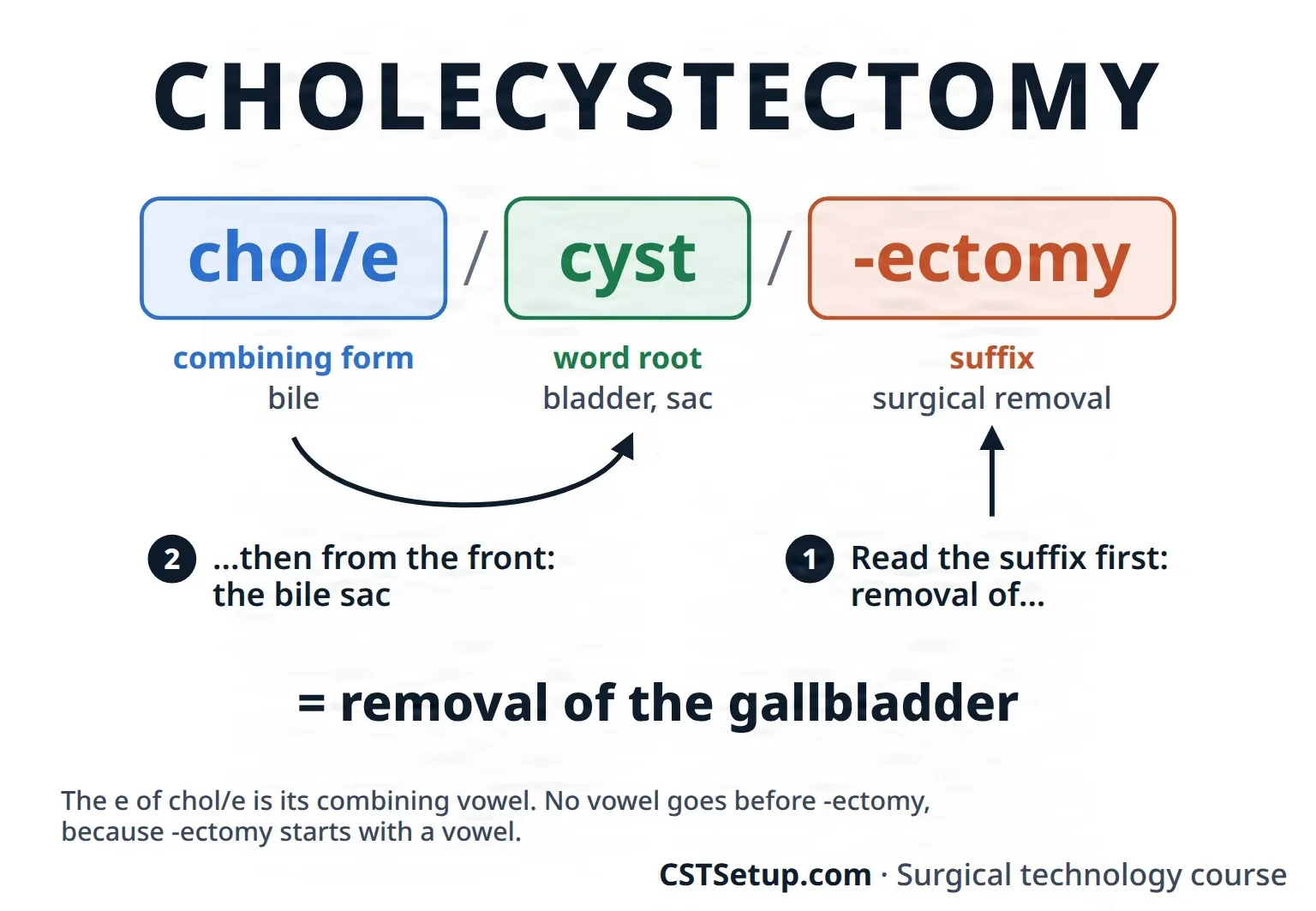
- Build the meaning. Start with the suffix, then go back to the front of the word and add the other parts in order.
Osteoarthropathy divides into oste/o/arthr/o/pathy. Oste means bone, arthr means joint and -pathy means disease. Start with the suffix and you get "disease of the bone and joint."
Intravenous divides into intra/ven/ous. Intra- means within, ven means vein and -ous means pertaining to, so the word means "pertaining to within a vein." With practice you shorten that to "within the vein."
Pericarditis is peri- (around) + card (heart) + -itis (inflammation): inflammation around the heart, of the sac that holds it. Tonsillitis is inflammation of the tonsils.
Every language has exceptions to its rules, and medical words do too. Some words look as if they are built from parts but cannot be translated part by part, and those you learn by heart.
Read the suffix first. It tells you what kind of word you have: a procedure, a condition or a disease. Then read the rest from the front of the word.
4Rules for combining word parts
The combining vowel follows four rules.
- Root + a suffix that starts with a consonant: keep the vowel. arthr + -pathy = arthropathy, disease of a joint.
- Root + a suffix that starts with a vowel: usually drop it. hepat + -ic = hepatic. Hemigastrectomy, removal of half the stomach, drops the o of gastr/o before -ectomy.
- Root + root: keep the vowel, even when the next root starts with a vowel. oste + arthr + -itis = osteoarthritis.
- Prefix + root: never add one. sub- + hepat + -ic = subhepatic.
Some words change, drop or add letters so they are easier to spell and say. Herniorrhaphy, the surgical repair of a hernia, adds an o between herni and -rrhaphy. Proctitis, inflammation of the rectum, drops the o of proct/o. Not every medical word has a combining vowel at all.
Many suffixes mean "pertaining to": -ac, -al, -ar, -ary, -eal, -ic, -ior and -ous. So cardiac means pertaining to the heart, dermal pertaining to the skin and pulmonary pertaining to the lungs.
Compound words
A compound word holds two or more word roots. The order of the roots comes from common use, so you learn the usual order as you meet each word.
- Cholecystectomy: chol/e (bile) + cyst (bladder, sac) + -ectomy (surgical removal). It means removal of the gallbladder.
- Electrocardiogram: electr/o (electricity) + cardi/o (heart) + -gram (record). It is a record of the heart's electrical activity.
- Cardiothoracic: cardi/o (heart) + thorac (chest) + -ic. A cardiothoracic surgeon operates on the heart, its major vessels and the lungs.
- Septorhinoplasty: sept/o (dividing wall) + rhin/o (nose) + -plasty (surgical repair). It is a repair of the nose.
Some compound words are written with a hyphen. Salpingo-oophorectomy is salping/o (fallopian tube) + oophor (ovary) + -ectomy: surgical removal of a fallopian tube and its ovary.
5Saying the word
Dictionaries show how to say a word by respelling it with marks.
- A line over a vowel (ā, ē, ī, ō, ū) means a long sound: the ō in "go."
- A small curve over a vowel (ă, ĕ, ĭ, ŏ, ŭ) means a short sound: the ŏ in "mop."
- Capital letters mark the syllable you stress. Debride is said di-BRĒD.
Some letters do not sound the way they look. The respellings show it.
- pn at the start of a word sounds like n: pneumonia is nū-MŌ-nē-ă.
- ps at the start of a word sounds like s: psoriasis is sō-RĪ-ə-sĭs.
- pt at the start of a word sounds like t: ptosis is TŌ-sĭs.
- x at the start sounds like z: xeroderma is zē-rō-DUR-mă.
- ch often sounds like k: cholecystectomy is kō-lĕ-sis-TEK-tŏ-mē.
- ph sounds like f: pharyngitis is fă-RĬN-JĪ-tĭs.
- rh sounds like r: rhinitis is rye-NYE-tis.
- c before y sounds like s: cyanosis is sī-ă-NŌ-sĭs, and cystoscopy is sĭs-TŎS-kŏ-pē.
- g before i often sounds like j: gingivitis is jin-jĭ-VĪT-ĭs.
Listen for the stress. In laparoscopy (lăp-ă-RŎS-kŏ-pē) and laparotomy (lap-uh-ROT-uh-mee), it falls on the syllable that holds the o just before the suffix. Words that end in -ectomy stress the "EK": appendectomy is ap-ĕn-DEK-tŏ-mē.
When you meet a new word, say it out loud. If you are not sure how it sounds, look up its respelling in a medical dictionary before you say it at the field.
6Writing and spelling
In medical words, one letter can change the body part or the procedure.
- Ileum and ilium sound the same. The ileum is the end of the small intestine; the ilium is the upper part of the hip bone.
- -ectomy, -otomy and -ostomy look alike. They mean removal, cutting into and making an opening. A colectomy removes part of the colon; a colostomy brings the colon out through the abdominal wall.
- -phagia means eating or swallowing, and -phasia means speech.
- Hyper- means above or excessive, and hypo- means below or deficient. Hyperglycemia is high blood sugar; hypoglycemia is low blood sugar.
- The double-r endings all start with rrh: -rrhage and -rrhagia (excessive flow), -rrhaphy (suturing), -rrhea (flow, discharge) and -rrhexis (rupture).
Drug names that look or sound alike cause errors too. Each facility keeps its own list of look-alike, sound-alike drugs, and labels may print part of a name in capital letters to show where two names differ, called tall man lettering. Chapter 12 covers drug names.
7Plural forms
Many medical words come from Greek and Latin, and many keep a Greek or Latin plural: they change the ending instead of adding -s.
| Singular ending | Plural ending | Examples |
|---|---|---|
| -a | -ae | bursa, bursae; vertebra, vertebrae |
| -us | -i | bronchus, bronchi; calculus (a stone), calculi |
| -um | -a | diverticulum, diverticula; septum, septa |
| -is | -es | diagnosis, diagnoses; testis, testes |
| -is (some words) | -ides | epididymis, epididymides |
| -ix, -ex | -ices | appendix, appendices; varix, varices; cortex, cortices; apex, apices |
| -on | -a | ganglion, ganglia |
| -en | -ina | foramen, foramina |
| -ma | -mata | myoma, myomata |
| -nx | -nges | phalanx, phalanges |
Some words also take an English -s: appendixes, apexes and myomas are correct too. Phalanges is the plural only for the bones of the fingers and toes; phalanxes is used for other meanings.
You will hear plurals at the field. Stones in a specimen cup are calculi, and the two main airways off the trachea are the bronchi.
8Prefixes
A prefix changes the meaning of the root it sits in front of. Peri- means around, so pericardial means around the heart and perioperative takes in the whole surgical process: before, during and after the operation. The same prefix names the periosteal elevator, an instrument that lifts tissue from around a bone.
These are the prefixes the Core Curriculum asks you to know, grouped by meaning.
Position and direction
| Prefix | Meaning |
|---|---|
| ab- | away from |
| ad- | toward, near |
| dia- | through, across, apart |
| ecto- | outside, outer |
| en- | in |
| endo- | within, inner |
| epi- | upon, over, on |
| ex- | out of, away from |
| exo- | outside, outer |
| inter- | between |
| intra- | within, inside |
| para- | beside, beyond |
| per- | through |
| peri- | around |
| retro- | behind, backward |
| sub- | under, beneath |
| super- | above, excessive |
| supra- | above |
Size, amount and sides
| Prefix | Meaning |
|---|---|
| ambi- | both |
| hemi- | half |
| semi- | half, partial |
| macro- | large |
| micro- | small |
Time and speed
| Prefix | Meaning |
|---|---|
| ante- | before, in front of |
| post- | after, behind |
| pre- | before, in front of |
| brady- | slow |
| tachy- | fast |
Not, against, good and bad
| Prefix | Meaning |
|---|---|
| a-, an- | without, absence of, not |
| anti- | against |
| contra- | against, opposed to |
| crypt- | hidden |
| dys- | bad, painful, difficult |
| eu- | normal, good |
| mal- | bad |
| hyper- | above, excessive |
| hypo- | below, deficient |
Put them to work. Bilateral means both sides, dysuria is painful urination, tachycardia is a fast heart rate and hypertension is high blood pressure. Subclavian means under the clavicle, suprapubic above the pubis, intraoperative during the operation and transurethral through the urethra.
9Suffixes
The suffix is where you start reading, because it tells you whether the word names a procedure, a condition or a disease. For example, -scopy (looking inside) names a procedure, -itis (inflammation) a condition and -oma (tumor) a disease.
Surgical suffixes
These endings name what the surgeon does.
| Suffix | Meaning | Example |
|---|---|---|
| -ectomy | surgical removal | appendectomy, removal of the appendix |
| -tomy (-otomy) | cutting into, incision | laparotomy, a large incision into the abdomen |
| -stomy (-ostomy) | a surgically made opening | colostomy, bringing the colon out through the abdominal wall |
| -plasty | surgical repair, reshaping | arthroplasty, surgical repair of a joint |
| -pexy | surgical fixation | hysteropexy, fixing the uterus in place |
| -rrhaphy | suturing | herniorrhaphy, repair of a hernia |
| -tripsy | crushing | lithotripsy, breaking up stones |
| -lysis | loosening, breaking down, separating | hemolysis, the breakdown of red blood cells |
| -centesis | surgical puncture to draw out fluid | thoracentesis, removing fluid from around the lungs |
| -scopy | looking inside, visual examination | bronchoscopy, looking into the airway |
| -scope | instrument for looking inside | bronchoscope, the thin viewing instrument used for it |
| -tome | instrument used to cut | osteotome, an instrument for cutting bone |
Some lists write these two as -tomy and -stomy, others as -otomy and -ostomy, with the combining vowel in front. They are the same suffixes.
An -ostomy can open an organ to the outside, as a colostomy does. It can also join two hollow organs inside the body. That surgical connection is an anastomosis: a gastroduodenostomy joins the stomach to the duodenum.
-ectomy takes out, -otomy cuts into, -ostomy makes an opening. One or two letters change the whole case, so read every surgical word to the end.
Suffixes for records and images
| Suffix | Meaning |
|---|---|
| -gram | a record or image |
| -graph | an instrument that records |
| -graphy | the process of recording |
An electrocardiogram is the record of the heart's electrical activity. During a cholecystectomy, the surgeon may take a cholangiogram, an X-ray image of the bile ducts made with contrast, to look for a blockage.
Suffixes for conditions and diseases
| Suffix | Meaning |
|---|---|
| -algia | pain |
| -cele | hernia, protrusion |
| -ectasia, -ectasis | stretching, dilation |
| -edema | swelling from fluid trapped in the tissues |
| -emesis | vomiting |
| -iasis | condition |
| -itis | inflammation |
| -malacia | softening |
| -megaly | enlargement |
| -oma | tumor, mass |
| -osis | abnormal condition |
| -pathy | disease |
| -ptosis | drooping, prolapse |
| -rrhage, -rrhagia | excessive flow |
| -rrhea | flow, discharge |
| -sclerosis | hardening |
| -spasm | sudden, involuntary contraction |
| -stasis | stopping, controlling |
Myalgia is muscle pain, appendicitis is inflammation of the appendix and cholelithiasis is the formation of gallstones. Hemostasis is hem/o (blood) + -stasis (stopping): stopping the flow of blood.
Endings that make nouns and adjectives
| Suffix | Meaning |
|---|---|
| -al | pertaining to |
| -ia | condition, abnormal state |
| -ism | state of, condition |
| -ist | a person who does or practices something |
| -ium | a noun ending, as in pericardium |
| -logist | specialist who studies and treats |
| -logy | study of |
| -oid | resembling |
| -sis | state of, condition |
A cardiologist is a doctor who specializes in heart disease, and cardiology is the study of the heart.
10Combining forms for position, number and color
Position and direction
These forms build the direction words of anatomy: anterior (toward the front) and posterior (toward the back), superior (above) and inferior (below), medial (toward the middle) and lateral (toward the side), proximal (nearer the trunk) and distal (farther from it). Chapter 2 teaches them on the body, with the planes and cavities.
| Word part | Meaning |
|---|---|
| anter/o | front |
| caud/o | tail; toward the lower end of the body |
| cephal/o | head |
| centr/o | center |
| dist/o | far from the trunk or the point of attachment |
| dors/o | back |
| extern/o | outside |
| infer/o | below, lower |
| intern/o | inside, within the body |
| later/o | side |
| medi/o | middle |
| pariet/o | the wall of a cavity |
| peripher/o | the outer part, away from the center |
| poster/o | back, behind |
| proxim/o | near the trunk or the point of attachment |
| super/o | above, higher |
| ventr/o | belly, front |
| viscer/o | internal organs |
Amount and number
| Word part | Meaning |
|---|---|
| bi- | two, double, both |
| di- | two, twice |
| mono- | one |
| multi- | many |
| nulli- | none |
| poly- | many, excessive |
| primi- | first |
| quad-, quadra-, quadri- | four |
| tetra- | four |
| tri- | three |
| uni- | one |
Color
| Word part | Meaning |
|---|---|
| alb/o, albin/o | white |
| chlor/o | green |
| cyan/o | blue |
| erythr/o | red |
| leuk/o | white |
| melan/o | black |
| poli/o | gray, as in the gray matter of the brain and spinal cord |
| xanth/o | yellow |
Cyanosis is a bluish color of the skin from poor circulation or too little oxygen in the blood, and erythema is redness of the skin. A leukocyte is a white blood cell.
11Word roots by body system
Each body system has its own set of roots. Chapters 3 to 9 teach what each part is and does; here you learn the word parts that name them. The tables follow the Core Curriculum's lists, system by system, and a few examples after each table show the roots at work. Some roots appear in more than one system, because the Core Curriculum lists them wherever they are used.
Skin (integumentary system)
| Word part | Meaning |
|---|---|
| adip/o | fat |
| caus/o | burning |
| cauter/o | heat, burning |
| cutane/o | skin |
| derm/o, dermat/o | skin |
| diaphor/o | sweat (diaphoresis is heavy sweating) |
| erythem/o, erythemat/o | redness |
| hidr/o | sweat |
| kerat/o | hard, horny tissue; keratin |
| leuk/o | white |
| lip/o | fat |
| melan/o | black |
| myc/o | fungus |
| onych/o | nail |
| phyt/o | plant |
| pil/o | hair |
| py/o | pus |
| seb/o | sebum, the skin's oil |
| sebace/o | sebum; the sebaceous (oil) glands |
| squam/o | scale |
| steat/o | fat, sebum |
| trich/o | hair |
| ungu/o | nail |
| xer/o | dry |
Xeroderma is very dry skin, cyanosis a bluish skin color, and diaphoresis heavy sweating.
Bones, joints and muscles (musculoskeletal system)
| Word part | Meaning |
|---|---|
| ankyl/o | stiff, bent |
| arthr/o | joint |
| burs/o | bursa |
| calc/o | calcium |
| carp/o | carpals, the wrist bones |
| cervic/o | neck |
| chondr/o | cartilage |
| clavicul/o | clavicle, the collarbone |
| coccyg/o | coccyx, the tailbone |
| cost/o | ribs |
| crani/o | cranium, the skull |
| femor/o | femur, the upper leg bone |
| fibul/o | fibula, a lower leg bone |
| humer/o | humerus, the upper arm bone |
| ili/o | ilium, the upper part of the hip bone |
| ischi/o | ischium |
| lumb/o | lower back, the lumbar spine |
| metacarp/o | metacarpals |
| metatars/o | metatarsals, the bones of the midfoot and forefoot |
| muscul/o | muscle |
| my/o | muscle |
| myel/o | bone marrow; spinal cord |
| oste/o | bone |
| patell/o | patella, the kneecap |
| pelv/i | pelvis |
| phalang/o | phalanges, the finger and toe bones |
| pub/o | pubis |
| radi/o | radius |
| sacr/o | sacrum |
| scapul/o | scapula, the shoulder blade |
| spondyl/o | vertebra, the spine |
| stern/o | sternum, the breastbone |
| tars/o | tarsals, the ankle bones |
| ten/o, tend/o | tendon |
| thorac/o | chest |
| tibi/o | tibia, a lower leg bone |
| uln/o | ulna, a forearm bone |
| vertebr/o | vertebra, the spine |
Arthroscopy is looking inside a joint, arthrodesis is surgical fusion of a joint, and osteotomy is cutting into a bone.
Nerves and brain (nervous system)
| Word part | Meaning |
|---|---|
| alges/o | sensitivity to pain |
| angi/o | vessel |
| caus/o | burning |
| cerebell/o | cerebellum |
| cerebr/o | cerebrum |
| comat/o | deep sleep; coma |
| crani/o | cranium, the skull |
| cry/o | cold |
| dur/o | dura mater; hard |
| encephal/o | brain |
| gli/o | glia, the supporting tissue of the brain and spinal cord |
| hydr/o | water |
| mening/o, meningi/o | meninges, the membranes that cover the brain and spinal cord |
| my/o | muscle |
| myel/o | spinal cord; bone marrow |
| narc/o | numbness, stupor |
| neur/o | nerve |
| pont/o | pons, a part of the brainstem |
| radicul/o | nerve root |
| spin/o | spine |
| syncop/o | fainting (syncope) |
| tax/o | order, coordination |
| thalam/o | thalamus |
| troph/o | nourishment |
| vag/o | vagus nerve |
A craniotomy is an incision into the skull, encephalitis is inflammation of the brain, and a meningioma is a tumor of the meninges.
The eye
| Word part | Meaning |
|---|---|
| aque/o | water |
| ambly/o | dull, dim |
| blephar/o | eyelid |
| conjunctiv/o | conjunctiva |
| cor/o | pupil |
| corne/o | cornea |
| cycl/o | ciliary body of the eye; circle |
| dacry/o | tear, tear duct |
| dipl/o | two, double |
| glauc/o | as in glaucoma, eye diseases with raised pressure that damage the optic nerve |
| ir/o, irid/o | iris |
| kerat/o | cornea |
| lacrim/o | tear, tear duct |
| mi/o | less, fewer |
| mydr/o | widening of the pupil (mydriasis) |
| ocul/o | eye |
| ophthalm/o | eye |
| opt/o, optic/o | eye, vision |
| palpebr/o | eyelid |
| papill/o | papilla, a small bump |
| phac/o | lens |
| phot/o | light |
| presby/o | old age |
| pupill/o | pupil |
| retin/o | retina |
| scler/o | sclera |
| uve/o | uvea, the middle layer of the eyeball |
| vitre/o | vitreous humor, the thick fluid that fills the back of the eye |
| xer/o | dry |
| -opia | vision condition |
| -opsia | vision, as in hemianopsia (blindness in half of the field of vision) |
| -tropia | turning (of the eye) |
Ptosis, spelled like the suffix -ptosis, is a drooping upper eyelid. Mydriasis is a widened pupil, and glaucoma is a group of eye diseases that damage the optic nerve, often from high pressure inside the eye.
The ear
| Word part | Meaning |
|---|---|
| acous/o | hearing |
| audi/o | hearing |
| aur/o | ear |
| auricul/o | ear |
| cochle/o | cochlea |
| mastoid/o | mastoid bone |
| myring/o | eardrum (tympanic membrane) |
| ossicul/o | ossicle, a middle ear bone |
| ot/o | ear |
| staped/o | stapes, a middle ear bone |
| tympan/o | eardrum; middle ear |
| -cusis | hearing condition, as in presbycusis (age-related hearing loss) |
| -otia | ear condition, as in microtia (a very small outer ear) |
A myringotomy is a small incision in the eardrum, and a tympanoplasty is surgical repair of the eardrum. Otitis media is inflammation of the middle ear.
Blood
| Word part | Meaning |
|---|---|
| agglutin/o | clumping |
| bas/o | base |
| chrom/o | color |
| coagul/o | clotting |
| cyt/o | cell |
| eosin/o | red, rosy |
| erythr/o | red |
| granul/o | granule |
| hem/o, hemat/o | blood |
| hemoglobin/o | hemoglobin, the protein in red blood cells that carries oxygen |
| leuk/o | white |
| mon/o | one, single |
| morph/o | form, shape |
| neutr/o | neutral |
| nucle/o | nucleus |
| phag/o | eat, swallow |
| thromb/o | clot |
| -apheresis | removal |
| -blast | immature cell |
| -cytosis | increase in cells |
| -emia | in the blood |
| -globin | protein |
| -globulin | protein (globulins are plasma proteins) |
| -lytic | breaking down (lysis) |
| -phoresis | transmission |
| -plasia | formation, development |
| -poiesis | formation, production |
A leukocyte is a white blood cell, thrombosis is a blood clot forming inside a vessel, and hemolysis is the breakdown of red blood cells.
Heart and vessels (cardiovascular system)
| Word part | Meaning |
|---|---|
| aneurysm/o | aneurysm, a bulging of a weak vessel wall |
| angi/o | vessel |
| aort/o | aorta |
| arter/o, arteri/o | artery |
| ather/o | fatty plaque |
| atri/o | atrium |
| cardi/o | heart |
| coron/o | heart; crown, circle |
| cyan/o | blue |
| isch/o | deficiency, blockage |
| lymph/o | lymph |
| lymphat/o | lymphatic system and vessels |
| my/o | muscle |
| pericardi/o | pericardium, the sac around the heart |
| phleb/o | vein |
| sphygm/o | pulse |
| valv/o | valve |
| vas/o | vessel |
| ven/o | vein |
| ventricul/o | ventricle |
An angiogram is an image of the inside of blood vessels made with contrast. Bradycardia is a slow heart rate: brady- (slow) + card (heart) + -ia (condition).
Lymphatic system
| Word part | Meaning |
|---|---|
| cervic/o | neck |
| immun/o | immune, immunity |
| lymph/o | lymph, lymph tissue |
| lymphaden/o | lymph node |
| lymphangi/o | lymph vessel |
| splen/o | spleen |
| thym/o | thymus gland |
A splenectomy is surgical removal of the spleen, and lymphadenopathy is disease of a lymph node, such as a node swollen by infection.
Lungs and airway (respiratory system)
| Word part | Meaning |
|---|---|
| alveol/o | alveolus |
| bronch/o, bronchi/o | bronchus |
| bronchiol/o | bronchiole, a small branch of a bronchus |
| laryng/o | larynx |
| lob/o | lobe |
| nas/o | nose |
| ox/o, ox/i | oxygen |
| pharyng/o | pharynx |
| phren/o | diaphragm |
| pleur/o | pleura |
| pneum/o, pneumon/o | lung, air |
| pulm/o, pulmon/o | lung |
| rhin/o | nose |
| thorac/o | chest |
| trache/o | trachea, the windpipe |
| -ole | small, as in bronchiole and arteriole |
| -pnea | breathing |
A tracheostomy is a new opening into the trachea, a thoracotomy is an incision into the chest, and pneumonia is an infection that inflames the air sacs of the lungs.
Digestive system
| Word part | Meaning |
|---|---|
| abdomin/o | abdomen |
| an/o | anus |
| append/o, appendic/o | appendix |
| bil/i | bile |
| cec/o | cecum, the first part of the large intestine |
| chol/e | bile, gall |
| cholecyst/o | gallbladder |
| col/o, colon/o | colon |
| dent/i, dent/o | tooth |
| doch/o | receptacle; found in choledoch/o, the common bile duct |
| duoden/o | duodenum |
| enter/o | intestine |
| esophag/o | esophagus |
| gastr/o | stomach |
| gingiv/o | gum |
| gloss/o | tongue |
| hepat/o | liver |
| ile/o | ileum |
| intestin/o | intestine |
| jejun/o | jejunum |
| lapar/o | abdomen |
| lingu/o | tongue |
| odont/o | tooth |
| omphal/o | navel |
| or/o | mouth |
| pancreat/o | pancreas |
| periton/o, peritone/o | peritoneum, the lining of the abdomen |
| proct/o | rectum |
| rect/o | rectum |
| sial/o | saliva, salivary gland |
| sigmoid/o | sigmoid colon |
| stomat/o | mouth |
Hepatitis is inflammation of the liver, a colectomy removes part of the large intestine, and an ileostomy makes a new opening to the ileum.
Urinary system (genitourinary)
| Word part | Meaning |
|---|---|
| albumin/o | albumin |
| cyst/o | bladder, sac |
| glomerul/o | glomerulus |
| hydr/o | water |
| lith/o | stone |
| olig/o | few, scanty |
| pyel/o | renal pelvis |
| ren/o | kidney |
| trigon/o | trigone, the triangle at the base of the bladder |
| ureter/o | ureter |
| urethr/o | urethra |
| urin/o | urine |
| vesic/o | bladder, sac |
Cystoscopy (cyst/o + -scopy) is looking inside the bladder and urethra with a cystoscope, and nephrolithiasis is stones in the kidney.
Female reproductive system
| Word part | Meaning |
|---|---|
| amni/o | amnion, amniotic fluid |
| cervic/o | cervix |
| colp/o | vagina |
| culd/o | cul-de-sac, a blind pouch |
| fet/o | fetus |
| gon/o | offspring, semen, genitals |
| gynec/o | woman |
| hyster/o | uterus |
| lapar/o | abdomen |
| mamm/o, mast/o | breast |
| men/o | menstruation |
| metr/o | uterus |
| myom/o | myoma, a muscle tumor |
| nat/i, nat/o | birth |
| oophor/o | ovary |
| ovar/o | ovary |
| par/o | to bear, give birth |
| salping/o | fallopian tube |
| uter/o | uterus |
| vagin/o | vagina |
| vulv/o | vulva |
A hysterectomy (hyster/o + -ectomy) removes the uterus, an oophorectomy removes one or both ovaries, and a mastectomy removes a breast.
Male reproductive system
| Word part | Meaning |
|---|---|
| epididym/o | epididymis |
| genit/o | genitals, reproduction |
| orchi/o, orchid/o | testis |
| pen/o | penis |
| prostat/o | prostate gland |
| scrot/o | scrotum |
| semin/o, semin/i | semen |
| spermat/o | sperm |
| test/o, testic/o | testis, testicle |
| varic/o | varicose (swollen, twisted) vein |
| vas/o | vas deferens; vessel, duct |
An orchiectomy removes one or both testicles, and prostatitis is inflammation of the prostate gland.
Glands (endocrine system)
| Word part | Meaning |
|---|---|
| aden/o | gland |
| adren/o, adrenal/o | adrenal glands |
| calc/o | calcium |
| cortic/o | cortex, the outer layer of an organ |
| crin/o | to secrete, as in endocrine (secreting into the blood) |
| estr/o | estrogen, the hormones of the female reproductive system |
| gluc/o, glyc/o | sugar |
| home/o | sameness |
| kal/i | potassium |
| pancreat/o | pancreas |
| parathyroid/o | parathyroid gland |
| pituitar/o | pituitary gland |
| thyr/o, thyroid/o | thyroid gland |
A parathyroidectomy removes the parathyroid glands, and hyperglycemia is too much sugar in the blood.
12Taking a procedure name apart
Every case on the schedule has a name, and many names are built from the parts in this chapter. Take each name apart before you open the case: the suffix tells you what the surgeon will do, and the roots tell you where. Each card below opens that setup.
Laparoscopic cholecystectomy. Laparoscopic is lapar/o (abdomen) + -scopic (pertaining to looking inside): the work is done through a scope in the abdomen. Cholecystectomy is chol/e (bile) + cyst (sac) + -ectomy: removal of the gallbladder. The diagnosis is often cholecystitis, inflammation of the gallbladder, or cholelithiasis, gallstones.
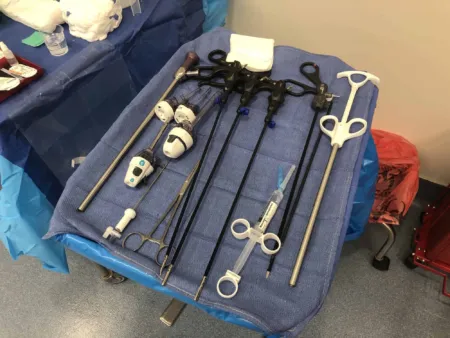
Appendectomy. append/o (appendix) + -ectomy: removal of the appendix. The disease uses the other form of the root: appendic/o + -itis = appendicitis.
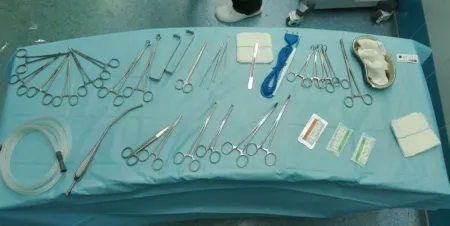
Exploratory laparotomy. lapar/o (abdomen) + -tomy (incision): a large incision into the abdomen to reach its organs. It is called exploratory when it is done to look inside because less invasive tests have not found the diagnosis.
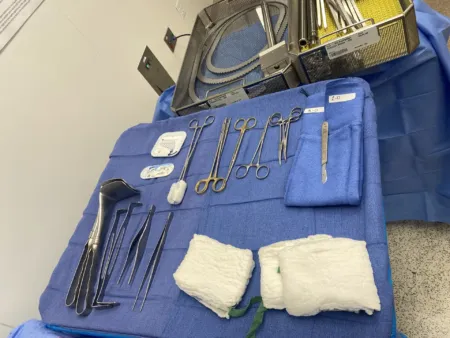
Colostomy. col/o (colon) + -stomy (opening): one end of the large intestine is brought out through the abdominal wall so stool can leave the body.
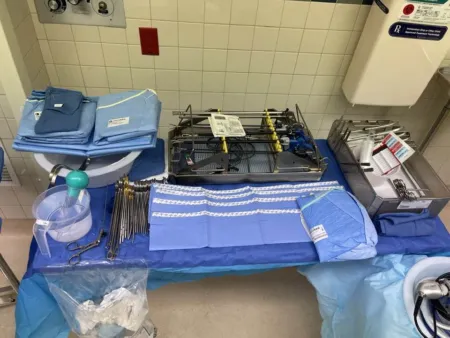
Gastrostomy. gastr/o (stomach) + -stomy: an opening through the stomach wall to the outside of the body. When it is done with a scope it is a percutaneous endoscopic gastrostomy (PEG), and percutaneous is per- (through) + cutane (skin) + -ous.
Rhinoplasty. rhin/o (nose) + -plasty (surgical repair): reshaping the nose to improve how it works, how it looks, or both.
Orchiopexy. orchi/o (testis) + -pexy (surgical fixation): bringing down a testis that has not descended into the scrotum and fixing it in place. The condition is cryptorchidism: crypt- (hidden) + orchid (testis) + -ism.
Bronchoscopy. bronch/o (bronchus) + -scopy (looking inside): examining the airway through a thin viewing instrument, the bronchoscope.
Bilateral myringotomy with tubes (BMT). Bilateral is bi- (two) + later (side) + -al: on both sides. Myringotomy is myring/o (eardrum) + -tomy: a small incision in the eardrum to drain fluid or relieve pressure. A small tube is placed in each incision so the middle ear keeps draining.
Total hip arthroplasty. arthr/o (joint) + -plasty (surgical repair). Also called a total hip replacement, it replaces the head of the femur and the acetabulum, the hip socket, with replacement parts.
Transurethral resection of the prostate (TURP). Transurethral is trans- (through) + urethr (urethra) + -al: through the urethra. In a TURP, part of the prostate gland is removed with a scope passed through the urethra.
Tonsillectomy and adenoidectomy (T&A). tonsill + -ectomy removes the tonsils; adenoid + -ectomy removes the adenoid, which sits behind the nasal cavity. The two are often done together.
Salpingo-oophorectomy. salping/o (fallopian tube) + oophor (ovary) + -ectomy: removal of the tube and the ovary. When both sides are done, it is a bilateral salpingo-oophorectomy (BSO).
Dilation and curettage (D&C). Dilation widens the cervix, and curettage scrapes the lining of the uterus with a curette. Together they remove tissue from inside the uterus, often to make a diagnosis.
Two common procedures have no card here but are good practice. Herniorrhaphy (herni/o, hernia + -rrhaphy, suturing) repairs a hernia. Lithotripsy (lith/o, stone + -tripsy, crushing) breaks up stones in the kidney, bladder or ureters.
13Abbreviations, acronyms and symbols
Abbreviations and symbols save time and fit words into small spaces. They also get misread. A misread abbreviation can cause a harmful error, and tracking down what one meant can delay the patient's care.
An acronym is an abbreviation made from first letters and said as a word, such as AIDS. Some abbreviations are said letter by letter instead: NPO is said en-pē-ō.
Use only the abbreviations your facility approves, the ones the whole health care team knows. BID, twice a day, comes from the Latin bis in die, and NPO, nothing by mouth, from the Latin nil per os. Lesser-known or outdated abbreviations can cause misunderstandings and errors.
The same abbreviation may be written with or without periods or a slash, in capitals or small letters: NPO or n.p.o., UA or U/A.
ISMP, the Institute for Safe Medication Practices, accepts that some abbreviations will always be used, so whoever uses one has to know it can be misread. An uncommon abbreviation should be spelled out by the writer. When an order uses an error-prone abbreviation, the order is clarified with the prescriber and rewritten without it.
Never guess what an abbreviation means. Ask the person who wrote it before you act.
The Core Curriculum lists 97 common abbreviations. They are grouped below by where you will meet them.
Common abbreviations: orders, timing and medications
| Abbreviation | Meaning |
|---|---|
| b.i.d. | twice a day |
| t.i.d. | three times a day |
| NPO (n.p.o.) | nothing by mouth |
| PRN | as needed |
| stat | immediately |
| D/C | discontinue |
| DNR | do not resuscitate |
| RX | drug prescription |
| IM | intramuscular |
| IV | intravenous |
| gt (gtt) | drop |
| gm | gram |
| NS | normal saline |
Common abbreviations: the chart and vital signs
| Abbreviation | Meaning |
|---|---|
| H & P | history & physical |
| DX | diagnosis |
| Bx | biopsy |
| Fx | fracture |
| Ca | cancer |
| NKA | no known allergies |
| BP | blood pressure |
| TPR | temperature, pulse, respiration |
| BSA | body surface area |
| CVP | central venous pressure |
| ICP | intracranial pressure |
| IOP | intraocular pressure |
| ROM | range of motion |
Common abbreviations: directions and body areas
| Abbreviation | Meaning |
|---|---|
| A/P | anterior-posterior |
| P/A | posterior-anterior |
| AK | above the knee |
| BK | below the knee |
| RUQ | right upper quadrant |
| LUQ | left upper quadrant |
| RLQ | right lower quadrant |
| LLQ | left lower quadrant |
| AD | right ear |
| AS | left ear |
| OD | right eye |
| OS | left eye |
| OU | both eyes |
| A/V | atrioventricular |
| CNS | central nervous system |
| CSF | cerebrospinal fluid |
| TMJ | temporomandibular joint |
| ENT | ear, nose, and throat |
| GU | genitourinary |
| GYN | gynecology |
| KUB | kidney, ureter, bladder |
Common abbreviations: procedures and treatments
| Abbreviation | Meaning |
|---|---|
| CABG | coronary artery bypass graft |
| CPR | cardiopulmonary resuscitation |
| D & C | dilation (dilatation) and curettage |
| I & D | incision & drainage; irrigation & debridement |
| T & A | tonsillectomy & adenoidectomy |
| TAH/BSO | total abdominal hysterectomy with bilateral salpingo-oophorectomy |
| TURP | transurethral resection of the prostate |
| TENS | transcutaneous electrical nerve stimulation |
| ACLS | advanced cardiac life support |
| BCLS | basic cardiac life support |
Common abbreviations: tests and imaging
| Abbreviation | Meaning |
|---|---|
| ABG | arterial blood gas |
| BUN | blood urea nitrogen |
| CAT | computed axial tomography |
| CBC | complete blood count |
| ECG (EKG) | electrocardiogram; electrocardiograph |
| EEG | electroencephalogram; electroencephalograph |
| HCT | hematocrit |
| MRI | magnetic resonance imaging |
| PET | positron emission tomography |
| UA (U/A) | urinalysis |
| RBC | red blood cell |
| WBC | white blood cell count |
Common abbreviations: diseases and conditions
| Abbreviation | Meaning |
|---|---|
| AF | atrial fibrillation |
| AIDS | acquired immunodeficiency syndrome |
| ARDS | acute respiratory distress syndrome |
| ASD | atrial septal defect |
| BPH | benign prostatic hypertrophy (also called benign prostatic hyperplasia) |
| CAD | coronary artery disease |
| CHF | congestive heart failure |
| COPD | chronic obstructive pulmonary disease |
| CVA | cerebrovascular accident |
| DIC | disseminated intravascular coagulation |
| DJD | degenerative joint disease |
| GERD | gastroesophageal reflux disease |
| GSW | gunshot wound |
| HBV | hepatitis B virus |
| HIV | human immunodeficiency virus |
| PAD | peripheral artery disease |
| PDA | patent ductus arteriosus |
| PID | pelvic inflammatory disease |
| PVC | premature ventricular contraction |
| STD | sexually transmitted disease |
| TB | tuberculosis |
| TIA | transient ischemic attack |
| URI | upper respiratory infection |
| UTI | urinary tract infection |
| VSD | ventricular septal defect |
Common abbreviations: places in the hospital
| Abbreviation | Meaning |
|---|---|
| ICU | intensive care unit |
| L & D | labor & delivery |
| PACU | post-anesthesia care unit |
Eyes and ears: a risky pair
The Core Curriculum lists AD (right ear), AS (left ear), OD (right eye), OS (left eye) and OU (both eyes) as common abbreviations. They are also on ISMP's list of error-prone abbreviations, because the ear abbreviations have been mistaken for the eye ones, and the eye ones for the ear ones. ISMP's advice is to write the words: right ear, left ear, each ear, right eye, left eye or each eye.
Other look-alikes have sent medicine to the wrong place. OD has also been used for "once daily," and oral liquid medicine has been put in a patient's eye. OJ, for orange juice, has been read as OD or OS. In per os, by mouth, the os has been read as left eye.
The Joint Commission "Do Not Use" list
The Joint Commission accredits health care organizations across the United States. In 2004, as part of its National Patient Safety Goals, it published an official list of abbreviations that must never be used. An accredited facility must put them on its own "Do Not Use" list and keep them off every order and every piece of medication documentation, whether handwritten, preprinted or electronic. Facilities may add more.
| Do not use | Why it goes wrong | Write instead |
|---|---|---|
| U, u (unit) | read as 0 or 4, so 4U is seen as 40; or read as cc | unit |
| IU (International Unit) | read as IV (intravenous) or the number 10 | International Unit |
| Q.D., QD, q.d., qd (daily) | read as q.i.d., four times a day | daily |
| Q.O.D., QOD, q.o.d, qod (every other day) | read as daily or four times a day | every other day |
| Trailing zero (X.0 mg) | the decimal point is missed, so 1.0 mg is seen as 10 mg | X mg |
| Lack of leading zero (.X mg) | the decimal point is missed, so .5 mg is seen as 5 mg | 0.X mg |
| MS | morphine sulfate, mistaken for magnesium sulfate | morphine sulfate |
| MSO4 | morphine sulfate, mistaken for magnesium sulfate | morphine sulfate |
| MgSO4 | magnesium sulfate, mistaken for morphine sulfate | magnesium sulfate |
A trailing zero may be used only to show how precise a reported value is: lab results, the size of a lesion on an imaging study, and the size of a catheter or tube. It is never used in a medication order or in any other medication documentation.
Never write a "Do Not Use" abbreviation on a medication label, a preference card or a chart. Write the word, put a leading zero in front of a decimal point, and leave off trailing zeros.
Possible future inclusion on the list
The Core Curriculum also teaches the abbreviations The Joint Commission has named for possible future inclusion on the "Do Not Use" list. They are not on the official list.
| Do not use | Why it goes wrong | Write instead |
|---|---|---|
| > (greater than), < (less than) | mistaken for the opposite; a handwritten < read as the number 4 | "greater than," "less than" |
| Abbreviations for drug names | mistaken for another drug | the drug name in full |
| Apothecary units | gr (grain) read as gram, dr (dram) as doctor | metric units |
| @ | read as the number 2 | "at" |
| cc | read as u (units) | mL or milliliters; the Core Curriculum also allows ml, but ISMP lists a small l as error-prone |
| µg | read as mg | mcg or micrograms |
The Core Curriculum's lists are current to its publishing date. The Joint Commission can change its list, so programs check it for updates.
Drug names: write them out
ISMP's advice is to avoid abbreviating drug names entirely, and never to abbreviate a drug on its list of high-alert medications. Real errors show why.
- MS and MSO4 (morphine sulfate) and MgSO4 (magnesium sulfate) have been mistaken for each other.
- HCT (hydrocortisone) and HCTZ (hydrochlorothiazide) have been mistaken for each other.
- TXA (tranexamic acid) has been read as TPA (tissue plasminogen activator), and TPA as TNK or TXA.
- "Neo," meant as Neo-Synephrine, a discontinued brand name for phenylephrine, has been read as neostigmine.
- APAP has not been recognized as acetaminophen.
Chapter 12 teaches drug names, doses and the medication label in full.
More error-prone abbreviations and symbols
ISMP's list goes further than The Joint Commission's. These entries matter on the back table and the preference card.
| Error-prone | What can go wrong | Best practice |
|---|---|---|
| D/C (discharge or discontinue) | a patient's medicines stopped by mistake when D/C meant discharge | write out the word meant: "discharge," "discontinue" or "stop" |
| SC, SQ, sq, sub q (subcutaneous) | SC read as SL (sublingual); SQ read as "5 every"; the q in sub q read as "every" | SUBQ, or subcutaneous |
| IN (intranasal) | read as IM or IV | intranasal |
| IT (intrathecal) | read as intratracheal, intratumor, intratympanic or inhalation therapy | intrathecal |
| ml (small l) | the l read as the number 1 | mL |
| A period after mg or mL | the period read as the number 1 | mg, mL, with no period |
| A dose and its unit run together (10mg) | the m read as one or two extra zeros | a space between them: 10 mg |
| Large numbers without commas (100000 units) | read as 10,000 or 1,000,000 | 100,000 units, or 100 thousand units |
| A ratio strength for a one-drug injection (1:1,000) | read as the wrong strength | the amount per volume, such as 1 mg/mL; combination local anesthetics, such as lidocaine 1% with epinephrine 1:100,000, are the exception |
| x1 | read as "for 1 day" when "once" was meant | words, such as "for 1 dose" |
| & and + | & read as the number 2; + read as 4 | "and," "plus" |
| ↑ and ↓ | read as the opposite; ↑ read as the letter T or the number 4 or 7 | "increase," "decrease" |
AST's guidance for the CST is direct: do not use error-prone abbreviations, symbols or dose designations when you create or update a surgeon's preference card or label medications and solutions.
14Putting it together: the schedule and the chart
Here is a schedule line and a short chart note of the kind you will read before and after a case. Read each one, then check it against the plain-English version. Chapter 15 teaches charting, and chapter 28 the chart review before a case.
On the schedule: OR 3, 0730. Laparoscopic cholecystectomy. Dx: cholelithiasis, RUQ pain. NPO. NKA. H & P, CBC and UA on the chart.
- Laparoscopic cholecystectomy: removal of the gallbladder through a scope in the abdomen.
- Dx: cholelithiasis, RUQ pain: the diagnosis is gallstones (chol/e + lith + -iasis), with pain in the right upper quadrant of the abdomen.
- NPO: nothing by mouth.
- NKA: no known allergies.
- H & P, CBC and UA: the history and physical, a complete blood count and a urinalysis are on the chart.
In the chart after surgery: To PACU. BP and TPR stable. Pain medicine PRN.
- PACU: the post-anesthesia care unit.
- BP and TPR: blood pressure, and temperature, pulse and respiration.
- PRN: as needed.
- Stat means now: a stat order is given immediately.
Spot the problem. Each of these has caused real errors.
- A dose written ".5 mg" can be read as 5 mg, ten times the dose. Write 0.5 mg.
- A dose written "1.0 mg" can be read as 10 mg. Write 1 mg.
- "4U" can be read as 40. Write "4 units."
- "D/C" on a medication list can be read as discontinue when the writer meant discharge. Write the word.
Lo que te llevas de este capítulo
- Most medical words are built from parts: a word root that names the body part, a prefix that adds meaning at the front, and a suffix at the end that names the procedure, condition or disease. A combining vowel, usually o, joins them.
- Read a word from its suffix first, then from the front: chol/e/cyst/ectomy is removal of the gallbladder.
- Keep the combining vowel before a suffix that starts with a consonant and between two roots; usually drop it before a suffix that starts with a vowel; never put one after a prefix.
- Surgical suffixes tell you the case: -ectomy removes, -otomy cuts into, -ostomy makes an opening, -plasty repairs, -pexy fixes in place, -rrhaphy sutures, -scopy looks inside and -tripsy crushes.
- Many plurals change the ending: vertebra to vertebrae, bronchus to bronchi, diverticulum to diverticula, diagnosis to diagnoses, appendix to appendices, ganglion to ganglia.
- Say and spell every word exactly. At the start of a word, the p is silent in pn, ps and pt, and one letter separates ileum from ilium and -otomy from -ostomy.
- Use only approved abbreviations, and ask when one is unclear. AD, AS, OD, OS and OU are easily confused, so write the side and the organ out.
- Never use The Joint Commission's "Do Not Use" abbreviations (U, IU, QD, QOD, trailing zeros, missing leading zeros, MS, MSO4, MgSO4) on a label, a preference card or a chart, and write drug names in full.
Ponte a prueba5 preguntas rápidas
Gratis para todos. Elige una respuesta para cada una y luego revísalas todas juntas.
En el quirófanoDónde vas a usar esto
Todo el banco de preguntas del capítulo en series de 10, con la respuesta explicada después de cada una.
Parte del programa para educadoresLas palabras del capítulo en tarjetas de estudio: las que fallas vuelven antes.
Parte del programa para educadoresLo asigna tu docente. Cada grupo saca sus propias 25 preguntas del banco del capítulo.
Parte del programa para educadores
Sugerir una corrección
¿Algo está mal, confuso o desactualizado en este capítulo? Avísanos y lo corregimos para todos. Tu correo solo se usa para responderte.