Medical terminology
Build any medical word from its parts, say it and spell it right, and read a chart the way the surgical team does.
1Why the words matter
Medical words can look like a foreign language on your first day. They are really a code with rules. Most of them are built from Greek and Latin parts, and once you know the parts, you can work out words you have never seen before.
In the OR, the words carry information the team acts on. The ending of a procedure's name tells you what kind of procedure it is, and that helps the team prepare the right instruments and equipment. You read the surgeon's preference card, the case schedule and the patient's chart, and you label every medication on the back table.
Abbreviations save time, but a misread one can hurt a patient. Every chart entry has to use the right terms and abbreviations so the next person reads it the way the writer meant it. Error-prone abbreviations should stay off preference cards and medication labels.
With patients, the rule flips. Talk to them in plain language and leave the medical words out.
This chapter teaches the words. Other chapters teach what the words name: body planes, directions and cavities as anatomy in chapter 2; each body system in chapters 3 to 9; drug names, doses and the medication label in chapter 12; charting and legal documentation in chapter 15; instrument names and eponyms in chapter 24; the preference card and the chart review before a case in chapter 28; and each procedure in full in chapters 32 to 42.
2The parts of a medical word
Most medical words are built from three kinds of parts.
- Word root: the core of the word. It usually names the body part or body system the word is about. In hepatitishep-uh-TY-tisInflammation of the liver, most often caused by a virus.hepat/o liver-itis inflammationFull entry , the root hepat means liver. Some words have more than one root.
- Prefix: a part at the start of the word that adds to the root's meaning, the way an adjective adds to a noun. A prefix often tells number, position, direction, time or "not." In subhepatic, the prefix sub- means below.
- Suffix: a part at the end of the word. It usually tells you the procedure, the condition or the disease. In hepatitis, the suffix -itis means inflammation.
Two more terms describe how the parts join.
- Combining vowel: a vowel added to make the word easier to say. It joins a root to a suffix, or one root to another. It is usually o.
- Combining form: a word root plus its combining vowel, written with a slash, such as hepat/oHEP-uh-tohA word root that means liver.Full entry . The vowel is usually o, but a few roots take another one, such as chol/eKOH-leeA word root that means bile or gall.Full entry (bilebileA yellow-green fluid made by the liver and stored in the gallbladder that helps digest fats.chol/e bileFull entry ) and pelv/iPEL-veeA word part that means the pelvis, the ring of bones at the base of the spine.Full entry (pelvis).
A prefix is written with a hyphen after it (sub-) and a suffix with a hyphen before it (-itis). Here is an easy way to remember their order: prefix, root and suffix are in alphabetical order, and that is the order they appear in a word.
Not every word has all three parts. A word can be a root alone, two roots, a root and a suffix, or a prefix and a root, and some words join three roots together.
Words you cannot build
Some medical terms are not made from Greek and Latin parts, so you learn them as whole words.
- Eponyms are named after a person, such as Parkinson diseasePAR-kin-sun dih-ZEEZA slowly worsening brain disease in which the nerve cells that help control movement die off.Full entry , first described by a physician named James Parkinson. Many instruments are named after the surgeon who invented them; chapter 24 covers those.
- Acronyms are abbreviations made from the first letters of several words and said as one word, such as AIDSAYDZAcquired immunodeficiency syndrome: the most advanced stage of HIV infection, when the immune system is badly damaged.Full entry , for acquired immunodeficiency syndrome.
- Modern-language terms are made from everyday English, such as post-traumatic stress disorderpohst-truh-MAT-ik STRES dis-OR-derA mental health condition that develops after a person lives through or sees a terrifying event.Full entry .
3Reading a word: start at the end
To work out a word that is built from parts, follow three steps.
- Divide the word into its parts. Put a slash between the parts and on each side of a combining vowel.
- Define each part.
- Build the meaning. Start with the suffix, then go back to the front of the word and add the other parts in order.
Osteoarthropathy divides into oste/o/arthr/o/pathy. Oste means bone, arthr means joint and -pathy means disease. Start with the suffix and you get "disease of the bone and joint."
Intravenous divides into intra/ven/ous. Intra- means within, ven means vein and -ous means pertaining to, so the word means "pertaining to within a vein." With practice you shorten that to "within the vein."
pericarditispair-ih-kar-DY-tisInflammation of the pericardium, the thin sac that surrounds the heart.peri- aroundcardi/o heart-itis inflammationFull entry is peri- (around) + card (heart) + -itis (inflammation): inflammation around the heart, of the sac that holds it. tonsillitiston-sih-LY-tisInflammation of the tonsils, the two lumps of lymph tissue at the back of the throat.tonsill/o tonsil-itis inflammationFull entry is inflammation of the tonsilTON-sulOne of the masses of lymph tissue at the back of the throat that help fight germs entering the mouth and nose.Full entry .
Every language has exceptions to its rules, and medical words do too. Some words look as if they are built from parts but cannot be translated part by part, and those you learn by heart.
Read the suffix first. It tells you what kind of word you have: a procedure, a condition or a disease. Then read the rest from the front of the word.
4Rules for combining word parts
The combining vowel follows four rules.
- Root + a suffix that starts with a consonant: keep the vowel. arthr + -pathy = arthropathy, disease of a joint.
- Root + a suffix that starts with a vowel: usually drop it. hepat + -ic = hepatichih-PAT-ikRelating to the liver.hepat/o liver-ic relating toFull entry . Hemigastrectomy, removal of half the stomach, drops the o of gastr/oGAS-trohA word part that means stomach.Full entry before -ectomy.
- Root + root: keep the vowel, even when the next root starts with a vowel. oste + arthr + -itis = osteoarthritisos-tee-oh-ar-THRY-tisA long-term joint disease in which the cartilage that cushions the ends of the bones wears away.oste/o bonearthr/o joint-itis inflammationFull entry .
- Prefix + root: never add one. sub- + hepat + -ic = subhepatic.
Some words change, drop or add letters so they are easier to spell and say. Herniorrhaphy, the surgical repair of a herniaHER-nee-uhA bulge of an organ or tissue through a weak spot in the muscle or tissue wall that normally holds it in.Full entry , adds an o between herni and -rrhaphy. Proctitis, inflammation of the rectum, drops the o of proct/oPROK-tohA word root that means anus and rectum; rect/o means rectum.Full entry . Not every medical word has a combining vowel at all.
Many suffixes mean "pertaining to": -ac, -al, -ar, -ary, -eal, -ic, -ior and -ous. So cardiac means pertaining to the heart, dermisDER-misThe thick layer of skin under the epidermis that holds blood vessels, nerves, hair roots and glands.derm/o skinFull entry pertaining to the skin and pulmonary pertaining to the lungs.
Compound words
A compound word holds two or more word roots. The order of the roots comes from common use, so you learn the usual order as you meet each word.
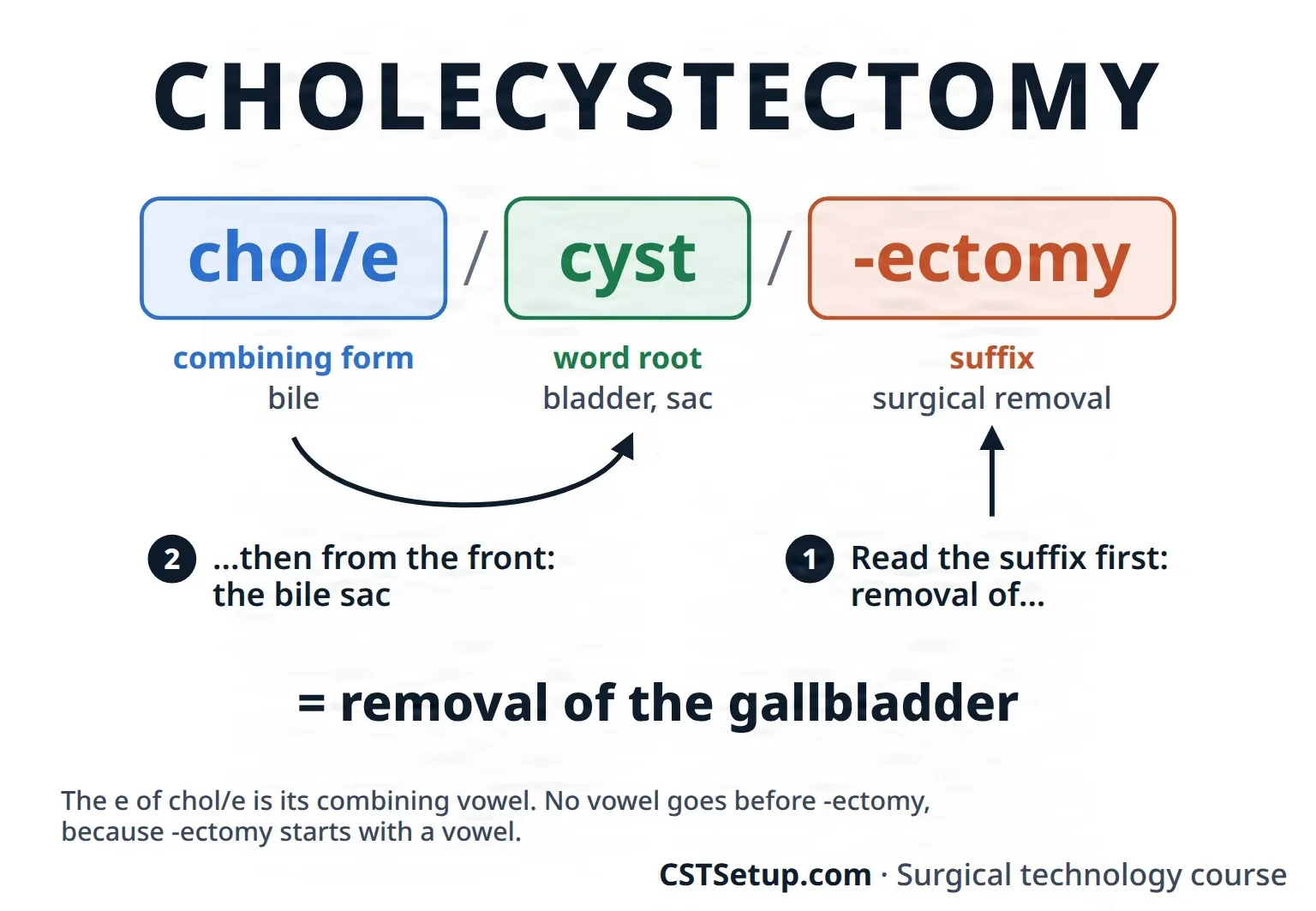
- cholecystectomykoh-luh-sis-TEK-tuh-meeSurgery to remove the gallbladder.chol/e bilecyst/o sac, bladder-ectomy surgical removalFull entry : chol/eKOH-leeA word root that means bile or gall.Full entry (bilebileA yellow-green fluid made by the liver and stored in the gallbladder that helps digest fats.chol/e bileFull entry ) + cyst (bladder, sac) + -ectomy (surgical removal). It means removal of the gallbladder.
- electrocardiogramih-lek-troh-KAR-dee-oh-gramA test that records the heart's electrical activity as waves on paper or a screen.electr/o electricitycardi/o heart-gram recordFull entry : electr/o (electricity) + cardi/o (heart) + -gram (record). It is a record of the heart's electrical activity.
- Cardiothoracic: cardi/o (heart) + thorac (chest) + -ic. A cardiothoracic surgeon operates on the heart, its major vessels and the lungs.
- Septorhinoplasty: sept/o (dividing wall) + rhin/o (nose) + -plasty (surgical repair). It is a repair of the nose.
Some compound words are written with a hyphen. Salpingo-oophorectomy is salping/osal-PING-gohA word root that means tube, most often the fallopian (uterine) tube.Full entry (fallopian tubefuh-LOH-pee-un TOOBOne of the two tubes that carry an egg from the ovary to the uterus, where fertilization usually happens.Full entry ) + oophor (ovary) + -ectomy: surgical removal of a fallopian tube and its ovary.
5Saying the word
Dictionaries show how to say a word by respelling it with marks.
- A line over a vowel (ā, ē, ī, ō, ū) means a long sound: the ō in "go."
- A small curve over a vowel (ă, ĕ, ĭ, ŏ, ŭ) means a short sound: the ŏ in "mop."
- Capital letters mark the syllable you stress. debridementdih-BREED-muntThe removal of dead, damaged or infected tissue from a wound so it can heal.Full entry is said di-BRĒD.
Some letters do not sound the way they look. The respellings show it.
- pn at the start of a word sounds like n: pneumonianoo-MOHN-yuhAn infection of one or both lungs in which the air sacs fill with fluid or pus.pneum/o lung, air-ia conditionFull entry is nū-MŌ-nē-ă.
- ps at the start of a word sounds like s: psoriasissuh-RY-uh-sisA long-term immune-related skin disease in which skin cells grow too fast and pile up on the surface.psor/o itch-iasis conditionFull entry is sō-RĪ-ə-sĭs.
- pt at the start of a word sounds like t: ptosis is TŌ-sĭs.
- x at the start sounds like z: xeroderma is zē-rō-DUR-mă.
- ch often sounds like k: cholecystectomykoh-luh-sis-TEK-tuh-meeSurgery to remove the gallbladder.chol/e bilecyst/o sac, bladder-ectomy surgical removalFull entry is kō-lĕ-sis-TEK-tŏ-mē.
- ph sounds like f: pharyngitisfair-in-JY-tisInflammation of the pharynx, the throat behind the mouth and nose.pharyng/o throat-itis inflammationFull entry is fă-RĬN-JĪ-tĭs.
- rh sounds like r: rhinitisry-NY-tisInflammation of the lining of the nose.rhin/o nose-itis inflammationFull entry is rye-NYE-tis.
- c before y sounds like s: cyanosissy-uh-NOH-sisA blue or gray color of the skin, lips or nail beds.cyan/o blue-osis abnormal conditionFull entry is sī-ă-NŌ-sĭs, and cystoscopy is sĭs-TŎS-kŏ-pē.
- g before i often sounds like j: gingivitisjin-jih-VY-tisInflammation of the gums.gingiv/o gums-itis inflammationFull entry is jin-jĭ-VĪT-ĭs.
Listen for the stress. In laparoscopylap-uh-ROS-kuh-peeSurgery or an exam done through small cuts in the belly, using a thin, lighted tube with a camera.lapar/o abdomen-scopy looking with an instrumentFull entry (lăp-ă-RŎS-kŏ-pē) and laparotomylap-uh-ROT-uh-meeSurgery that opens the abdomen through a large cut to reach the organs inside.lapar/o abdomen-tomy cutting intoFull entry (lap-uh-ROT-uh-mee), it falls on the syllable that holds the o just before the suffix. Words that end in -ectomy stress the "EK": appendectomyap-en-DEK-tuh-meeSurgery to remove the appendix.append appendix-ectomy surgical removalFull entry is ap-ĕn-DEK-tŏ-mē.
When you meet a new word, say it out loud. If you are not sure how it sounds, look up its respelling in a medical dictionary before you say it at the field.
6Writing and spelling
In medical words, one letter can change the body part or the procedure.
- ileumIL-ee-umThe last and longest part of the small intestine, which joins the large intestine.Full entry and iliumIL-ee-umThe large, wing-shaped upper part of each hip bone.Full entry sound the same. The ileum is the end of the small intestine; the ilium is the upper part of the hip bone.
- -ectomy, -otomy and -ostomyOS-tuh-meeA surgically made opening from an inside organ, such as the bowel or urinary tract, through the belly wall to the outside.-ostomy surgical openingFull entry look alike. They mean removal, cutting into and making an opening. A colectomykoh-LEK-tuh-meeSurgery to remove all or part of the colon.col/o colon-ectomy surgical removalFull entry removes part of the colon; a colostomykuh-LOS-tuh-meeA surgical opening that brings part of the colon through the belly wall, so stool leaves the body into a pouch.col/o colon-stomy surgical openingFull entry brings the colon out through the abdominal wall.
- -phagia means eating or swallowing, and -phasia means speech.
- Hyper- means above or excessive, and hypo- means below or deficient. hyperglycemiahy-per-gly-SEE-mee-uhA blood glucose level above normal, over 100 mg/dL when fasting.hyper- aboveglyc/o sugar-emia in the bloodFull entry is high blood sugar; hypoglycemiahy-poh-gly-SEE-mee-uhA blood glucose level below normal, under 70 mg/dL.hypo- belowglyc/o sugar, glucose-emia in the bloodFull entry is low blood sugar.
- The double-r endings all start with rrh: -rrhage and -rrhagia (excessive flow), -rrhaphy (suturing), -rrhea (flow, discharge) and -rrhexis (rupture).
Drug names that look or sound alike cause errors too. Each facility keeps its own list of look-alike, sound-alike drugs, and labels may print part of a name in capital letters to show where two names differ, called tall man letteringtawl man LET-er-ingWriting parts of look-alike drug names in capital letters so the difference between them stands out.Full entry . Chapter 12 covers drug names.
7Plural forms
Many medical words come from Greek and Latin, and many keep a Greek or Latin plural: they change the ending instead of adding -s.
| Singular ending | Plural ending | Examples |
|---|---|---|
| -a | -ae | bursa, bursae; vertebra, vertebrae |
| -us | -i | bronchusBRONG-kusOne of the large air tubes that branch from the windpipe into each lung.bronch/o airwayFull entry , bronchi; calculus (a stone), calculi |
| -um | -a | diverticulum, diverticula; septumSEP-tumA wall of tissue that divides two spaces or cavities, such as the two sides of the heart or nose.sept/o wall, partitionFull entry , septa |
| -is | -es | diagnosis, diagnoses; testis, testes |
| -is (some words) | -ides | epididymisep-ih-DID-ih-misA coiled tube on the back of each testis where sperm mature and are stored.epi- upondidym testis (twin)Full entry , epididymides |
| -ix, -ex | -ices | appendixuh-PEN-diksA small, finger-shaped pouch attached to the first part of the large intestine, in the lower right abdomen.Full entry , appendices; varicesVAIR-ih-seezSwollen, twisted veins, most often in the lower esophagus or the stomach, or in the legs.Full entry , varices; cortexKOR-teksThe outer layer of an organ, especially the folded gray outer layer of the brain.cortic/o cortex, outer layerFull entry , cortices; apex, apices |
| -on | -a | ganglionGANG-glee-unA cluster of nerve cell bodies outside the brain and spinal cord; plural ganglia.Full entry , ganglia |
| -en | -ina | foramen, foramina |
| -ma | -mata | myoma, myomata |
| -nx | -nges | phalanx, phalanges |
Some words also take an English -s: appendixes, apexes and myomas are correct too. Phalanges is the plural only for the bones of the fingers and toes; phalanxes is used for other meanings.
You will hear plurals at the field. Stones in a specimen cup are calculi, and the two main airways off the tracheaTRAY-kee-uhThe windpipe: the tube that carries air from the throat to the lungs.Full entry are the bronchi.
8Prefixes
A prefix changes the meaning of the root it sits in front of. Peri- means around, so pericardiumpair-ih-KAR-dee-umThe thin, two-layered sac that surrounds the heart.peri- aroundcardi/o heart-um a structureFull entry means around the heart and perioperativepair-ee-OP-er-uh-tivRelating to the whole time around a surgery: before, during and after it.peri- aroundoperative relating to surgeryFull entry takes in the whole surgical process: before, during and after the operation. The same prefix names the periosteal elevator, an instrument that lifts tissue from around a bone.
These are the prefixes the Core Curriculum asks you to know, grouped by meaning.
Position and direction
| Prefix | Meaning |
|---|---|
| ab- | away from |
| ad- | toward, near |
| dia- | through, across, apart |
| ecto- | outside, outer |
| en- | in |
| endo- | within, inner |
| epi- | upon, over, on |
| ex- | out of, away from |
| exo- | outside, outer |
| inter- | between |
| intra- | within, inside |
| paraPAIR-uhThe number of pregnancies a person has carried to 20 weeks or more, whatever the outcome.Full entry - | beside, beyond |
| per- | through |
| peri- | around |
| retro- | behind, backward |
| sub- | under, beneath |
| super- | above, excessive |
| supra- | above |
Size, amount and sides
| Prefix | Meaning |
|---|---|
| ambi- | both |
| hemi- | half |
| semi- | half, partial |
| macro- | large |
| micro- | small |
Time and speed
| Prefix | Meaning |
|---|---|
| ante- | before, in front of |
| post- | after, behind |
| pre- | before, in front of |
| brady- | slow |
| tachy- | fast |
Not, against, good and bad
| Prefix | Meaning |
|---|---|
| a-, an- | without, absence of, not |
| anti- | against |
| contra- | against, opposed to |
| crypt- | hidden |
| dys- | bad, painful, difficult |
| eu- | normal, good |
| mal- | bad |
| hyper- | above, excessive |
| hypo- | below, deficient |
Put them to work. Bilateral means both sides, dysuriadis-YOOR-ee-uhPain, burning or discomfort when passing urine.dys- painful, difficultur/o urine-ia conditionFull entry is painful urination, tachycardiatak-ih-KAR-dee-uhA heart rate faster than normal; in an adult, more than 100 beats per minute.tachy- fastcardi/o heart-ia conditionFull entry is a fast heart rate and hypertension is high blood pressure. Subclavian means under the clavicleKLAV-ih-kulThe long, slightly S-shaped bone that runs from the top of the breastbone to the shoulder; the collarbone.clavicul/o collarboneFull entry , suprapubic above the pubisPYOO-bisThe front part of each hip bone, low in the pelvis; the two meet in the middle at the pubic symphysis.pub/o pubisFull entry , intraoperativein-truh-OP-er-uh-tivHappening during surgery, from when the client is brought into the operating room until they are moved to recovery.intra- within, duringoperative of surgeryFull entry during the operation and transurethral through the urethrayoo-REE-thruhThe tube that carries urine from the bladder out of the body.Full entry .
9Suffixes
The suffix is where you start reading, because it tells you whether the word names a procedure, a condition or a disease. For example, -scopy (looking inside) names a procedure, -itis (inflammation) a condition and -oma (tumor) a disease.
Surgical suffixes
These endings name what the surgeon does.
| Suffix | Meaning | Example |
|---|---|---|
| -ectomy | surgical removal | appendectomyap-en-DEK-tuh-meeSurgery to remove the appendix.append appendix-ectomy surgical removalFull entry , removal of the appendixuh-PEN-diksA small, finger-shaped pouch attached to the first part of the large intestine, in the lower right abdomen.Full entry |
| -tomy (-otomy) | cutting into, incision | laparotomylap-uh-ROT-uh-meeSurgery that opens the abdomen through a large cut to reach the organs inside.lapar/o abdomen-tomy cutting intoFull entry , a large incision into the abdomen |
| -stomy (-ostomyOS-tuh-meeA surgically made opening from an inside organ, such as the bowel or urinary tract, through the belly wall to the outside.-ostomy surgical openingFull entry ) | a surgically made opening | colostomykuh-LOS-tuh-meeA surgical opening that brings part of the colon through the belly wall, so stool leaves the body into a pouch.col/o colon-stomy surgical openingFull entry , bringing the colon out through the abdominal wall |
| -plasty | surgical repair, reshaping | arthroplastyAR-throh-plas-teeSurgery to repair or replace a joint, most often the hip or knee.arthr/o joint-plasty surgical repairFull entry , surgical repair of a joint |
| -pexy | surgical fixation | hysteropexy, fixing the uterus in place |
| -rrhaphy | suturing | herniorrhaphy, repair of a herniaHER-nee-uhA bulge of an organ or tissue through a weak spot in the muscle or tissue wall that normally holds it in.Full entry |
| -tripsy | crushing | lithotripsy, breaking up stones |
| -lysis | loosening, breaking down, separating | hemolysishee-MOL-ih-sisThe breaking apart of red blood cells, which releases hemoglobin into the blood.hem/o blood-lysis breaking downFull entry , the breakdown of red blood cells |
| -centesis | surgical puncture to draw out fluid | thoracentesisthor-uh-sen-TEE-sisA procedure in which a needle is passed through the chest wall to remove fluid or air from the space around a lung.thorac/o chest-centesis puncture to remove fluidFull entry , removing fluid from around the lungs |
| -scopy | looking inside, visual examination | bronchoscopybrong-KOS-kuh-peeA procedure in which a thin, lighted tube with a camera is passed through the nose or mouth to look inside the airways.bronch/o airway (bronchus)-scopy looking with an instrumentFull entry , looking into the airway |
| -scope | instrument for looking inside | bronchoscope, the thin viewing instrument used for it |
| -tome | instrument used to cut | osteotome, an instrument for cutting bone |
Some lists write these two as -tomy and -stomy, others as -otomy and -ostomy, with the combining vowel in front. They are the same suffixes.
An -ostomy can open an organ to the outside, as a colostomy does. It can also join two hollow organs inside the body. That surgical connection is an anastomosisuh-nas-tuh-MOH-sisA connection between two tube-shaped structures, such as two ends of bowel or two blood vessels, made by surgery or found naturally.Full entry : a gastroduodenostomy joins the stomach to the duodenumdoo-uh-DEE-numThe first, short part of the small intestine, just after the stomach.Full entry .
-ectomy takes out, -otomy cuts into, -ostomy makes an opening. One or two letters change the whole case, so read every surgical word to the end.
Suffixes for records and images
| Suffix | Meaning |
|---|---|
| -gram | a record or image |
| -graph | an instrument that records |
| -graphy | the process of recording |
An electrocardiogramih-lek-troh-KAR-dee-oh-gramA test that records the heart's electrical activity as waves on paper or a screen.electr/o electricitycardi/o heart-gram recordFull entry is the record of the heart's electrical activity. During a cholecystectomykoh-luh-sis-TEK-tuh-meeSurgery to remove the gallbladder.chol/e bilecyst/o sac, bladder-ectomy surgical removalFull entry , the surgeon may take a cholangiogram, an X-ray image of the bile ductbyle duktOne of the tubes that carry bile from the liver and gallbladder to the small intestine.Full entry made with contrastKON-trastA dye or other substance given before an imaging test so body parts show up more clearly.Full entry , to look for a blockage.
Suffixes for conditions and diseases
| Suffix | Meaning |
|---|---|
| -algia | pain |
| -cele | hernia, protrusion |
| -ectasia, -ectasis | stretching, dilationdy-LAY-shunThe widening or opening up of a body part, such as the cervix during labor, the pupils or a blood vessel.dilat widen-ion processFull entry |
| -edema | swelling from fluid trapped in the tissues |
| -emesisEM-uh-sisVomiting, or the material that is vomited.Full entry | vomiting |
| -iasis | condition |
| -itis | inflammation |
| -malacia | softening |
| -megaly | enlargement |
| -oma | tumor, mass |
| -osis | abnormal condition |
| -pathy | disease |
| -ptosis | drooping, prolapsePROH-lapsThe slipping or falling of an organ or part from its normal position.Full entry |
| -rrhage, -rrhagia | excessive flow |
| -rrhea | flow, discharge |
| -sclerosisskluh-ROH-sisAbnormal hardening of a body tissue, often from scarring.scler/o hard-osis abnormal conditionFull entry | hardening |
| -spasmSPAZ-umA sudden, involuntary tightening of a muscle or of the muscle in a hollow organ or tube.Full entry | sudden, involuntary contraction |
| -stasisSTAY-sisA slowing or stopping of the normal flow of a body fluid.stasis standing stillFull entry | stopping, controlling |
myalgiamy-AL-juhMuscle pain or aching.my/o muscle-algia painFull entry is muscle pain, appendicitisuh-pen-dih-SY-tisInflammation of the appendix, the small pouch that hangs from the start of the large intestine.append/o appendix-itis inflammationFull entry is inflammation of the appendix and cholelithiasiskoh-lee-lih-THY-uh-sisStones in the gallbladder.chol/e bilelith/o stone-iasis conditionFull entry is the formation of gallstones. hemostasishee-moh-STAY-sisThe stopping of bleeding, either by the body's own clotting process or by medical or surgical methods.hem/o blood-stasis stopping, standing stillFull entry is hem/oHEE-mohA word part that means blood.Full entry (blood) + -stasis (stopping): stopping the flow of blood.
Endings that make nouns and adjectives
| Suffix | Meaning |
|---|---|
| -al | pertaining to |
| -ia | condition, abnormal state |
| -ism | state of, condition |
| -ist | a person who does or practices something |
| -ium | a noun ending, as in pericardiumpair-ih-KAR-dee-umThe thin, two-layered sac that surrounds the heart.peri- aroundcardi/o heart-um a structureFull entry |
| -logist | specialist who studies and treats |
| -logy | study of |
| -oid | resembling |
| -sis | state of, condition |
A cardiologist is a doctor who specializes in heart disease, and cardiology is the study of the heart.
10Combining forms for position, number and color
Position and direction
These forms build the direction words of anatomy: anterior (toward the front) and posterior (toward the back), superior (above) and inferior (below), medial (toward the middle) and lateral (toward the side), proximalPROK-sih-mulNearer the center of the body, or nearer the place where a part is attached.Full entry (nearer the trunk) and distal (farther from it). Chapter 2 teaches them on the body, with the planes and cavities.
| Word part | Meaning |
|---|---|
| anter/o | front |
| caud/o | tail; toward the lower end of the body |
| cephal/oSEF-uh-lohA word part that means head.Full entry | head |
| centr/o | center |
| dist/o | far from the trunk or the point of attachmentuh-TACH-mentThe deep emotional bond between an infant and a parent or caregiver.Full entry |
| dors/oDOR-sohA word root that means the back of the body, or the top surface of a hand or foot.Full entry | back |
| extern/o | outside |
| infer/o | below, lower |
| intern/o | inside, within the body |
| later/o | side |
| medi/o | middle |
| pariet/o | the wall of a cavity |
| peripher/o | the outer part, away from the center |
| poster/o | back, behind |
| proxim/o | near the trunk or the point of attachment |
| super/o | above, higher |
| ventr/o | belly, front |
| viscer/oVIS-er-ohA word root that means the internal organs, especially those in the abdomen.Full entry | internal organs |
Amount and number
| Word part | Meaning |
|---|---|
| bi- | two, double, both |
| di- | two, twice |
| mono- | one |
| multi- | many |
| nulli- | none |
| poly- | many, excessive |
| primi- | first |
| quad-, quadra-, quadri- | four |
| tetra- | four |
| tri- | three |
| uni- | one |
Color
| Word part | Meaning |
|---|---|
| alb/o, albin/oAL-bih-nohA word root that means white.Full entry | white |
| chlor/oKLOR-ohA word part that means green; in chemistry words it stands for chlorine.Full entry | green |
| cyan/oSY-uh-nohA word root that means blue.Full entry | blue |
| erythr/oeh-RITH-rohA word root that means red.Full entry | red |
| leuk/oLOO-kohA word part that means white.Full entry | white |
| melan/oMEL-uh-nohA word root that means black or dark.Full entry | black |
| poli/o | gray, as in the gray mattergray MAT-erNerve tissue made mostly of nerve cell bodies, found on the outer layer of the brain and in the center of the spinal cord.Full entry of the brain and spinal cord |
| xanth/oZAN-thohA word root that means yellow.Full entry | yellow |
cyanosissy-uh-NOH-sisA blue or gray color of the skin, lips or nail beds.cyan/o blue-osis abnormal conditionFull entry is a bluish color of the skin from poor circulation or too little oxygen in the blood, and erythemaair-ih-THEE-muhRedness of the skin caused by more blood flowing in the small vessels near the surface.erythr/o red-ema conditionFull entry is redness of the skin. A leukocyte is a white blood cell.
11Word roots by body system
Each body system has its own set of roots. Chapters 3 to 9 teach what each part is and does; here you learn the word parts that name them. The tables follow the Core Curriculum's lists, system by system, and a few examples after each table show the roots at work. Some roots appear in more than one system, because the Core Curriculum lists them wherever they are used.
Skin (integumentary system)
| Word part | Meaning |
|---|---|
| adip/oAD-ih-pohA word root that means fat; lip/o means the same.Full entry | fat |
| caus/o | burning |
| cauter/o | heat, burning |
| cutane/okyoo-TAY-nee-ohA word root that means skin; derm/o and dermat/o mean the same.Full entry | skin |
| derm/o, dermat/o | skin |
| diaphor/o | sweat (diaphoresisdy-uh-fuh-REE-sisHeavy sweating, more than expected for the temperature or activity.Full entry is heavy sweating) |
| erythem/o, erythemat/o | redness |
| hidr/oHY-drohA word part that means sweat.Full entry | sweat |
| kerat/oKAIR-uh-tohA word root that means horny tissue (keratin, as in skin and nails) or the cornea of the eye.Full entry | hard, horny tissue; keratin |
| leuk/oLOO-kohA word part that means white.Full entry | white |
| lip/o | fat |
| melan/oMEL-uh-nohA word root that means black or dark.Full entry | black |
| myc/oMY-kohA word root that means fungus.Full entry | fungus |
| onych/oON-ih-kohA word root that means nail (of a finger or toe).Full entry | nail |
| phyt/o | plant |
| pil/oPY-loeA word root that means hair.Full entry | hair |
| py/oPY-ohA word part that means pus.Full entry | pus |
| seb/oSEB-ohA word root that means sebum, the oily substance made by glands in the skin.Full entry | sebum, the skin's oil |
| sebace/o | sebum; the sebaceous (oil) glands |
| squam/o | scale |
| steat/ostee-AT-ohA word part that means fat.Full entry | fat, sebum |
| trich/oTRIK-ohA word root that means hair.Full entry | hair |
| ungu/o | nail |
| xer/oZEER-ohA word root that means dry.Full entry | dry |
Xeroderma is very dry skin, cyanosissy-uh-NOH-sisA blue or gray color of the skin, lips or nail beds.cyan/o blue-osis abnormal conditionFull entry a bluish skin color, and diaphoresis heavy sweating.
Bones, joints and muscles (musculoskeletal system)
| Word part | Meaning |
|---|---|
| ankyl/oANG-kih-lohA word part that means stiff, fused or bent.Full entry | stiff, bent |
| arthr/o | joint |
| burs/oBUR-sohA word root that means bursa, a small fluid-filled sac that cushions a joint.Full entry | bursa |
| calc/oKAL-kohA word root that means calcium.Full entry | calcium |
| carp/oKAR-pohA word part that means wrist.Full entry | carpals, the wrist bones |
| cervic/oSER-vih-kohA word part that means neck, or the cervix, the narrow lower end of the uterus.Full entry | neck |
| chondr/oKON-drohA word root that means cartilage.Full entry | cartilageKAR-tih-lijFirm, smooth, rubbery tissue that cushions joints and gives shape to parts such as the ear, nose and windpipe.chondr/o cartilageFull entry |
| clavicul/o | clavicleKLAV-ih-kulThe long, slightly S-shaped bone that runs from the top of the breastbone to the shoulder; the collarbone.clavicul/o collarboneFull entry , the collarbone |
| coccyg/o | coccyxKOK-siksThe small, triangle-shaped bone at the very bottom of the spine; the tailbone.Full entry , the tailbone |
| cost/oKOS-tohA word part that means rib.Full entry | ribs |
| crani/oKRAY-nee-ohA word part that means the skull.Full entry | craniumKRAY-nee-umThe part of the skull that encloses and protects the brain.crani/o skullFull entry , the skull |
| femor/o | femur, the upper leg bone |
| fibul/o | fibulaFIB-yuh-luhThe thin outer bone of the lower leg, beside the larger tibia.Full entry , a lower leg bone |
| humer/o | humerusHYOO-mer-usThe long bone of the upper arm, from the shoulder to the elbow.Full entry , the upper arm bone |
| ili/oIL-ee-ohA word root that means the ilium, the large upper bone of the hip (pelvis).Full entry | iliumIL-ee-umThe large, wing-shaped upper part of each hip bone.Full entry , the upper part of the hip bone |
| ischi/o | ischium |
| lumb/oLUM-bohA word part that means the lower back, between the ribs and the hips.Full entry | lower back, the lumbarLUM-barHaving to do with the lower back, the part of the spine between the ribs and the pelvis.Full entry spine |
| metacarp/o | metacarpals |
| metatars/o | metatarsals, the bones of the midfoot and forefoot |
| muscul/o | muscle |
| my/oMY-ohA word root that means muscle.Full entry | muscle |
| myel/oMY-uh-lohA word root that means spinal cord or bone marrow.Full entry | bone marrowbone MAIR-ohThe soft, spongy tissue inside bones that makes blood cells.Full entry ; spinal cord |
| oste/o | bone |
| patell/o | patella, the kneecap |
| pelv/iPEL-veeA word part that means the pelvis, the ring of bones at the base of the spine.Full entry | pelvis |
| phalang/ofuh-LANG-ohA word part that means the phalanges, the bones of the fingers and toes.Full entry | phalanges, the finger and toe bones |
| pub/o | pubisPYOO-bisThe front part of each hip bone, low in the pelvis; the two meet in the middle at the pubic symphysis.pub/o pubisFull entry |
| radi/oRAY-dee-ohA word part that means radiation or x-rays; it can also mean the radius, a bone of the forearm.Full entry | radius |
| sacr/oSAY-kroeA word root that means the sacrum, the triangle-shaped bone at the base of the spine.Full entry | sacrumSAY-krumThe large, triangle-shaped bone at the base of the spine, between the two hip bones.sacr/o sacrumFull entry |
| scapul/oSKAP-yoo-loeA word root that means the scapula, the shoulder blade.Full entry | scapulaSKAP-yuh-luhThe flat, triangle-shaped bone at the back of each shoulder; the shoulder blade.scapul/o shoulder bladeFull entry , the shoulder blade |
| spondyl/oSPON-dih-lohA word part that means vertebra, one of the bones of the spine.Full entry | vertebra, the spine |
| stern/oSTER-nohA word part that means the sternum, the breastbone.Full entry | sternum, the breastbone |
| tars/o | tarsals, the ankle bones |
| ten/oTEN-ohA word part that means tendon, the tough cord that joins a muscle to a bone.Full entry , tend/o | tendon |
| thorac/oTHOR-uh-kohA word part that means the chest.Full entry | chest |
| tibi/o | tibiaTIB-ee-uhThe large inner bone of the lower leg, between the knee and the ankle; the shinbone.tibi/o tibiaFull entry , a lower leg bone |
| uln/o | ulna, a forearm bone |
| vertebr/o | vertebra, the spine |
Arthroscopy is looking inside a joint, arthrodesis is surgical fusion of a joint, and osteotomy is cutting into a bone.
Nerves and brain (nervous system)
| Word part | Meaning |
|---|---|
| alges/o | sensitivitysen-sih-TIV-ih-teeHow strongly something responds; in lab work, which drugs stop a germ, or how well a test finds people who have a disease.Full entry to pain |
| angi/oAN-jee-ohA word root that means vessel, usually a blood vessel.Full entry | vessel |
| caus/o | burning |
| cerebell/o | cerebellumser-uh-BEL-umThe part of the brain at the back, under the cerebrum, that coordinates movement, balance and posture.Full entry |
| cerebr/oSAIR-uh-brohA word part that means the cerebrum, the largest part of the brain, or the brain in general.Full entry | cerebrumsuh-REE-brumThe largest part of the brain, made of two halves, that handles thinking, memory, language, sensation and voluntary movement.Full entry |
| comat/o | deep sleep; comaKOH-muhA deep state of unconsciousness in which a person cannot be woken and does not respond with purpose.Full entry |
| crani/o | cranium, the skull |
| cry/oKRY-ohA word root that means cold.Full entry | cold |
| dur/o | duraDOOR-uhThe tough outer layer of the membranes that cover the brain and spinal cord.Full entry mater; hard |
| encephal/oen-SEF-uh-lohA word part that means brain.Full entry | brain |
| gli/oGLY-ohA word root that means glue, used for the glial cells that support nerve cells.Full entry | glia, the supporting tissue of the brain and spinal cord |
| hydr/oHY-drohA word part that means water or fluid.Full entry | water |
| mening/omeh-NING-gohA word part that means the meninges, the layers of tissue that cover the brain and spinal cord.Full entry , meningi/o | meningesmuh-NIN-jeezThe three thin layers of tissue that cover and protect the brain and spinal cord.mening/o membraneFull entry , the membranes that cover the brain and spinal cord |
| my/o | muscle |
| myel/o | spinal cord; bone marrow |
| narc/o | numbness, stupor |
| neur/oNOOR-ohA word root that means nerve or the nervous system.Full entry | nerve |
| pont/o | ponsPONZThe part of the brain stem between the midbrain and the medulla.Full entry , a part of the brain stemBRAYN STEMThe lowest part of the brain, which connects it to the spinal cord and controls breathing, heart rate and other automatic functions.Full entry |
| radicul/o | nerve root |
| spin/o | spine |
| syncop/o | fainting (syncopeSING-kuh-peeFainting: a short loss of consciousness from a drop in blood flow to the brain.Full entry ) |
| tax/o | order, coordination |
| thalam/o | thalamusTHAL-uh-musA pair of egg-shaped masses deep in the brain that relay sensory signals to the cerebral cortex.thalam/o thalamus (from the Greek for inner chamber)Full entry |
| troph/o | nourishment |
| vag/o | vagus nerveVAY-gus nervThe 10th cranial nerve, which runs from the brain stem to the chest and belly and slows the heart and helps digestion.Full entry |
A craniotomykray-nee-OT-uh-meeSurgery in which a piece of the skull is removed to reach the brain, and usually put back at the end.crani/o skull-tomy cutting intoFull entry is an incision into the skull, encephalitisen-sef-uh-LY-tisInflammation of the brain tissue.encephal/o brain-itis inflammationFull entry is inflammation of the brain, and a meningioma is a tumor of the meninges.
The eye
| Word part | Meaning |
|---|---|
| aque/o | water |
| ambly/o | dull, dim |
| blephar/oBLEF-uh-rohA word part that means eyelid.Full entry | eyelid |
| conjunctiv/o | conjunctivakon-junk-TY-vuhThe thin, clear layer that lines the inside of the eyelids and covers the white of the eye.Full entry |
| cor/oKOR-ohA word root that means the pupil of the eye.Full entry | pupil |
| corne/o | corneaKOR-nee-uhThe clear, dome-shaped layer at the front of the eye, over the iris and pupil.Full entry |
| cycl/o | ciliary body of the eye; circle |
| dacry/oDAK-ree-ohA word part that means tears or the tear duct.Full entry | tear, tear duct |
| dipl/o | two, double |
| glauc/o | as in glaucomaglaw-KOH-muhAn eye disease in which the optic nerve is damaged, usually with raised pressure inside the eye, leading to loss of vision.Full entry , eye diseases with raised pressure that damage the optic nerveOP-tik nervThe nerve that carries visual signals from the back of the eye to the brain; the second cranial nerve.Full entry |
| irid/oIR-ih-dohA word part that means the iris, the colored part of the eye.Full entry , irid/o | iris |
| kerat/o | cornea |
| lacrim/o | tear, tear duct |
| mi/o | less, fewer |
| mydr/o | widening of the pupil (mydriasismih-DRY-uh-sisWidening (dilation) of the pupil of the eye.Full entry ) |
| ocul/oOK-yoo-lohA word root that means eye; ophthalm/o means eye too.Full entry | eye |
| ophthalm/o | eye |
| opt/oOP-tohA word part that means eye or vision.Full entry , optic/o | eye, vision |
| palpebr/o | eyelid |
| papill/o | papilla, a small bump |
| phac/o | lens |
| phot/oFOE-toeA word root that means light.Full entry | light |
| presby/o | old age |
| pupill/o | pupil |
| retin/o | retinaRET-ih-nuhThe thin layer of light-sensing tissue at the back of the inside of the eye.Full entry |
| scler/oSKLAIR-ohA word root that means hard, or the sclera, the white of the eye.Full entry | scleraSKLAIR-uhThe tough white outer layer of the eyeball.Full entry |
| uve/o | uvea, the middle layer of the eyeball |
| vitre/o | vitreous humor, the thick fluid that fills the back of the eye |
| xer/o | dry |
| -opia | vision condition |
| -opsia | vision, as in hemianopsia (blindness in half of the field of vision) |
| -tropia | turning (of the eye) |
Ptosis, spelled like the suffix -ptosis, is a drooping upper eyelid. Mydriasis is a widened pupil, and glaucoma is a group of eye diseases that damage the optic nerve, often from high pressure inside the eye.
The ear
| Word part | Meaning |
|---|---|
| acous/o | hearing |
| audi/oAW-dee-ohA word root that means hearing or sound.Full entry | hearing |
| aur/oAW-rohA word root that means ear or hearing; ot/o means ear too.Full entry | ear |
| auricul/o | ear |
| cochle/o | cochlea |
| mastoid/o | mastoid bone |
| myring/omih-RING-gohA word root that means the eardrum (tympanic membrane).Full entry | tympanic membranetim-PAN-ik MEM-braynThe thin, cone-shaped sheet of tissue between the outer ear canal and the middle ear; the eardrum.Full entry (tympanic membrane) |
| ossicul/o | ossicle, a middle ear bone |
| ot/o | ear |
| staped/o | stapes, a middle ear bone |
| tympan/o | eardrum; middle ear |
| -cusis | hearing condition, as in presbycusisprez-bih-KYOO-sisHearing loss that comes on slowly with aging, in both ears.presby- old age-cusis hearingFull entry (age-related hearing loss) |
| -otia | ear condition, as in microtia (a very small outer ear) |
A myringotomy is a small incision in the eardrum, and a tympanoplasty is surgical repair of the eardrum. otitis mediaoh-TY-tis MEE-dee-uhInflammation or infection of the middle ear, the space behind the eardrum.ot/o ear-itis inflammationmedia middleFull entry is inflammation of the middle ear.
Blood
| Word part | Meaning |
|---|---|
| agglutin/o | clumping |
| bas/o | base |
| chrom/oKROE-moeA word root that means color.Full entry | color |
| coagul/o | clottingKLOT-ingThe process by which blood thickens into a gel to plug a damaged vessel and stop bleeding; also called coagulation.Full entry |
| cyt/oSY-tohA word part that means cell.Full entry | cell |
| eosin/o | red, rosy |
| erythr/oeh-RITH-rohA word root that means red.Full entry | red |
| granul/o | granule |
| hem/oHEE-mohA word part that means blood.Full entry , hemat/o | blood |
| hemoglobin/o | hemoglobin, the protein in red blood cells that carries oxygen |
| leuk/o | white |
| mono-MON-ohA word beginning that means one or single.Full entry | one, single |
| morph/o | form, shape |
| neutr/oNOO-troeA word root that means neutral, neither acid nor base.Full entry | neutral |
| nucle/o | nucleus |
| phag/oFAY-goh, or FAG-ohA word root that means eating or swallowing.Full entry | eat, swallow |
| thromb/oTHROM-bohA word part that means blood clot.Full entry | clot |
| -apheresis | removal |
| -blast | immature cell |
| -cytosis | increase in cells |
| -emia | in the blood |
| -globin | protein |
| -globulin | protein (globulins are plasmaPLAZ-muhThe pale yellow liquid part of the blood, which carries the blood cells, proteins, nutrients and wastes.Full entry proteins) |
| -lytic | breaking down (lysis) |
| -phoresis | transmission |
| -plasia | formation, development |
| -poiesis | formation, production |
A leukocyte is a white blood cell, thrombosisthrom-BOH-sisThe forming of a blood clot (a thrombus) inside a blood vessel or the heart.thromb/o clot-osis conditionFull entry is a blood clot forming inside a vessel, and hemolysishee-MOL-ih-sisThe breaking apart of red blood cells, which releases hemoglobin into the blood.hem/o blood-lysis breaking downFull entry is the breakdown of red blood cells.
Heart and vessels (cardiovascular system)
| Word part | Meaning |
|---|---|
| aneurysmAN-yuh-riz-umA weak spot in the wall of an artery that bulges outward like a balloon.aneurysm a widening (Greek)Full entry /o | aneurysm, a bulging of a weak vessel wall |
| angi/o | vessel |
| aort/oay-OR-tohA word root that means the aorta, the body's largest artery.Full entry | aorta |
| arter/o, arteri/oar-TEER-ee-ohA word part that means artery.Full entry | artery |
| ather/oATH-er-ohA word root that means fatty plaque, the soft fatty buildup that can form inside arteries.Full entry | fatty plaquePLAKA deposit that builds up on a surface in the body, such as a sticky film of bacteria on teeth or a fatty buildup in an artery wall.Full entry |
| atri/oAY-tree-ohA word root that means atrium, one of the two upper chambers of the heart.Full entry | atriumAY-tree-umOne of the two upper chambers of the heart, which receive blood coming back to the heart.atri/o atrium-um noun endingFull entry |
| cardi/o | heart |
| coron/o | heart; crown, circle |
| cyan/oSY-uh-nohA word root that means blue.Full entry | blue |
| isch/oISS-kohA word root that means to hold back or keep back.Full entry | deficiency, blockage |
| lymph/oLIM-fohA word root that means lymph, the clear fluid of the lymphatic system.Full entry | lymphLIMFThe clear fluid that flows through the lymphatic vessels and carries white blood cells.Full entry |
| lymphat/o | lymphatic systemlim-FAT-ik SIS-tumThe network of lymph vessels, lymph nodes and organs such as the spleen and thymus that drains tissue fluid and helps fight infection.Full entry and vessels |
| my/o | muscle |
| pericardi/o | pericardiumpair-ih-KAR-dee-umThe thin, two-layered sac that surrounds the heart.peri- aroundcardi/o heart-um a structureFull entry , the sac around the heart |
| phleb/oFLEB-ohA word root that means vein; ven/o means the same.Full entry | vein |
| sphygm/o | pulse |
| valv/o | valve |
| vas/o | vessel |
| ven/o | vein |
| ventricul/oven-TRIK-yoo-lohA word root that means a ventricle, a chamber of the heart or a fluid-filled space in the brain.Full entry | ventricleVEN-trih-kulOne of the two lower chambers of the heart, or one of the fluid-filled spaces inside the brain.Full entry |
An angiographyan-jee-OG-ruh-feeAn imaging test that shows blood vessels by injecting a contrast dye and taking x-ray, CT or MRI pictures.angi/o vessel-graphy process of recordingFull entry is an image of the inside of blood vessels made with contrastKON-trastA dye or other substance given before an imaging test so body parts show up more clearly.Full entry . bradycardiabray-dee-KAR-dee-uhA heart rate slower than normal; in an adult, fewer than 60 beats per minute.brady- slowcardi/o heart-ia conditionFull entry is a slow heart rate: brady- (slow) + card (heart) + -ia (condition).
Lymphatic system
| Word part | Meaning |
|---|---|
| cervic/o | neck |
| immun/oIM-yoo-nohA word root that means immune, or protection from disease.Full entry | immune, immunityih-MYOO-nih-teeThe body's ability to resist or fight off a particular infection or disease.immun/o protection-ity stateFull entry |
| lymph/o | lymph, lymph tissue |
| lymphaden/o | lymph nodelimf nohdA small, bean-shaped organ of the immune system that filters lymph fluid and holds white blood cells.Full entry |
| lymphangi/o | lymph vessel |
| splen/oSPLEN-ohA word root that means spleen.Full entry | spleenspleenAn organ in the upper left abdomen that filters the blood and helps fight infection.splen/o spleenFull entry |
| thym/oTHY-mohA word root that means the thymus, a gland in the chest that helps T cells mature; it can also mean mind or mood.Full entry | thymusTHY-musA small gland in the upper chest, behind the breastbone, where T cells (a kind of white blood cell) mature.Full entry gland |
A splenectomy is surgical removal of the spleen, and lymphadenopathylim-fad-uh-NOP-uh-theeSwollen or enlarged lymph nodes.lymph/o lymphaden/o gland-pathy diseaseFull entry is disease of a lymph node, such as a node swollen by infection.
Lungs and airway (respiratory system)
| Word part | Meaning |
|---|---|
| alveol/oal-VEE-uh-lohA word root that means alveolus, a tiny air sac in the lungs.Full entry | alveolusal-VEE-uh-lus (plural alveoli, al-VEE-uh-ly)One of the tiny air sacs at the ends of the smallest airways in the lungs.Full entry |
| bronch/oBRONG-kohA word root that means the bronchi, the large airways of the lungs.Full entry , bronchi/o | bronchusBRONG-kusOne of the large air tubes that branch from the windpipe into each lung.bronch/o airwayFull entry |
| bronchiol/o | bronchioleBRONG-kee-ohlOne of the smallest airways in the lungs, branching from the bronchi and leading to the air sacs.bronch/o airway (bronchus)-iole smallFull entry , a small branch of a bronchus |
| laryng/oluh-RING-gohA word part that means the larynx, the voice box.Full entry | larynxLAIR-inksThe voice box: the part of the airway in the neck, above the windpipe, that holds the vocal cords.laryng/o larynxFull entry |
| lob/oLOH-bohA word part that means lobe, a rounded section of an organ.Full entry | lobe |
| nas/oNAY-zohA word part that means nose.Full entry | nose |
| ox/oOK-sohA word root that means oxygen.Full entry , ox/i | oxygen |
| pharyng/ofuh-RING-gohA word part that means the pharynx, the throat.Full entry | pharynxFAIR-inksThe throat: the passage behind the nose and mouth that carries air to the voice box and food to the esophagus.pharyng/o throatFull entry |
| phren/oFREN-ohA word root that means the diaphragm, the main breathing muscle; it can also mean the mind.Full entry | diaphragmDY-uh-framThe dome-shaped sheet of muscle under the lungs that is the main muscle of breathing; also the flat side of a stethoscope.Full entry |
| pleur/oPLOOR-ohA word root that means the pleura, the thin two-layer covering of the lungs, or the side of the chest.Full entry | pleuralPLOOR-ulHaving to do with the pleura, the thin two-layer membrane that covers the lungs and lines the chest wall.pleur/o pleura-al relating toFull entry |
| pneum/oNOO-mohA word root that means air or lung; pneumon/o and pulmon/o also mean lung.Full entry , pneumon/o | lung, air |
| pulm/o, pulmon/o | lung |
| rhin/o | nose |
| thorac/o | chest |
| trache/oTRAY-kee-ohA word part that means the trachea, the windpipe.Full entry | tracheaTRAY-kee-uhThe windpipe: the tube that carries air from the throat to the lungs.Full entry , the windpipe |
| -ole | small, as in bronchiole and arteriolear-TEER-ee-ohlA very small artery that carries blood from an artery into the capillaries.arteri/o artery-ole smallFull entry |
| -pnea | breathing |
A tracheostomytray-kee-OS-tuh-meeA surgical opening through the front of the neck into the windpipe, usually holding a tube that the person breathes through.trache/o windpipe-stomy surgical openingFull entry is a new opening into the trachea, a thoracotomythor-uh-KOT-uh-meeA surgical cut through the chest wall to reach the lungs, heart or other organs in the chest.thorac/o chest-tomy cutting intoFull entry is an incision into the chest, and pneumonianoo-MOHN-yuhAn infection of one or both lungs in which the air sacs fill with fluid or pus.pneum/o lung, air-ia conditionFull entry is an infection that inflames the air sacs of the lungs.
Digestive system
| Word part | Meaning |
|---|---|
| abdomin/o | abdomen |
| an/o | anus |
| append/o, appendic/o | appendixuh-PEN-diksA small, finger-shaped pouch attached to the first part of the large intestine, in the lower right abdomen.Full entry |
| bil/i | bilebileA yellow-green fluid made by the liver and stored in the gallbladder that helps digest fats.chol/e bileFull entry |
| cec/o | cecum, the first part of the large intestine |
| chol/eKOH-leeA word root that means bile or gall.Full entry | bile, gall |
| cholecyst/okoh-luh-SIST-ohA word part that means the gallbladder.chol/e bilecyst/o sac, bladderFull entry | gallbladder |
| col/oKOH-lohA word root that means colon, the large intestine.Full entry , colon/o | colon |
| dent/i, dent/o | tooth |
| doch/o | receptacle; found in choledoch/okoh-LED-uh-kohA word root that means the common bile duct.Full entry , the common bile ductKOM-un BILE DUKTThe tube that carries bile from the liver and gallbladder into the small intestine.Full entry |
| duoden/odoo-oh-DEE-noh, or doo-OD-uh-nohA word root that means the duodenum, the first part of the small intestine.Full entry | duodenumdoo-uh-DEE-numThe first, short part of the small intestine, just after the stomach.Full entry |
| enter/oEN-ter-ohA word part that means intestine, usually the small intestine.Full entry | intestine |
| esophag/oeh-SOF-uh-gohA word root that means the esophagus, the tube that carries food from the throat to the stomach.Full entry | esophagusih-SOF-uh-gusThe muscular tube that carries food and liquid from the throat to the stomach.esophag/o esophagusFull entry |
| gastr/oGAS-trohA word part that means stomach.Full entry | stomach |
| gingiv/oJIN-jih-vohA word part that means the gums.Full entry | gum |
| gloss/oGLOS-ohA word part that means tongue.Full entry | tongue |
| hepat/oHEP-uh-tohA word root that means liver.Full entry | liver |
| ile/oIL-ee-ohA word root that means the ileum, the last part of the small intestine.Full entry | ileumIL-ee-umThe last and longest part of the small intestine, which joins the large intestine.Full entry |
| intestin/o | intestine |
| jejun/ojeh-JOO-nohA word root that means the jejunum, the middle section of the small intestine.Full entry | jejunumjeh-JOO-numThe second of the three sections of the small intestine; it follows the duodenum and leads into the ileum.jejun/o jejunum (from the Latin for empty)Full entry |
| lapar/oLAP-uh-rohA word root that means abdomen or abdominal wall.Full entry | abdomen |
| lingu/o | tongue |
| odont/o | tooth |
| omphal/o | navel |
| or/oOR-ohA word part that means mouth.Full entry | mouth |
| pancreat/oPAN-kree-uh-tohA word root that means pancreas.Full entry | pancreasPAN-kree-usA long, flat gland behind the stomach that makes digestive enzymes and the hormones insulin and glucagon.pan- allcreas fleshFull entry |
| periton/o, peritone/opair-ih-toh-NEE-ohA word root that means the peritoneum, the thin lining of the abdominal cavity.Full entry | peritoneumpair-ih-toh-NEE-umThe thin membrane that lines the belly cavity and covers most of the organs inside it.peri- aroundton stretched-eum a structureFull entry , the lining of the abdomen |
| proct/oPROK-tohA word root that means anus and rectum; rect/o means rectum.Full entry | rectum |
| rect/o | rectum |
| sial/osy-AL-ohA word root that means saliva or the glands that make it.Full entry | saliva, salivary glandSAL-ih-vair-ee GLANDA gland that makes saliva and releases it into the mouth.Full entry |
| sigmoid/oSIG-moy-dohA word root that means the sigmoid colon, the S-shaped last part of the colon before the rectum.Full entry | sigmoidSIG-moydShaped like the letter S; most often short for the sigmoid colon, the S-shaped last part of the colon before the rectum.Full entry colon |
| stomat/o | mouth |
hepatitishep-uh-TY-tisInflammation of the liver, most often caused by a virus.hepat/o liver-itis inflammationFull entry is inflammation of the liver, a colectomykoh-LEK-tuh-meeSurgery to remove all or part of the colon.col/o colon-ectomy surgical removalFull entry removes part of the large intestine, and an ileostomyil-ee-OS-tuh-meeA surgical opening that brings the end of the ileum through the belly wall, so stool leaves the body there.ile/o ileum-stomy surgical openingFull entry makes a new opening to the ileum.
Urinary system (genitourinary)
| Word part | Meaning |
|---|---|
| albuminal-BYOO-minThe main protein in blood plasma, made by the liver, which holds fluid inside the blood vessels and carries drugs and hormones.Full entry /o | albumin |
| cyst/oSIS-tohA word root that means bladder, most often the urinary bladder, or a sac.Full entry | bladder, sac |
| glomerul/ogloh-MAIR-yoo-lohA word root that means glomerulus, the tiny ball of capillaries in the kidney that filters the blood.Full entry | glomerulusgloh-MAIR-yuh-lusA tiny ball of capillaries in the kidney that filters the blood as the first step in making urine.Full entry |
| hydr/o | water |
| lith/oLITH-ohA word root that means stone.Full entry | stone |
| olig/oOL-ih-gohA word root that means few, little or less than normal.Full entry | few, scanty |
| pyel/oPY-uh-lohA word part that means the renal pelvis, the funnel-shaped space in the kidney where urine collects.Full entry | renal pelvis |
| ren/o | kidney |
| trigon/o | trigone, the triangle at the base of the bladder |
| ureter/oyoo-REE-ter-ohA word root that means ureter, one of the two tubes that carry urine from the kidneys to the bladder.Full entry | ureterYOOR-uh-terOne of the two tubes that carry urine from the kidneys down to the bladder.Full entry |
| urethr/oyoo-REE-throhA word part that means the urethra, the tube that carries urine out of the body from the bladder.Full entry | urethrayoo-REE-thruhThe tube that carries urine from the bladder out of the body.Full entry |
| urin/o | urine |
| vesic/oVES-ih-kohA word root that means the urinary bladder.Full entry | bladder, sac |
Cystoscopy (cyst/o + -scopy) is looking inside the bladder and urethra with a cystoscope, and nephrolithiasisnef-roh-lih-THY-uh-sisThe forming of stones in the kidney.nephr/o kidneylith stone-iasis conditionFull entry is stones in the kidney.
Female reproductive system
| Word part | Meaning |
|---|---|
| amni/o | amnion, amniotic fluidam-nee-OT-ik FLOO-idThe fluid inside the amniotic sac that surrounds and protects the baby during pregnancy.Full entry |
| cervic/o | cervix |
| colp/oKOL-pohA word part that means vagina.Full entry | vagina |
| culd/o | cul-de-sac, a blind pouch |
| fet/o | fetus |
| gon/o | offspring, semen, genitals |
| gynec/oGY-nuh-kohA word part that means woman or female.Full entry | woman |
| hyster/oHIS-ter-ohA word part that means the uterus, the womb.Full entry | uterus |
| lapar/o | abdomen |
| mamm/oMAM-ohA word root that means breast; mast/o means the same.Full entry , mast/o | breast |
| men/oMEN-ohA word part that means menstruation or month.Full entry | menstruation |
| metr/o | uterus |
| myom/o | myoma, a muscle tumor |
| nat/i, nat/oNAY-tohA word root that means birth.Full entry | birth |
| oophor/ooh-OFF-uh-rohA word part that means ovary.Full entry | ovary |
| ovar/o | ovary |
| par/oPAIR-ohA word root that means to bear or give birth; part/o means labor or birth.Full entry | to bear, give birth |
| salping/osal-PING-gohA word root that means tube, most often the fallopian (uterine) tube.Full entry | fallopian tubefuh-LOH-pee-un TOOBOne of the two tubes that carry an egg from the ovary to the uterus, where fertilization usually happens.Full entry |
| uter/o | uterus |
| vagin/o | vagina |
| vulv/o | vulva |
A hysterectomyhis-tuh-REK-tuh-meeSurgery to remove the uterus.hyster/o uterus-ectomy surgical removalFull entry (hyster/o + -ectomy) removes the uterus, an oophorectomy removes one or both ovaries, and a mastectomyma-STEK-tuh-meeSurgery to remove all or part of a breast.mast/o breast-ectomy surgical removalFull entry removes a breast.
Male reproductive system
| Word part | Meaning |
|---|---|
| epididym/o | epididymisep-ih-DID-ih-misA coiled tube on the back of each testis where sperm mature and are stored.epi- upondidym testis (twin)Full entry |
| genit/o | genitals, reproduction |
| orch/oOR-kohA word root that means testis; orchi/o, orchid/o and test/o mean the same.Full entry , orchid/o | testis |
| pen/o | penis |
| prostat/oPROS-tuh-tohA word root that means the prostate, the gland below the bladder in men.Full entry | prostatePROS-taytA walnut-sized gland below the bladder in males that surrounds the urethra and makes part of the fluid in semen.Full entry |
| scrot/o | scrotumSKROH-tumThe pouch of skin and muscle that holds the testicles.Full entry |
| semin/o, semin/i | semen |
| sperm/oSPUR-mohA word root that means sperm, the male reproductive cell.Full entry | sperm |
| test/o, testic/o | testis, testicle |
| varic/oVAIR-ih-kohA word root that means a swollen, twisted vein.Full entry | varicose (swollen, twisted) vein |
| vas/o | vas deferens; vessel, duct |
An orchiectomy removes one or both testicles, and prostatitispros-tuh-TY-tisInflammation of the prostate gland.prostat/o prostate-itis inflammationFull entry is inflammation of the prostate gland.
Glands (endocrine system)
| Word part | Meaning |
|---|---|
| aden/oAD-uh-nohA word root that means gland.Full entry | gland |
| adren/ouh-DREE-nohA word root that means the adrenal glands, which sit on top of the kidneys.Full entry , adrenaluh-DREE-nulHaving to do with the adrenal glands, the two small glands that sit on top of the kidneys.ad- nearren/o kidney-al relating toFull entry /o | adrenal glanduh-DREE-nul GLANDOne of two small glands that sit on top of the kidneys and make hormones such as cortisol, aldosterone and epinephrine.ad- toward, nearren/o kidney-al relating toFull entry |
| calc/o | calcium |
| cortic/oKOR-tih-koeA word root that means cortex, the outer layer of an organ.Full entry | cortexKOR-teksThe outer layer of an organ, especially the folded gray outer layer of the brain.cortic/o cortex, outer layerFull entry , the outer layer of an organ |
| crin/o | to secretionsih-KREE-shunA substance a gland or cell makes and releases, such as mucus, saliva, sweat or a hormone.Full entry , as in endocrineEN-doh-krinRelating to the glands that release hormones straight into the blood, or to those hormones.endo- withincrin/o to secreteFull entry (secreting into the blood) |
| estr/o | estrogenES-truh-jenA female sex hormone, made mainly by the ovaries, and the group of drugs that act like it.Full entry , the hormones of the female reproductive system |
| gluc/oGLOO-kohA word root that means sugar or glucose; glyc/o means the same.Full entry , glyc/o | sugar |
| home/o | sameness |
| kal/iKAY-leeA word root that means potassium, from its Latin name kalium.Full entry | potassium |
| pancreat/o | pancreas |
| parathyroid glandpair-uh-THY-royd glandOne of four small glands behind the thyroid that control the amount of calcium in the blood.para- besidethyr/o thyroid gland-oid likeFull entry /o | parathyroid gland |
| pituitar/o | pituitary glandpih-TOO-ih-tair-ee glandA gland the size of a pea, hanging below the brain, whose hormones control many other glands.Full entry |
| thyr/oTHY-rohA word part that means the thyroid gland.Full entry , thyroid/o | thyroid gland |
A parathyroidectomy removes the parathyroid glands, and hyperglycemiahy-per-gly-SEE-mee-uhA blood glucose level above normal, over 100 mg/dL when fasting.hyper- aboveglyc/o sugar-emia in the bloodFull entry is too much sugar in the blood.
12Taking a procedure name apart
Every case on the schedule has a name, and many names are built from the parts in this chapter. Take each name apart before you open the case: the suffix tells you what the surgeon will do, and the roots tell you where. Each card below opens that setup.
laparoscopiclap-uh-roh-SKOP-ikDone through a few small cuts in the abdomen with a thin camera and long instruments, instead of one large opening.lapar/o abdomen-scopic viewingFull entry cholecystectomykoh-luh-sis-TEK-tuh-meeSurgery to remove the gallbladder.chol/e bilecyst/o sac, bladder-ectomy surgical removalFull entry . Laparoscopic is lapar/oLAP-uh-rohA word root that means abdomen or abdominal wall.Full entry (abdomen) + -scopic (pertaining to looking inside): the work is done through a scope in the abdomen. Cholecystectomy is chol/eKOH-leeA word root that means bile or gall.Full entry (bilebileA yellow-green fluid made by the liver and stored in the gallbladder that helps digest fats.chol/e bileFull entry ) + cyst (sac) + -ectomy: removal of the gallbladder. The diagnosis is often cholecystitiskoh-luh-sis-TY-tisInflammation of the gallbladder.chol/e bilecyst/o sac, bladder-itis inflammationFull entry , inflammation of the gallbladder, or cholelithiasiskoh-lee-lih-THY-uh-sisStones in the gallbladder.chol/e bilelith/o stone-iasis conditionFull entry , gallstones.
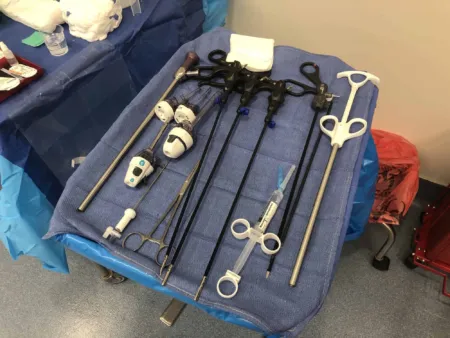
appendectomyap-en-DEK-tuh-meeSurgery to remove the appendix.append appendix-ectomy surgical removalFull entry . append/o (appendixuh-PEN-diksA small, finger-shaped pouch attached to the first part of the large intestine, in the lower right abdomen.Full entry ) + -ectomy: removal of the appendix. The disease uses the other form of the root: appendic/o + -itis = appendicitisuh-pen-dih-SY-tisInflammation of the appendix, the small pouch that hangs from the start of the large intestine.append/o appendix-itis inflammationFull entry .
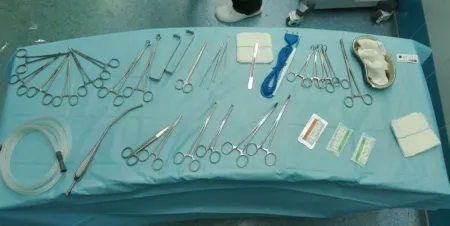
Exploratory laparotomylap-uh-ROT-uh-meeSurgery that opens the abdomen through a large cut to reach the organs inside.lapar/o abdomen-tomy cutting intoFull entry . lapar/o (abdomen) + -tomy (incision): a large incision into the abdomen to reach its organs. It is called exploratory when it is done to look inside because less invasive tests have not found the diagnosis.
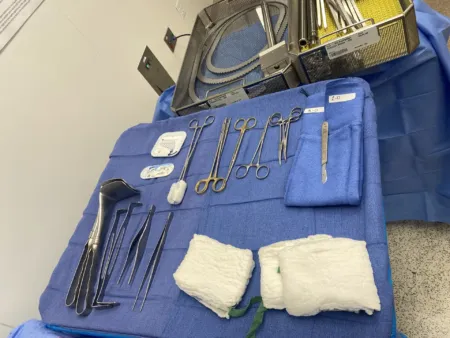
colostomykuh-LOS-tuh-meeA surgical opening that brings part of the colon through the belly wall, so stool leaves the body into a pouch.col/o colon-stomy surgical openingFull entry . col/oKOH-lohA word root that means colon, the large intestine.Full entry (colon) + -stomy (opening): one end of the large intestine is brought out through the abdominal wall so stool can leave the body.
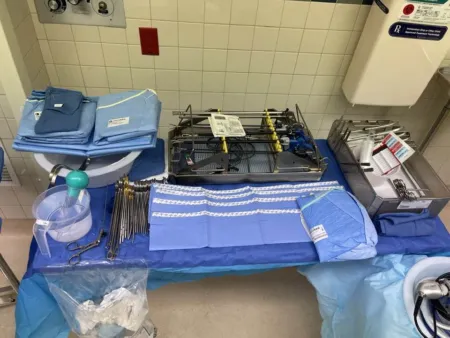
Gastrostomy. gastr/oGAS-trohA word part that means stomach.Full entry (stomach) + -stomy: an opening through the stomach wall to the outside of the body. When it is done with a scope it is a percutaneous endoscopicen-doh-SKOP-ikDone with an endoscope, a thin tube with a light and camera passed into the body.endo- within-scopic viewingFull entry gastrostomy (PEGPEG, or pee-ee-JEE (said as letters)An abbreviation that can mean a feeding tube placed through the belly into the stomach, or the laxative polyethylene glycol.Full entry ), and percutaneous is per- (through) + cutane (skin) + -ous.
Rhinoplasty. rhin/o (nose) + -plasty (surgical repair): reshaping the nose to improve how it works, how it looks, or both.
Orchiopexy. orch/oOR-kohA word root that means testis; orchi/o, orchid/o and test/o mean the same.Full entry (testis) + -pexy (surgical fixation): bringing down a testis that has not descended into the scrotumSKROH-tumThe pouch of skin and muscle that holds the testicles.Full entry and fixing it in place. The condition is cryptorchidismkrip-TOR-kih-diz-umA condition in which one or both testicles have not moved down into the scrotum.crypt/o hiddenorch/o testis-ism conditionFull entry : crypt- (hidden) + orchid (testis) + -ism.
bronchoscopybrong-KOS-kuh-peeA procedure in which a thin, lighted tube with a camera is passed through the nose or mouth to look inside the airways.bronch/o airway (bronchus)-scopy looking with an instrumentFull entry . bronch/oBRONG-kohA word root that means the bronchi, the large airways of the lungs.Full entry (bronchusBRONG-kusOne of the large air tubes that branch from the windpipe into each lung.bronch/o airwayFull entry ) + -scopy (looking inside): examining the airway through a thin viewing instrument, the bronchoscope.
Bilateral myringotomy with tubes (BMTbee-em-tee (said as letters)Bone marrow transplant: replacing damaged or destroyed bone marrow with healthy blood-forming stem cells.Full entry ). Bilateral is bi- (two) + later (side) + -al: on both sides. Myringotomy is myring/omih-RING-gohA word root that means the eardrum (tympanic membrane).Full entry (tympanic membranetim-PAN-ik MEM-braynThe thin, cone-shaped sheet of tissue between the outer ear canal and the middle ear; the eardrum.Full entry ) + -tomy: a small incision in the eardrum to drain fluid or relieve pressure. A small tube is placed in each incision so the middle ear keeps draining.
total hip replacementTOH-tul HIP rih-PLAYS-mentSurgery that replaces the worn or damaged ball and socket of the hip joint with artificial parts; also called total hip arthroplasty.Full entry . arthr/o (joint) + -plasty (surgical repair). Also called a total hip replacement, it replaces the head of the femur and the acetabulum, the hip socket, with replacement parts.
transurethral resection of the prostatetrans-yoo-REE-thrul rih-SEK-shun of the PROS-taytSurgery that removes part of the prostate gland with an instrument passed up through the urethra.trans- throughurethr/o urethra-al relating toresection cutting outFull entry (TURP). Transurethral is trans- (through) + urethr (urethrayoo-REE-thruhThe tube that carries urine from the bladder out of the body.Full entry ) + -al: through the urethra. In a TURP, part of the prostatePROS-taytA walnut-sized gland below the bladder in males that surrounds the urethra and makes part of the fluid in semen.Full entry is removed with a scope passed through the urethra.
Tonsillectomy and adenoidectomy (T&A). tonsill + -ectomy removes the tonsilTON-sulOne of the masses of lymph tissue at the back of the throat that help fight germs entering the mouth and nose.Full entry ; adenoid + -ectomy removes the adenoid, which sits behind the nasal cavity. The two are often done together.
Salpingo-oophorectomy. salping/osal-PING-gohA word root that means tube, most often the fallopian (uterine) tube.Full entry (fallopian tubefuh-LOH-pee-un TOOBOne of the two tubes that carry an egg from the ovary to the uterus, where fertilization usually happens.Full entry ) + oophor (ovary) + -ectomy: removal of the tube and the ovary. When both sides are done, it is a bilateral salpingo-oophorectomy (BSO).
dilationdy-LAY-shunThe widening or opening up of a body part, such as the cervix during labor, the pupils or a blood vessel.dilat widen-ion processFull entry and curettage (D&C). Dilation widens the cervix, and curettage scrapes the lining of the uterus with a curettekyoo-RETA surgical instrument with a small spoon- or loop-shaped tip used to scrape tissue.Full entry . Together they remove tissue from inside the uterus, often to make a diagnosis.
Two common procedures have no card here but are good practice. Herniorrhaphy (herni/oHER-nee-ohA word root that means hernia, a bulge of an organ or tissue through a weak spot in the wall around it.Full entry , herniaHER-nee-uhA bulge of an organ or tissue through a weak spot in the muscle or tissue wall that normally holds it in.Full entry + -rrhaphy, suturing) repairs a hernia. Lithotripsy (lith/oLITH-ohA word root that means stone.Full entry , stone + -tripsy, crushing) breaks up stones in the kidney, bladder or ureterYOOR-uh-terOne of the two tubes that carry urine from the kidneys down to the bladder.Full entry .
13Abbreviations, acronyms and symbols
Abbreviations and symbols save time and fit words into small spaces. They also get misread. A misread abbreviation can cause a harmful error, and tracking down what one meant can delay the patient's care.
An acronym is an abbreviation made from first letters and said as a word, such as AIDSAYDZAcquired immunodeficiency syndrome: the most advanced stage of HIV infection, when the immune system is badly damaged.Full entry . Some abbreviations are said letter by letter instead: NPO is said en-pē-ō.
Use only the abbreviations your facility approves, the ones the whole health care team knows. BID, twice a day, comes from the Latin bis in die, and NPO, nothing by mouth, from the Latin nil per os. Lesser-known or outdated abbreviations can cause misunderstandings and errors.
The same abbreviation may be written with or without periods or a slash, in capitals or small letters: NPO or n.p.o., UA or U/A.
ISMP, the Institute for Safe Medication Practices, accepts that some abbreviations will always be used, so whoever uses one has to know it can be misread. An uncommon abbreviation should be spelled out by the writer. When an order uses an error-prone abbreviation, the order is clarified with the prescriber and rewritten without it.
Never guess what an abbreviation means. Ask the person who wrote it before you act.
The Core Curriculum lists 97 common abbreviations. They are grouped below by where you will meet them.
Common abbreviations: orders, timing and medications
| Abbreviation | Meaning |
|---|---|
| b.i.d. | twice a day |
| t.i.d. | three times a day |
| NPO (n.p.o.) | nothing by mouth |
| PRN | as needed |
| stat | immediately |
| D/Cdee-see (said as letters)An abbreviation that can mean either discharge or discontinue; it should not be used because the two are easily confused.Full entry | discontinue |
| do-not-resuscitate orderdoo-not-rih-SUS-ih-tayt OR-derA provider's order that CPR will not be started if the client's heart or breathing stops.Full entry | do not resuscitate |
| RX | drug prescription |
| intramuscularin-truh-MUS-kyoo-lerInto a muscle; used for a drug given by injection into muscle tissue.intra- insidemuscul/o muscle-ar relating toFull entry | intramuscular |
| IV | intravenous |
| gt (gttdrops (read as the word)An abbreviation for drop or drops, from the Latin gutta and guttae.Full entry ) | drop |
| gm | gram |
| NSen-ES (said as letters)An abbreviation used most often for normal saline, a solution of 0.9% sodium chloride in water.Full entry | normal saline |
Common abbreviations: the chart and vital signs
| Abbreviation | Meaning |
|---|---|
| H & P | history & physical |
| DX | diagnosis |
| Bx | biopsy |
| Fx | fracture |
| Ca | cancer |
| NKA | no known allergies |
| BP | blood pressure |
| TPR | temperature, pulse, respiration |
| body surface areaBOD-ee SUR-fus AIR-ee-uhThe total area of the outside of a person's body, in square meters, worked out from height and weight.Full entry | body surface area |
| central venous pressureSEN-trul VEE-nus PRESH-erThe blood pressure in the large vein near the heart's right atrium, measured through a central line.Full entry | central venous pressure |
| intracranial pressurein-truh-KRAY-nee-ul PRESH-erThe pressure inside the skull, made by the brain, the blood and the fluid around the brain.intra- insidecrani/o skull-al relating toFull entry | intracranial pressure |
| IOP | intraocular pressure |
| ROM | range of motion |
Common abbreviations: directions and body areas
| Abbreviation | Meaning |
|---|---|
| A/P | anterior-posterior |
| P/A | posterior-anterior |
| AK | above the knee |
| BK | below the knee |
| RUQ | right upper quadrant |
| LUQ | left upper quadrant |
| RLQ | right lower quadrant |
| LLQ | left lower quadrant |
| ADay-DEE (said as letters)An abbreviation that has been used for right ear, and also for Alzheimer disease and advance directive.Full entry | right ear |
| ASay-ES (said as letters)A short form for the left ear, from the Latin auris sinistra.Full entry | left ear |
| ODoh-DEE (said as letters)An abbreviation that has been used for right eye, for once daily and for overdose.Full entry | right eye |
| OSoh-ES (said as letters)An abbreviation for left eye, from the Latin oculus sinister.Full entry | left eye |
| OUoh-YOO (said as letters)An old abbreviation for "both eyes" that should not be used; write "each eye" or "both eyes" instead.Full entry | both eyes |
| A/V | atrioventricular |
| central nervous systemSEN-trul NER-vus SIS-tumThe brain and the spinal cord together.centr/o center-al having to do withFull entry | central nervous system |
| cerebrospinal fluidser-uh-broh-SPY-nul FLOO-idThe clear, watery fluid that bathes and cushions the brain and spinal cord.cerebr/o brainspin spine-al relating toFull entry | cerebrospinal fluid |
| TMJ | temporomandibular joint |
| ENT | ear, nose, and throat |
| genitourinaryjen-ih-toh-YOOR-ih-nair-eeRelating to the genital (reproductive) organs and the urinary organs together.genit/o reproductive organsurin/o urine-ary relating toFull entry | genitourinary |
| gynecologygy-nuh-KOL-uh-jeeThe branch of medicine that cares for the female reproductive organs and breasts.gynec/o woman-logy study ofFull entry | gynecology |
| KUB | kidney, ureterYOOR-uh-terOne of the two tubes that carry urine from the kidneys down to the bladder.Full entry , bladder |
Common abbreviations: procedures and treatments
| Abbreviation | Meaning |
|---|---|
| CABG | coronary arteryKOR-uh-nair-ee AR-ter-eeOne of the blood vessels on the surface of the heart that bring oxygen-rich blood to the heart muscle.Full entry bypass graftGRAFTTissue or a man-made material moved into place in surgery to replace or repair a damaged part.Full entry |
| CPR | cardiopulmonary resuscitation |
| D & C | dilationdy-LAY-shunThe widening or opening up of a body part, such as the cervix during labor, the pupils or a blood vessel.dilat widen-ion processFull entry (dilatation) and curettage |
| I & D | incision & drainage; irrigationeer-ih-GAY-shunWashing out a wound, body cavity, tube or eye with a steady flow of liquid.Full entry & debridementdih-BREED-muntThe removal of dead, damaged or infected tissue from a wound so it can heal.Full entry |
| T & A | tonsillectomy & adenoidectomy |
| TAH/BSO | total abdominal hysterectomyab-DOM-ih-nul his-ter-EK-tuh-meeSurgery to remove the uterus through a cut in the lower abdomen.hyster/o uterus-ectomy surgical removalFull entry with bilateral salpingo-oophorectomy |
| transurethral resection of the prostatetrans-yoo-REE-thrul rih-SEK-shun of the PROS-taytSurgery that removes part of the prostate gland with an instrument passed up through the urethra.trans- throughurethr/o urethra-al relating toresection cutting outFull entry | transurethral resection of the prostate |
| TENStenzTranscutaneous electrical nerve stimulation: mild electric pulses sent through pads on the skin to ease pain.Full entry | transcutaneous electrical nerve stimulation |
| ACLSay-see-el-ES (said as letters)Advanced Cardiovascular Life Support: the American Heart Association's guidelines and course for treating cardiac arrest and other heart emergencies.Full entry | advanced cardiac life support |
| BCLS | basic cardiac life support |
Common abbreviations: tests and imaging
| Abbreviation | Meaning |
|---|---|
| arterial blood gasar-TEER-ee-ul BLUD GASA blood test from an artery that measures oxygen, carbon dioxide, bicarbonate and the blood's pH.Full entry | arterial blood gas |
| blood urea nitrogenblud yoo-REE-uh NY-truh-jenA blood test that measures urea nitrogen, a waste product made when the body breaks down protein.Full entry | blood urea nitrogen |
| CAT | computed axial tomographytoh-MOG-ruh-feeImaging that produces pictures of the body in thin slices.tom/o cut, slice-graphy process of recordingFull entry |
| CBC | complete blood count |
| electrocardiogramih-lek-troh-KAR-dee-oh-gramA test that records the heart's electrical activity as waves on paper or a screen.electr/o electricitycardi/o heart-gram recordFull entry (EKG) | electrocardiogram; electrocardiograph |
| electroencephalogramih-lek-troh-en-SEF-uh-loh-gramA test that records the electrical activity of the brain through small sensors placed on the scalp.electr/o electricityencephal/o brain-gram recordFull entry | electroencephalogram; electroencephalograph |
| HCT | hematocrithih-MAT-uh-kritA blood test that shows what share of the blood's volume is made up of red blood cells, given as a percentage.hemat/o blood-crit to separateFull entry |
| magnetic resonance imagingmag-NET-ik REZ-uh-nunts IM-uh-jingAn imaging test that uses a strong magnet and radio waves to make detailed pictures of the inside of the body.Full entry | magnetic resonance imaging |
| positron emission tomographyPOZ-ih-tron ih-MISH-un toh-MOG-ruh-feeAn imaging test that uses a small amount of a radioactive tracer to show how active the body's tissues are.tom/o cut, slice-graphy recordingFull entry | positron emission tomography |
| UA (U/A) | urinalysis |
| RBC | red blood cell |
| WBC | white blood cell countwite blud sel kowntA blood test that counts the white blood cells, the cells that fight infection, in a sample of blood.Full entry |
Common abbreviations: diseases and conditions
| Abbreviation | Meaning |
|---|---|
| atrial fibrillationAY-tree-ul fib-rih-LAY-shunAn irregular heart rhythm in which the upper chambers of the heart quiver instead of beating in an organized way.atri/o atrium (upper heart chamber)fibrill/o small fibers, quivering-ation processFull entry | atrial fibrillation |
| AIDS | acquired immunodeficiency syndrome |
| acute respiratory distress syndromeuh-KYOOT RES-pruh-tor-ee dih-STRES SIN-drohmA sudden, severe lung injury in which fluid leaks into the air sacs, so the lungs cannot get enough oxygen into the blood.Full entry | acute respiratory distress syndrome |
| ASDay-es-DEE (said as letters)An abbreviation with several meanings, most often autism spectrum disorder or atrial septal defect.Full entry | atrial septal defectAY-tree-ul SEP-tul DEE-fektA hole in the wall between the two upper chambers of the heart.atri/o atrium (upper heart chamber)sept/o wall, partition-al relating toFull entry |
| benign prostatic hyperplasiabee-NINE proh-STAT-ik hy-per-PLAY-zhuhA prostate gland that has grown larger than normal, from growth that is not cancer.hyper- more than normalplas growth or formation-ia conditionFull entry | benign prostatic hypertrophy (also called benign prostatic hyperplasia) |
| coronary artery diseaseKOR-uh-nair-ee AR-tuh-ree dih-ZEEZNarrowing of the arteries that supply blood to the heart muscle, most often from fatty plaque buildup.Full entry | coronary artery disease |
| heart failurehart FAYL-yerA long-term condition in which the heart cannot pump enough blood to meet the body's needs.Full entry | congestive heart failure |
| COPDsee-oh-pee-dee (said as letters)Chronic obstructive pulmonary disease: a long-term lung disease that makes it hard to move air out of the lungs.chronic long-lastingobstructive blockingpulmon/o lung-ary relating toFull entry | chronic obstructive pulmonary disease |
| CVA | cerebrovascular accidentser-uh-broh-VAS-kyuh-ler AK-sih-dentA stroke: injury to part of the brain because a blood vessel in the brain is blocked or has burst.cerebr/o brainvascul blood vessel-ar relating toFull entry |
| disseminated intravascular coagulationdih-SEM-ih-nay-tid in-truh-VAS-kyuh-ler koh-ag-yuh-LAY-shunA disorder in which clotting is switched on throughout the blood vessels until the clotting factors are used up.intra- withinvascul/o vesselcoagul/o clottingFull entry | disseminated intravascular coagulation |
| DJD | degenerative joint disease |
| gastroesophageal reflux diseasegas-troh-ih-sof-uh-JEE-ul REE-fluks dih-ZEEZA long-term condition in which stomach contents, including acid, flow back up into the esophagus.gastr/o stomachesophag/o esophagus-al relating toFull entry | gastroesophageal reflux disease |
| GSW | gunshot wound |
| hepatitis B virushep-uh-TY-tis BEE VY-rusThe virus that causes hepatitis B, an infection of the liver.Full entry | hepatitis B virus |
| HIVaych-eye-VEE (said as letters)Human immunodeficiency virus: a virus that infects and destroys immune cells called CD4 T cells.Full entry | human immunodeficiency virus |
| PADpee-ay-DEE (said as letters)An abbreviation that most often means peripheral artery disease, a narrowing of the arteries outside the heart and brain.Full entry | peripheral artery diseasepuh-RIF-er-ul AR-tuh-ree dih-ZEEZNarrowing of the arteries that carry blood to the legs, and sometimes the arms, usually from fatty plaque.Full entry |
| patent ductus arteriosusPAY-tent DUK-tus ar-teer-ee-OH-susA heart defect in which the ductus arteriosus, a blood vessel between the aorta and pulmonary artery, stays open after birth.Full entry | patent ductus arteriosus |
| pelvic inflammatory diseasePEL-vik in-FLAM-uh-tor-ee dih-ZEEZInfection of the female upper reproductive organs: the uterus, fallopian tubes and ovaries.Full entry | pelvic inflammatory disease |
| premature ventricular contractionpree-muh-CHOOR ven-TRIK-yuh-ler kun-TRAK-shunAn extra heartbeat that starts early from a ventricle instead of from the heart's normal pacemaker.Full entry | premature ventricular contraction |
| sexually transmitted infectionSEK-shoo-uh-lee trans-MIT-id in-FEK-shunAn infection passed from one person to another mainly through sexual contact.Full entry | sexually transmitted disease |
| tuberculosistoo-ber-kyoo-LOH-sisAn infection caused by the bacterium Mycobacterium tuberculosis, which most often attacks the lungs.tubercul/o small swelling-osis abnormal conditionFull entry | tuberculosis |
| transient ischemic attackTRAN-zee-unt is-KEE-mik uh-TAKA short-lived blockage of blood flow to part of the brain that clears on its own and leaves no lasting brain damage.transient passingisch hold back-emic relating to the bloodFull entry | transient ischemic attack |
| URI | upper respiratory infection |
| UTI | urinary tract infection |
| ventricular septal defectven-TRIK-yuh-ler SEP-tul DEE-fektA hole in the wall between the heart's two lower chambers, present from birth.Full entry | ventricular septal defect |
Common abbreviations: places in the hospital
| Abbreviation | Meaning |
|---|---|
| ICU | intensive care unit |
| L & D | labor & delivery |
| PACU | post-anesthesia care unit |
Eyes and ears: a risky pair
The Core Curriculum lists AD (right ear), AS (left ear), OD (right eye), OS (left eye) and OU (both eyes) as common abbreviations. They are also on ISMP's list of error-prone abbreviations, because the ear abbreviations have been mistaken for the eye ones, and the eye ones for the ear ones. ISMP's advice is to write the words: right ear, left ear, each ear, right eye, left eye or each eye.
Other look-alikes have sent medicine to the wrong place. OD has also been used for "once daily," and oral liquid medicine has been put in a patient's eye. OJoh-jay (said as letters)An abbreviation for orange juice that ISMP advises against in medication orders.Full entry , for orange juice, has been read as OD or OS. In per osper OHSLatin for "by mouth"; a way of writing the oral route that should not be used.Full entry , by mouth, the os has been read as left eye.
The Joint Commission "Do Not Use" list
The Joint Commissionthuh JOYNT kuh-MISH-unAn independent US organization that inspects and accredits hospitals and other health care organizations against safety and quality standards.Full entry accredits health care organizations across the United States. In 2004, as part of its National Patient Safety Goals, it published an official list of abbreviations that must never be used. An accredited facility must put them on its own "Do Not Use" list and keep them off every order and every piece of medication documentation, whether handwritten, preprinted or electronic. Facilities may add more.
| Do not use | Why it goes wrong | Write instead |
|---|---|---|
| U, u (unit) | read as 0 or 4, so 4U is seen as 40; or read as cc | unit |
| IUeye-YOO (said as letters)An abbreviation for international unit, banned by the Joint Commission because it is misread.Full entry (International Unit) | read as IV (intravenous) or the number 10 | International Unit |
| Q.D., QD, q.d., qd (daily) | read as q.i.d., four times a day | daily |
| Q.O.D., QODkyoo-oh-dee (said as letters)An abbreviation for "every other day" that must not be used; write "every other day" in full.Full entry , q.o.d, qod (every other day) | read as daily or four times a day | every other day |
| trailing zeroTRAY-ling ZEER-ohA zero written after the decimal point in a whole-number dose, as in 1.0 mg; it must not be used.Full entry (X.0 mg) | the decimal point is missed, so 1.0 mg is seen as 10 mg | X mg |
| Lack of leading zeroLEED-ing ZEER-ohA zero written before the decimal point of a number less than one, as in 0.5 mg.Full entry (.X mg) | the decimal point is missed, so .5 mg is seen as 5 mg | 0.X mg |
| MSem-ES (said as letters)An abbreviation that can stand for morphine sulfate, magnesium sulfate or multiple sclerosis.Full entry | morphineMOR-feenA strong opioid drug used to relieve moderate to severe pain.Full entry , mistaken for magnesium sulfatemag-NEE-zee-um SUL-fateA magnesium salt given by IV or IM to raise a low magnesium level or prevent seizures in severe preeclampsia.Full entry | morphine sulfate |
| MSO4em-es-oh-FOR (said as letters)The shorthand for morphine sulfate, banned from medication orders by the Joint Commission.Full entry | morphine sulfate, mistaken for magnesium sulfate | morphine sulfate |
| MgSO4em-jee-es-oh-FOR (said as letters)The chemical shorthand for magnesium sulfate, banned from medication orders by the Joint Commission.Full entry | magnesium sulfate, mistaken for morphine sulfate | magnesium sulfate |
A trailing zero may be used only to show how precise a reported value is: lab results, the size of a lesionLEE-zhunAn area of tissue that has been damaged or has changed from normal, such as a sore, wound, lump or spot.Full entry on an imaging study, and the size of a catheter or tube. It is never used in a medication order or in any other medication documentation.
Never write a "Do Not Use" abbreviation on a medication label, a preference card or a chart. Write the word, put a leading zero in front of a decimal point, and leave off trailing zeros.
Possible future inclusion on the list
The Core Curriculum also teaches the abbreviations The Joint Commission has named for possible future inclusion on the "Do Not Use" list. They are not on the official list.
| Do not use | Why it goes wrong | Write instead |
|---|---|---|
| > (greater than), < (less than) | mistaken for the opposite; a handwritten < read as the number 4 | "greater than," "less than" |
| Abbreviations for drug names | mistaken for another drug | the drug name in full |
| Apothecary units | gr (grain) read as gram, dr (dram) as doctor | metric units |
| @ | read as the number 2 | "at" |
| cc | read as u (units) | mL or milliliters; the Core Curriculum also allows ml, but ISMP lists a small l as error-prone |
| µgMY-kroe-gramA symbol for microgram that should not be used in medication orders; write "mcg" instead.Full entry | read as mg | mcg or micrograms |
The Core Curriculum's lists are current to its publishing date. The Joint Commission can change its list, so programs check it for updates.
Drug names: write them out
ISMP's advice is to avoid abbreviating drug names entirely, and never to abbreviate a drug on its list of high-alert medicationHY-uh-lert med-ih-KAY-shunA drug that can cause serious harm to a client if it is used in error; also called a high-risk medication.Full entry . Real errors show why.
- MS and MSO4 (morphine sulfate) and MgSO4 (magnesium sulfate) have been mistaken for each other.
- HCT (hydrocortisonehy-droh-KOR-tih-soneA corticosteroid drug that is the same as the body's own cortisol, given by mouth, IV, on the skin or rectally.Full entry ) and HCTZaych-see-tee-zee (said as letters)An abbreviation for hydrochlorothiazide, a thiazide diuretic; it should not be used because it can be misread.Full entry (hydrochlorothiazidehy-droh-klor-oh-THY-uh-zideA thiazide diuretic that lowers blood pressure and reduces swelling by helping the kidneys remove salt and water.Full entry ) have been mistaken for each other.
- TXAtee-eks-ay (said as letters)An abbreviation for tranexamic acid, a drug that slows the breakdown of blood clots; ISMP advises writing the full name.Full entry (tranexamic acidtran-ek-SAM-ik AS-idA drug that reduces bleeding by stopping the body from breaking down blood clots.Full entry ) has been read as TPAtee-pee-ay (said as letters)An abbreviation for tissue plasminogen activator (alteplase), a clot-dissolving drug; ISMP advises writing the full drug name.Full entry (alteplaseAL-tuh-playsA clot-dissolving drug (thrombolytic) given IV; a man-made form of tissue plasminogen activator.Full entry ), and TPA as TNKtee-en-kay (said as letters)An abbreviation for TNKase (tenecteplase), a clot-dissolving drug; ISMP advises writing the full drug name.Full entry or TXA.
- "Neo," meant as phenylephrinefen-il-EF-rinA drug that tightens blood vessels, given IV to raise low blood pressure and used in nose sprays and eye drops.Full entry , a discontinued brand name for phenylephrine, has been read as neostigminenee-oh-STIG-meenA drug that blocks the enzyme that breaks down acetylcholine, so nerve signals to muscles get stronger.Full entry .
- APAPay-pee-ay-pee (said as letters), or AY-papAn abbreviation for acetaminophen; ISMP advises writing the full drug name.Full entry has not been recognized as acetaminophen.
Chapter 12 teaches drug names, doses and the medication label in full.
More error-prone abbreviations and symbols
ISMP's list goes further than The Joint Commission's. These entries matter on the back table and the preference card.
| Error-prone | What can go wrong | Best practice |
|---|---|---|
| D/C (discharge or discontinue) | a patient's medicines stopped by mistake when D/C meant discharge | write out the word meant: "discharge," "discontinue" or "stop" |
| SCes-SEE (said as letters)An abbreviation for subcutaneous, meaning into the fatty layer under the skin.Full entry , SQes-KYOO (said as letters)An abbreviation for subcutaneous (under the skin) that ISMP lists as error-prone; ISMP advises SUBQ instead.Full entry , sq, sub q (subcutaneoussub-kyoo-TAY-nee-usUnder the skin; in the fatty layer between the skin and the muscle.sub- undercutane/o skin-ous relating toFull entry ) | SC read as SL (sublingualsub-LING-gwulUnder the tongue.sub- underlingu/o tongue-al relating toFull entry ); SQ read as "5 every"; the q in sub q read as "every" | SUBQ, or subcutaneous |
| INeye-EN (said as letters)A short form for intranasal, meaning given into the nose.Full entry (intranasal) | read as IM or IV | intranasal |
| ITeye-TEE (said as letters)An abbreviation for intrathecal (into the spinal fluid) that ISMP lists as error-prone, because it is misread.Full entry (intrathecal) | read as intratracheal, intratumor, intratympanic or inhalationin-huh-LAY-shunBreathing in; also, a way of giving a drug as a mist or powder that is breathed into the lungs.in- inhal breathe-ation the act ofFull entry therapy | intrathecal |
| ml (small l) | the l read as the number 1 | mL |
| A period after mg or mL | the period read as the number 1 | mg, mL, with no period |
| A dose and its unit run together (10mg) | the m read as one or two extra zeros | a space between them: 10 mg |
| Large numbers without commas (100000 units) | read as 10,000 or 1,000,000 | 100,000 units, or 100 thousand units |
| A ratio strength for a one-drug injection (1:1,000) | read as the wrong strength | the amount per volume, such as 1 mg/mL; combination local anestheticLOH-kul an-es-THET-ikA drug that blocks feeling in one part of the body without making the person unconscious.Full entry , such as lidocaineLY-doh-kaynA local anesthetic that numbs an area, also given by IV to treat some fast, abnormal heart rhythms.Full entry 1% with epinephrineep-ih-NEF-rinA hormone and drug, also called adrenaline, that raises heart rate and blood pressure and opens the airways.Full entry 1:100,000, are the exception |
| x1 | read as "for 1 day" when "once" was meant | words, such as "for 1 dose" |
| & and + | & read as the number 2; + read as 4 | "and," "plus" |
| ↑ and ↓ | read as the opposite; ↑ read as the letter T or the number 4 or 7 | "increase," "decrease" |
AST's guidance for the CSTsee-es-tee (said as letters)Certified Surgical Technologist, a credential for surgical technologists; in maternity care, contraction stress test.Full entry is direct: do not use error-prone abbreviations, symbols or dose designations when you create or update a surgeon's preference card or label medications and solutions.
14Putting it together: the schedule and the chart
Here is a schedule line and a short chart note of the kind you will read before and after a case. Read each one, then check it against the plain-English version. Chapter 15 teaches charting, and chapter 28 the chart review before a case.
On the schedule: OR 3, 0730. laparoscopiclap-uh-roh-SKOP-ikDone through a few small cuts in the abdomen with a thin camera and long instruments, instead of one large opening.lapar/o abdomen-scopic viewingFull entry cholecystectomykoh-luh-sis-TEK-tuh-meeSurgery to remove the gallbladder.chol/e bilecyst/o sac, bladder-ectomy surgical removalFull entry . Dx: cholelithiasiskoh-lee-lih-THY-uh-sisStones in the gallbladder.chol/e bilelith/o stone-iasis conditionFull entry , RUQ pain. NPO. NKA. H & P, CBC and UA on the chart.
- Laparoscopic cholecystectomy: removal of the gallbladder through a scope in the abdomen.
- Dx: cholelithiasis, RUQ pain: the diagnosis is gallstones (chol/eKOH-leeA word root that means bile or gall.Full entry + lith + -iasis), with pain in the right upper quadrant of the abdomen.
- NPO: nothing by mouth.
- NKA: no known allergies.
- H & P, CBC and UA: the history and physical, a complete blood count and a urinalysis are on the chart.
In the chart after surgery: To PACU. BP and TPR stable. Pain medicine PRN.
- PACU: the post-anesthesia care unit.
- BP and TPR: blood pressure, and temperature, pulse and respiration.
- PRN: as needed.
- Stat means now: a stat order is given immediately.
Spot the problem. Each of these has caused real errors.
- A dose written ".5 mg" can be read as 5 mg, ten times the dose. Write 0.5 mg.
- A dose written "1.0 mg" can be read as 10 mg. Write 1 mg.
- "4U" can be read as 40. Write "4 units."
- "D/Cdee-see (said as letters)An abbreviation that can mean either discharge or discontinue; it should not be used because the two are easily confused.Full entry " on a medication list can be read as discontinue when the writer meant discharge. Write the word.
What to take from this chapter
- Most medical words are built from parts: a word root that names the body part, a prefix that adds meaning at the front, and a suffix at the end that names the procedure, condition or disease. A combining vowel, usually o, joins them.
- Read a word from its suffix first, then from the front: chol/e/cyst/ectomy is removal of the gallbladder.
- Keep the combining vowel before a suffix that starts with a consonant and between two roots; usually drop it before a suffix that starts with a vowel; never put one after a prefix.
- Surgical suffixes tell you the case: -ectomy removes, -otomy cuts into, -ostomy makes an opening, -plasty repairs, -pexy fixes in place, -rrhaphy sutures, -scopy looks inside and -tripsy crushes.
- Many plurals change the ending: vertebra to vertebrae, bronchus to bronchi, diverticulum to diverticula, diagnosis to diagnoses, appendix to appendices, ganglion to ganglia.
- Say and spell every word exactly. At the start of a word, the p is silent in pn, ps and pt, and one letter separates ileum from ilium and -otomy from -ostomy.
- Use only approved abbreviations, and ask when one is unclear. AD, AS, OD, OS and OU are easily confused, so write the side and the organ out.
- Never use The Joint Commission's "Do Not Use" abbreviations (U, IU, QD, QOD, trailing zeros, missing leading zeros, MS, MSO4, MgSO4) on a label, a preference card or a chart, and write drug names in full.
Check yourself5 quick questions
Free for everyone. Pick an answer for each, then check them all at once.
In the ORWhere you'll use this
The chapter's whole question pool in sets of 10, with the answer explained after each one.
Part of the educators programThe chapter's words on spaced cards: the ones you miss come back sooner.
Part of the educators programGiven by your class's teacher. Each class draws its own 25 from the chapter's pool.
Part of the educators program
Suggest a fix
Something wrong, unclear or out of date in this chapter? Tell us and we will fix it for everyone. Your email is only used to reply.