Dr. Jerome Belinson and the Biopsy Forceps That Tells You the Diagnosis
Dr. Jerome Belinson used a 2mm biopsy forceps to screen thousands of women in rural China. He told us how it works, how to handle it, and what his research has led to since.
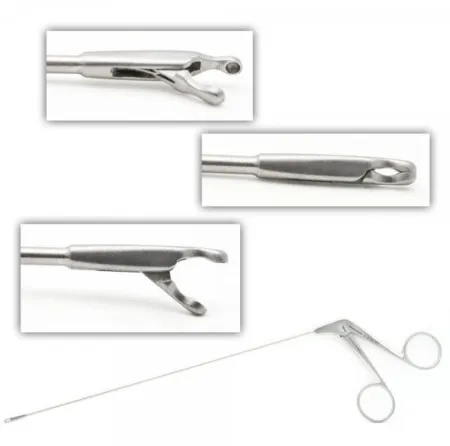
When a 2mm Belinson forceps closes on normal cervical tissue, the tissue takes a firm pull to release. When it closes on high-grade dysplasia, the tissue comes away with a gentle pull, often in a strip half a centimeter wide. An experienced clinician can tell if the tissue is abnormal by feel, before pathology confirms it.
Dr. Jerome Belinson, the gynecologic oncologist the forceps is named for, learned this while taking thousands of biopsies in rural China in the late 1990s. That study helped show that standard colposcopy protocols were inaccurate and that taking more biopsies during colposcopy finds more disease, which is now part of standard practice. If you have passed this instrument, opened it onto a back table or reprocessed it in SPD, it came out of that work.
We spoke with him for most of an hour in October about how the forceps works, how to handle it, how he used it to teach, and the screening research and implementation that has since reached hundreds of thousands of women.
Dr. Jerome Belinson.
Dr. Belinson started the first gynecologic oncology service at the University of Vermont in 1977, and in 1990 he was recruited to chair Obstetrics and Gynecology at Cleveland Clinic. He is Clinical Professor Emeritus at the Cleveland Clinic Lerner College of Medicine of Case Western Reserve University, and the founder of Preventive Oncology International, which has run population-based cervical cancer screening trials, often with 10,000 women in a study. To date, POI has conducted research in China, Malaysia, Mexico, Peru, the Dominican Republic and the United States, and has collaborated with research groups working in India, Haiti, Kenya, Brazil, the Netherlands, Belgium and the United States.
He also holds a 100-ton merchant marine captain's license and has put 35,000 miles on his own boat.
Where the forceps came from.
The Belinson forceps is an adapted bronchoscopy biopsy instrument. Its jaws measure 2mm, compared with 5mm or more for a standard cervical biopsy forceps. Dr. Belinson began using it in the colposcopy clinics at Cleveland Clinic, although pathologists generally prefer larger biopsies.
"This instrument came to my attention. I didn't really invent it. In fact, I didn't even name it. But we started using it, and then of course began writing about it a lot."
A Cleveland company that distributed the instrument started calling it the Belinson biopsy instrument, and the name stayed with it. It comes in 9- and 11-inch lengths.
Belinson Biopsy ForcepIts photos, uses and care notes in our libraryTwo thousand women, five biopsies each.
In 1997, Preventive Oncology International began its first major project, the Shanxi Province Cervical Cancer Screening Study, known as SPOCCS I. Dr. Belinson and his longtime research partner, Dr. Jerry Pretorius, wanted to measure how accurate the common screening tests really were, using a population that had never been screened. He pointed out that the Pap smear came into use in the 1960s without ever being tested in a randomized prospective trial.
"In fact, the Pap doesn't work very well. It's just the combination of pre-cancer progressing slowly and women coming back year after year that cytology gets the answer right. This of course is a problem in the parts of the world where cervical cancer is a major problem and women may only have one chance in their life for screening."
The team flew into Beijing, took a 12-hour train to Taiyuan, and then a bus for three hours into rural Xiangyuan, Shanxi. Women came by bus from mountain villages. "Most of them had never seen Western faces before," he said. "Those first few trips were remarkable."
The study enrolled women aged 35 to 45. Each had six different screening tests, including colposcopy, and every woman had at least five biopsies whether her cervix looked abnormal or not. Biopsying normal-looking tissue as well as abnormal tissue is how the study found each test's false negatives and false positives and measured the true sensitivity and specificity of each screening method for the first time.
Five biopsies per woman was practical because of the 2mm forceps. The small biopsies caused little discomfort and healed quickly. SPOCCS I started a line of research, since repeated by investigators around the world, showing that more biopsies provide a more accurate diagnosis.
It's so light, it becomes an extension of your hand. If the tissue separates easily, that's high-grade dysplasia, a high percentage of the time. Dr. Jerome Belinson
How the tissue tells you the diagnosis.
In a colposcopy clinic, most biopsies come from tissue that already looks abnormal. In SPOCCS I he was biopsying normal tissue too, about 2,000 women in four to six weeks, and that is where he noticed how differently the two release.
Holds on
Squamous metaplasia, inflammation and thickened areas of epithelium from irritation, such as by IUD strings, can all look white. The cells are still firmly attached to each other.
- Takes a firm pull to release
- The patient feels the pinch
- If it will not come away, grab less tissue, never twist
Lets go
The cells have lost their adhesion, so the white epithelium peels away, often in a strip half a centimeter to a centimeter wide.
- Comes away with a gentle pull
- Less of a pinch for the patient
- CIN 2 falls in between; cancer tends to come away in small pieces and bleed
"You look and you say, that patient's got real high-grade dysplasia. You close the instrument on it, you pull off, and you end up with a piece of tissue that's a half a centimeter or a centimeter wide. The white epithelium just literally peels away."
This follows Coman's work from the 1940s, which showed that normal epithelial cells adhere tightly to one another and malignant cells lose that intercellular adhesion, with premalignant cells in between. A light instrument lets the clinician feel the difference.
"It was that use, the first large-volume application, that really made us realize what a remarkable instrument we had sort of discovered," he said, "because it told you what the biopsy was going to reveal."
Check the aim before anything is taken.
Because the jaws clamp without cutting, a teacher can confirm a student's placement on the cervix before the biopsy is taken.
Pick the spot
The student examines the cervix and chooses where to take the biopsy.
Close without pulling
The jaws clamp the tissue. They do not cut, so nothing is taken yet.
Open and check
The jaws leave a clear imprint on the cervix, on normal and abnormal tissue alike. The instructor looks and agrees, or not.
Close again and pull
The forceps goes back into the same marks and a quick straight pull takes the biopsy.
"You close it slowly. It settles right into the grooves that you made."
His colleagues in China prefer the 9-inch forceps. Dr. Belinson usually uses the 11-inch, partly because of differences in pelvic anatomy and partly for teaching:
"As a surgical teacher, if my students or residents and fellows used long instruments, their hands were out of my sight lines, and so I could teach more effectively and more safely."
What to know when you handle it.
Never twist it
The biopsy comes away with a quick straight pull in line with the instrument. Twisting is what damages the jaws.
It needs no sharpening
The teeth clamp and hold rather than cut, so it was never sharp to begin with. Cleaning, sterilization and correct use are all the care it needs.
Weight matters
The originals, made in Germany, weighed 34 grams. Some sold today weigh around 120. Make it thicker and stronger, he says, "and you start losing the specialness of the instrument."
It lasts
Of the two dozen he took to rural Shanxi in the late 1990s, 19 were still in use when he went back around 2014.
The nuances of the instrument are known to only a few. But fortunately, those few have reached tens of thousands of women who needed care. Dr. Jerome Belinson, in an email to us before our call
An HPV test a woman can take herself.
We asked which of his results meant the most to him personally. He chose self-collection.
The idea came during SPOCCS I from Dr. Attila Lorincz, who invented the Hybrid Capture HPV test. Because the HPV assay is a molecular test and does not need well-preserved cells, self-collection was suggested. In that first study, self-samples were 15 to 20% less sensitive than samples taken directly from the cervix by a physician. A second study of 8,497 women used a different collection device (a brush versus a swab) and got the same result. In a third study of 2,653 participants, the team sampled the cervix, the upper and lower vagina and the vulva, along with a self-sample. If any of a patient's samples was positive by Hybrid Capture, all of her samples were re-tested with a PCR-based genotyping assay to understand the misses. With PCR, the self-samples matched the direct samples. At last the team had its answer: self-collection could work if the HPV assay amplified the sample, as a PCR-based assay does.
From 2010 to 2012, a randomized trial of 10,000 women (SHENCCAST II) showed definitively that self-collection was equal to direct collection when the test was PCR-based. The trial also showed that the collection device was not important: a nylon brush did as well as a flocked swab.
"Most importantly, the sampling device must be simple, inexpensive and acceptable to women. The key is the PCR-based assay."
Self-collection reaches women who do not see a doctor, including in places with no doctor to see, and many women are more willing to take a self-test. Dr. Belinson's team built a self-collection program that registers women by smartphone, since "even in poor areas, somebody's got a phone."
Dr. Belinson kept a presence in China for more than 25 years and received China's Friendship Award, the highest honor the country gives a foreign national. His team introduced HPV testing and liquid-based cytology to China, and the Chinese colleagues he first worked with went on to build a consortium that now covers the whole country.
Screening at a much larger scale.
An 18,000-woman trial in China exploring new screening and triage methods is due to finish early next year. Dr. Belinson also introduced a third-generation HPV assay from Atila BioSystems, which he had tested, to the NIH. A team at the National Cancer Institute redesigned it to support risk-based cervical screening and management. The assay, now called ScreenFire, is very fast, simple and inexpensive, and combined with self-collection and potentially phone-based AI triage, he believes it can support screening on a very large scale. The NIH team has tested it on more than 50,000 women in collaboration with nine countries in Africa, Central and South America and Asia. Funding is still being sought for the final phase, which would test real in-field implementation and cost-effectiveness.
"We know it's going to work, but you've got to do the science and demonstrate it in the places that have big populations and big need."
Trust well-done science.
At the end of our call, we asked Dr. Belinson what he would most like surgical techs and their educators to hear. He chose to talk about trust in science.
It's disappointing to see the distrust of well-done science. The internet has been a wonderful thing, but it's also caused a lot of problems. You hear people saying, "Well, I do my own research." Most people don't know how to do their own research. It's not easy to evaluate data. Having spent a lifetime doing science, it's disappointing to see that people don't understand and don't believe good science. Dr. Jerome Belinson
He hopes institutions like the CDC, the FDA, the National Cancer Institute and the NIH can continue their work, "because they really make a difference."
What makes a country great? You can spot a great country. It's where young people go to get educated. Dr. Jerome Belinson
Surgical techs work to standards for counts, sterilization and aseptic technique that came out of the same kind of careful research. Dr. Belinson has spent his career doing that research, much of it for women who had never been screened before.
Dr. Belinson first contacted us to correct the spelling of his name on our instrument page. Our thanks to him for his time and his generosity. Quotes have been lightly edited for length and clarity.
Know the instrument before it is passed.
The Belinson forceps has its own card in our library: photos, uses, the caution about twisting, and how to care for it.