Introduction to Colonoscopy
What a colonoscopy involves, the instruments you are responsible for, and what the scrub actually does before, during and after the procedure.
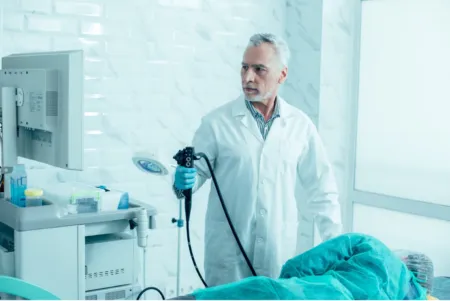
What a colonoscopy is.
A colonoscopy is an examination of the whole large bowel with a flexible scope carrying a camera and a light. It is used to screen for and prevent colorectal cancer, because a polyp found during the examination can usually be removed in the same sitting, before it ever becomes cancer. It also answers bleeding, anaemia and unexplained changes in bowel habit. Most take twenty minutes to an hour under sedation.
For a surgical tech the important thing about that description is the word usually. A colonoscopy is booked as a look and can turn into a resection of tissue without anybody stopping to renegotiate. Your tray has to be ready for the therapeutic case every time, even when the schedule says diagnostic.
Two cases wearing the same name.
Looking for something
A screening or symptom-driven scope. The plan is to look, photograph and come out.
- Screening from age 45, or sooner with risk
- Bleeding, anaemia or a change in habit
- May become therapeutic without warning
- Often books as a short case
Removing something
A polyp comes out, a lesion is tattooed, a bleed is controlled. The tray has to be ready for all three.
- Snare polypectomy, hot or cold
- Biopsy forceps for tissue sampling
- Clips or injection for haemostasis
- Specimen handling becomes your problem
What actually happens, and where you fit.
Position and prep
Left lateral decubitus, knees drawn up. Bowel prep has already happened at home, and a poor prep is the commonest reason a case gets abandoned.
Check the tower
Light source, processor, insufflation, suction, irrigation. Confirm the image before the scope goes anywhere, because nobody wants to find a dead light at the hepatic flexure.
Advance and survey
To the caecum, then the real examination happens on the way out. Withdrawal time is the quality metric.
Specimens and count
Every polyp is a labelled specimen with a location. Get the site right on the pot, because the pathology report is read against it.
What is on the table.
Our Colonoscopy setup has the room, the positioning and the instrument list laid out case by case.
The things that go wrong.
None of this is exotic. It is the ordinary variance of a common case, and the difference between a smooth list and a tense one is whether the person handing over the instruments saw it coming.
Looping
The scope forms a loop in the sigmoid and the tip stops advancing while the shaft keeps going in. Expect abdominal pressure or a position change to be asked for, and be ready before it is.
A poor prep
If the bowel is not clean the examination is not reliable, and the case may be abandoned and rebooked. It is the single most common reason a list runs short.
Bleeding after a polypectomy
Usually controlled endoscopically with clips or injection. Know where both are before the snare is ever opened.
Perforation
Rare, and the reason the room stays a room rather than a cupboard. If it happens the case converts, and the tray you need next is a laparotomy tray.
Behind the scenes of the case.
Curious how the room gets ready for a procedure like this one, or studying to work in one? Start here.
The Colonoscopy setup
The room, the positioning and the instruments for this case.
How the back table is set up
The back table and Mayo stand, step by step.
The instrument library
2,800+ surgical instruments with real photos.
Today's instrument quiz
Five questions with pictures. How many do you know?
Know the table before you walk in.
Endoscopy lists move fast and repeat all day, which is exactly when knowing the tray from memory beats knowing it from a book. Every setup is in the free CSTSetup app too.