Law, ethics and safety
The laws, rules and values behind every case: consent, records, scope of practice, what to do when something goes wrong, and doing right when nobody is watching.
1Why it matters
In the OR the patient is often asleep or sedationsih-DAY-shunA calm, relaxed or sleepy state brought on by drugs, or the use of drugs to cause it.sed calm, settle-ation processFull entry , and depends on the team for their safety. An anesthetized patient cannot even tell the team that a position is hurting. Every patient trusts the team to do no harm, and that trust is the base of the whole relationship.
Health professionals work inside a frame of laws, regulations, standards and policies, and they follow a code of ethicsKOHD uv ETH-iksA written set of moral principles and duties that guides the conduct of members of a profession.Full entry , because the public holds them to a high level of accountabilityuh-kown-tuh-BIL-ih-teeBeing answerable for your own decisions, actions and the results of the care you give or hand to others.Full entry . A law is one of society's rules, made by the people and enforced by government, and breaking one has legal consequences.
Harm in surgery is not rare. Nearly a third of the sentinel eventSEN-tih-nul ee-VENTAn unexpected event in health care that causes a client's death, permanent harm or severe temporary harm.Full entry reported to The Joint Commissionthuh JOYNT kuh-MISH-unAn independent US organization that inspects and accredits hospitals and other health care organizations against safety and quality standards.Full entry from 2005 to 2020 could have happened in the perioperativepair-ee-OP-er-uh-tivRelating to the whole time around a surgery: before, during and after it.peri- aroundoperative relating to surgeryFull entry setting. The Joint Commission counted 127 wrong surgery events in 2024, up from 112 in 2023.
Not long ago a surgical technologistSUR-jih-kul tek-NOL-uh-jistA member of the operating room team who prepares the sterile field and instruments and hands them to the surgeon.Full entry was almost never named in a lawsuit. That is changing, and any member of the team, as well as the facility itself, can be held liable.
Law and ethicsETH-iksThe study of right and wrong, and the principles that guide good conduct and decisions.eth/o custom, character-ics the study ofFull entry overlap: legal doctrines are often used to interpret ethicalETH-ih-kulHaving to do with what is morally right, or acting in line with accepted moral principles.Full entry ideas. Ethics also asks a wider question, what is right, and a person acting as a professional carries a heavier ethical load than a private person does.
This chapter teaches the law, the ethics and the safety system behind your work. Other chapters hold the pieces around it: abbreviations and the "Do Not Use" list as language in chapter 1; drug handling in chapter 12; the profession, its organizations and certificationser-tih-fih-KAY-shunA credential from a professional organization showing that a person has met the standards for a specialty.Full entry in chapter 14; communication and speaking up in chapter 16; how the department runs, including cost containment, in chapter 17; the patient's fears and culture, organ donation and death in the OR in chapter 18; computers, the electronic record and HIPAA in ITeye-TEE (said as letters)An abbreviation for intrathecal (into the spinal fluid) that ISMP lists as error-prone, because it is misread.Full entry systems in chapter 19; fire and electrical safety in chapter 20; surgical asepsisSUR-jih-kul ay-SEP-sisPractices that keep an area or object completely free of microorganisms; also called sterile technique.a- withoutsepsis decay, infectionFull entry and its breaks in chapter 26; the chart review, consents and the time-outTYM-owtA pause just before a procedure when the whole team confirms the right client, procedure and site; also, a short break to calm a child.Full entry as steps of the case, and the counts, in chapter 28; counts at closing, specimens and drugs on the field in chapter 29; and transport, positioning and skin prep in chapter 31.
2Ethics, morals and values
The words
- Values: the beliefs that move a person to act one way or another and guide what they see as right and wrong. Most people take on the values they were raised with.
- Morals: a society's common standards of right behavior, the rules that let people live together in groups. Most laws are built on them.
- ethicsETH-iksThe study of right and wrong, and the principles that guide good conduct and decisions.eth/o custom, character-ics the study ofFull entry : a set of moral principles and rules that a profession takes on as its standards of conduct. As a branch of philosophy, ethics studies what is good for the person and for society, and what duties people owe one another.
- Professional ethics: the behavior society expects from the people who provide its services. Medical ethics sets the conduct of everyone in the health professions.
- ethical dilemmaETH-ih-kul dih-LEM-uhA situation in which a person must choose between two or more actions that each have moral reasons for and against them.Full entry : a decision in which none of the choices is fully acceptable, often because two principles or two people's values pull in opposite directions.
Ethics and morality are not the same thing. Morality is the code of behavior a society hands to its members; ethics is the agreed standard of a profession, and once you act as a professional you take on its extra duties.
That matters because your values will not always match your patient's. A patient who looks or lives very differently from you is still a person with a name, a history and the same needs and pain as anyone. You respond to those needs, never to the patient's lifestyle or appearance.
The ethical principles
These principles guide ethicalETH-ih-kulHaving to do with what is morally right, or acting in line with accepted moral principles.Full entry decisions, and all but fidelityfih-DEL-ih-teeThe ethical principle of keeping promises and being faithful to commitments.Full entry are on the Core Curriculum's list. You will use them every day.
| Principle | What it means | At the field |
|---|---|---|
| autonomyaw-TON-uh-meeA person's right to make their own choices about their body and their care.Full entry | The patient's right to make their own decisions about their own body, including the right to refuse care | Consent comes from the patient, and a refusal is respected |
| beneficencebuh-NEF-ih-sunsThe ethical principle of doing good and acting in the client's best interest.bene- good, well-ficence doingFull entry | Doing good: acting for the patient's benefit and removing harm | You act as the patient's advocateAD-vuh-kayt (verb), AD-vuh-kit (noun)To speak up and act for a client's rights, safety and wishes; also, a person who does this.Full entry , doing what the patient would do if they were able |
| nonmaleficencenon-muh-LEF-ih-sunsThe ethical principle of doing no harm to the client.non- notmale- bad, ill-ficence doingFull entry | Do no harm, on purpose or by accident, and weigh any harm against the good it brings | Complex instruments and equipment used carelessly can injure or kill, so you use them safely |
| justiceJUS-tisThe ethical principle of treating people fairly and sharing care and resources fairly.Full entry | Fair and equal care for everyone, whatever their age, gender identityJEN-der eye-DEN-tih-teeA person's own inner sense of their gender, whether or not it matches the sex they were assigned at birth.Full entry , body, mental capacity, ethnicity or income | The same surgical asepsisSUR-jih-kul ay-SEP-sisPractices that keep an area or object completely free of microorganisms; also called sterile technique.a- withoutsepsis decay, infectionFull entry and the same respect for every patient |
| veracityveh-RAS-ih-teeThe ethical principle of telling the truth.Full entry (truthfulness) | Telling the truth, and never covering up a mistake | You admit a contaminated glove so it can be fixed |
| Fidelity | Keeping promises | You finish what you take on, even when it gets hard |
| Confidentiality | Keeping what you learn about a patient inside the care team | You never talk about a patient outside the care setting, and gossip counts |
| accountabilityuh-kown-tuh-BIL-ih-teeBeing answerable for your own decisions, actions and the results of the care you give or hand to others.Full entry | Answering for your own choices and actions, and their results | You sign for the counts you took part in |
| Responsibility | The duty to carry out a task you have accepted, and to carry it out well | You accept only tasks you are able to do safely |
Ways of deciding
Two big theories shape how people decide what is right.
- Deontology judges an act by duty and fixed moral rules, such as "Do not lie, do not steal, do not cheat." It is simple to follow because it does not weigh costs and benefits. The bond between caregiver and patient is deontological at heart, built on the duties to do good and avoid harm.
- Utilitarianism judges an act by its results: the right choice brings the greatest good to the greatest number of people. It looks at society as a whole, for example when deciding how to share out limited money, time and staff.
The two can clash. Utilitarian thinking might say one brain-dead patient's organs should save four other patients, while a deontologist would answer that the rule "do no harm" forbids it. They can also reach the same decision for different reasons.
Other things weigh on every ethical decision: your personal values, your accountability and responsibility for your actions, religious beliefs, cultural beliefs, the integrity of the organization you work for, and the way you solve problems.
Culture can change what feels right. In some cultures the family, not the patient, receives news of a serious illness and makes the decisions. In the United States that can conflict with the patient's autonomy and with the HIPAA Privacy Rule, which is how a caregiver ends up in a dilemma.
Corporate integrity means the facility itself acts lawfully and ethically. Its leaders set a code of conduct that defines acceptable behavior, and compliance officers work to prevent illegal, unethical or improper conduct by people or groups in the organization.
Working through an ethical problem
Ethics starts with five questions: what makes a right act right, to whom duty is owed, what kinds of acts are right, how the situation in front of you fits the principles, and what you should do now.
A structured approach keeps you from deciding on feelings alone. One model follows the same steps as patient care:
- Gather the facts. What is the problem, who is involved, what are the facts, and what do the patient, the family and the team care about?
- Analyze. Weigh the facts against the ethical principles and your code of ethicsKOHD uv ETH-iksA written set of moral principles and duties that guides the conduct of members of a profession.Full entry .
- List the options. Sometimes there is only a "best available" choice.
- Choose and act, working with the patient, the family and the team.
- Evaluate what happened and what you learned.
You do not have to solve hard cases alone. Society works on medical dilemmas through ethics committeeETH-iks kuh-MIT-eeA group in a health care facility that helps staff, clients and families work through difficult moral questions about care.Full entry , public debate and laws, and a hospital's ethics committee is the main place staff turn for help with an ethical problem.
Knowing the right action but feeling blocked from taking it is called moral distress. Doing what is right anyway, when others push you to act otherwise, takes moral courage.
3Patient rights
The Patient Care Partnership
Laws and agencies exist to protect patients, and health professionals hold an unspoken contract to keep a certain kind of relationship with every patient.
The American Hospital Association's Patient Care Partnership replaced its older Patient's Bill of Rights. In plain language, it tells patients what to expect during a hospital stay and what their rights and responsibilities are, and it frames care as a partnership between the patient and the people caring for them. It is not a law: the American Heart Associationuh-MAIR-ih-kun HART uh-soh-see-AY-shunA US nonprofit group that funds heart and stroke research and publishes guidelines, including for CPR.Full entry encourages hospitals to adapt it for their own patients.
Patients can expect:
- High-quality hospital care
- A clean and safe environment
- Involvement in their care
- Protection of their privacy
- Help when they leave the hospital
- Help with their bills and insurance claims
The Partnership also asks patients to take part in their care and to ask questions at any time, because unasked and unanswered questions add to the stress of a hospital stay.
Rights the law protects
U.S. courts have long held that every adult has the right to decide what happens to their own body. That is a legal right and an ethicalETH-ih-kulHaving to do with what is morally right, or acting in line with accepted moral principles.Full entry one.
The Patient Self-Determination ActPAY-shunt self-dee-ter-mih-NAY-shun AKTA 1990 US federal law requiring health care facilities to tell adults about their right to make advance directives and to accept or refuse treatment.Full entry of 1990 says each patient has a right under state law to make decisions about their care, including the right to refuse treatment. Hospitals that take Medicare and Medicaid must ask patients whether they have an advance directivead-VANS dih-REK-tivA legal document in which a person states their wishes for medical care, for a time when they cannot speak for themselves.Full entry , and the answer goes in the record.
The Joint Commissionthuh JOYNT kuh-MISH-unAn independent US organization that inspects and accredits hospitals and other health care organizations against safety and quality standards.Full entry 2026 goals require accredited hospitals to:
- give patients information in a way they understand, with interpreters and translation as needed, and in a way that meets the needs of a patient with a vision, speech, hearing or cognitive impairmentKOG-nih-tiv im-PAIR-muntTrouble with thinking, memory, learning, attention or making decisions that is more than expected for the person's age.cognit- knowing-ive relating toFull entry
- honor the patient's right to give or withhold informed consentin-FORMD kun-SENTA person's agreement to a treatment or procedure, given freely after the risks, benefits and other choices have been explained to them.Full entry
- screen for patients who may be victims of abuse, neglectnih-GLEKTFailure to give a child or dependent adult the food, shelter, care, safety or medical help they need.Full entry or exploitation, teach staff the signs, and report possible cases inside the hospital
- treat every patient with dignity and respect, honor their cultural and personal values, beliefs and preferences, and make room for religious and spiritual services
intimate partner violenceIN-tih-mut PART-ner VY-uh-lensPhysical, sexual or emotional harm, stalking or control by a current or former partner or spouse.Full entry is real or threatened physical or sexual violence, or psychological or emotional abuse, by a current or former partner, who need not live with the patient. cueKYOOA piece of information about a client, such as a sign, symptom, lab value or remark, that the nurse notices and uses to make a judgment.Full entry include a delay of hours or days in seeking care, vague explanations of injuries, complaints that do not point anywhere, and a partner who will not let the patient be seen alone; pregnancy raises the risk. A nurse who suspects it is required to report it in most states, so tell the nurse what you saw.
In the OR, protect the patient's body as well as their information: expose no more of the body than the procedure needs, and treat every patient with respect, dignity and compassion.
The patient on the table cannot speak up for themselves, so you speak for them: as their advocateAD-vuh-kayt (verb), AD-vuh-kit (noun)To speak up and act for a client's rights, safety and wishes; also, a person who does this.Full entry , you do what they would ask for if they could.
4The AST Code of Ethics
AST adopted its code of ethicsKOHD uv ETH-iksA written set of moral principles and duties that guides the conduct of members of a profession.Full entry for surgical technologistSUR-jih-kul tek-NOL-uh-jistA member of the operating room team who prepares the sterile field and instruments and hands them to the surgeon.Full entry in 1985 and last updated it in 2013. A professional code of ethics spells out what a profession expects of its members when they face ethicalETH-ih-kulHaving to do with what is morally right, or acting in line with accepted moral principles.Full entry choices.
The code, in plain words:
- Hold to the highest standards of professional conduct and of patient care.
- Keep every personal matter about the patient in confidence, with respect for the patient's beliefs. What you see and hear in the OR stays with the care team.
- Respect the patient's legal and moral right to good care, and protect it, including the rights to consent, to refuse and to privacy.
- Never knowingly cause injury or injustice to anyone in your care.
- Work with other surgical technologists and other health professionals in harmony and unity, for better patient care.
- Always follow the principles of asepsisay-SEP-sisThe state of being free of germs that cause disease, and the practices used to keep things that way.a- withoutsep- decay or infection-sis conditionFull entry , for every patient.
- Keep yourself efficient and current through continuing education. Standards can go out of date quickly as new research appears.
- Practice surgical technology willingly, with pride and dignity.
- When you see unethical conduct or practice, report it to the proper authority.
- Keep to this code at all times, with every member of the health care team.
A code of ethics or conduct is not a law, and breaking it has no legal consequence unless it matches a law. But the organization can act on a breach, for example by revoking a membership or a person's privileges to practice in a facility. And any professional code can influence how a court judges a professional's conduct.
5The surgical conscience
The surgical conscience is taking responsibility for your own actions in surgery, including errors that could seriously injure the patient, even when nobody else saw them. Contaminating the sterile fieldSTAIR-ul feeldAn area set up with sterile drapes and supplies, kept free of all germs, for a sterile procedure.Full entry , preparing or giving the wrong drug, and forgetting a safety step are all examples. It means practicing excellent technique whether or not anyone is watching.
Admitting a mistake opens the door to fixing it. A mistake that is not reported right away can have devastating results for the patient. Honesty and trustworthiness are the base of a sound surgical conscience.
What it includes
The Core Curriculum names the parts of a surgical conscience:
- Principles of asepsisay-SEP-sisThe state of being free of germs that cause disease, and the practices used to keep things that way.a- withoutsep- decay or infection-sis conditionFull entry . AST holds the surgical technologistSUR-jih-kul tek-NOL-uh-jistA member of the operating room team who prepares the sterile field and instruments and hands them to the surgeon.Full entry responsible for practicing and enforcing aseptic technique for every patient, whatever their gender, religion, disability or background. These principles are the basis of the surgical conscience, and chapter 26 teaches them.
- Professional honesty. You tell the truth and never try to cover up a mistake.
- Moral integrity. A moral code of integrity moves you to speak up when a break has happened, or you think it may have, to protect the patient.
- Confidentiality and HIPAA. What you learn about a patient is kept private, by ethicsETH-iksThe study of right and wrong, and the principles that guide good conduct and decisions.eth/o custom, character-ics the study ofFull entry and by federal law (see Confidentiality and HIPAA, below).
- Nondiscriminatory treatment. Every patient receives the same care, whatever their age, gender identityJEN-der eye-DEN-tih-teeA person's own inner sense of their gender, whether or not it matches the sex they were assigned at birth.Full entry , body, mental capacity, ethnicity or income.
- Commitment to cost containment. You avoid waste. sutureSOO-cherA stitch, or the thread used to stitch, that holds the edges of a wound or incision together.Full entry , for example, is opened from the list on the surgeon's preference card, with more kept ready to open if it is needed, and it is handled no more than necessary. Chapter 17 teaches the department's cost containment processes.
What gets in its way
The Core Curriculum names three barriers. Knowing them helps you notice when they are pulling at you.
- Lack of resources. Short staffing and doing more with fewer resources can lead to patient safety problems.
- Peer apathy. Teammates who do not seem to care can make speaking up feel pointless. Moral courage means being willing to speak up and do the right thing when others push you the other way.
- Stress. Hurry, stress and distraction raise the risk of errors, such as drug errors, and distraction is a major reason a task gets missed.
The surgical conscience works the same whether or not anyone is watching. Say "I contaminated my glove," fix it, and move on. Practice it in the asepsis labs until it is automatic.
6Ethical issues in practice
You will be asked to take part in cases that test your values, and well-meaning people will see them differently from you.
Your right to step aside, and its limits
You may opt out of certain kinds of cases that go against your ethicalETH-ih-kulHaving to do with what is morally right, or acting in line with accepted moral principles.Full entry or religious values. Tell the facility when you are hired: human resources may ask for a written list of the cases you will not take part in. It is not ethical to refuse a case suddenly, unless it is one nobody could have expected. Refusing to scrub at the last minute, or walking out in the middle of a case, can be judged abandonmentuh-BAN-dun-mentLeaving clients in your care without proper notice or a handoff to another qualified caregiver.Full entry of the patient and is grounds for probation or dismissal. If the reason is a personality clash with a teammate, the problem must be worked out, because it can lead to poor patient care.
Issues you will meet
The Core Curriculum lists the ethical issues of clinical practice. For each one, people hold strong views on more than one side.
- Elective abortion.
- Elective sterilizationstair-uh-luh-ZAY-shunA process that destroys all microorganisms, including spores, on an item; also a permanent birth control procedure.Full entry . Some facilities use a specific consent form for an elective procedure that ends a patient's ability to have children.
- Reproductive technology: artificial insemination and in vitro fertilizationin VEE-troh fer-tuh-lih-ZAY-shunA fertility treatment in which eggs are joined with sperm in a lab and an embryo is then placed in the uterus.Full entry .
- Genetic engineering and stem cellSTEM SELAn unspecialized cell that can divide to make more of itself and develop into specialized cells.Full entry research.
- Gender reassignment. Chapter 34 covers gender confirmation surgery.
- Human experimentation. A patient who agrees to take part in experimental surgery or other research must be fully told the risks and possible outcomes, on a special consent designed by an institutional review board under FDA rules.
- Animal experimentation.
- Organ donation and transplantation. A patient has the right to refuse to have their organs removed for transplant after death, and that wish is written in the chart. Chapter 18 covers donation and death in the OR.
- Refusal of treatment. Every patient has the right to refuse care, including blood (see advance directivead-VANS dih-REK-tivA legal document in which a person states their wishes for medical care, for a time when they cannot speak for themselves.Full entry , below). A refusal made for a child, such as parents refusing treatment on religious grounds, raises especially hard questions.
- The right to die: assisted suicide and end-of-life careEND-uv-LYF KAIRThe care given to a person and their family in the last days, weeks or months of life.Full entry decisions, including do-not-resuscitate orderdoo-not-rih-SUS-ih-tayt OR-derA provider's order that CPR will not be started if the client's heart or breathing stops.Full entry orders in the OR (see Advance directives, below).
- communicable diseasekuh-MYOO-nih-kuh-bul dih-ZEEZA disease that can spread from one person, or animal, to another.Full entry . A patient with HIVaych-eye-VEE (said as letters)Human immunodeficiency virus: a virus that infects and destroys immune cells called CD4 T cells.Full entry or another communicable disease gets the same care and the same aseptic technique as any other patient. Chapter 10 teaches the precautionprih-KAW-shunA step taken ahead of time to prevent harm, such as the infection-control practices used with every client.Full entry that protect you.
- Insurance fraud. Fraud is deceiving someone for personal gain. Charting care that was never given, or changing a record to cover up an error, can be fraud, and fraud can bring civil and criminal charges. Patients and their insurers receive a detailed list of the charges in the record, so charges must be true and exact.
- Workplace violence (see Abuse and disruptive behavior, below).
- substance abuseSUB-stuns uh-BYOOSAn older term for using alcohol or drugs in a harmful way; today it is usually called substance use disorder.Full entry (below).
Substance abuse
The Core Curriculum asks you to think about substance abuse in three people: a coworker, a patient and yourself.
An impairmentim-PAIR-mentA loss or weakening of a body function or ability, such as sight, hearing, movement or thinking.Full entry coworker is a major threat to the patient and to everyone in the room. Health care workers have both a legal and an ethical duty to report a coworker they suspect is impaired. Substance abuse is an illness, not a weakness, and reporting it protects the abuser as well as everyone else.
A teammate may notice long absences, many mistakes (drug errors among them), reduced alertness or confusion, or signs of drug diversion, drugs taken from their intended use for the worker's own use, for sale or for others: wrong opioid analgesicOH-pee-oyd an-ul-JEE-zikA strong drug that relieves moderate to severe pain by acting on the brain and spinal cord.Full entry counts, unusual amounts of opioid wasted, many corrections to drug records, and patients who often say their pain medicine did not work.
Report it to your supervisor, and report what you saw and heard, not a diagnosis. "Dr. X smelled strongly of alcohol. Their speech was slurred" is a proper statement; it gives facts and no opinion.
A patient is asked about drugs, alcohol and tobacco before anesthesiaan-us-THEE-zhuhLoss of feeling or sensation, often brought on by drugs so that surgery or a procedure can be done without pain.an- withoutesthesi/o feeling, sensation-ia conditionFull entry . An honest answer matters, because the effects of a substance are hard to predict when the patient cannot or will not say what they took. Care for the patient the same way whatever the answer.
Yourself. If you have a problem with drugs or alcohol, you have the same duty you have to a coworker: get treatment.
7Kinds of law
The U.S. Constitution and its Bill of Rights are the base of every law in the country, and no later law may take away the rights they give. As a surgical technologistSUR-jih-kul tek-NOL-uh-jistA member of the operating room team who prepares the sterile field and instruments and hands them to the surgeon.Full entry , the laws that touch you most are statutes and the rules of liability.
Where law comes from
- Statutory law: laws passed by a legislature, such as Congress or a state legislature. These laws are called statutes. Federal statutes in health care include HIPAA and the laws on Medicare.
- State law and Practice Acts: the Constitution lets each state make the laws that define and regulate its own health professions. These laws are the Practice Acts. They set the education and experience a profession needs and its scope of practiceSKOHP uv PRAK-tisThe actions and duties a licensed professional is legally allowed to perform.Full entry : what its members may and may not do.
- Administrative law and regulations: government agencies run large public programs and issue regulations to enforce their standards. The Occupational Safety and Health AdministrationOH-shuh (said as a word)The US federal agency, part of the Department of Labor, that sets and enforces rules to keep workplaces safe.Full entry (OSHA) issues rules that protect workers, and the Food and Drug Administration (FDA) sets rules for the safety of drugs and medical devices. When a regulation is broken, the facility is fined, not the employee, and its accreditation can suffer; employees are expected to follow the rules that keep their facility in line.
- Common law: law built from earlier court decisions. A judge applies the principles of past cases, called precedents, to the case in front of them. Legal doctrines, the principles below, grew out of these precedents, and most civil and criminal law rests on common law.
Civil and criminal law
- Civil law protects the rights of individuals. The person who was harmed brings the case, and a win usually means money, called damages. malpracticemal-PRAK-tisNegligence by a professional, such as a nurse or doctor, that harms a client.Full entry suits are civil cases.
- Criminal law makes certain acts crimes, such as homicide, theft and robbery. The state brings the charge, and the punishment is prison or a fine. Care so poor that it rises to a crime can bring criminal charges, such as negligenceNEG-lih-junsFailure to use the care that a reasonably careful person would use in the same situation.Full entry homicide.
The same act can lead to both. Operating on a patient without consent, for example, can bring a civil suit and criminal charges of batteryBAT-uh-reeIn law, touching a person on purpose without their consent.Full entry .
Torts and liability
A torttortA wrong act, or a failure to act, that harms another person and for which a court can make the wrongdoer pay.Full entry is a wrong that causes injury to a person or to their property, for which the injured person can sue in civil court. Tort law is the part of civil law that handles these cases, and its purpose is to make amends to the injured person, mostly with money. Most legal actions against OR staff are civil actions for torts, either intentional or unintentional.
Liability is the legal duty to make up for a loss or damage you caused. Personal liability belongs to the individual; corporate liability belongs to an organization. The law treats a registered corporation as a person, so a hospital can be sued and is accountabilityuh-kown-tuh-BIL-ih-teeBeing answerable for your own decisions, actions and the results of the care you give or hand to others.Full entry for its patients' safety.
Policies, standards and codes
Some rules you must follow are not laws, but they still bind you.
- Hospital policy: rules every employee must follow, written to protect patients and staff and to keep the hospital running safely. To earn and keep accreditation from The Joint Commissionthuh JOYNT kuh-MISH-unAn independent US organization that inspects and accredits hospitals and other health care organizations against safety and quality standards.Full entry , a facility must have policies that meet or exceed its standards. Breaking a policy can bring discipline, and forgetting it or not knowing it is no excuse. The OR's own procedure manual adds the department's methods, such as disinfectiondis-in-FEK-shunCleaning a surface or object with chemicals or heat to kill most germs, though not always all bacterial spores.Full entry , room turnover and laser safety.
- Standards of practice: technical guidelines for how to do a task, such as the surgical scrub or the count. AST, AORN and other professional groups publish them, based on recent research, and update them as the evidence changes. They are not laws, but your professional organization expects you to follow them.
- Position statements: an organization's public opinion on a practice issue. A position statement can never be used to get around a law, a Practice Act or hospital policy.
- Codes of conduct: an organization's rules for its members' behavior, based on its values (see The AST code of ethicsKOHD uv ETH-iksA written set of moral principles and duties that guides the conduct of members of a profession.Full entry , above).
The difference matters. A law carries legal penalties. A standard or policy does not, unless it matches a law, but breaking one can still cost you your job or your membership, and in a lawsuit, experts use standards, policies and The Joint Commission's goals to show what a careful professional should have done.
8Torts in the OR
Intentional torts
An intentional torttortA wrong act, or a failure to act, that harms another person and for which a court can make the wrongdoer pay.Full entry is a wrong done on purpose. The Core Curriculum lists five.
- assaultuh-SAWLTIn law, a threat or act that makes a person afraid they are about to be touched in a harmful or unwanted way.Full entry : a threat or attempt to harm or touch a person in an offensive way, whether or not it is carried out. Threatening to force a drug on a patient to make them behave is assault.
- batteryBAT-uh-reeIn law, touching a person on purpose without their consent.Full entry : actual harmful or unwanted contact with a person, including contact without proper consent. Giving a blood transfusionBLUD trans-FYOO-zhunGiving blood, or a part of blood, from a donor into a person's vein.trans- acrossfus/o pourFull entry without consent is battery, and so is surgery without consent.
- defamationdef-uh-MAY-shunMaking false statements about a person that harm their good name.Full entry : false statements that damage a person's good name. Spoken defamation is slander; written defamation is libel.
- false imprisonmentfawls im-PRIZ-un-mentUnlawfully keeping a person from moving freely or leaving, by force, threats or restraint.Full entry : holding a person against their will without the legal authority to do so, such as using restraintrih-STRAYNTAny device, drug or method used to limit a person's movement or behavior that they cannot easily remove or refuse.Full entry without consent or keeping a person from leaving.
- invasion of privacyin-VAY-zhun uv PRY-vuh-seeIntruding on a person's private life or sharing their private information or images without permission.Full entry : disclosing a patient's private information, or photographing a patient, without consent. Talking about a patient in public or posting about them on social media without their specific permission counts.
Negligence and malpractice
negligenceNEG-lih-junsFailure to use the care that a reasonably careful person would use in the same situation.Full entry is the unintentional tort. The Joint Commissionthuh JOYNT kuh-MISH-unAn independent US organization that inspects and accredits hospitals and other health care organizations against safety and quality standards.Full entry defines it as failing to take the care that a reasonable, careful person would take in the same situation. It happens in two ways:
- an act of omission: failing to do what a reasonable professional would do
- an act of commission: doing what a reasonable professional would not do
The negligent person did not mean to cause harm. Negligence is the most common cause of injury and death of patients in health care.
malpracticemal-PRAK-tisNegligence by a professional, such as a nurse or doctor, that harms a client.Full entry is negligence by a professional, in the course of professional work, that causes injury. Examples are a surgeon who lets an untrained assistant finish the operation while the surgeon takes a break, a missed diagnosis, and operating on the wrong patient or the wrong side.
The standard of careSTAN-derd uv kairThe level of care that a reasonably careful nurse with the same training would give in the same situation.Full entry is the conduct expected of a person in a given situation. In the OR you are measured against a reasonably skilled, competent and experienced member of your own profession, not against an average person. In court, expert witnesses explain that standard to the jury, using Practice Acts, facility policies and national guidelines. Following your facility's policy is part of the standard: working around a policy creates liability.
The four elements of negligence
To win a negligence suit, the injured person, the plaintiff, must prove all four of these.
- Duty: the defendant owed the patient care. Your duty starts when you accept responsibility for a patient, such as when you take a handoff reportHAND-off ree-PORTThe passing of information and responsibility for a client's care from one nurse or team to another.Full entry .
- Breach of duty: the defendant failed to meet the standard of care, and harm was a foreseeable result.
- Cause: the breach caused the injury. It is not enough to show a mistake: the plaintiff must link that mistake to the harm.
- Damages: the patient was actually harmed. The harm can be physical, emotional or financial, and the court can award money for it.
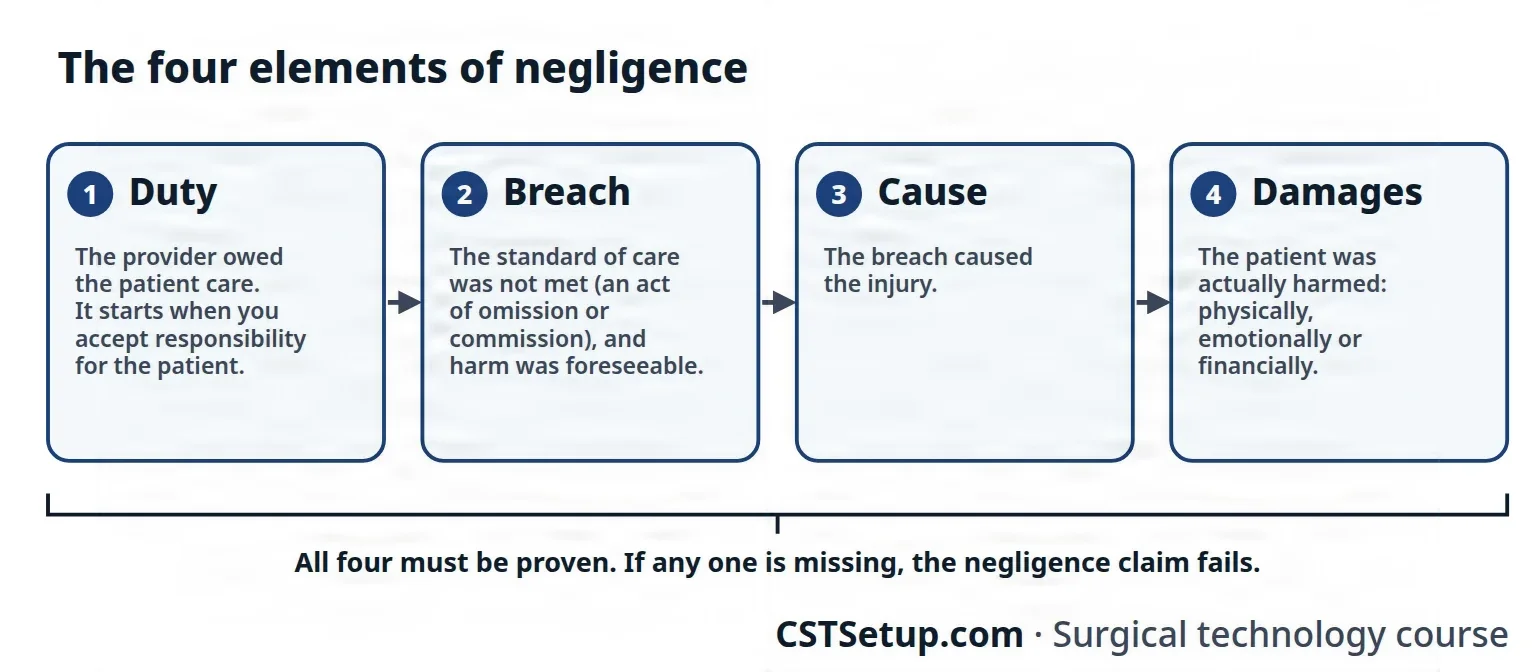
Some references list foreseeability and injury as separate elements. The Core Curriculum's own list covers the same ground: the standard of care and the failure to meet it, an act of commission or omission, foreseeable harm, and actual damages.
Because damages must be proven, it is rarely possible to sue for malpractice without an injury.
If a patient is injured, the team must act at once to keep the injury from getting worse, and risk management is told right away. Patients who feel they were treated with respect and dignity are less likely to sue, even when the result was not perfect.
Negligence needs all four: duty, breach, cause and damages. You owe every patient you accept a duty, and the standard you are held to is that of a careful, competent surgical technologistSUR-jih-kul tek-NOL-uh-jistA member of the operating room team who prepares the sterile field and instruments and hands them to the surgeon.Full entry .
Words of a lawsuit
- Plaintiff: the person who brings the lawsuit.
- Defendant: the person or organization being sued (in a criminal case, the person accused of the crime).
- Subpoena: a court order to appear and testify, or to hand over documents. Medical records can be subpoenaed.
- Deposition: testimony given under oath before the trial. A court reporter records it, and every lawyer in the case may question the witness.
- Trial: the hearing where both sides present their evidence in court.
- Jury: a group of citizens who hear the evidence and decide the outcome, unless the case is settled early.
- Perjury: lying on purpose after swearing to tell the truth. It is a crime.
When a negligence suit is filed, everyone who may have had a part in the injury is named in it. If you are asked to testify about something that happened at work, check with the hospital administration first. The hospital, or its insurer, may provide a lawyer.
Liability insurance
Health professionals can protect themselves with professional liability (malpractice) insurance. There are two schools of thought. One says that carrying a policy makes you more likely to be named in a suit; the other says it is wiser to be covered in case a suit is brought and won. Some references advise every practicing surgical technologist to carry it, because the chance of being sued is greater than in the past. A hospital's policy may not cover everything when you are sued as an individual, and without insurance, a court can take the money from your property or your future earnings.
9Legal doctrines
A legal doctrine is a principle that courts have set through past decisions. These are the ones the Core Curriculum names.
| Doctrine | What it means | In the OR |
|---|---|---|
| Respondeat superior ("let the master answer") | An employer is liable for an employee's negligenceNEG-lih-junsFailure to use the care that a reasonably careful person would use in the same situation.Full entry acts done at work | Your hospital can be sued for your negligence on the job |
| Borrowed servant | The person who directs an employee's work, not the one who pays them, carries more responsibility for it | Courts often held the surgeon liable for any negligent act done in the surgeon's presence in the OR, under the related captain of the ship doctrine. Some rulings have found the surgeon not always responsible when a surgical technologistSUR-jih-kul tek-NOL-uh-jistA member of the operating room team who prepares the sterile field and instruments and hands them to the surgeon.Full entry or nurse fails at a routine task they were trained to do |
| Personal liability | Each person answers for their own conduct, even when others are liable too | A surgeon's promise to "take responsibility" does not take your responsibility away |
| Corporate negligence | A facility can be negligent if it fails to make sure care meets an acceptable level | Hospitals screen and monitor their staff for competenceKOM-puh-tunsHaving the knowledge, skill and judgment to do something well; in law, a person's ability to make their own decisions.Full entry |
| Foreseeability | Professionals are expected to predict the risks of their work and take care to prevent harm | You can be liable for failing to recognize, or failing to act on, a critical event you should have seen coming, such as a risk with the electrosurgeryee-LEK-troh-SUR-jer-eeUsing high-frequency electric current through a handheld tool to cut tissue or seal bleeding vessels during surgery.Full entry , a laser or positioning |
| Res ipsa loquitur ("the thing speaks for itself") | Some injuries do not happen without negligence. When the patient was under the team's control, the injury itself is the evidence, and the defense must prove there was no negligence | A sponge left in a patient, wrong-site surgery and burns are all judged this way |
| Reasonably prudent person | You are expected to act as a reasonable, careful person would | This is the measure behind the standard of careSTAN-derd uv kairThe level of care that a reasonably careful nurse with the same training would give in the same situation.Full entry |
Two traditional principles sit beside these.
- Primum non nocere: "first, do no harm." Your care must never injure the patient.
- Aeger primo: "the patient first," the motto of AST.
The Core Curriculum also lists advance directivead-VANS dih-REK-tivA legal document in which a person states their wishes for medical care, for a time when they cannot speak for themselves.Full entry and informed consentin-FORMD kun-SENTA person's agreement to a treatment or procedure, given freely after the risks, benefits and other choices have been explained to them.Full entry with the legal doctrines. Each has its own section below.
Historically the surgeon or the facility answered for the whole team. Today each professional on the team is held accountabilityuh-kown-tuh-BIL-ih-teeBeing answerable for your own decisions, actions and the results of the care you give or hand to others.Full entry for their own acts, whether those acts are negligent, unintentional or delegateDEL-uh-gaytTo hand a specific nursing task to another trained person while the nurse stays responsible for the client.Full entry .
10Scope of practice and standards of conduct
Scope of practice
scope of practiceSKOHP uv PRAK-tisThe actions and duties a licensed professional is legally allowed to perform.Full entry is a legal term for the knowledge and skills a profession needs to give safe, reliable care, and the services its members are accountabilityuh-kown-tuh-BIL-ih-teeBeing answerable for your own decisions, actions and the results of the care you give or hand to others.Full entry for, based on their education, experience, credentials and state law.
The state Practice Acts set it, and they differ from state to state. Many states now name surgical technologistSUR-jih-kul tek-NOL-uh-jistA member of the operating room team who prepares the sterile field and instruments and hands them to the surgeon.Full entry in their statutes, which they did not in the past. Look up your own state's laws: search for the state legislature, your state and "surgical technologist."
In the first scrub role, you work under the superviseSOO-per-vyzeTo guide, watch over and check the work of another staff member who is doing a task.Full entry and broad delegatory authority of the surgeon, and the rules for that vary from state to state. Under federal Medicare rules (CMSsee-em-ES (said as letters)An abbreviation for the Centers for Medicare & Medicaid Services, the US agency that runs Medicare, or for a circulation, motor and sensation check.Full entry ), a surgical technologist in the scrub role works under the supervision of a registered nurse who is immediately available.
Where standards of conduct come from
Your standards of conduct come from several sources at once, and each of them shapes the standard of careSTAN-derd uv kairThe level of care that a reasonably careful nurse with the same training would give in the same situation.Full entry you are held to:
- the AST code of ethicsKOHD uv ETH-iksA written set of moral principles and duties that guides the conduct of members of a profession.Full entry and AST's standards and guidelines for best practice
- federal agencies, such as Occupational Safety and Health AdministrationOH-shuh (said as a word)The US federal agency, part of the Department of Labor, that sets and enforces rules to keep workplaces safe.Full entry and the FDA, and federal laws, such as HIPAA
- state laws and regulations, including the Practice Acts
- your facility's policies
- legal precedent: past court decisions
- private agencies, such as The Joint Commissionthuh JOYNT kuh-MISH-unAn independent US organization that inspects and accredits hospitals and other health care organizations against safety and quality standards.Full entry , a private, independent, nonprofit organization that sets standards for health care facilities and accredits them
- professional agencies, such as AST, AORN and the American College of Surgeons
Before you take on a task
When you are asked to do something new, a strong surgical conscience, with a thorough knowledge of your state's laws and your hospital's policy, can guide you through four questions:
- Does hospital policy or state law forbid a surgical technologist from doing it?
- Would a reasonable and prudent person with your education, training and experience do it, within an accepted standard of care?
- Do professional standards, guidelines or position statements support it, with extra education and experience?
- Are you ready to accept responsibility and accountability for doing it competently and safely?
Where no law or regulation forbids it, a surgical technologist may perform accepted intraoperativein-truh-OP-er-uh-tivHappening during surgery, from when the client is brought into the operating room until they are moved to recovery.intra- within, duringoperative of surgeryFull entry tasks that their education and experience have prepared them for and that they have shown they can do safely.
Doing more than your role allows is exceeding your authority, and it is one of the events that harm patients in the OR. For example, AST's position is that only a Certified Surgical First Assistant (CSFA) has the knowledge, training and experience for advanced tasks such as closing body planes. Wound closure is done under the surgeon's delegateDEL-uh-gaytTo hand a specific nursing task to another trained person while the nurse stays responsible for the client.Full entry authority, and its rules vary with state law and facility policy.
Delegation
Delegation is handing your duty to do a task to another person. The person who delegates keeps accountability for the action. State Practice Acts sometimes, but not always, define what may be delegated to a surgical technologist, so learn the statutes that apply to you before you need them.
Before you accept a delegated task:
- You must be legally allowed to do it, under the Practice Acts and hospital policy. Both you and the person delegating can be held legally accountable, because both of you are expected to know your scopes of practice.
- You must have the training to do it safely.
- You must be competent and able to do it at that moment.
- You accept only what you are competent to do, and you never pass a delegated task on to someone else.
When you accept a delegated task, you agree to be named in the record as the person who did it, and you sign for it. If you are pressured again and again to do tasks you are not comfortable doing, write down what happened and take it up the chain of commandCHAYN uv kuh-MANDThe order of authority in an organization: who reports to whom, from staff up through managers to leaders.Full entry .
negligenceNEG-lih-junsFailure to use the care that a reasonably careful person would use in the same situation.Full entry delegation is handing a task to someone who is not qualified to do it safely. Delegating a patient's care to an unqualified colleague is also a form of abandonmentuh-BAN-dun-mentLeaving clients in your care without proper notice or a handoff to another qualified caregiver.Full entry .
The right to practice
Three kinds of credentials show that a person has met a profession's requirements. From the least to the most restrictive:
- Registration: the state keeps an official record of the professional, such as their address and workplace, so it can identify them and run background checks. Some states require surgical technologists to register.
- certificationser-tih-fih-KAY-shunA credential from a professional organization showing that a person has met the standards for a specialty.Full entry : recognition, by a qualified body, that a person has met a set standard. It may or may not be required by law. Surgical technology chose national certification instead of licensureLY-sun-sherThe granting of a license by a government body that gives a person legal permission to practice a profession.Full entry , and the CSTsee-es-tee (said as letters)Certified Surgical Technologist, a credential for surgical technologists; in maternity care, contraction stress test.Full entry and the TS-C are certifications; chapter 14 covers them.
- Licensure: a legal right to practice, granted by a state agency under a statute. Physicians, registered nurses, respiratory therapists and radiology technologists are licensed. Most states allow a person licensed in one state to apply for a license in another, which is called reciprocity.
A credential sets a minimum base of knowledge for a profession. It does not prove competenceKOM-puh-tunsHaving the knowledge, skill and judgment to do something well; in law, a person's ability to make their own decisions.Full entry , which must be judged again and again.
11Informed consent
What it is
informed consentin-FORMD kun-SENTA person's agreement to a treatment or procedure, given freely after the risks, benefits and other choices have been explained to them.Full entry is how the patient's right to decide about their own body becomes real. The Joint Commissionthuh JOYNT kuh-MISH-unAn independent US organization that inspects and accredits hospitals and other health care organizations against safety and quality standards.Full entry describes it as permission given with full knowledge of what is being agreed to. In torttortA wrong act, or a failure to act, that harms another person and for which a court can make the wrongdoer pay.Full entry law, a provider must explain the nature and risks of a procedure before they can claim protection from a charge of batteryBAT-uh-reeIn law, touching a person on purpose without their consent.Full entry or from blame for complications.
Two things are easy to confuse:
- The surgical consent form is the patient's written permission for the operation.
- Informed consent is the process behind it: a conversation, before anything is signed, in which the provider explains the plan and the procedure, its risks and benefits, and the other choices the patient has. A signature alone is not informed consent.
Routine, low-risk care, such as a blood draw or an X-ray, needs only simple consent. Surgery and other higher-risk care need informed consent. On admission, the patient signs a general consent for routine services; a special consent is needed for anything with more than normal risk: surgery, anesthesiaan-us-THEE-zhuhLoss of feeling or sensation, often brought on by drugs so that surgery or a procedure can be done without pain.an- withoutesthesi/o feeling, sensation-ia conditionFull entry , a blood transfusionBLUD trans-FYOO-zhunGiving blood, or a part of blood, from a donor into a person's vein.trans- acrossfus/o pourFull entry , antineoplastican-tee-nee-oh-PLAS-tikA drug used to treat cancer by killing cancer cells or stopping them from growing and dividing.anti- againstneo- newplas growth, formation-tic relating toFull entry , sterilizationstair-uh-luh-ZAY-shunA process that destroys all microorganisms, including spores, on an item; also a permanent birth control procedure.Full entry and fertility procedures, research, and receiving an implant such as a heart valve or a plate and screws. A general consent can never take the place of a special one.
The anesthesia consent is a separate process from the surgical consent. Some facilities also use their own forms for sterilization and for implanted devices.
Who obtains it
Obtaining informed consent is the surgeon's job. The surgeon explains the condition, the proposed treatment, its risks and the alternatives, and makes sure the patient understands. Staff then prepare the documents, the patient signs, a witness signs, and the form becomes part of the record. The Joint Commission requires each hospital to have a written policy naming which licensed practitioners may hold the consent discussion, as the law allows.
For an elective case, the consent may be signed in the surgeon's office several days before surgery. In an emergency it is prepared right before the operation.
What the patient must be told
The consent discussion covers:
- the proposed care and the procedure, including the site and side
- its benefits, risks and side effects, how likely it is to reach the patient's goals, and the problems that might come up during recovery
- reasonable alternatives, with their own risks and benefits, and the risks of having no treatment at all
It must be given in words the patient understands: "inflamed gallbladder," not "cholecystitiskoh-luh-sis-TY-tisInflammation of the gallbladder.chol/e bilecyst/o sac, bladder-itis inflammationFull entry ." A patient who does not speak English needs an interpreter, and a patient with a hearing impairmentim-PAIR-mentA loss or weakening of a body function or ability, such as sight, hearing, movement or thinking.Full entry needs a qualified one. Family members and friends are not trained interpreters.
The patient must never be made to feel they have no choice. Consent given under pressure is not freely given.
What makes consent valid
To give valid consent, the patient must be:
- of legal age, or a legally emancipated minor
- mentally alert and legally competent
- not under the influence of alcohol or drugs
- acting freely, without coercionkoh-UR-zhunPressuring or forcing someone to act against their will by using threats or force.Full entry
The form is signed before the patient enters the OR, and before any preoperative medication is given. The surgical consent form at least includes:
- the patient's name and identifiers, and the guardian's if there is one
- the facility's name
- the exact procedure, in words the patient understands, and its site and side
- who will do the procedure
- the risks, and the alternatives
- the signature of the patient (or guardian), with the date and time
- a statement that the procedure was explained, and the name and signature of the person who explained it, usually the surgeon
- the witness's signature
Special cases
State law and facility policy decide how consent is handled when the normal process cannot be followed: who may consent, how many people must be present, who may witness, and how it is recorded.
- A minor: a parent or legal guardian signs. Who counts as an emancipated minor, able to consent for themselves, differs from state to state.
- A patient who cannot read: the patient makes an X, and the witness signs beside it with the words "patient's mark."
- A patient who cannot understand or sign: a legal guardian or another legal representative, the surrogate decision maker, consents instead. A guardian is a court-appointed protector for a person who cannot make their own decisions. The same rules for informed consent apply to them.
- An emergency: consent is not needed for immediate lifesaving treatment when the patient cannot consent and no one authorized can be reached. The law treats this as implied consent, and it is never the preferred route. The attending physician decides, and some cases need a court order; these laws vary by state.
- Consent by telephone: one reference allows it only when two registered nurses take the verbal permission, with written consent signed later. Your facility's policy and your state's law decide whether it is allowed.
When the operation changes
Sometimes the surgeon finds a condition nobody expected. Under the extension doctrine, the patient is taken to have agreed to treatment of an unexpected condition found during surgery. But a surgeon who goes beyond the consent may be liable for assaultuh-SAWLTIn law, a threat or act that makes a person afraid they are about to be touched in a harmful or unwanted way.Full entry and battery, unless they can show they used good judgment when the unexpected condition was found. The consent form also typically allows the surgeon to do any emergency procedure that becomes necessary.
Refusing and withdrawing
The patient may refuse or withdraw consent at any time before the procedure. A refusal or withdrawalwith-DRAW-ulThe physical and mental symptoms that occur when a person stops or cuts down a substance the body has come to depend on.Full entry is written in the medical record, and when possible the patient signs a form that releases the hospital and team from responsibility for that decision. The record of the consent process must include any refusal of care and its risks.
The witness
A witness's signature is required on every consent. The witness confirms only that they saw the patient, or the patient's representative, sign the form, and the time and date. The witness does not vouch that the patient understood: that stays the surgeon's duty.
A witness must see the signing with their own eyes and sign at that moment. Nobody who was not there, such as a holding area nurse, may fill in a missing witness signature later.
Who may witness is set by facility policy, built on state and federal law, including how many witnesses are needed; two are usually preferred. The surgeon never witnesses, because of the conflict of interest. AST's position is that a CSTsee-es-tee (said as letters)Certified Surgical Technologist, a credential for surgical technologists; in maternity care, contraction stress test.Full entry or CSFA who graduated from a CAAHEP-accredited program has the knowledge and the experience to act as an authorized witness. Many facilities, though, do not allow any member of the team who will perform the surgery, the surgical technologistSUR-jih-kul tek-NOL-uh-jistA member of the operating room team who prepares the sterile field and instruments and hands them to the surgeon.Full entry included, to witness, for the same ethicalETH-ih-kulHaving to do with what is morally right, or acting in line with accepted moral principles.Full entry reason as the surgeon. Follow your facility's policy.
If a patient seems sedationsih-DAY-shunA calm, relaxed or sleepy state brought on by drugs, or the use of drugs to cause it.sed calm, settle-ation processFull entry , confused or unable to understand, they cannot give valid consent. Do not witness the signature. Take your concern to the surgeon, or to the anesthesia provideran-us-THEE-zhuh pruh-VY-derThe licensed professional who gives anesthesia and watches over the client's breathing and vital functions during a procedure.Full entry for the anesthesia consent, and through the chain of commandCHAYN uv kuh-MANDThe order of authority in an organization: who reports to whom, from staff up through managers to leaders.Full entry if needed.
Never sign as a witness to a signature you did not see, and never witness for a patient who cannot understand what they are signing.
Checking consent before the case
Except in an emergency, no operation is done without documented consent. Before the patient is moved, the team checks the consent with the patient and against the history and physical and the schedule, and fixes any mismatch first; chapter 28 teaches this check in the chart review and the Universal Protocol.
12Advance directives
An advance directivead-VANS dih-REK-tivA legal document in which a person states their wishes for medical care, for a time when they cannot speak for themselves.Full entry is a document in which a person gives instructions about their medical care in case they become unable to speak for themselves. It carries the weight of state law.
The two main kinds:
- A living willLIV-ing WILA written legal document that says which medical treatments a person does or does not want if they cannot speak for themselves.Full entry states what end-of-life careEND-uv-LYF KAIRThe care given to a person and their family in the last days, weeks or months of life.Full entry the person wants or refuses, such as whether to be endotracheal intubationen-doh-TRAY-kee-ul in-too-BAY-shunPutting a breathing tube through the mouth or nose into the windpipe (trachea).endo- withintrache/o windpipe-al relating toFull entry , put on a mechanical ventilationmeh-KAN-ih-kul ven-tuh-LAY-shunBreathing support from a machine, a ventilator, that pushes air into the lungs through a tube or a mask.Full entry , given drugs to support the blood pressure, shocked for a dangerous heart rhythm, or fed by tube or IV. It is written while the person is still competent.
- A health care proxyHELTH KAIR PROK-seeA person a client chooses in a legal document to make health care decisions for them if they cannot decide for themselves.Full entry (also called a medical power of attorneyPOW-er uv uh-TUR-neeA legal paper that names someone to make decisions for another person.Full entry or health care proxy) names a person to make medical decisions for the patient. It gives that person authority over medical treatment only.
Advance directives are more detailed than they used to be. A do-not-resuscitate orderdoo-not-rih-SUS-ih-tayt OR-derA provider's order that CPR will not be started if the client's heart or breathing stops.Full entry (DNR) order once simply meant no medical effort near death; now a patient can choose which treatments to decline, such as refusing a ventilator but accepting medicine. A guardian or family member may sign a directive for a minor or for a patient who is not competent. States have different rules for directives, and in most institutions a directive must be renewed at each new admission.
Advance directives in the OR
Patients have a legal right to accept or refuse treatment, resuscitationrih-sus-ih-TAY-shunEmergency treatment to restore breathing, heartbeat or blood circulation.Full entry included, even when refusing will likely lead to death. Suspending a patient's DNR order automatically because they are having surgery violates their autonomyaw-TON-uh-meeA person's right to make their own choices about their body and their care.Full entry . Instead, the surgeon and anesthesia provideran-us-THEE-zhuh pruh-VY-derThe licensed professional who gives anesthesia and watches over the client's breathing and vital functions during a procedure.Full entry review any directive that limits resuscitation with the patient, or their surrogate, before surgery and agree on one of three choices:
- A full attempt at resuscitation, with the DNR order suspended during surgery and right after it.
- A limited attempt: the patient keeps or refuses specific measures, such as chest compressions, defibrillationdee-fib-ruh-LAY-shunAn electric shock given to the heart to stop a chaotic, life-threatening rhythm so a normal rhythm can return.Full entry or intubation.
- A limited attempt guided by the patient's goals and values, with the anesthesiaan-us-THEE-zhuhLoss of feeling or sensation, often brought on by drugs so that surgery or a procedure can be done without pain.an- withoutesthesi/o feeling, sensation-ia conditionFull entry team using its judgment in the moment.
The decision is written in the record. When a patient arrives with an advance directive, the perioperativepair-ee-OP-er-uh-tivRelating to the whole time around a surgery: before, during and after it.peri- aroundoperative relating to surgeryFull entry nurse checks with the surgeon and the anesthesia provider that they have talked with the patient about what it means in the OR.
Refusal of blood. Some patients, because of their faith or personal beliefs, decline blood or tissue products. Simply belonging to a faith does not limit care on its own. If a patient who does not want a blood transfusionBLUD trans-FYOO-zhunGiving blood, or a part of blood, from a donor into a person's vein.trans- acrossfus/o pourFull entry cannot speak for themselves, lifesaving measures may be started, so the patient needs an advance directive to refuse it. Some patients who refuse transfusion will accept other options, such as receiving their own blood back or certain blood productBLUD PROD-uktAny part of donated blood prepared for transfusion, such as red cells, plasma or platelets.Full entry .
Checking the consent and any advance directive, along with the allergies and the lab results, is part of reading the chart before a case (chapter 28).
13Documentation
The record is a legal document
The medical record is the sum of every contact the patient has with the health care system: reports, assessments, operative records, nursing notes, anesthesiaan-us-THEE-zhuhLoss of feeling or sensation, often brought on by drugs so that surgery or a procedure can be done without pain.an- withoutesthesi/o feeling, sensation-ia conditionFull entry records, count records and the dates of admission and discharge. It may be on paper or electronic, and it is available wherever the patient is being cared for.
Every item in the record is a legal document. All or part of it can be demanded by a court order, and it is protected by state and federal privacy laws. Losing or misplacing any part of a record is a serious event.
Good documentation protects the patient and the team. If a patient is injured, a record showing that the team took steps to prevent the harm may make a lawsuit less likely to succeed. An incomplete or inaccurate record does the opposite: it makes the team look like it was not acting with reasonable care.
The record of the patient's care during surgery follows the plan of care: what was assessed, the problems found, the outcomes expected, the interventions carried out, and how the patient responded, along with any unusual event. The operative record adds the diagnosis before and after surgery, what was done and found, the specimens removed, and the names of everyone who took part.
Rules for every entry
- Identify the patient. Every document carries the patient's identifiers, such as the name and hospital number.
- Get the time right. Write the correct date and time, and never date an entry earlier or later than it happened. Document at the time of care or just after, never before.
- Write facts. Use brief, exact words. A record holds facts only, never opinions.
- Write clearly. Handwriting must be legible, in black ink, on a clean, dry page, away from spills.
- Spell correctly, and never use texting language.
- Use standard terms and only approved abbreviations, and never one on The Joint Commissionthuh JOYNT kuh-MISH-unAn independent US organization that inspects and accredits hospitals and other health care organizations against safety and quality standards.Full entry "Do Not Use" list (chapter 1).
- Correct errors the legal way. Draw a single line through the error, write the correct information, and initial it. The person who made the error makes the correction. Never erase, and never blank out an error with correction fluid or tape. Changing a record to hide an error can be fraud.
- Sign it. Each entry is signed by the person who made it. Never sign another person's entry, and never let anyone sign for you. When you sign the count, include your credentials.
- Protect electronic records. Log off when you finish, and never share your password. Chapter 19 covers the electronic record.
A record is a legal document that a court can read years later. Write it as if it will be: facts, the right time, your own signature, and errors crossed out with one line, never hidden.
The documents of surgery
| Document | What it holds | Your part |
|---|---|---|
| Consent forms (surgical, anesthesia, implants, sterilizationstair-uh-luh-ZAY-shunA process that destroys all microorganisms, including spores, on an item; also a permanent birth control procedure.Full entry ) | The patient's written permission for each procedure | Check that they match the schedule and the patient's own words |
| intraoperativein-truh-OP-er-uh-tivHappening during surgery, from when the client is brought into the operating room until they are moved to recovery.intra- within, duringoperative of surgeryFull entry record | The patient's assessment, position and prep, the equipment, drains and implants used, the specimens and drugs, and the names of everyone who took part, including relief staff; for an implant, its type, maker, identification number and size | Where policy allows, a CSTsee-es-tee (said as letters)Certified Surgical Technologist, a credential for surgical technologists; in maternity care, contraction stress test.Full entry may record the patient identification and correct-site checks |
| Anesthesia record | The type of anesthesia, the drugs and fluids given, monitoring, blood productBLUD PROD-uktAny part of donated blood prepared for transfusion, such as red cells, plasma or platelets.Full entry , fluid loss and any complications | The drugs the anesthesia provideran-us-THEE-zhuh pruh-VY-derThe licensed professional who gives anesthesia and watches over the client's breathing and vital functions during a procedure.Full entry gives are recorded here |
| Count record | Every count and its result, with the names and signatures of those who counted | You sign it with the circulator; it attests to the result. Chapters 28 and 29 teach the counts |
| time-outTYM-owtA pause just before a procedure when the whole team confirms the right client, procedure and site; also, a short break to calm a child.Full entry record | That the time-out was done | It goes in the operative record or another permanent part of the chart |
| Preference card | The supplies, equipment and steps each surgeon wants for each procedure | Chapter 28 shows how to use and update it |
| Laboratory and pathologypuh-THOL-uh-jeeThe study of disease and its causes and effects, or the disease changes found in a person or tissue.path/o disease-logy study ofFull entry records | The forms that go with every specimen: a description of the tissue, where it came from, the time it was removed and any special markings | Chapter 29 teaches specimen handling |
| Patient charges | The services and supplies used, and what they cost | Recorded by the OR's policy; patients and insurers receive a detailed report |
| Incident and sentinel eventSEN-tih-nul ee-VENTAn unexpected event in health care that causes a client's death, permanent harm or severe temporary harm.Full entry reports | What happened when something went wrong | Written by those involved, never filed in the chart (see incident reportIN-sih-dent rih-PORTA written record of an unexpected event in a health care setting that caused or could have caused harm.Full entry , below) |
| Birth and death certificates | Legal records issued by the county or state; the facility gathers the information and sends it to the vital records office | A physician or the coroner provides the facts for a death certificate |
14When something goes wrong
Incidents, near misses and sentinel events
Unexpected events happen in every health care setting, and each one has to be managed. How it is handled depends on what happened, and above all on whether anyone was hurt.
- An incident, also called an adverse eventad-VERS ih-VENTHarm to a client that results from medical care rather than from the client's illness.Full entry , is an unexpected, unwanted or possibly dangerous event in a health care organization.
- A near missNEER MISAn error or unsafe situation that was caught before it reached the client, so no harm was done.Full entry (or close call) is an event that almost happened but was caught in time. It is reported too, because it shows where the system can fail.
- A sentinel eventSEN-tih-nul ee-VENTAn unexpected event in health care that causes a client's death, permanent harm or severe temporary harm.Full entry is a patient safety event, not mainly due to the natural course of the patient's illness or condition, that reaches the patient and causes death, permanent harm or severe harm. Severe harm is a life-threatening injury that needs constant monitoring, surgery or other treatment to resolve, however long it lasts.
Every sentinel event is an incident, but most incidents are not sentinel events. Usually the test is the harm: a sentinel event is one of the worst outcomes, and it is not mainly due to the disease the patient came in with. The Joint Commissionthuh JOYNT kuh-MISH-unAn independent US organization that inspects and accredits hospitals and other health care organizations against safety and quality standards.Full entry Sentinel Event Policy also lists events that are sentinel events whatever the harm. Among them are wrong-site, wrong-patient and wrong-procedure surgery, a foreign object left in a patient by accident after an invasive procedure, and a fire, flame, or unexpected smoke, heat or flash during patient care, caused by equipment in use (see the events table, below; chapter 20 covers surgical fire).
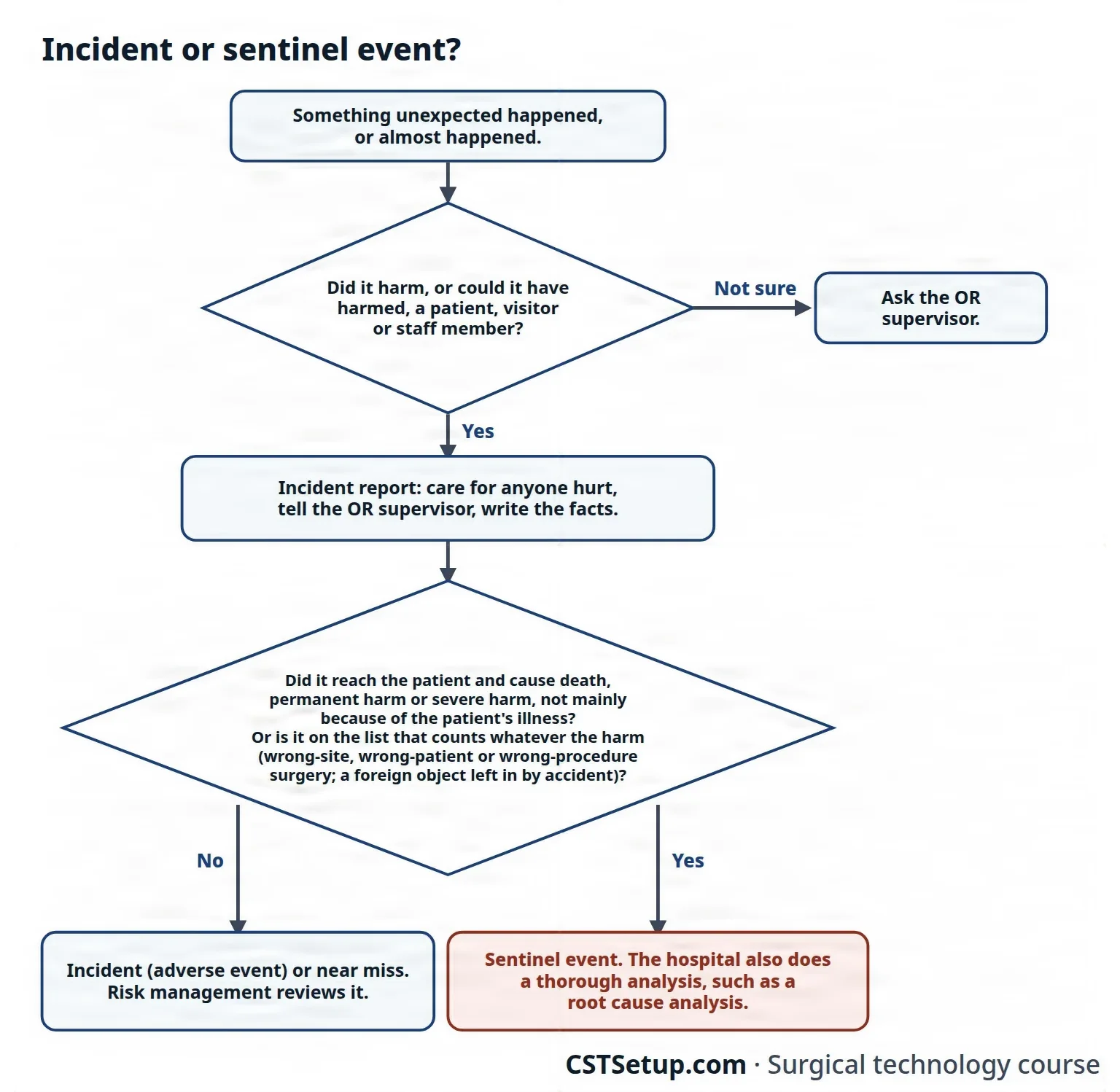
After a sentinel event, the hospital must carry out a thorough, credible analysis, such as a root cause analysisroot kawz uh-NAL-uh-sisA structured review after a serious error or harmful event that looks for the underlying system problems that let it happen.Full entry . It asks what happened, where, when and how, and looks at systems and processes rather than at who to blame, to keep the same event from happening again. Hospitals are encouraged to report sentinel events to The Joint Commission: its 2026 goals list its Sentinel Event Database as a voluntary program, although some references describe that report as required.
Some events must also be reported outside the hospital:
- a medical device that may have caused a death or a serious injury: to the device maker, and for a death to the FDA as well (see Defective equipment, below)
- a severe injury to an employee at work: to Occupational Safety and Health AdministrationOH-shuh (said as a word)The US federal agency, part of the Department of Labor, that sets and enforces rules to keep workplaces safe.Full entry
A needlestick or other sharps injury is written in the sharps injury log that OSHA's rules require the employer to keep (chapter 10).
Never events are adverse events that are clear-cut, serious and preventable. They include surgery on the wrong site or the wrong patient, the wrong procedure, a foreign object left in a patient after surgery, and the death during or right after surgery of a patient classed as ASA I (chapter 13 explains the classes).
Events that harm patients in the OR
The Core Curriculum lists the operating room events that harm patients and lead to lawsuits. Any of them that harms, or could harm, someone calls for an incident reportIN-sih-dent rih-PORTA written record of an unexpected event in a health care setting that caused or could have caused harm.Full entry . One that reaches the patient and causes death, permanent harm or severe harm is also a sentinel event, and wrong-site, wrong-patient or wrong-procedure surgery and an object left in by accident are sentinel events whatever the harm. Many are examples of negligenceNEG-lih-junsFailure to use the care that a reasonably careful person would use in the same situation.Full entry . The last row, failure to communicate, is not on the Core Curriculum's list but is another common act of negligence.
| Event | What it looks like | Prevention, taught in |
|---|---|---|
| Wrong patient, wrong site, wrong procedure, including misidentification | Doing surgery or any other invasive procedure on the wrong patient, at the wrong site, or doing the wrong procedure is a sentinel event, whatever the type of procedure or the outcome. Wrong surgery is one of the most reported sentinel events, and most are wrong-site or wrong-side errors. There is no acceptable excuse for any of them | The Universal Protocol and the time-outTYM-owtA pause just before a procedure when the whole team confirms the right client, procedure and site; also, a short break to calm a child.Full entry , chapter 28 |
| Retained foreign bodies | A retained foreign object is a sponge, needle, instrument or a piece of a device (an unretrieved device fragment, such as a broken needle tip or an instrument's hinge pin) left in the patient by accident. It can cause infection, tissue damage, bleeding, poor healing and pain. Leaving one in by accident after an invasive procedure is a sentinel event even when it causes no harm. An object left in on purpose, because searching for it and removing it would put the patient at more risk than leaving it, is not a sentinel event, but the patient is told and the facility keeps a record of it | The counts, chapters 28 and 29 |
| Specimen errors: wrong identification or loss | A lost or mislabeled specimen can mean a wrong diagnosis, a delay in treatment or another operation | Specimen care, chapter 29 |
| Medication errors: the wrong drug, or the wrong way of giving it | Labeling errors are among the most common and serious errors in surgery | Drugs on the field, chapters 12 and 29 |
| Burns | One of the most frequent injuries in the OR: from electrosurgeryee-LEK-troh-SUR-jer-eeUsing high-frequency electric current through a handheld tool to cut tissue or seal bleeding vessels during surgery.Full entry , lasers, a misplaced return electrode, warming devices, hot instruments or solutions, and prep solution left pooled under the patient | Electrical and fire safety, chapter 20; skin prep, chapter 31 |
| Incorrect positioning: poor padding, and injury | Overstretched limbs, pressure on bony points, lost circulation and restricted breathing; nerve, skin, joint and vessel injury. An anesthetized patient cannot report pain | Positioning, chapter 31 |
| Patient falls | Side rails left down, a safety strap not fastened, a sedationsih-DAY-shunA calm, relaxed or sleepy state brought on by drugs, or the use of drugs to cause it.sed calm, settle-ation processFull entry or confused patient climbing over the rails, or an unsafe transfer. Falls are among the sentinel events reviewed most often, and in adults 65 and older, falls are the main cause of the injuries that lead to disability and death | Transport and transfer, chapter 31 |
| Harm from a major break in surgical asepsisSUR-jih-kul ay-SEP-sisPractices that keep an area or object completely free of microorganisms; also called sterile technique.a- withoutsepsis decay, infectionFull entry | A surgical site infection that can disable or kill | Sterile technique and the surgical conscience, chapter 26 |
| Harm from defective equipment or instruments | A device that malfunctions during a case | Testing and maintenance; the Safe Medical Devices Act, below |
| Loss of or damage to the patient's property | Lost dentures, hearing aids, glasses or jewelry | Label each item with the patient's name and number and store it by hospital policy |
| abandonmentuh-BAN-dun-mentLeaving clients in your care without proper notice or a handoff to another qualified caregiver.Full entry | Failing to stay with a patient and give care after taking on that duty: leaving a patient alone in the room, on the table or in a hallway; leaving at shift change with no relief; walking out without telling anyone | Never leave your patient until another qualified person takes over |
| Exceeding authority or accepted functions | Doing a task your scope, your training or your facility's policy does not allow | scope of practiceSKOHP uv PRAK-tisThe actions and duties a licensed professional is legally allowed to perform.Full entry and delegateDEL-uh-gaytTo hand a specific nursing task to another trained person while the nurse stays responsible for the client.Full entry , above |
| Critical events: failure to recognize, failure to act | Missing, or not acting on, a danger you should have foreseen | The doctrine of foreseeability, above |
| assaultuh-SAWLTIn law, a threat or act that makes a person afraid they are about to be touched in a harmful or unwanted way.Full entry , batteryBAT-uh-reeIn law, touching a person on purpose without their consent.Full entry , defamationdef-uh-MAY-shunMaking false statements about a person that harm their good name.Full entry , invasion of privacyin-VAY-zhun uv PRY-vuh-seeIntruding on a person's private life or sharing their private information or images without permission.Full entry , breach of confidentiality, lack of informed consentin-FORMD kun-SENTA person's agreement to a treatment or procedure, given freely after the risks, benefits and other choices have been explained to them.Full entry | The intentional torttortA wrong act, or a failure to act, that harms another person and for which a court can make the wrongdoer pay.Full entry , and consent and privacy failures | Torts in the OR, Informed consent, and Confidentiality and HIPAA |
| Documentation errors | A wrong or missing entry, which can lead to serious medical errors | Documentation, above |
| Failure to communicate | Vital information not passed on, often because of distraction or noise | Communication and the team, chapter 16 |
A retained item is the sentinel event reported most often for surgery and other invasive procedures (half of all surgical sentinel events from 2018 to 2020), and every member of the team is accountabilityuh-kown-tuh-BIL-ih-teeBeing answerable for your own decisions, actions and the results of the care you give or hand to others.Full entry for it.
If a count is wrong, or the site, side or patient does not match, say so and keep saying it until it is resolved. An incomplete or ineffective time-out is the most common root cause of wrong surgery, and most retained sponges were left in patients whose counts had been recorded as correct.
Defective equipment and the Safe Medical Devices Act
A device that malfunctions can injure a patient, and the institution can be held liable if the equipment was not properly maintained and tested. Follow the maker's instructions for service and operation, and test electrical equipment on schedule.
When a piece of equipment fails:
- Tag nonworking equipment and take it out of service.
- If it harmed a patient, do not take it apart or change its settings. It goes straight to the biomedical department as it is, so the technicians can find out how it was assembled and used and what went wrong.
The Safe Medical Devices Act of 1990 gave the FDA more power over medical devices and requires facilities to report devices that may have caused harm. A death that a device may have caused is reported to the FDA and to the maker within 10 days; a serious injury is reported to the maker within 10 days, or to the FDA if the maker is unknown. The act also requires tracking of devices whose failure could seriously harm a patient, such as permanent implants and life-sustaining devices. The report includes the type of device, its serial number and date of manufacture, and a description of the event.
15Incident reports
When to report
An incident reportIN-sih-dent rih-PORTA written record of an unexpected event in a health care setting that caused or could have caused harm.Full entry is needed whenever an event has caused, or might cause, death, injury or harm, and harm includes psychological as well as physical injury. Incidents may also be reported for team conflict in the middle of a case, for bullying or sexual harassment, and for other coercionkoh-UR-zhunPressuring or forcing someone to act against their will by using threats or force.Full entry .
The first steps are always the same:
- Care for anyone who is hurt. An injured patient or staff member is treated at once, to prevent complications.
- Tell the OR supervisor. The supervisor decides what kind of report to make, on which form, and where it goes.
- Write the report as soon as you can. The longer the delay, the more details are forgotten. If you are not sure whether a report is needed, ask the supervisor.
What to write
The report is written on the hospital's form and states:
- the date, time and place of the incident
- who was involved and who was there
- what happened and how, exactly as it happened, in your own words, including any injury
- for a device, its type, serial number and date of manufacture, and how it failed
Anyone involved may write their own report. To write a good one:
- State facts only, never opinions or blame. The report records what happened; it does not judge it. For example: "The needle count was wrong at the end of the case. An x-ray did not show the needle, and the needle was not found anywhere in the room."
- Use precise, professional words. "Dr. X refused a sponge count and threw surgical scissors off the field onto the floor," not "Dr. X was acting horrible and smashed the Metz."
- Write in the first person. "When I arrived in OR 4, I saw the patient lying on the floor."
- Take your time, somewhere you will not be interrupted.
- Do not let anyone pressure you into protecting a coworker. Keep the patient's safety in mind.
Where it goes
Give the report straight to the OR supervisor or the person your policy names. Never leave it where others can read it, and never put it in the patient's chart; the chart gets a description of the event and any injury in the progress notes instead. The report then goes to risk management, which may investigate and may notify the hospital's insurer. Incident reviews follow legal steps that keep them confidential.
An incident report exists to improve safety and reduce risk, and to keep an accurate record if anyone takes legal action. The hospital must give staff a way to report errors and unsafe conditions without fear of retaliation, and must offer support to staff involved in an adverse or sentinel eventSEN-tih-nul ee-VENTAn unexpected event in health care that causes a client's death, permanent harm or severe temporary harm.Full entry . That does not stop the hospital holding a person accountabilityuh-kown-tuh-BIL-ih-teeBeing answerable for your own decisions, actions and the results of the care you give or hand to others.Full entry for negligenceNEG-lih-junsFailure to use the care that a reasonably careful person would use in the same situation.Full entry .
When an error reaches a patient, the patient and family are told. The Joint Commissionthuh JOYNT kuh-MISH-unAn independent US organization that inspects and accredits hospitals and other health care organizations against safety and quality standards.Full entry has required disclosure of unanticipated outcomes to patients since 2001, and the disclosure expresses regret without necessarily admitting fault.
Whistleblowing
Whistleblowing means reporting misconduct or suspected negligence. Staff used to stay silent to "protect" the surgeon or the institution; that is no longer expected of anyone, and professional organizations now encourage staff to report every violation of their codes and give them a way to do it.
16Abuse and disruptive behavior
Abuse, disruption and violence are a widespread problem in the OR. The Joint Commissionthuh JOYNT kuh-MISH-unAn independent US organization that inspects and accredits hospitals and other health care organizations against safety and quality standards.Full entry tolerates no abuse or violence of any kind: its policy is zero toleranceTOL-er-ensA reduced response to a drug after repeated use, so a higher dose is needed for the same effect; also the ability to endure something.Full entry .
Sexual harassment is illegal: the U.S. Equal Employment Opportunity Commission defines it legally as a form of sex discrimination.
The Joint Commission requires hospital leaders to write a code of conduct that defines acceptable behavior and behavior that undermines a culture of safety, and to manage that behavior. Each hospital must also run a workplace violence prevention program, with policies, a way to report incidents, support and counseling for victims and witnesses, and training at hire and every year.
Chapter 16 teaches the behaviors themselves (verbal abuse, lateral and vertical abuse, bullying and hazing, disruptive behavior and sexual harassment), how to cope with them, how to report them and how to prevent them.
17Confidentiality and HIPAA
The law
The Health Insurance Portability and Accountability Act (HIPAA) of 1996 was the first federal law to set privacy standards for medical records. Its Privacy Rule protects a patient's identifiable health information, called protected health information (PHI): anything about their past, present or future health, their care, or payment for it. It covers that information in every form: spoken, written on paper, or electronic. Its Security Rule protects the electronic part, with administrative, physical and technical safeguards.
Information that identifies a patient includes their name, address and birth date, photographs, Social Security number, medical record, health plan and account numbers, phone and fax numbers, email address, license numbers, and vehicle identifiers.
Health information may be used for treatment, payment and the business of health care; anything else needs the patient's consent. Even inside the team, the minimum necessary standard applies: look at and share only the information you need to do your job. Patients have the right to see and get copies of their records, paper or electronic, ask for corrections, and be told how their information may be used.
Every employee signs a confidentiality statement agreeing to follow the Privacy Rule. Breaking it can bring civil or criminal penalties for the individual as well as the facility, and a deliberate violation is punished severely.
In the OR
- Talk carefully. In holding areas where patients are separated only by curtains, keep your voice low, or move to a private place for sensitive talk. Never discuss a patient outside the care setting. Gossip is a breach of confidentiality.
- No photos. Never photograph a patient without the patient's or guardian's written permission beforehand, even for their care or for teaching. Photos of the facility itself need written permission from the administration.
- No social media. Never post images, videos or details of a patient, even without a name and even in a private group. A tattoo, a scar, jewelry, the type of injury or the place can identify a patient. Posting an image of a person's private area without consent can also be a federal crime under the Video Voyeurism Prevention Act.
- Visitors. Facility policy controls who may be in the OR, such as industry representatives, and requires the patient's consent.
- Records and screens. Log off the computer when you are done, and keep your password to yourself. Chapter 19 covers privacy in the electronic record.
- The patient's body. Expose no more of the patient than the procedure needs.
Never take or post a picture of a patient, or talk about a patient where anyone outside the care team can hear. A privacy breach can cost you your job and bring disciplinary action, fines and other penalties.
18Risk management
Risk management is the hospital's system for preventing and controlling harm: it collects and uses data to lower the chance of harm to patients, visitors and staff, or damage to property. Its main goal is to prevent harm and injury.
Its aims
Risk management aims to:
- keep risks to patients, visitors and employees as low as possible
- avoid or control financial loss to the hospital
- find the real or possible causes of accidents to patients and staff, by detecting and evaluating risks
- carry out programs, policies and procedures that remove or reduce these events, including sentinel eventSEN-tih-nul ee-VENTAn unexpected event in health care that causes a client's death, permanent harm or severe temporary harm.Full entry
- enforce the hospital's policies
Money is part of it: Medicare (CMSsee-em-ES (said as letters)An abbreviation for the Centers for Medicare & Medicaid Services, the US agency that runs Medicare, or for a circulation, motor and sensation check.Full entry ) will not pay for the extra treatment some preventable harm needs, such as a retained foreign object, a fall or a burnBURNAn injury to the skin or deeper tissues caused by heat, chemicals, electricity, radiation or friction.Full entry , and those costs cannot be passed on to the patient.
Collecting the data
Spotting and reporting unsafe conditions and hazards is the most important part of every risk management process, because everything else depends on it. Each risk found is rated by how severe it is and how often it happens.
incident reportIN-sih-dent rih-PORTA written record of an unexpected event in a health care setting that caused or could have caused harm.Full entry are much of the data, and risk managers use them to find what caused each event and how to prevent it. If chemical burns among staff were rising, for example, the team would look at when they happened, who was involved and how, then change the policy or the training. Risk management also looks ahead, finding high-risk processes and fixing them before anything goes wrong.
Managing events
- Injuries. An injured employee or patient is treated and the injury is reported at once. The report becomes the legal record if the patient was harmed or the employee files for workers' compensationkom-pen-SAY-shunThe body's effort to make up for a problem in one system by changing how another works.Full entry .
- Malfunctioning equipment. Take it out of service, tag it, and send it to biomedical engineering; report it under the Safe Medical Devices Act when it harmed someone.
- Unsafe conditions. Report them before they hurt someone. Hospitals keep strict policies for reporting unsafe conditions and equipment.
Preventing harm
- Education: training for all staff, an in-service on safety at least every year, and a yearly review of policies and procedures.
- Preventive maintenance: equipment is serviced on a schedule, and faulty devices are taken out of service.
- Safety systems: signs and posters, and following safety measures such as the Universal Protocol.
In the OR, you prevent errors by following written policies and procedures, using standard precautions and protective equipment, and knowing where the emergency equipment is and how to use it.
What to take from this chapter
- Law, standards, policy and ethics all shape your work. A law carries legal penalties; standards, policies and codes are not laws, but breaking them can cost you your job, and courts use them to judge what a careful professional should have done.
- Ethics rests on principles you use every day: autonomy, beneficence, nonmaleficence, justice, veracity, fidelity, confidentiality and accountability. When they clash, work the problem step by step and ask for help, such as the ethics committee.
- The surgical conscience means owning and reporting your own errors, especially breaks in sterile technique, whether or not anyone saw them. Short staffing, peer apathy and stress push against it.
- Negligence needs four elements: duty, breach of the standard of care, cause and damages. You are measured against a careful, competent surgical technologist, and you answer for your own acts even when a surgeon says they will take responsibility.
- Informed consent is a process the surgeon carries out; the form records it. A valid consent needs a patient of legal age (or an emancipated minor) who is alert, competent, free of drugs and pressure, and told the risks, benefits and alternatives in words they understand. A witness only confirms seeing the signature, and facility policy decides who may witness.
- Advance directives, such as a living will and a durable power of attorney for health care, speak for the patient who cannot. A DNR order is reconsidered with the patient before surgery, never suspended automatically.
- The record is a legal document: facts only, on time, signed, and errors corrected with a single line and initials. Incident reports state facts, go to the supervisor, and never go in the chart.
- A sentinel event reaches the patient and causes death, permanent harm or severe harm, not mainly because of the patient's illness. Some count whatever the harm: wrong-site, wrong-patient or wrong-procedure surgery, and an object left in by accident. Both are never events that the whole team prevents.
Check yourself5 quick questions
Free for everyone. Pick an answer for each, then check them all at once.
In the ORWhere you'll use this
The chapter's whole question pool in sets of 10, with the answer explained after each one.
Part of the educators programThe chapter's words on spaced cards: the ones you miss come back sooner.
Part of the educators programGiven by your class's teacher. Each class draws its own 25 from the chapter's pool.
Part of the educators program
Suggest a fix
Something wrong, unclear or out of date in this chapter? Tell us and we will fix it for everyone. Your email is only used to reply.