Communication and the team
How a surgical team talks, listens and works together, and how you speak up for the patient, hand off care safely and handle conflict, even under pressure.
1Why it matters
Surgery is done by teams. A surgeon, an anesthesia provideran-us-THEE-zhuh pruh-VY-derThe licensed professional who gives anesthesia and watches over the client's breathing and vital functions during a procedure.Full entry , a circulator, a scrub and often assistants all care for one patient at the same time, each with a role of their own. They often have to pull together fast, even when some of them have never worked together before.
A patient under anesthesiaan-us-THEE-zhuhLoss of feeling or sensation, often brought on by drugs so that surgery or a procedure can be done without pain.an- withoutesthesi/o feeling, sensation-ia conditionFull entry cannot speak. Everything the team knows about that patient moves from person to person by spoken words, notes and signals, and every message that is lost or misheard is a chance for harm. Poor communication and poorly coordinated care are the most common causes of medical errors.
The numbers show it. Over a decade of reports, The Joint Commissionthuh JOYNT kuh-MISH-unAn independent US organization that inspects and accredits hospitals and other health care organizations against safety and quality standards.Full entry found poor communication to be a root cause in nearly 70% of the serious events sent to it, and it still lists failures of communication and teamwork among the leading causes of the sentinel eventSEN-tih-nul ee-VENTAn unexpected event in health care that causes a client's death, permanent harm or severe temporary harm.Full entry reported to it, such as wrong-site surgery, items left inside patients, delays in treatment, and fires. In one study of operating rooms, about 3 in 10 exchanges among the team failed, and about a third of those failures put the patient at risk.
Good communication takes skill and practice, and sharing information is everyone's job. Many new health workers are surprised to find that getting along with people, and coping with the mood of the workplace, is harder than the work itself. AST asks every member of the team to keep building their skills in communication, in settling conflict and in making decisions together, because good outcomes for the patient depend on them.
This chapter teaches how communication works, how to speak up for the patient, how to hand off care, how a team grows and stays safe, and how to handle conflict and behavior that harms the team. Other chapters hold the pieces around it: the profession, precepting, mentoring and leadership in chapter 14; the law and ethicsETH-iksThe study of right and wrong, and the principles that guide good conduct and decisions.eth/o custom, character-ics the study ofFull entry , incident reportIN-sih-dent rih-PORTA written record of an unexpected event in a health care setting that caused or could have caused harm.Full entry , and abuse at work under the code of conduct and the workplace violence program in chapter 15; the members of the team, the chain of commandCHAYN uv kuh-MANDThe order of authority in an organization: who reports to whom, from staff up through managers to leaders.Full entry and how the department runs in chapter 17; the patient's fears and culture, communication barriers and interpreters in chapter 18; computers, the electronic record and email systems in chapter 19; the time-outTYM-owtA pause just before a procedure when the whole team confirms the right client, procedure and site; also, a short break to calm a child.Full entry and the Surgical Safety Checklist as steps in chapter 28; hand signals and the relief checklist during the case in chapter 29; the debriefing as a step in chapter 30; and the handoff reportHAND-off ree-PORTThe passing of information and responsibility for a client's care from one nurse or team to another.Full entry to the PACU nurse in chapter 13.
2How communication works
The four parts
Every message, from a request for a clamp to a report on a patient, has the same parts.
- Sender: the person with an idea to share. The sender encodes the idea: chooses the words, the tone and the way to send it.
- Message: the idea, fact, thought or feeling being shared.
- Receiver: the person the message is meant for. The receiver decodes it, using their own knowledge, background and surroundings, and has to listen actively to do it well.
- feedbackFEED-bakInformation about a result that is sent back to change what happens next, in the body or between people.Full entry : the receiver's response. It shows that the message arrived, that it was understood, and that the receiver knows what to do with it. When only part of the message got through, the receiver asks for the rest.
A message also travels through a channel, the way it is sent: face to face, by phone, in a note, in an email or by a gesture.
Feedback is the part that makes communication safe at work. Without it, the sender can only hope the message landed. A receiver who just nods or says "OK" may have heard something different, and the sender walks away sure that all is well.
AST's guideline on handing off care breaks the same loop into seven elements: the sender, the idea, encoding, the channel, the receiver, decoding and feedback. It calls the whole circuit the communication feedback loop. The loop can break at any point, so the receiver is always free to ask questions.
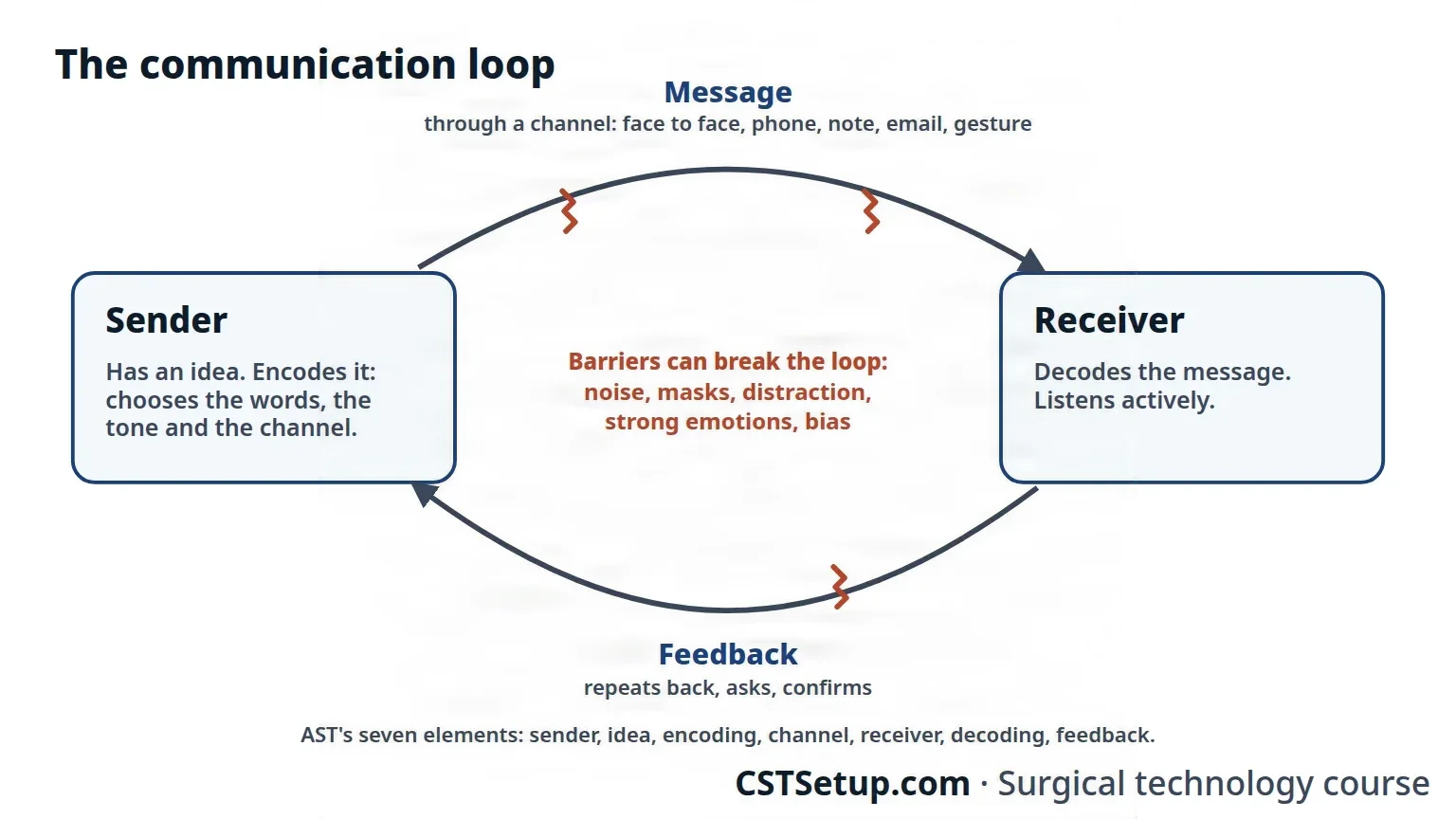
Communication has worked when the receiver understands both the content and the tone the way the sender meant them.
Content and tone
Every message has content, which is the facts, and a tone, which comes from the way it is said. The same words can sound neutral, kind, angry, respectful or mocking. Tone travels in writing too: a short email can sound cold even when every fact in it is fine.
Tone matters because people react to it. Your words and your tone of voice can change what a message means, and can leave the listener feeling helped or attacked. In the OR, a sharp word at a tense moment can stop a teammate from speaking up the next time, when it may matter most.
Speech carries more than its words: the pitch of your voice, its tone, volume and pace, and how clearly you say each word all change how a message is heard.
Verbal communication
The Core Curriculum sorts communication into three types: verbal, nonverbal and written.
Verbal communication is the spoken word. At work, aim for these qualities whenever you speak:
- Clear: simple, plain words that the listener understands.
- Neutral: no "charged" words that carry emotion and pull attention from the meaning, and no impatient or unsure tone.
- Concise: short and to the point. If the listener needs more, they will ask.
- Civil: being brief never requires being rude. Politeness rests on respect for the other person.
- Assertive, never aggressive: you state your own needs and rights while respecting other people's. Assertiveness shows confidence without confronting anyone or acting superior.
- To the right person, at the right time and place: tell someone who needs to know, and when action is needed, someone with the authority and the means to act. Unless it is urgent, choose a moment when they are not busy with another task or another conversation, and a private place when the matter is confidential. Watch for signs that the person has stopped listening, such as looking away, fidgeting or backing up.
- Through the chain of commandCHAYN uv kuh-MANDThe order of authority in an organization: who reports to whom, from staff up through managers to leaders.Full entry : take a problem to the person whose job it is to solve it. Ask yourself first whether this person needs to know. If the matter is urgent, do not delay.
- With relaxed eye contact, where the person's culture welcomes it. A fixed stare can feel intense.
- One conversation at a time: on the phone, do not also talk with people in the room.
Nonverbal communication
Nonverbal communication is everything you say without words: posture, gestures, facial expressions, eye contact, tone of voice, how close you stand, and touch. It can back up your words or send a message quite different from the one you meant.
Body language is the way posture, gestures and expressions carry meaning. Some common signals in Western culture:
- Leaning in a little, relaxed and unfolded arms, nodding and steady eye contact usually show attention and respect.
- Arms folded tight across the chest can mean resentment or guardingGAR-dingTightening of muscles, or protecting a body part with the hands or posture, to avoid pain when it is touched or moved.Full entry ; hands on the hips can mean anger or authority.
- Frowning, rolling the eyes and pressing the lips tightly together send a negative message, and tapping a foot shows impatience.
- Stepping back can mean you are standing too close, or that the person wants to leave.
- A raised eyebrow can mean doubt; eyes cast down can mean thought, embarrassment or regret.
- A rigid posture can mean tension or held-back feelings; an upright posture usually shows confidence.
These meanings are not fixed. A gesture that is friendly in one country can be an insult in another, and some people do not hold eye contact because of their culture or faith. Read body language as a clue, never as proof, and never show patients gestures such as a thumbs up or the OK sign, which are rude in some cultures. Chapter 18 covers culture and the patient.
In the OR, masks and hair covers hide most of the face, and with it many of the cueKYOOA piece of information about a client, such as a sign, symptom, lab value or remark, that the nurse notices and uses to make a judgment.Full entry that tell a speaker whether they were understood. So check understanding out loud: confirm the information in words, and ask questions.
Touch is nonverbal too. Therapeutic touch is touching a person on purpose to show empathy and care, such as a hand on the shoulder of a frightened patient. It comforts many patients, but it can be misread, so experienced staff watch the patient's body language before they offer it. A patient always has the right to decline being touched.
Written communication
Written communication includes notes, forms, labels and electronic messages.
- Handwriting in health care is kept for a few jobs that matter for safety or the law, such as your signature on a count or a checklist, a witness signature, and the information that goes with a specimen. Apart from your signature, make every word easy to read: a note nobody can read wastes time and can cause a serious error.
- Netiquette is good manners in electronic messages. A work email has a short subject line that says what it is about, a greeting, short points, and your name and contact details at the end. It has no emotional words, no emojis and no texting shortcuts. Use "reply all" only when the message is for everyone, and never forward someone's message or attachmentuh-TACH-mentThe deep emotional bond between an infant and a parent or caregiver.Full entry without their permission.
- Anything you write can last. An email can be stored, found again and used as a legal document, so choose every word with care and keep every patient's information confidential (chapter 15). Posts and messages online can become a permanent record that follows you for your whole career.
3Relationships and goals
Three kinds of relationships
The Core Curriculum names three kinds of communication relationships. You will be in all three every working day.
- Professional: with the surgeon, your coworkers and the other health care providers.
- Social: with peers and friends.
- Therapeutic: with the patient and the patient's family. therapeutic communicationther-uh-PYOO-tik kuh-myoo-nih-KAY-shunPurposeful, client-centered communication that helps a client express feelings and work toward health.Full entry has a goal: it helps the patient say what they feel and need, and it builds trust. Social chat has no set goal; therapeutic talk always does.
In every one of them, speak with respect and professionalism, and at work keep the talk on the patient and the procedure.
professional boundariespruh-FESH-uh-nul BOWN-duh-reezThe limits that keep the nurse-client relationship focused on the client's needs and not on the nurse's own.Full entry keep the relationship focused on the patient's needs. Boundaries leave room for warmth: they protect the patient's trust, and keeping them is your job, never the patient's.
Your time with a patient may be short, such as the trip on the stretcher from the ward to the surgery department, so the relationship has to form quickly and rest on open, honest talk. With the family, keep some formality and stay calm and neutral, because they are worried and may count on you for that calm. They may also believe you know more than you are telling them, which is a normal part of the relationship and no sign of mistrust. Chapter 18 covers the patient's fears and culture, barriers to communication, and working with an interpreter.
What communication is for
The Core Curriculum lists seven goals of communication:
- to express yourself: your needs, concerns and feelings
- to obtain information
- to provide information
- to persuade: to change someone's opinion or behavior
- to solve problems
- to prevent errors
- to promote the patient's safety
In the OR these goals are concrete. Clear talk among coworkers gives everyone the facts they need to set priorities and act on them. It clarifies working relationships, solves problems and keeps the team working toward the same goals. It keeps the patient's care steady when people change, such as at a shift change, and it makes the patient feel safe enough to tell the team their fears and needs. Poor communication brings errors, conflict and stress.
Here are a few things a scrub passes on during a case, and to whom:
- to the anesthesia provideran-us-THEE-zhuh pruh-VY-derThe licensed professional who gives anesthesia and watches over the client's breathing and vital functions during a procedure.Full entry , how much irrigationeer-ih-GAY-shunWashing out a wound, body cavity, tube or eye with a steady flow of liquid.Full entry has been used and how much local anestheticLOH-kul an-es-THET-ikA drug that blocks feeling in one part of the body without making the person unconscious.Full entry has been injected
- to the surgeon, what is in a syringe before it is used, and the result of a count
- to the circulator, a change in the plan that calls for different sutureSOO-cherA stitch, or the thread used to stitch, that holds the edges of a wound or incision together.Full entry or supplies
4Good communication
The qualities
The Core Curriculum lists eight qualities of good communication.
- Respect: for yourself and for others.
- Positive language: words that build people up and never belittle them, with no charged words.
- Active listening: listening with your full attention, to understand, and responding with thought.
- Eye contact: relaxed and attentive, as far as the person's culture allows.
- feedbackFEED-bakInformation about a result that is sent back to change what happens next, in the body or between people.Full entry : confirming what you heard, and inviting the other person to confirm what you said.
- sensitivitysen-sih-TIV-ih-teeHow strongly something responds; in lab work, which drugs stop a germ, or how well a test finds people who have a disease.Full entry : thinking before you answer, and answering sincerely, in a way that never cuts the other person down.
- Understanding: trying to see from the other person's side, and staying open to the chance that there is more going on than you can see.
- Clarity: precise, simple words; facts, such as a blood pressure or a lab value, rather than vague impressions; and only the jargon your listener knows.
You may also meet the "7 Cs": correct, clear, concise, complete, considerate, concrete and courteous.
The CSTsee-es-tee (said as letters)Certified Surgical Technologist, a credential for surgical technologists; in maternity care, contraction stress test.Full entry exam outline names listening, diplomacy and responsiveness among the people skills it tests. Diplomacy is tact: saying a hard thing in a calm, respectful way so that the listener can take it in. Responsiveness means answering requests for help without resentment, and offering help before you are asked.
Listening
People like talking with good listeners, and seek them out, because they feel heard and treated with respect. Listening takes effort. A passive listener hears the words without really being present and often gets the message wrong, and many people start planning their answer before the speaker has finished.
To listen actively:
- Focus on the speaker, and tune out background noise and other conversations.
- Listen for what is said, rather than for what you hope to hear.
- Set aside your opinion of the speaker; judging them gets in the way of the message.
- Watch the speaker's face and posture for clues.
- Ask when something is unclear, and say the message back in your own words: "So you want..."
- If the talk wanders, steer it back to the topic. If your own attention wandered, ask the speaker to repeat.
- Do not fill gaps with guesses. A request that seems unreasonable may have reasons you do not know about.
- Show you are listening with nods and an open posture, listen for the feelings behind the words, and sum up at the end.
To check understanding, ask open questions that start with what, how or who. "Do you understand?" invites a "yes" that proves nothing.
Assertive, not aggressive
Assertiveness means stating your personal and professional needs plainly while protecting your rights and respecting other people's. It is direct and honest, it shows confidence without arrogance, and it never turns confrontational or aggressive. It is the voice you use to raise a concern, to settle a conflict and to speak up for the patient.
Why messages fail
Communication fails for many reasons. The most common are:
- perceptionper-SEP-shunThe brain's way of taking in and making sense of what the senses detect; also a person's own view or understanding of something.Full entry : you see the situation differently from the other person and act on your assumptions.
- Bias: a fixed opinion about a person, based on their group, culture, income or even their disease, shuts out new information.
- The environment: masks muffle speech, and suction, irrigationeer-ih-GAY-shunWashing out a wound, body cavity, tube or eye with a steady flow of liquid.Full entry , power tools and loud music drown it out.
- Lack of understanding: the receiver does not know enough to follow the message, which is why asking for clarification matters.
- Social and cultural background: each person fits a message into what they already know and believe.
- Emotions: anger, resentment, fear and anxiety make it very hard to send or take in a message.
- No wish to communicate: a person who does not want to talk does not focus on the message.
Teams add barriers of their own: different values and personalities, hierarchy, a lack of cultural humilityKUL-chur-ul hyoo-MIL-ih-teeA lifelong habit of self-reflection and learning in which the nurse treats each client as the expert on their own culture.Full entry , old rivalries between professions, different schedules and routines, different levels of training, and jargon.
Verbal blocking is shutting down someone who needs to talk. People do it out of fear of strong emotions or a hard topic, lack of confidence, lack of privacy, or not trusting a colleague to keep a confidence. It sounds like:
- brushing the topic aside: "I want to talk about my mistake this morning." "Don't worry about it, it was nothing."
- shutting off a feeling: "It upset me so much." "Well, you're fine now."
- making abuse sound normal: "A surgeon shoved me in the locker room." "Everyone knows that's what they do when they're angry."
- excusing another person's behavior, even an unwanted touch.
Instead, let the person finish, take the concern seriously, and help them find the right next step. A coworker who is being bullied needs support, and help through the reporting process.
5Talking at the sterile field
Noise, masks and distraction
The OR is a hard place to be heard. Staff juggle several tasks at once and keep thinking ahead to the next one, and distraction is a major reason a task gets missed. Masks muffle speech, and noise from devices and loud music can weaken communication enough to make surgery less safe for the patient.
Distraction comes from inside the case, such as alarms, device noise, shift changes and the talk the work needs, and from outside it, such as phones, pagers, computers, calls from outside the room, talk that has nothing to do with the case, visitors and traffic through the door. Noise and distraction have been linked to wrong counts, wrong-site errors, longer operations, more stress and weaker teamwork, and more talking during wound closure has been linked to more surgical site infections.
AORN asks the whole team to keep noise down together:
- Noise and distraction that serve no clinical purpose are kept to a minimum. If music is played, the whole team agrees on it before the case, at a sensible volume.
- During the critical phases of a procedure, the team keeps a no-interruption zone: no talk, music or activity that the work does not need. You may also hear it called a sterile cockpit or a red zone.
- Critical phases include the briefing and the time-outTYM-owtA pause just before a procedure when the whole team confirms the right client, procedure and site; also, a short break to calm a child.Full entry , the start of anesthesiaan-us-THEE-zhuhLoss of feeling or sensation, often brought on by drugs so that surgery or a procedure can be done without pain.an- withoutesthesi/o feeling, sensation-ia conditionFull entry and waking up from it, delicate moments such as a critical dissectiondy-SEK-shunA tear in the inner layer of an artery wall that lets blood split the layers apart; also, the cutting apart of tissue in surgery.Full entry or opening an implant, the counts, preparing and giving medications, and handling specimens. Teams may add their own, such as positioning and handoff reportHAND-off ree-PORTThe passing of information and responsibility for a client's care from one nurse or team to another.Full entry .
- Phones and other personal devices are used only for the patient's care or for resources the procedure needs.
Your facility's policy sets the details, such as whether music is played at all.
Closed-loop communication
A spoken message is safe only once the loop is closed. Closed-loop communication makes sure a message was heard, understood and carried out:
- The sender gives the message.
- The receiver repeats it back to confirm it.
- The sender confirms that the repeat is right, or corrects it.
- The receiver reports when the task is done.
It matters most in an emergency, when spoken orders are carried out at once. The names of the steps vary: some teams call the repeat a check-back, and others use that word for the report that the task is done.
Here is a loop at the field:
- Scrub: "I need another package of lap sponges, please."
- Circulator: "Another package of laps."
- Scrub: "Yes, thank you."
- Circulator, after opening them onto the field: "The laps are on your table. Let's count them."
Without the repeat, the circulator might nod and move on, and the scrub would walk away sure the sponges were coming. The loop also catches mishearing, which masks and noise make common.
Repeat back anything complicated: orders, the names of medications and solutions, and count results. If you are unsure what was asked, ask.
Drugs on the field are confirmed out loud too, when they arrive and when you pass them; chapters 12 and 29 teach the steps.
Read-back
Read-back is closed-loop communication for orders and results. The person who takes a spoken order or result writes it down, reads it back to the person who gave it, and waits for them to confirm it. Many hospitals require a read-back for every verbal orderVER-bul OR-derAn order for a treatment or drug that a provider speaks aloud, in person or by phone, instead of writing or entering it.Full entry and telephone orderTEL-eh-fone OR-derA treatment or medication order a provider gives to a nurse by phone instead of entering it in writing.Full entry .
In the OR, a pathologypuh-THOL-uh-jeeThe study of disease and its causes and effects, or the disease changes found in a person or tissue.path/o disease-logy study ofFull entry result reported to the room is read back the same way, with music down and talk kept low, and so is a critical lab value; chapter 29 covers specimens.
Call-outs
A call-out is critical information said aloud to the whole team at the same moment, such as a vital sign, so that everyone hears it at once. The scrub also says aloud what others need to know, such as "The first closing count is correct" to the surgeon, or how much irrigationeer-ih-GAY-shunWashing out a wound, body cavity, tube or eye with a steady flow of liquid.Full entry has been used to the anesthesia provideran-us-THEE-zhuh pruh-VY-derThe licensed professional who gives anesthesia and watches over the client's breathing and vital functions during a procedure.Full entry .
6Speaking up for the patient
Why it is hard
Most operating rooms have a steep hierarchy, and team members are often reluctant to communicate across its levels. In studies of intensive care teams, nurses, unlike physicians, said that it was hard to speak up and that disagreements were not settled well. People stay silent for fear of losing their job or of payback.
Silence costs patients. Holding back, or never speaking up at all, is a mark of an unhealthy safety culture. Where the safety culture is strong, people speak up for the patient more often, and they trust that reporting a problem will lead to a fix.
You are the patient's advocateAD-vuh-kayt (verb), AD-vuh-kit (noun)To speak up and act for a client's rights, safety and wishes; also, a person who does this.Full entry : while they are asleep or sedationsih-DAY-shunA calm, relaxed or sleepy state brought on by drugs, or the use of drugs to cause it.sed calm, settle-ation processFull entry , you speak for them (chapter 14). Speaking up is every team member's duty, whatever their position: when you see a possible danger to the patient, tell the person who makes the decision, firmly and with respect.
Speaking up includes owning your own mistakes. If you break surgical asepsisSUR-jih-kul ay-SEP-sisPractices that keep an area or object completely free of microorganisms; also called sterile technique.a- withoutsepsis decay, infectionFull entry , or think you may have, say so at once (chapter 26). If you are not sure what is in a syringe, say so, and it is discarded. The patient's safety may depend on your honesty.
How to speak up
Use a clear order:
- Make an opening: get the person's attention, using their name.
- State your concern.
- State the problem, real or possible.
- Offer a solution.
- Agree on the next step.
A gentle first step can be a question, such as "Is that the right side? The consent says left." If the question is brushed off, say the concern plainly.
The two-challenge rule. If the decision maker does not respond, say it again: voice the concern at least twice, to be sure it was heard. Where a facility adopts the rule, any member of the team may pause care for a serious safety breach, and the person challenged is expected to acknowledge the concern.
CUS. When stress is high, a person in charge may not hear you even the second time. A facility can set three phrases that every staff member knows as a signal to stop and listen: "I am Concerned. I am Uncomfortable. This is a Safety issue."
The chain of commandCHAYN uv kuh-MANDThe order of authority in an organization: who reports to whom, from staff up through managers to leaders.Full entry . If the danger is still not dealt with, take it up the chain of command, the line of authority in your facility (chapter 17).
Stop the line. The American College of Surgeons says that if any part of checking the patient, procedure, consent or site is incomplete, activity in the OR stops until it is done. At the time-outTYM-owtA pause just before a procedure when the whole team confirms the right client, procedure and site; also, a short break to calm a child.Full entry , any member of the team who sees a mismatch says so, and the case waits (chapter 28).
Here is how silence can harm. During a hard gallbladder dissectiondy-SEK-shunA tear in the inner layer of an artery wall that lets blood split the layers apart; also, the cutting apart of tissue in surgery.Full entry , an impatient surgeon snapped at the team. A junior member doubted that the structure about to be clipped was the cystic duct, asked once, was criticized for asking, and said nothing more. The structure was the common bile ductKOM-un BILE DUKTThe tube that carries bile from the liver and gallbladder into the small intestine.Full entry , and the patient was injured. A plain statement such as "I'm uncomfortable clipping that; I'm not sure it's the cystic duct," and a leader who listened and closed the loop, might have prevented it.
A concern protects the patient only when it is heard. Say it clearly, say it twice if you must, use "I am concerned, I am uncomfortable, this is a safety issue," and go up the chain of command if the danger is still there.
7Handoffs
What a handoff is
A handoff reportHAND-off ree-PORTThe passing of information and responsibility for a client's care from one nurse or team to another.Full entry (also called a hand-off or handover) passes the responsibility for a patient, and the information that goes with it, from one caregiver or team to another. The Joint Commissionthuh JOYNT kuh-MISH-unAn independent US organization that inspects and accredits hospitals and other health care organizations against safety and quality standards.Full entry describes it as a real-time process whose purpose is to keep the patient's care continuous and safe. The spoken summary is the handoff report.
Handoffs are where information gets lost. The Joint Commission has warned that poor handoffs have led to wrong-site surgery, delays in treatment, falls and medication errors. After surgery, an intraoperativein-truh-OP-er-uh-tivHappening during surgery, from when the client is brought into the operating room until they are moved to recovery.intra- within, duringoperative of surgeryFull entry event that is never passed on can mean the wrong level of watching, a complication nobody is looking out for, or a missed or late antibiotic or anticoagulantan-tee-koh-AG-yoo-luntA drug that slows the blood's ability to form clots.anti- againstcoagul/o clotting-ant an agent that doesFull entry .
What makes a handoff safe:
- A set process. The Joint Commission requires every hospital to have a process for handoffs, and the process must give the giver and the receiver a chance to discuss the patient.
- Spoken and written. Information passes in words, face to face where possible, and in a written or electronic form. The record alone is not enough: briefings, time-outs and handoffs add what it cannot.
- Standard content in a standard order. Without a standard, information goes missing and errors rise, so AORN recommends a standardized handover, and The Joint Commission, AORN and WHO all recommend formal handoffs before and after surgery.
- Repeat-back. AORN recommends a read-back during the handoff, because staff who answer aloud remember more.
- Quiet and time to ask. Interruptions make information fail or be forgotten, and the receiver must have time to ask questions and clear up anything unclear.
SBAR
SBARES-barA four-part way to report about a client: situation, background, assessment and recommendation.Full entry is one of the most widely used formats for reporting on a patient. It was built to cut errors caused by miscommunication, and it works between people of different professions.
- S, Situation: a clear, short statement of the problem right now.
- B, Background: a one-line history, and what led up to the problem.
- A, Assessment: what you found, and what you think is causing it.
- R, Recommendation: what you suggest be done, or what you are asking for.
After one hospital introduced SBAR, its adverse eventad-VERS ih-VENTHarm to a client that results from medical care rather than from the client's illness.Full entry fell from 90 to 40 per 1,000 patient days. A common longer form, ISBARRIZ-barIntroduction, Situation, Background, Assessment, Request, Repeat back: a set order for sharing client information.Full entry , starts with an Introduction (your name, your role and where you are) and ends with a Repeat-back of any orders.
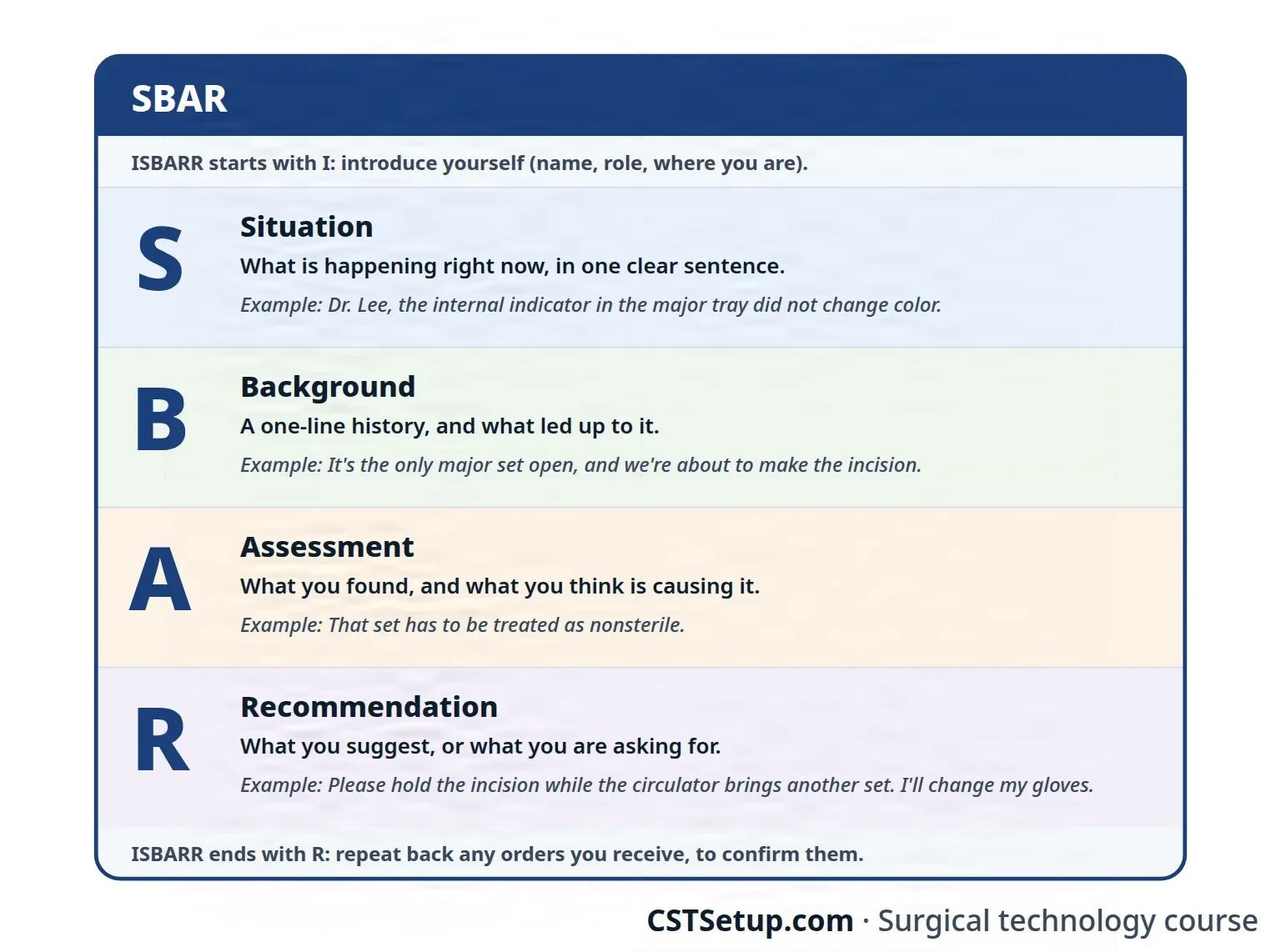
SBAR works for a scrub too. Here, a scrub opens a set and finds a problem just before the incision:
- S: "Dr. Lee, the internal indicator in the major tray did not change color."
- B: "It's the only major set open, and we're about to make the incision."
- A: "That set has to be treated as nonsterile."
- R: "Please hold the incision while the circulator brings another set. I'll change my gloves."
Other handoff tools
Facilities choose their own tools. I-PASS, built for changes of shift, stands for Illness severity, Patient summary, Action list, Situation awareness and contingency plans, and Synthesis by the receiver, who sums up and repeats back the key points.
Two others you may meet in surgery are I-PASS the BATON and SWITCH (Surgical procedure, Wet, Instruments, Tissue, Counts, and Have you any questions?). Every tool does the same work: the same content in the same order, said aloud, with a chance to ask and to repeat back.
Handoffs in surgery
A surgical patient is handed off many times: from the preoperative nurse to the OR team, between staff during the case, and from the OR to the PACU or the ICU. After heart surgery, the perioperativepair-ee-OP-er-uh-tivRelating to the whole time around a surgery: before, during and after it.peri- aroundoperative relating to surgeryFull entry nurse telephones a report to the receiving unit, usually the cardiovascular surgical ICU, before the patient moves: the operation and the graftGRAFTTissue or a man-made material moved into place in surgery to replace or repair a damaged part.Full entry used, on or off bypass, the monitoring lines, the pressures and rhythm, the lowest and highest temperatures, the cross-clamp and pump times, the blood productBLUD PROD-uktAny part of donated blood prepared for transfusion, such as red cells, plasma or platelets.Full entry and drugs given, the tubes and drains, and whether the heart is being paced.
When staff change during the case, a scrub passes on at least the patient, procedure and site; special precautionprih-KAW-shunA step taken ahead of time to prevent harm, such as the infection-control practices used with every client.Full entry ; the medications and solutions on the field; specimens; implants and grafts; which instruments are needed and where they are; and the status of the counts and where counted items are, such as inside the cavity or off the field.
Coming into the OR, the preoperative nurse hands off to the perioperative nurse; chapter 13 covers the report given in the PACU.
When a CST relieves a CST
When one CSTsee-es-tee (said as letters)Certified Surgical Technologist, a credential for surgical technologists; in maternity care, contraction stress test.Full entry takes over the scrub role from another during a case, AST's guideline sets the principle: a spoken, face-to-face handoff from the department's standard checklist, with the circulator calling out each item, at a calm moment, and a count together before the first CST leaves, at every relief, for a break or for good. The first CST then tells the team that the relief CST is now first scrub and that the counts are correct.
The counts are also done whenever a scrub or a circulator is relieved for good, and never during a critical phase of the case.
Chapter 29's "Transfer of care during the case" teaches the timing, the steps and the items on the checklist.
Be honest in a handoff. If you did not check something, say so: "I didn't confirm what is in that syringe during the report, so it has to be discarded."
Hand off in the middle of a critical moment, such as heavy bleeding, a closing count or a specimen being passed. Keep working, finish the moment, then hand off with the checklist and a full count.
8What makes a team
Teams and groups
A team is a set of people who join together to reach shared goals. The surgical team (the surgeon, the anesthesia provideran-us-THEE-zhuh pruh-VY-derThe licensed professional who gives anesthesia and watches over the client's breathing and vital functions during a procedure.Full entry , the assistants, the surgical technologistSUR-jih-kul tek-NOL-uh-jistA member of the operating room team who prepares the sterile field and instruments and hands them to the surgeon.Full entry and the registered nurse) works together on one procedure, and its talk is usually focused on the task. Surgical technologists serve on other teams too, such as one that designs instrument sets, orders equipment and keeps up with the surgeons' changes to their procedures, or a team from several departments working to improve care.
A group need not share a goal. Its members share something else, such as a profession or a shift. People who work the same shift form a group, and an understanding grows among them that they will help each other and work through problems together.
Some teams are close to permanent, such as a department committee or a specialty team. A case team may come together for one operation, among people who have never met, and still has to work as one.
An interprofessional team brings people from different professions together around the patient, each with their own expertise. A strong one works as a whole with shared goals, rather than as separate professions working side by side in their own silos.
AST's position is that teamwork is essential in surgery. Every member's first aim is a smooth, safe and efficient operation with a good outcome for the patient. Fast, highly technical surgery means less time for each patient in the OR, so it takes more skill, closer teamwork and stronger people skills to keep that patient safe.
The principles of teamwork
The Core Curriculum names the principles of teamwork as acceptance, collaboration, constructive criticism, flexibility, politeness and the team itself.
- Acceptance: accepting your teammates, their differences and the changes the work brings. Respect, gratitude and acceptance are the marks of acceptable behavior on a team.
- Collaboration: working together for a common purpose. Each person brings skills, time and energy and contributes what the work needs and what is within their ability, without pulling rank. Each knows that their part is one of many, and that trouble in one area affects the whole effort.
- Constructive criticism: feedbackFEED-bakInformation about a result that is sent back to change what happens next, in the body or between people.Full entry that helps a teammate do better (see below).
- Flexibility: accepting change. A case can change course in minutes, with unexpected findingun-ek-SPEK-tid FYN-dingAn assessment result that is not what would be expected for this client's condition, age or treatment.Full entry , a switch of instruments or new tasks. A flexible team member works out what the new tasks are and does them with as little disruption as possible.
- Politeness: saying "please" and "thank you," offering help before you are asked, answering a request for help without resentment, and speaking calmly, without sarcasm. Teams that practice this civility are pleasant and efficient, have fewer conflicts and keep up a high level of professionalism. The most powerful way to bring civility to a team is to show it yourself.
- The team: people working toward shared goals. Good teamwork grows out of good communication and healthy relationships. Conflict is normal in any group, because people have different ideas, values and beliefs; what marks a good team is how it handles conflict.
A good team member can also yield: accept that other people's views are valid while keeping their own values. People who can yield stay open-minded and fair. A team member who tries to control every decision and every conversation cannot imagine any way but their own.
Team members can share a goal and still disagree about how to reach it. Say the surgeon keeps setting used instruments down out of the scrub's reach. The surgeon wants to work without pauses, and the scrub wants to stay a step ahead, which means getting each instrument back, wiping it and returning it to the Mayo standMAY-oh standA small tray on an adjustable stand placed over or beside the patient during surgery to hold the instruments used most often.Full entry . Soon both are frustrated. The answer is simple: the scrub points out that the case will run faster and more smoothly if used instruments come back within reach, and the two reach a consensus, an agreement among the members of a group.
Giving and taking constructive criticism
The Core Curriculum breaks constructive criticism into educating, giving and receiving, handling negativity, positive reinforcement, providing the rationale, speaking out, and understanding the other person's perspective.
Criticism helps when it corrects a work habit or points out something unsafe. Offered well, it is specific, free of judgment and aimed at the problem, never at the person.
To give it:
- In person, in private, and soon, while memories are fresh. Let the person know first that you have some feedback for them.
- About the behavior. Describe what you saw with an "I" statement: "I noticed the count sheet wasn't filled in," rather than "You never pay attention."
- Specific and objective, with a concrete example.
- With the reason. Explain why it matters to the patient or the team.
- With a way forward. Suggest what to do next time, and offer help, training or resources. This is how criticism educates.
- With what goes well, too. Positive reinforcement tells the person that their good work is seen.
- With time to answer. Give the person time to think, to ask questions and to help find the solution.
To take it:
- Listen to the end, and ask for an example if anything is unclear.
- Notice the urge to defend yourself. Getting defensive, blaming someone else and denying that it happened are common first reactions, and each one blocks the help on offer.
- Try to see it from the other person's side. They may know something you do not.
- Use it: set yourself a goal and plan how you will improve.
Speaking out belongs here too. Good team training encourages every member to speak up in the moment: to name a change from the plan, or something the team could do better.
Handling negativity means telling helpful criticism from harmful criticism. When someone criticizes to show power over others, or to feel superior, the criticism does damage (see Negativity in a team, below).
Your part and the team's part
Every member of the surgical team knows their own role and usually does not need to be told what to do or when. Each one also watches what is happening around them, because all of them share one aim: the patient's safety.
Some of your work is yours alone. You keep the field sterile, pass instruments, and stay ahead of the surgeon by thinking about what comes next while you meet the needs of the moment. Every member of the team is accountabilityuh-kown-tuh-BIL-ih-teeBeing answerable for your own decisions, actions and the results of the care you give or hand to others.Full entry for their own actions.
Some work belongs to the whole team, and no one can do it alone: the time-outTYM-owtA pause just before a procedure when the whole team confirms the right client, procedure and site; also, a short break to calm a child.Full entry , the counts, the handoff reportHAND-off ree-PORTThe passing of information and responsibility for a client's care from one nurse or team to another.Full entry and the debriefing. Team members support one another by keeping an eye on each other's workload, helping before they are asked, and watching each other's work as a safety net that catches mistakes early.
Role confusion happens when people are unsure what is expected of them. It sounds like "That's not my job" or "I thought you were doing that." Most of it comes from poor communication and unclear job descriptions, so every new employee needs a detailed job description, and the team leader makes any change in duties clear. If you are given a task you are not confident doing, ask the person who gave it to you for support. Once you accept a task, you see it through; if you cannot finish it, you report back to the person who assigned it. Whether a task is within your scope of practiceSKOHP uv PRAK-tisThe actions and duties a licensed professional is legally allowed to perform.Full entry at all is a question for chapter 15.
When teamwork fails, patients pay
Studies of what went wrong after serious events show that more than half of adverse eventad-VERS ih-VENTHarm to a client that results from medical care rather than from the client's illness.Full entry are related to poor teamwork.
Surgical teams that share less information put their patients at up to four times the risk of complications and death, and skipping the debriefing raises the risk of complications. Teamwork failures in heart surgery are commonly blamed on poor communication, which leads to unclear roles, wasted resources, tension, broken procedures and errors. Conflict on a team brings stress, low motivation and lost productivity, and members start to worry about safety and accountability.
Good teamwork pays off just as clearly. When eight pilot hospitals in very different settings used the WHO Surgical Safety Checklist, a tool for team communication, complications fell by more than a third and deaths by nearly half. In one study, team training borrowed from aviation, called crew resource management, improved surgical teams' people skills and their use of the checklist.
9How teams grow
Teams pass through stages as they form and mature. The Core Curriculum uses five: forming, storming, norming, performing and adjourning. They are based on Bruce Tuckman's 1965 model of how small groups develop.
| Stage | What happens | What the team works on |
|---|---|---|
| Forming | The members come together as a team. | Opening discussions about quality and goals; roles and responsibilities; who should be on the team; a timeline. |
| Storming | Ideas, points of view, options and plans come out and are debated. | Clarifying what each member means; handling clashes of personality; sharing information. |
| Norming | The team settles into shared ways of working. | Looking honestly at its strengths and weaknesses; building steady, shared patterns of work. |
| Performing | The members work as a team with little superviseSOO-per-vyzeTo guide, watch over and check the work of another staff member who is doing a task.Full entry . | Finding solutions; meeting deadlines; keeping one another motivated. |
| Adjourning | The task is done and the team breaks up. | Evaluating the work; congratulating the members; summing up what was achieved. |
One reference text lists only four stages, leaving out norming, so performing follows storming there. The Core Curriculum's five are the ones to know.
Storming is a normal stage. Conflict is part of every group, and a team that talks its problems through can come out closer and more committed to its goals.
Every team and group has norms: the behaviors a group accepts as part of its culture. Norms are set by custom and by what most people go along with, rather than by law, though the two can overlap.
When peer pressure takes over, the result can be groupthink: a group's conformity to one way of thinking and acting. It splits people into an "in" group that agrees and an "out" group that does not, and people bend their own values to avoid being shut out. Its unwritten rules can wear away standards of practice. A surgical technologistSUR-jih-kul tek-NOL-uh-jistA member of the operating room team who prepares the sterile field and instruments and hands them to the surgeon.Full entry thinks independently and critically, keeps to high standards and acts professionally, even when the room does otherwise.
10A safe team
What a safe team looks like
The Core Curriculum names four principles of a safe team environment: appreciation, constructive criticism, listening and transparency.
- Appreciation: in a healthy workplace, every member's contribution is recognized and respected. Say thank you. In one study, a debriefing that made time to thank the team for a job well done enhanced communication and encouraged members to speak up about safety.
- Constructive criticism: given and taken as described above, so the team keeps learning.
- Listening: every member is heard with the same attention and respect, and everyone can take part in the discussion.
- Transparency: open, honest information. Share the plan, say a hard thing clearly instead of leaving people guessing, and report errors and near missNEER MISAn error or unsafe situation that was caught before it reached the client, so no harm was done.Full entry .
Treating others with kindness and respect makes a team psychologically safe: a place where people feel able to speak up and ask questions. A surgeon who snaps and rolls their eyes at a question destroys that safety, and the next question may never be asked.
A just culture looks for the system faults that lead people into unsafe acts, while still holding each person accountabilityuh-kown-tuh-BIL-ih-teeBeing answerable for your own decisions, actions and the results of the care you give or hand to others.Full entry and never tolerating reckless behavior. Staff can report errors and near misses, close calls caught in time, without fear of retaliation (chapter 15 covers the incident reportIN-sih-dent rih-PORTA written record of an unexpected event in a health care setting that caused or could have caused harm.Full entry ).
AORN describes healthy teams as ones whose communication is clear, accurate, timely, respectful, inclusive, open and trusting.
Briefings, huddles and debriefings
Briefings and debriefings help the whole team share one picture of the case, which some call a shared mental model. Checklists alone do not improve outcomes, but they make the team's communication more meaningful.
- Briefing: before the procedure, the team confirms the plan of care, prepares for likely changes and talks over safety concerns.
- Huddle: a short meeting before or during a shift to check that everyone knows what is going on, back up the plan and change it if needed.
- Debriefing: at the end, the team reviews what was done and any critical events, plans the patient's recovery, and asks what went well and what could be better.
Used together, briefings and debriefings improve how well team members feel they work together, and after a death or another hard case a debriefing can help the team talk it through. Chapter 28 teaches the time-outTYM-owtA pause just before a procedure when the whole team confirms the right client, procedure and site; also, a short break to calm a child.Full entry and the checklist's pauses, where each member reviews the case, and chapter 30 the debriefing as a step of the case.
Briefings and debriefings exist so that the whole team shares one picture of the case. If you have a concern, the briefing is the time to raise it; if something went wrong, the debriefing is the time to learn from it. Take part in both.
TeamSTEPPS®
TeamSTEPPS®TEEM-stepsA teamwork and communication training program for health care teams, created by AHRQ and the US Department of Defense.Full entry ® (Team Strategies & Tools to Enhance Performance & Patient Safety) is a teamwork program that the US Agency for Healthcare Research and Quality and the Department of Defense developed to make patients safer. The American College of Surgeons names it as one standard way to train surgical teams. It rests on a clear team structure and four skills:
- Communication: structured tools such as SBARES-barA four-part way to report about a client: situation, background, assessment and recommendation.Full entry , handoff reportHAND-off ree-PORTThe passing of information and responsibility for a client's care from one nurse or team to another.Full entry and closed-loop communication.
- Leadership: organizing the team, sharing the plan, adjusting it as things change, and reviewing how it went, through the brief, the huddle and the debrief.
- Situation monitoring: watching what is happening with the patient, the team and the room, so that everyone stays aware of what is going on. Watching one another's actions, called cross-monitoring, catches mistakes early.
- Mutual support: knowing teammates' jobs and workload well enough to see what they need, helping with tasks, giving feedbackFEED-bakInformation about a result that is sent back to change what happens next, in the body or between people.Full entry , and using assertive statements such as CUS to protect the patient.
Leading a team
surgical technologistSUR-jih-kul tek-NOL-uh-jistA member of the operating room team who prepares the sterile field and instruments and hands them to the surgeon.Full entry more and more often lead teams, such as a specialty team or a project. A modern team leader is a facilitator: someone who guides the direction and flow of a meeting without steering what people say, so they feel free to share ideas without being judged. A good team leader:
- listens to everyone with equal attention and respect
- sets realistic goals and keeps the team focused on them
- watches for frictionFRIK-shunThe rubbing of one surface against another, such as skin against bed sheets.Full entry , and stays unemotional in team discussions
- makes sure every member can take part, and lets others speak more than they do
- welcomes new ideas, allows mistakes, and points out what the team has achieved
- keeps meetings short, planned and focused
- stays out of department politics and does not criticize management
- shares knowledge generously and holds opinions humbly
Teams today take a bigger part in decisions. The leader decides alone mainly in an emergency, when a decision has immediate consequences. Chapter 14 covers leadership in full.
11Conflict
Where conflict comes from
Conflict arises when two or more people hold opposing ideas, feelings, values, opinions or plans. It is part of every working life, and it can help or harm. Handled well, it can spark growth, honest talk, problem solving, change and creativity, and draw a team closer. Handled badly, it breeds hostility, rivalry, distrust and frustration.
Conflict on a team takes several forms:
- Interpersonal conflict: clashes of personality, attempts to control the group, and power plays. Every team has some, but chronic conflict is more than most teams can bear. The others resent the tension, the team starts to come apart, and members worry about productivity, safety and accountabilityuh-kown-tuh-BIL-ih-teeBeing answerable for your own decisions, actions and the results of the care you give or hand to others.Full entry .
- Role confusion: people unsure who does what (see Your part and the team's part).
- Team goals against personal goals: a student scrubbing with a staff surgical technologistSUR-jih-kul tek-NOL-uh-jistA member of the operating room team who prepares the sterile field and instruments and hands them to the surgeon.Full entry wants hands-on practice, while the staff member worries that the surgeon will grow tense if the pace slows. When the two talk about their goals openly, they can find a plan that works for both. Chapter 14 covers precepting.
- Communication conflict: a message is misunderstood, so one member reads an instruction differently and tasks are done twice or not at all. Different styles, cultures and languages make it more likely.
- Values conflict: people hold deeply different beliefs. These conflicts are the hardest to settle and need mutual respect for each other's views.
The skills you need
The Core Curriculum names six skills for managing conflict: active listening, communication, emotional agility, problem solving, stress management and teamwork.
- Active listening: hear the other side out fully, and check that you understood, before you answer.
- Communication: direct, honest and respectful words; good eye contact; empathy; awareness of your own body language; and attention on the concern, never a personal attack.
- Emotional agility: managing your own emotions in positive, helpful ways during a conflict. The references teach this as emotional intelligence: knowing your own emotions and how they affectAF-ekt (stress on the first syllable)In mental health, the outward expression of a person's emotions, as seen in the face, voice and body language.Full entry others, controlling impulseIM-pulsAn electrical signal that travels along a nerve or through the heart muscle; also, a sudden urge to act.Full entry , sensing what others feel, and handling relationships and conflict well. Under stress most people fall back on their usual way of reacting, but other ways can be learned with practice and self-awareness.
- Problem solving: treating the conflict as a problem the team solves together (see the steps below).
- Stress management: stress at work can block good communication and teamwork, and rising emotion and a sense of threat make a conflict grow, while calmer emotions help it settle (see Preventing conflict).
- Teamwork: the principles earlier in this chapter.
Ways to settle a conflict
The Core Curriculum lists five solution strategies:
- Avoidance, when it is right. Stepping back is sometimes the wise choice: when the issue is trivial, when something else is more urgent, or when emotions are too high or the facts are missing. During an emergency, a scrub who is spoken to rudely may wait until the patient is stable to raise it. But if the problem keeps coming back, avoiding it no longer works: disputes pile up and may finally explode.
- No "us versus them." Conflict grows when people take sides and look for allies, and groupthink can split a department into camps, or one profession against another. Treat the problem as the team's problem, never as yours against theirs.
- What truly matters. Separate the issues that can never be bargained over, above all the patient's safety, from the ones that only feel important in the moment. When a patient is about to be harmed, safety comes first and someone may have to step in firmly. A disagreement over where the sutureSOO-cherA stitch, or the thread used to stitch, that holds the edges of a wound or incision together.Full entry packets go can wait, or be settled by compromise.
- The deeper concern. Look for the need beneath the position. A person who avoids conflict may need to feel safe; one who pushes hard may need to see the problem solved; one who gives in may need to know the working relationship will survive. Remember that there may be a bigger picture than the one you can see.
- Recognizing bias, your own included. Admit that you may already have an opinion or a bias about the situation, and look at the problem as objectively as you can. Everyone has hidden (implicit) biases, so be aware of yours.
The goal is a win-win solution, one that lets both sides gain. A win-lose solution leaves one side satisfied and the other not, and in a lose-lose outcome neither side is satisfied. Reaching win-win takes flexibility, a willingness to yield, and attention on the problem rather than on the people.
People handle conflict in five broad ways, depending on how much they care about their goal and about the relationship. Each fits some situations and makes others worse:
| Approach | What it looks like | When it fits |
|---|---|---|
| Avoiding | Low on goal and relationship: walking away, changing the subject, putting it off. The most common approach. | The issue is trivial, something is more urgent, or emotions are too high or the facts missing. |
| Competing | High on goal, low on relationship: using authority, pressure or persuasion to win. | Quick action is vital, such as stopping an unsafe act to protect a patient, or enforcing a rule. |
| Accommodating | Low on goal, high on relationship: giving in to the other person. | The issue matters more to them, keeping the peace matters more than the outcome, or you were wrong. |
| Compromising | Both sides give up something and meet in the middle. | A quick answer is needed under time pressure, or a short-term fix while more facts are gathered. |
| Collaborating | High on goal and relationship: working together for an answer that meets everyone's needs. | There is time, and the issue is too important to compromise on or needs fresh ideas. |
Using the wrong approach can make a conflict worse, damage relationships and keep the team from its goals. The only person you control in a conflict is yourself, so choose your approach to fit the situation.
Steps to resolve a conflict
Conflict cannot be managed until people admit there is a problem and talk about it. Members of strong teams share what they saw without judging, state the facts and their effect, and never accuse. Then:
- Recognize any opinion or bias you bring, and look at the problem as objectively as you can.
- Stay open-minded about solutions, rather than stuck on one fact or one answer.
- Gather information about the problem, and talk it over with the team, before looking for a solution.
- Treat it as the team's problem, and brainstorm: suggest solutions freely, without judging them yet.
- Settle any personal conflict in the team before solving other problems, because tension drains the energy that problem solving needs.
- Make a plan for improvement that names the behaviors needed and the reasons for the changes.
- Aim for win-win. If you do not reach it, go back over the plan and see what concessions could make the result more satisfying for both sides.
- Get outside help if the conflict cannot be resolved.
The DESC script
For a conflict with one person, TeamSTEPPS®TEEM-stepsA teamwork and communication training program for health care teams, created by AHRQ and the US Department of Defense.Full entry ® offers the DESC script. Use it in private, and keep the focus on what is right, rather than on who is right:
- D, Describe the specific situation or behavior, with concrete facts.
- E, Express how it made you feel, or what concerns you, with "I" statements.
- S, Suggest other ways to handle it, and seek agreement.
- C, Consequences: say what is at stake for the team's goals, and aim for consensus.
Say a surgeon shouted at you in front of the team. After the case, in private, you might say: "During the closure you raised your voice at me in front of everyone. I felt embarrassed, and I'm worried it made the room tense. If something I do isn't working, please tell me quietly. Our department has a process for settling this if we can't agree."
Mediation and the chain of command
When two people cannot settle a conflict themselves, a neutral third party can help them talk and negotiate; this is mediation. The team leader steps in to help solve it, or refers the people involved to a human resources manager. If it still is not settled, it goes up the chain of commandCHAYN uv kuh-MANDThe order of authority in an organization: who reports to whom, from staff up through managers to leaders.Full entry (chapter 17). Whatever happens, the patient's care must never suffer because people cannot get along.
How conflict grows, and how it calms
Conflict tends to grow when emotions rise, when someone feels threatened, when others join in and take sides, when the people were never on good terms, and when someone wants the fight. It calms when attention turns to solving the problem, when emotion and threat drop, when the people were on good terms before, and when both want it to end.
Left alone, a small clash can climb step by step: from "a misunderstanding we can work out," to hardened positions and a search for allies, to assuming the other person meant harm, to blame and stereotyping, until the aim is to hurt the other side more than you are hurt. Deal with it early, while it is still small.
Negativity in a team
Teams lose their ability to work together for many reasons, and two common ones are poor leadership and people who spread negativity.
Chronic complainers. A fair complaint about working conditions should be raised, because it can lead to a safer, more efficient workplace. Habitual complaining without any interest in a solution wears down morale and spreads. To cope:
- Do not join in. Offer an answer, or a way the person could fix the problem themselves. If they brush it aside, they want to vent rather than solve.
- Just listen, without emotion, then leave the conversation politely.
- If they complain in front of a patient, say "Not now," and later, in private, tell them the effect their complaining has on patients and the team. If you need to, walk away.
Overly critical people. Criticism is a useful tool when it is specific, fair and about the problem. When a person criticizes to show power or to feel superior, it does real damage, and people who criticize by habit often get defensive when it is pointed out. Point it out anyway: say that you find the behavior upsetting rather than helpful, and that you will gladly discuss your work in private.
Gossip and rumors. Gossip is telling and retelling things about another person's private life, work or health to shockshokA life-threatening state in which blood flow is too low to bring enough oxygen to the body's tissues.Full entry or entertain, and it is a common breach of confidentiality. A rumor is information whose truth is doubtful; once it spreads, people treat it as fact and react to it. Both hurt people and damage the team. To cope, do not pass them on, and call attention to the behavior without accusing anyone: "We shouldn't be talking about this. It's their private business," or "It isn't fair to talk about someone who can't answer back."
Passive-aggressive behavior. A person agrees to a request in the meeting, then complains about it to others and does not do it. The best answer is to raise it calmly and directly. A leader might say: "I was sorry to hear you're unhappy with the new policy, because you didn't say so to me. Please bring concerns to me so we can talk them through."
When a leader must correct someone
Sooner or later a leader has to correct a team member, and the Core Curriculum ties resolving corrective action to these conflict skills.
- Lead with the truth. Give the hard message clearly, and do not leave the person guessing: state the gap in performance, what is expected, why it matters, and the timeline for improvement, with a meeting set to review progress. Offer support and resources to help the change happen.
- Expect the common reactions, defensiveness, deflection and denialdih-NY-ulRefusing to accept or believe a painful fact or situation, often without being aware of doing so.Full entry , and answer them calmly with the facts.
- Fit the response to the error. In a just culture, a simple human error calls for coaching on the policy and procedure, while reckless behavior may call for discipline by a manager.
- Use the help available. An employee assistance program can help counsel a team member and change disruptive behavior, along with the code of conduct, skill training and help for an impairmentim-PAIR-mentA loss or weakening of a body function or ability, such as sight, hearing, movement or thinking.Full entry worker.
- Document it. Performance concerns are assessed and recorded, and any further step follows the facility's policy (chapter 14).
12Behavior that harms the team
The OR has long run on hierarchy and authority, and that tradition has made abuse seem normal; some professionals even trained among aggressive behavior such as objects thrown at team members. That is changing. The Joint Commissionthuh JOYNT kuh-MISH-unAn independent US organization that inspects and accredits hospitals and other health care organizations against safety and quality standards.Full entry requires hospital leaders to write a code of conduct that defines acceptable behavior and behavior that undermines a culture of safety, to manage that behavior, and to run a workplace violence prevention program. AORN calls for zero toleranceTOL-er-ensA reduced response to a drug after repeated use, so a higher dose is needed for the same effect; also the ability to endure something.Full entry of abuse and disrespect from any member of the team, and the American College of Surgeons condemns disruptive behavior because it puts patients at risk.
Chapter 15 covers the incident reportIN-sih-dent rih-PORTA written record of an unexpected event in a health care setting that caused or could have caused harm.Full entry and the law. This section teaches how to recognize these behaviors, how to cope with them, how to report them and how to prevent them.
Workplace violence is the threat of violence or actual violence at work, as Occupational Safety and Health AdministrationOH-shuh (said as a word)The US federal agency, part of the Department of Labor, that sets and enforces rules to keep workplaces safe.Full entry defines it. It includes physical violence, verbal harassment, sexual harassment and threatening words or behavior, and it can come from coworkers, managers, patients or their families. Health care workers face a high risk of it.
Verbal abuse
Verbal abuse is a deliberate attempt to devalue, intimidate, bully or embarrass another person with loud, vulgar, sexual or intimidating language.
Verbal abuse is one form of workplace violence, and The Joint Commission describes five kinds of violence at work:
- threats to professional status, such as public humiliation
- threats to personal standing, such as name-calling, insults and teasing
- isolation, such as withholding information
- overwork, such as impossible deadlines
- destabilization, such as failing to give credit where it is due
Incivility, rude or disrespectful conduct meant to hurt, is close kin: screaming, name-calling, eye-rolling, public shaming and rude remarks.
What causes it:
- the OR's long tradition of hierarchy and authority, and people who learned their manners in an aggressive workplace
- a hierarchy that gives status to those at the top, and a competitive culture that rewards individuals over the team
- a lack of empathy or social skills, or a mentor who taught that condescending, argumentative behavior gets results
- the pressure for productivity, quick turnovers and cost control
- a workplace that has tolerated abuse for so long that even severe behavior looks normal
Why it is so destructive: victims suffer depression, anxiety, high blood pressure, headaches and exhaustion; they lose their motivation and may leave the profession; and severe, persistent bullying has been linked to suicide. Patients suffer too, through poorer care, more errors and less safety, and a team member who has been belittled may never ask the question that would have saved a patient.
To cope:
- Keep the patient safe first. If a critical moment is under way, finish it, and deal with the behavior once the patient is stable.
- Stay calm and do not answer in the same tone. Practice set phrases for uncivil moments ahead of time, called cognitive rehearsal, so the words are ready when you need them.
- Afterwards, in private, use the DESC script and say how the behavior affected you. Ask that any criticism of your work be given in private.
- Write down each incident, with names, dates and witnesses, and report it (see Coping and reporting, below).
Lateral violence
Lateral violence, also called horizontal violence, is behavior between coworkers of the same rank, such as two surgical technologistSUR-jih-kul tek-NOL-uh-jistA member of the operating room team who prepares the sterile field and instruments and hands them to the surgeon.Full entry , that is disrespectful, unkind, discourteous or disruptive, and that goes on over time: sarcasm, gossip, sabotage, withholding support or information, ignoring or brushing off someone's input, insults, condescension and patronizing remarks. Often it happens behind the person's back, as backbiting and infighting. In one review, 87 percent of the nurses studied said they had experienced it.
Chronic means it keeps happening. Its warning signs include frequent conflict between colleagues, gossip and rumors, and frequent complaints about one colleague's work. Abuse across ranks is vertical abuse: most often a person with more authority abuses one with less, such as a surgeon abusing a surgical technologist, and more rarely the other way around.
To cope, address it directly, calmly and early, because it gets worse when ignored. You might say: "I value your experience, and I'm asking for your help and support." If it goes on, tell your supervisor through the chain of commandCHAYN uv kuh-MANDThe order of authority in an organization: who reports to whom, from staff up through managers to leaders.Full entry , and report it the way your policy says.
Bullying
Bullying is repeated, persistent behavior, verbal, nonverbal or physical, aimed at a person or a group, in which a real or felt imbalance of power wears down the target and creates a hostile work environment. It is long-term and targeted, and it is the most common abusive behavior in health care. The Joint Commission's description covers verbal abuse; threatening, intimidating or humiliating behavior, including actions without words; and interfering with someone's work, which is sabotage.
Some bullying is open: taunting in front of others, verbal attacks and threats. Bullying can also be covert, or hidden: sabotage, leaving the person out, withholding information, impossible workloads and never giving credit. Hidden bullying is easy to miss, which is one more reason to keep a record of every incident.
A bully may target someone they feel threatened by, such as a person with more education. A bully may also pick someone who cannot easily fight back, or a member of a minority group. Hazing is bullying aimed at students and new staff: acts meant to humiliate and embarrass them, which in severe cases can cause physical injury. Bullying also happens online, by social media, text or email; in the US, laws on it vary by state, and many states have laws on cyberbullying.
To cope, use the same steps as for verbal abuse. Talk with your peers: you may find that others have had the same experience, and documentation from several people can push a facility to act. If you see someone else being bullied, support them and help them through the reporting process.
Disruptive behavior
The American Medical Association describes disruptive behavior as abusive conduct of any kind, harassment of a sexual or other nature included, or any verbal or nonverbal conduct that harms or intimidates others so much that the quality of care or the patient's safety could suffer. Its examples include physical threats, threatening contact, throwing things, threats of violence or revenge, and persistent inappropriate behavior that becomes harassment. Staff have been hurt by instruments and equipment thrown or dropped on them. Disruption can be quiet too: everyday disrespect and poor communication slowly wear away the team's working relationships, and that puts patients at risk.
The Core Curriculum names six disruptive behaviors:
- Being argumentative: turning discussions into fights and talking down to people.
- Blaming others: getting defensive and putting the blame for your own shortcomings on someone else. When someone does this, calmly restate the facts and bring the talk back to the problem and the patient's safety.
- Poor control of temper: raising the voice, sarcasm, throwing instruments. Losing control does not get better results for patients, and emotional intelligence can be learned.
- Questioning authority or standards: the harmful kind is complaining about a decision or a policy to others instead of raising it with the person responsible, or trying to control every decision. A fair complaint raised directly is welcome, because it can lead to a safer way of working.
- Refusing to follow rules: agreeing to a policy, then ignoring it. The same rules apply to everyone.
- Spreading rumors: passing on information whose truth is doubtful (see Negativity in a team).
Raising a safety concern is never disruptive. The behaviors above harm the team. A clear, respectful concern about the patient protects them, and every member of the team, whatever their rank, has the duty to raise one.
Sexual harassment and a hostile environment
Sexual harassment is unwelcome sexual conduct: sexual advances, requests for sexual favors, and other spoken or physical behavior of a sexual nature, in person or online. Examples include offering a promotion only in exchange for sex, jokes about someone's sexual preferences, unwanted sexual photos, emails or texts, and touch that is not wanted.
It takes two forms:
- Quid pro quo: giving in to the harasser becomes a condition of keeping a job or getting ahead.
- A hostile work environment: unwanted attention makes the workplace threatening, demeaning or unsafe, or offensive conduct creates an intimidating atmosphere that gets in the way of a person's work. The person whose work suffers need not be the one harassed.
Sexual harassment is an extreme misuse of power: a person uses sexual words, gestures or unwanted touch to pressure or intimidate someone. In quid pro quo harassment, the harasser holds the target's job or advancement over them. Health professionals hold the power that comes with their role and must use it wisely, and with patients the professional is always the one responsible for keeping to boundaries.
To cope and report:
- No one in any profession has to put up with sexual aggression, implied or actual, spoken or physical.
- Document each incident as it happens, and report each one. Keep an exact copy of every report you make.
- If the harasser is your superior, report above their level, up the chain of command.
- Many people do not report because they fear for their job. Talking with peers often shows that others have had the same experience, and documentation from several people can force a facility to act.
- A hospital accredited by The Joint Commission must offer follow-up and support to victims and witnesses of workplace violence, including counseling when needed.
The law. In the United States, sexual harassment is illegal: the Equal Employment Opportunity Commission defines it in law as a form of sex discrimination, and sexual assaultuh-SAWLTIn law, a threat or act that makes a person afraid they are about to be touched in a harmful or unwanted way.Full entry is a crime. That is a US definition. Outside the United States, your country's own law and your employer's policy set the legal steps. Chapter 15 covers the legal side.
Coping and reporting
Everyone shares the work of keeping the workplace safe and respectful. Staff and leaders can:
- build healthy working relationships, and stay aware of how they treat others
- take part in training on communication, diversity and conflict negotiation
- agree on a code signal the team uses to warn others when harmful behavior is happening
- practice cognitive rehearsal, so set phrases are ready for uncivil moments
- report incidents promptly, through the right channels
- keep detailed records of incivility or bullying, with names, dates and witnesses
- support their coworkers
Report through the channel your facility's policy names: your supervisor, someone above them when they are the problem, human resources, or the workplace violence program. Your facility should let you report without fear of retaliation, and a hospital accredited by The Joint Commission must have a way to report workplace violence and must follow up with support for victims and witnesses. Chapter 15 covers the incident report.
If a behavior leaves you feeling threatened, humiliated or unsafe, or keeps you from doing your work, write down what happened and report it. You do not have to be sure it "counts." Many people never report because they are unsure, and when nothing is reported, nothing can be done.
13Preventing conflict
The Core Curriculum names four ways to prevent conflict in the surgical setting:
- Active listening. Many conflicts begin as a misunderstanding. Listening fully, asking and summing up catches it early, and resolving issues early keeps them from growing and harming the team and the patient's care.
- Designated prevention coordinators. The Joint Commissionthuh JOYNT kuh-MISH-unAn independent US organization that inspects and accredits hospitals and other health care organizations against safety and quality standards.Full entry requires each hospital's workplace violence prevention program to be led by a designated person and built by a team from many disciplines. The program sets policies to prevent and respond to violence, a way to report incidents and track trends, follow-up support for victims and witnesses, and reports to the hospital's governing body. Find out who leads it where you work.
- Participation of all. Leaders, staff and licensed practitioners are trained at hire, every year and whenever the program changes: what counts as workplace violence, each person's role, how to de-escalationdee-es-kuh-LAY-shunCalming a person who is upset, angry or agitated, mainly by talking, so the situation does not grow into violence.Full entry , and how to report. Staff and leaders share the duty to keep the culture safe and respectful.
- Stress management plans. Stress harms health, and stress at work can block good communication and teamwork (see below).
Clear roles and job descriptions, a written code of conduct and leaders who act at once all prevent conflict too. A leader who does not deal with abuse as soon as it happens gives silent permission for it to go on.
Stress and burnout
A stressorSTRES-erAnything that causes stress, such as an illness, a loss, a change, pain or a threat.Full entry is an event or situation that sets off a person's stress response, and the OR has many: noise, long hours and on-call shifts, emergencies, heavy workloads, time pressure and conflict. Learning to recognize your own stress, which often shows as anxiety or fatigue (exhaustion, sleepiness, low energy), is part of the job. Left unchecked, it can end in burnout, a work-related syndrome of emotional exhaustion and detachment that people often do not see in themselves until they are well into it.
A stress management plan works on two levels. You can sleep enough, eat well, practice mindfulness and use your breaks to move or walk outside; your facility can reduce job demands, build teamwork and offer an employee assistance program.
14Working under pressure
In an emergency
In a true surgical emergency, teamwork decides the outcome more than at any other time. One person, the surgeon, makes the decisions, because there is almost no time to discuss or argue. Your part is accuracy as well as speed, deliberate and precise words, and the sense to prioritizepry-OR-ih-tyzeTo decide which client, problem or task comes first, second and so on.Full entry : decide what must happen first, and do that. Chapters 13 and 29 teach the emergency actions.
In an emergency, one person decides, everyone closes the loop on every order, and any conflict waits until the patient is safe.
Staying steady
A calm voice, without sarcasm, keeps the room even and lowers stress, for the team and for an anxious patient.
Check your own fitness to give safe care with the I'M SAFE checklist: Illness, Medication, Stress, Alcohol and drugs, Fatigue, and Eating and elimination. If any of them lowers your ability to give safe care, tell your supervisor, and report a teammate who is impairmentim-PAIR-mentA loss or weakening of a body function or ability, such as sight, hearing, movement or thinking.Full entry or working unsafely as your policy says.
What to take from this chapter
- Every message has a sender, the message itself, a receiver and feedback, and travels through a channel. Feedback closes the loop. A message carries content and tone, and it can be verbal, nonverbal or written.
- Good communication shows respect, positive language, active listening, eye contact, feedback, sensitivity, understanding and clarity. Be assertive, never aggressive, and know the barriers: perception, bias, noise and masks, lack of understanding, culture, emotions and an unwillingness to talk.
- At the field, keep a no-interruption zone during critical phases, close the loop on every request and order, read back orders and results, and call out what the whole team needs to hear.
- Speaking up for the patient is every member's duty, whatever their rank: make an opening, state the concern and the problem, offer a solution, agree on the next step. Say it twice if needed, use "I am concerned, I am uncomfortable, this is a safety issue," and go up the chain of command.
- A safe handoff follows a set process, spoken and written, with time to ask and repeat back. SBAR is Situation, Background, Assessment, Recommendation. A CST relief uses a checklist at a calm moment, a count together, and a clear word to the team before the first scrub leaves.
- Teamwork rests on acceptance, collaboration, constructive criticism, flexibility and politeness. Teams pass through forming, storming, norming, performing and adjourning, and stay safe through appreciation, constructive criticism, listening, transparency, briefings and debriefings.
- Conflict is managed with listening, communication, emotional agility, problem solving, stress management and teamwork. Avoid only when it is right, drop "us versus them," protect what truly matters, find the deeper concern, check your bias, and aim for win-win, with DESC, mediation and the chain of command when needed.
- Verbal abuse, lateral violence, bullying, disruptive behavior and sexual harassment harm the team and the patient. Document each incident, report it through your facility's channels, support your coworkers, and remember that raising a safety concern is never disruptive. Prevention takes listening, a designated coordinator, training for everyone and plans for stress.
Check yourself5 quick questions
Free for everyone. Pick an answer for each, then check them all at once.
In the ORWhere you'll use this
The chapter's whole question pool in sets of 10, with the answer explained after each one.
Part of the educators programThe chapter's words on spaced cards: the ones you miss come back sooner.
Part of the educators programGiven by your class's teacher. Each class draws its own 25 from the chapter's pool.
Part of the educators program
Suggest a fix
Something wrong, unclear or out of date in this chapter? Tell us and we will fix it for everyone. Your email is only used to reply.