The hospital and the operating room
How a hospital and its surgical department are organized, paid for, built and kept safe, and what you do when a disaster strikes.
1Why it matters
The operating room can look like a world of its own, closed off behind its doors, but it could not run for a day without the departments around it: the lab, the blood bank, pathologypuh-THOL-uh-jeeThe study of disease and its causes and effects, or the disease changes found in a person or tissue.path/o disease-logy study ofFull entry , sterile processing, the pharmacy, the engineers and many more. Knowing what each one does, and who answers to whom, is part of working safely and well.
The operating room is also one of the riskiest places in health care for accidents and injury. High-voltage equipment, strong chemicals, blood and body fluids, and the strain of lifting and standing are part of every day. The room is designed and engineered so that it controls infection, keeps people safe and uses staff, time, space and supplies efficiently.
And sometimes the whole hospital is tested at once: a tornado, a bus crash, a chemical spill or a pandemicpan-DEM-ikAn outbreak of disease that spreads across several countries or continents and affects very many people.pan- alldem/o people-ic relating toFull entry . The accreditation standards for surgical technology programs include emergency preparednessprih-PAIR-id-nesBeing ready ahead of time, especially with plans, training and supplies for a disaster or emergency.Full entry , because every allied health student must understand their role in an emergency, as a citizen and as a health professional.
This chapter covers how the facility and its surgical department are organized and paid for, how the surgical suite and the operating room are built and kept safe, and how a hospital prepares for and responds to a disaster.
Other chapters hold the pieces around it: the profession and its organizations in chapter 14; the law, sentinel eventSEN-tih-nul ee-VENTAn unexpected event in health care that causes a client's death, permanent harm or severe temporary harm.Full entry , incident reportIN-sih-dent rih-PORTA written record of an unexpected event in a health care setting that caused or could have caused harm.Full entry and risk management in chapter 15; the chain of commandCHAYN uv kuh-MANDThe order of authority in an organization: who reports to whom, from staff up through managers to leaders.Full entry when there is conflict, and speaking up, in chapter 16; germs and how epidemicep-ih-DEM-ikA rise in cases of a disease in a community or region well above what is normally expected.epi- upondem/o people-ic relating toFull entry spread, Standard Precautions, protective equipment as infection control, and care after an exposure in chapter 10; computers and records in chapter 19; electricity, fire at the field, surgical smoke and lasers in chapter 20; radiationray-dee-AY-shunEnergy that travels as waves or particles, such as X-rays, used to make images or treat cancer; also pain that spreads from its starting point.radi/o rays, radiation-ation processFull entry in chapter 22; the room's furniture and equipment, and readying the room, in chapter 23; sterile processing in chapter 27; the attire and conduct each area requires in chapters 26 and 28; and cleaning the room, waste and spills in chapter 30.
2The surgical team
Every operation is done by a team, and the team works in two groups. The sterile team members have done a surgical hand and arm antisepsis and wear sterile gowns and gloves; they perform the operation or assist at the field. The nonsterile team members handle only nonsterile equipment and supplies. Chapter 14 teaches the surgical technologistSUR-jih-kul tek-NOL-uh-jistA member of the operating room team who prepares the sterile field and instruments and hands them to the surgeon.Full entry 's roles in depth.
The sterile team
- First scrub: the surgical technologist (or a nurse) in the scrub role. You prepare the instruments and equipment before the case, help get the patient ready, set up and protect the sterile fieldSTAIR-ul feeldAn area set up with sterile drapes and supplies, kept free of all germs, for a sterile procedure.Full entry , and pass instruments and supplies to the surgeon throughout the operation.
- Second scrub: a second surgical technologist who retracts, sponges, suctions and irrigates, holds the camera and cuts sutureSOO-cherA stitch, or the thread used to stitch, that holds the edges of a wound or incision together.Full entry , but never cuts into or removes tissue.
- Surgical first assistant: helps the surgeon with exposure, hemostasishee-moh-STAY-sisThe stopping of bleeding, either by the body's own clotting process or by medical or surgical methods.hem/o blood-stasis stopping, standing stillFull entry and the other technical tasks of the operation, such as positioning and draping the patient, retracting, suctioningSUK-shun-ingRemoving mucus, saliva or other secretions from the mouth, nose or airway with a tube connected to a suction source.Full entry and sponging, closing tissue layers and applying dressings. The first assistant may be a physician (MD or DO), such as an assistant surgeon who can take over the case if the primary surgeon cannot go on, or a nonphysician: a physician assistant, a registered nurse first assistant, or a certified surgical first assistant (CSFA). For Medicare's payment rules, a CSTsee-es-tee (said as letters)Certified Surgical Technologist, a credential for surgical technologists; in maternity care, contraction stress test.Full entry who is also a CSFA counts as a nonphysician surgical assistant.
- Surgeon: the patient's main physician in the operating room, who leads the operation. The surgeon decides whether surgery is needed and which procedure, discusses its risks and benefits with the patient and obtains consent, offers alternatives, identifies the correct site, performs the operation and follows the patient afterward. Surgeons work under the hospital's policies and their state license. A physician surgeon trains for about 4 years of college, 4 of medical school and 4 to 8 of residency in a surgical specialty.
A surgeon may hold any of these degrees:
- MD, Doctor of Medicine
- DO, Doctor of Osteopathic Medicine, also called Doctor of Osteopathy
- DDS, Doctor of Dental Surgery, and Duchenne muscular dystrophydoo-SHEN MUS-kyuh-ler DIS-truh-feeAn inherited disease, mostly in boys, in which a missing muscle protein makes the muscles weaken and waste away over time.Full entry , Doctor of Dental Medicine, two degrees for dentists
- DPM, Doctor of Podiatric Medicine
The Core Curriculum and one textbook spell out DDS as Doctor of Dental Science, and the Core Curriculum abbreviates the dental medicine degree DDM; the degree letters you will see are DDS and DMD.
The nonsterile team
- Circulator: the main nonsterile team member. The circulator gets and prepares nonsterile equipment, opens sterile supplies onto the field, positions the patient, helps the anesthesia provideran-us-THEE-zhuh pruh-VY-derThe licensed professional who gives anesthesia and watches over the client's breathing and vital functions during a procedure.Full entry and receives specimens. The primary circulator is a registered nurse: AORN calls for an RN circulator dedicated to each patient, and federal hospital rules require the circulating nurse to be an RN. A surgical technologist may work as the assistant circulator, with an RN immediately available; chapter 31 teaches that role.
- Anesthesia provider: assesses the patient before surgery, gives the anesthetican-us-THET-ikA drug that causes loss of feeling, with or without loss of consciousness.an- withoutesthesi/o feeling, sensation-ic relating toFull entry , monitors and adjusts the patient's condition throughout, and follows the patient into recovery.
- An anesthesiologist is a physician (MD or DO) who has completed a residency in anesthesiaan-us-THEE-zhuhLoss of feeling or sensation, often brought on by drugs so that surgery or a procedure can be done without pain.an- withoutesthesi/o feeling, sensation-ia conditionFull entry .
- A certified registered nurse anesthetist (CRNA) is a registered nurse with critical care experience and advanced education in anesthesia. In many hospitals CRNAs work in a care team with anesthesiologists, and in most small rural hospitals a CRNA is the only anesthesia provider.
Chapter 13 teaches the whole anesthesia team, the anesthesiologist assistant included, and anesthesia itself.
Support personnel
Many other people help the case go well. The Core Curriculum names these:
| Role | What they do |
|---|---|
| Anesthesia technician or technologist | Prepares and maintains anesthesia equipment and supplies, calibrates the monitors, helps get lab tests, blood and drugs, and may assist with some anesthesia procedures |
| Biomedical engineering technician (BMET) | Maintains, repairs and checks the safety of the hospital's medical devices, and is called to the OR when equipment fails during a case |
| Central sterile supply technician | Decontaminates, sterilizationstair-uh-luh-ZAY-shunA process that destroys all microorganisms, including spores, on an item; also a permanent birth control procedure.Full entry and manages instruments and equipment, keeps the inventories, and may order supplies; a CST may work in this role, sometimes after extra training |
| Clerical staff (unit clerk or secretary) | Takes scheduling requests, answers the phones and relays messages, and in an emergency helps reschedule cases and notify everyone involved |
| electroencephalogramih-lek-troh-en-SEF-uh-loh-gramA test that records the electrical activity of the brain through small sensors placed on the scalp.electr/o electricityencephal/o brain-gram recordFull entry technician | Measures the brain's activity, and may monitor it during some operations |
| Medical sales representative | Works for a device or instrument company and trains the team to use its products, such as implants, sometimes in the room during the case |
| Patient care technician | A nursing assistant who helps patients with moving, dressing, eating and toileting; a certified PCT may also draw blood and record electrocardiogramih-lek-troh-KAR-dee-oh-gramA test that records the heart's electrical activity as waves on paper or a screen.electr/o electricitycardi/o heart-gram recordFull entry |
| Perfusionist | Sets up and runs the heart-lung machine, which oxygenates the blood outside the body while the heart is stopped for cardiac surgery |
| Radiologic technologist | Takes x-rays, fluoroscopyfloo-ROS-kuh-peeAn x-ray method that shows moving pictures of the inside of the body in real time.fluor/o glowing (from the fluorescent screen)-scopy looking, viewingFull entry , computed tomographykum-PYOO-tid toh-MOG-ruh-feeAn imaging test that uses x-rays and a computer to make cross-section pictures of the inside of the body.tom/o cut, slice-graphy process of recordingFull entry and magnetic resonance imagingmag-NET-ik REZ-uh-nunts IM-uh-jingAn imaging test that uses a strong magnet and radio waves to make detailed pictures of the inside of the body.Full entry images, in the imaging department or on call in surgery; a radiologist, a physician, reads them |
| Sterile processing department (SPD) liaison | A sterile processing professional who links the SPD and the OR, which must work closely together so instruments and supplies turn over smoothly |
Each member of the surgical team is educated in an accredited program and holds a credential, by state license, national certificationser-tih-fih-KAY-shunA credential from a professional organization showing that a person has met the standards for a specialty.Full entry or board certification, such as the CNOR for the operating room nurse and the CRNA for the nurse anesthetist. Chapter 27 covers the credential for sterile processing.
3How the hospital is organized
Who runs the hospital
A hospital is organized much like any large company.
- The board of directors or trustees sets the hospital's mission, its policies and its plans for growth, and hires the chief executive officer.
- The chief executive officer (CEO) puts the board's plans into practice, makes sure the facility meets its regulations, and leads it inside and in the community. The chief operating officer (COO) oversees day-to-day operations and stands in for the CEO when needed.
- Administration is the group that manages the institution, plans its work and oversees its daily operations and employees. It writes the personnel policies and runs the finances, and it speaks for the facility to the community, the government and the media. Large hospitals have several layers of administrators, such as vice presidents over medical affairs, patient services, finance and the building.
- The medical staff is organized by department under a chief of staff, with a chief of surgery and a chief for each surgical specialty. A medical staff committee checks the credentials of physicians and certain other professionals and reviews their applications for privileges, the procedures each is allowed to do.
- Nursing services, led by a director of nursing, usually includes surgical services, and most hospitals place surgical technologistSUR-jih-kul tek-NOL-uh-jistA member of the operating room team who prepares the sterile field and instruments and hands them to the surgeon.Full entry under nursing services.
Within surgical services:
- The director of surgical services, called the operating room supervisor in some places, oversees all clinical and professional work in the department and writes its policies from evidence-based standards.
- The perioperativepair-ee-OP-er-uh-tivRelating to the whole time around a surgery: before, during and after it.peri- aroundoperative relating to surgeryFull entry nurse manager runs the day-to-day work: supplies, safety, education, infection control and staff schedules. The nurse manager often organizes triageTREE-ahzhSorting clients by how urgently they need care, to decide who is seen first.Full entry and the emergency response in the operating room.
- Specialty areas may have their own coordinators; sterile processing, too, may run as its own unit under a coordinator.
The organizational chart and the chain of command
An organizational chart draws these relationships as boxes and lines, from the board at the top down to every staff position. Two charts matter to you: the one for the whole facility, and the one for surgical services.
The chain of commandCHAYN uv kuh-MANDThe order of authority in an organization: who reports to whom, from staff up through managers to leaders.Full entry is the ranking of positions on that chart. It sets both the vertical relationships (who reports to whom) and the horizontal ones (who works beside whom). You report to your immediate line manager, who reports to the next level up.
The chain of command matters because:
- information has to reach the right person, as when a safety warning about a device goes to everyone who uses it
- an incident in surgery must reach the person who is in a position to act on it, both right away and later, when risk management analyzes it
- questions about policy go to your line manager, who resolves them or sends them on to the right person
- each manager can focus on their own area, so the department runs more smoothly and patients do better
Except in unusual circumstances, do not skip a level when you report something or ask for information. Going over your manager's head can look like a lack of respect, or a lack of faith in their ability to manage. Chapter 16 covers what to do when the chain of command and a conflict meet, and chapter 15 covers the incident reportIN-sih-dent rih-PORTA written record of an unexpected event in a health care setting that caused or could have caused harm.Full entry .
The chain of command decides who is in charge of a response before anything happens. In an emergency, nobody has time to work it out.
Policies, job descriptions and job titles
- Personnel policy: the facility's written rules for its staff, covering job descriptions and roles, the requirements for employment and the rules of conduct, along with topics such as employee safety, what to do in an emergency, insurance and ethicalETH-ih-kulHaving to do with what is morally right, or acting in line with accepted moral principles.Full entry conduct. These policies follow state and federal law and meet The Joint Commissionthuh JOYNT kuh-MISH-unAn independent US organization that inspects and accredits hospitals and other health care organizations against safety and quality standards.Full entry standards. You read them, and often sign that you understand them, because they define how the department runs safely.
- Job description: a document that sets out a position's duties and responsibilities, where it works, its pay and whom it reports to, so you know what is expected of you and every task is assigned to someone.
- Job title: the name of the position, such as "certified surgical technologist" or "chief of surgery".
- Risk management is the process of tracking and studying accidents and incidents so policies can change to protect patients and staff. Chapter 15 teaches it.
4The departments around the OR
The operating room depends on many departments, and the Core Curriculum sorts them by how they serve the patient. Patience, respect and professionalism with other departments, especially when they are stretched, make for better care.
Departments that care for the patient directly
- Blood bank: provides blood productBLUD PROD-uktAny part of donated blood prepared for transfusion, such as red cells, plasma or platelets.Full entry for blood transfusionBLUD trans-FYOO-zhunGiving blood, or a part of blood, from a donor into a person's vein.trans- acrossfus/o pourFull entry in surgery, the PACU and the hospital's units. Blood is handled, stored, carried and identified under strict protocols, so learn your facility's policy for ordering and transporting it.
- Clinical laboratories: test body fluids, tissues and cells (chemistry, blood counts, immune and bacterial tests and blood typeBLUD typeThe group a person's blood belongs to, based on markers on the red blood cells: A, B, AB or O, and Rh positive or negative.Full entry ) and send the results to the physician. During surgery they may run tests such as blood gases and electrolytes.
- Diagnostic imaging: radiology, computed tomographykum-PYOO-tid toh-MOG-ruh-feeAn imaging test that uses x-rays and a computer to make cross-section pictures of the inside of the body.tom/o cut, slice-graphy process of recordingFull entry , magnetic resonance imagingmag-NET-ik REZ-uh-nunts IM-uh-jingAn imaging test that uses a strong magnet and radio waves to make detailed pictures of the inside of the body.Full entry and ultrasound, before, during and after surgery. Interventional radiology uses imaging to guide instruments into vessels and organs, as in angiographyan-jee-OG-ruh-feeAn imaging test that shows blood vessels by injecting a contrast dye and taking x-ray, CT or MRI pictures.angi/o vessel-graphy process of recordingFull entry , angioplasty or a needle biopsy, and because those procedures need surgical asepsisSUR-jih-kul ay-SEP-sisPractices that keep an area or object completely free of microorganisms; also called sterile technique.a- withoutsepsis decay, infectionFull entry , surgical technologistSUR-jih-kul tek-NOL-uh-jistA member of the operating room team who prepares the sterile field and instruments and hands them to the surgeon.Full entry may work there. Nuclear medicine uses radioactive materials to diagnose and treat disease.
- Nursing care units: the patient care units, such as medical-surgical, labor and delivery, pediatric and orthopedicor-thuh-PEE-dikHaving to do with the bones, joints, muscles, ligaments and tendons, and the branch of medicine that treats them.orth/o straightped/o child (the field began with straightening children's bones)-ic relating toFull entry units, and the intensive care units, including the PACU.
- pathologypuh-THOL-uh-jeeThe study of disease and its causes and effects, or the disease changes found in a person or tissue.path/o disease-logy study ofFull entry : receives every tissue sample and specimen from surgery. A pathologist, a physician, examines them to identify the tissue and any disease and to make a permanent legal record. When the surgeon needs an answer during the operation, as with a suspected cancer, the pathologist freezes and slices the tissue for an immediate look under the microscope, a frozen section, so the surgeon can decide whether a bigger operation is needed now.
- Surgery department: surgical services itself, with the operating rooms, the preoperative area and the PACU.
Departments that support care
- Biomedical engineering: keeps the hospital's medical devices safe and working, often with an office near surgery.
- Environmental services: cleans and decontaminates every department. In the OR they clean the floors, furniture and surfaces between cases (room turnover), working with the team to turn the room over quickly.
- Facilities management (maintenance): runs the building's systems: normal and emergency power, ventilationven-tuh-LAY-shunAir moving in and out of the lungs as a person breathes.Full entry , piped gases, suction, electricity, water, lighting, heating, cooling and humidity control. Never ignore a system that is not working, and never try to fix it yourself; maintenance staff are on call at all times.
- Law enforcement and security: security officers watch public areas, traffic and staff identity, respond to disorder inside the facility and work directly with local police, though they are not police officers themselves.
- Nutrition services: dietitians plan care for patients whose condition affects, or is affected by, what they eat, such as patients with kidney disease or after weight-loss surgery, and coordinate the meals.
- Pharmacy: sends medications to the units; operating room drugs and anesthetican-us-THET-ikA drug that causes loss of feeling, with or without loss of consciousness.an- withoutesthesi/o feeling, sensation-ic relating toFull entry agents come from the main pharmacy or a pharmacy inside the surgical department.
- Sterile processing: decontaminates, sterilizationstair-uh-luh-ZAY-shunA process that destroys all microorganisms, including spores, on an item; also a permanent birth control procedure.Full entry and returns the instruments and equipment used in surgery, usually through a case cart system. Chapter 27 teaches it.
Other departments support the OR too: materials management buys supplies and keeps the supply chain running; central supply sends out disposable items, linens and equipment and tracks them to control costs; infection control writes the policies that prevent and investigate infections; medical records keeps the patient records, which are legal documents; and the communications center routes calls and messages.
5Paying for care
Health care in the United States is paid for mainly by government programs, employers and private insurance.
Health insurance
Insurance is a contract: one party agrees to pay another for a stated loss or condition. With health insurance, the person (or their employer, for all or part of it) pays the insurer a regular fee, called a premium, and the insurer pays for the care the policy covers.
- Private insurance: a contract between a person, or an employer, and a private insurance company. It was historically the most common kind, and it is still used today.
- Health maintenance organization (HMO): a group of hospitals, doctors and other providers who give care for a set fee, under guidelines the HMO sets to keep care economical. An HMO may require the patient to see a primary care physician for every referral.
- Preferred provider organization (PPO): a network of doctors, labs, facilities and hospitals that agree to give an insurer's members care at a reduced, agreed rate. Patients have more choice, and need no referral to see a doctor in the network.
- Medicare: the federal program for people 65 and older and for people with certain permanent disabilities. Workers pay into it through payroll taxes; its hospital insurance generally costs those workers no premium, while its medical and drug coverage takes a monthly premium.
- Medicaid: health care for certain people with low incomes and special needs, including disability, paid for jointly by the state and federal governments. Who qualifies depends on both income and health.
Most coverage today comes through HMOs, PPOs and plans like them, which exist mainly to control costs through contracts that limit what providers are paid. The CMSsee-em-ES (said as letters)An abbreviation for the Centers for Medicare & Medicaid Services, the US agency that runs Medicare, or for a circulation, motor and sensation check.Full entry (CMS), part of the Department of Health and Human Services, regulates payment for Medicare and Medicaid and oversees coverage for more than 100 million people.
Prospective payment and DRGs
Each diagnosis has an ICD code, and each procedure a CPT code (Current Procedural Terminology, kept by the American Medical Association). Payers use these codes to decide what to pay.
A diagnosis-related group (DRG) groups patients whose conditions are clinically alike and use similar care, and each DRG carries a set payment. Medicare introduced DRGs in 1983, and insurers use them too. This is a prospective payment system: the rate is set ahead of time, and the hospital receives it whatever the patient's care actually costs.
The impact is simple: a case that costs more than its DRG payment loses the hospital money. Supplies, time in the OR and complications all count, and Medicare will not pay for the extra care some preventable harms need (chapter 15). That is why everyone on the team needs both cost awareness and a quality conscience.
Cost containment: your part
Surgery is the biggest user of supplies in the hospital, about a third of its supply costs, and the OR makes a large share of its waste. Every CSTsee-es-tee (said as letters)Certified Surgical Technologist, a credential for surgical technologists; in maternity care, contraction stress test.Full entry is expected to follow the department's cost containment processes.
- Open only what the case needs. Read the preference card first, and open only as many sutureSOO-cherA stitch, or the thread used to stitch, that holds the edges of a wound or incision together.Full entry packets as the surgeon will use; an opened suture cannot be resterilized. Keep extras in the room, ready to open if they are needed.
- Keep preference cards current. Work with the surgeon to take items off the card that are not used; AST suggests listing only items used more than 90 percent of the time and marking items used half the time or less as "hold" (in the room, unopened).
- Sort waste correctly. Only items soiled with blood or body fluids go in the red bag; clean packaging is regular trash. Chapter 30 teaches waste sorting.
- Use reprocessingree-PROS-es-ingThe steps that make a used reusable medical device safe to use on the next patient.Full entry and reusable items where your facility does. Reprocessed single-use devices, made safe again by FDA-regulated reprocessors, often cost 40 to 60 percent less than new ones, and reusable textiles, rigid containers and sharps containers cut waste.
- Store and handle equipment with care. Poor storage causes accidents that cost operating rooms thousands of dollars in repairs every year.
- Put unused supplies back where they belong, and know your facility's donation program for opened but unused items.
6Standards, regulation and accreditation
Many agencies set the technical standards for the surgical environment, from infection control to building engineering and workplace safety:
- Occupational Safety and Health AdministrationOH-shuh (said as a word)The US federal agency, part of the Department of Labor, that sets and enforces rules to keep workplaces safe.Full entry , the Occupational Safety and Health Administration, regulates hazards at work.
- The EPAee-pee-ay (said as letters)Environmental Protection Agency: the US agency that registers disinfectants; also eicosapentaenoic acid, an omega-3 fat.Full entry , the Environmental Protection Agency, enforces rules on the environment, including hazardous chemicals.
- The CDC is the federal government's central authority on infectious disease.
- APIC, the Association for Professionals in Infection Control and epidemiologyep-ih-dee-mee-OL-uh-jeeThe study of how often diseases happen in groups of people, who gets them, and why.epi- upondem/o people-logy study ofFull entry , researches infection control and writes guidelines.
- The Facility Guidelines Institute (FGI) and the American Institute of Architects publish standards for designing and building health care facilities.
- NFPA, the National Fire Protection Association, writes codes and standards that lessen the threat of fire and other hazards; its Health Care Facilities Code (NFPA 99) includes the humidity standard for operating rooms.
- AHRQ, the Agency for Healthcare Research and Quality, provides research, resources and recommendations, disaster planning among them.
Professional groups such as AORN, the American College of Surgeons, the CDC and The Joint Commissionthuh JOYNT kuh-MISH-unAn independent US organization that inspects and accredits hospitals and other health care organizations against safety and quality standards.Full entry use shared terms, and the course uses the same ones, so everyone means the same thing by a word. Their guidelines are reviewed often to keep them current, accurate and clear.
Accreditation is the process by which an independent organization evaluates a facility's practices, policies and patient outcomes; a facility that meets its standards is accredited. The Joint Commission (TJC) is the main body that accredits American hospitals and other health care facilities. Its standards cover every area of the facility and center on patient safety, protection and quality care. Accreditation is voluntary, but government agencies and insurers use it to decide whether a facility qualifies to be paid for patient care.
7Where surgery happens
Surgery is done in hospitals, community healthkuh-MYOO-nih-tee helthThe health of the people who live in a certain area or share something in common, and the work done to improve it.Full entry centers, freestanding centers and surgeons' offices. A hospital has a governing body, a medical staff and other professional staff, and beds for inpatients, and it gives care around the clock. Hospitals may be privately owned and run for profit, or run not-for-profit by a community, church or other group, or by a government. Large medical centers also run satellite facilities, such as ambulateAM-byuh-laytTo walk, or to help a client walk.Full entry surgery centers, clinics and urgent care centers.
In a hospital, surgery is coordinated with the other departments, and emergency services are immediately available. Patients who stay in the hospital's beds are inpatients; patients who come in from outside the hospital for their care are outpatients.
Ambulatory surgery
Short-acting anesthetican-us-THET-ikA drug that causes loss of feeling, with or without loss of consciousness.an- withoutesthesi/o feeling, sensation-ic relating toFull entry and minimally invasive surgery have moved much of surgery out of the hospital: about 60 percent of operations are now done as ambulatory cases. An ambulatory patient goes home the same day, or in special cases is observed for up to 24 hours.
There are four main types of ambulatory facility:
- Freestanding ambulatory surgery center (ASC): separate from any hospital, with no emergency or inpatient services, so it must have a plan for emergencies, including transferring patients who need urgent care.
- Integrated hospital-based outpatient service: shares the hospital's operating rooms but has its own preoperative and recovery areas.
- Self-contained hospital outpatient facility: run separately from the hospital's inpatient services, with its own reception, operating rooms and PACU.
- Office-based surgery: convenient and less costly, but with fewer staff, less equipment and less capacity to handle an emergency.
An ambulatory facility has the same basic areas as a hospital surgical department: public waiting and reception, patient preparation, staff changing rooms, operating rooms, separate clean and soiled processing areas, a two-phase recovery area (acute recovery, then a recovery lounge), and storage for supplies, medical gases, chemicals and cleaning supplies. Its traffic follows the same rules of surgical asepsisSUR-jih-kul ay-SEP-sisPractices that keep an area or object completely free of microorganisms; also called sterile technique.a- withoutsepsis decay, infectionFull entry .
CMSsee-em-ES (said as letters)An abbreviation for the Centers for Medicare & Medicaid Services, the US agency that runs Medicare, or for a circulation, motor and sensation check.Full entry regulates ASCs at the federal level and the state health department at the state level, and The Joint Commissionthuh JOYNT kuh-MISH-unAn independent US organization that inspects and accredits hospitals and other health care organizations against safety and quality standards.Full entry accredits them.
The standard of careSTAN-derd uv kairThe level of care that a reasonably careful nurse with the same training would give in the same situation.Full entry is the same in an ambulatory center as in a hospital.
- Advantages: patients like the personal care, the cost is lower, cases are rarely bumped by emergencies, staff have more control over supplies and equipment, and the day runs efficiently for surgeon and patient.
- Disadvantages: there may be too little space or staff for instrument processing; staff may be given jobs they do not usually do, such as stock management, risk management and environmental safety; centralized services such as infection control and pharmacy are often missing; the facility must be able to transfer an emergency patient quickly; and patients go home without skilled care after discharge.
8Designing the surgical suite
Where the suite sits
The surgical suite is placed so patients can move easily between it and the departments that support surgery, such as the intensive care unit, the emergency department, labor and delivery, and central sterile supply. Above all, it sits where traffic is limited and the public has no access. Doors that stay closed separate it from the hospital's corridors and units.
Three goals of the design
Every surgical department, whatever its shape, is designed to meet three goals:
- Infection control. The layout rests mainly on two ideas: keep the surgical environment physically separate from sources of contamination, and contain any source that cannot be separated. The decontaminationdee-kun-tam-ih-NAY-shunRemoving or destroying germs, chemicals or radioactive material from a person, surface or object to make it safe.de- removecontamination being made uncleanFull entry area, for example, is walled off from the operating rooms. The air inside the suite cannot be fully sealed off from the air outside, so it is contained instead, by keeping the doors closed and the suite's air pressure higher than the hallway's. Floors are nonporous, so soil and body fluids stay on the surface where disinfectantdis-in-FEK-tuntA chemical used on objects and surfaces to kill most germs.Full entry can remove them.
- Environmental safety. The suite holds lasers and electrosurgeryee-LEK-troh-SUR-jer-eeUsing high-frequency electric current through a handheld tool to cut tissue or seal bleeding vessels during surgery.Full entry units, strong chemicals, very high temperatures for cleaning instruments, and high-pressure gas cylinders, including oxygen, which supports fire. Its electrical circuits, piped gases and lighting are engineered to national standards so patients and staff are protected from fire, explosion and electrocution.
- Efficiency. Efficiency means using time and energy economically, so that no work, material or time is wasted. A good design cuts walking and strain, stores sterile supplies so they stay sterile and are easy to find, and keeps hallways clear; equipment stacked too high or blocking a hallway can injure someone. In an emergency, time can decide the outcome.
The Core Curriculum names the principles of the layout as traffic patterns, environmental control and communication systems. Each has a section below.
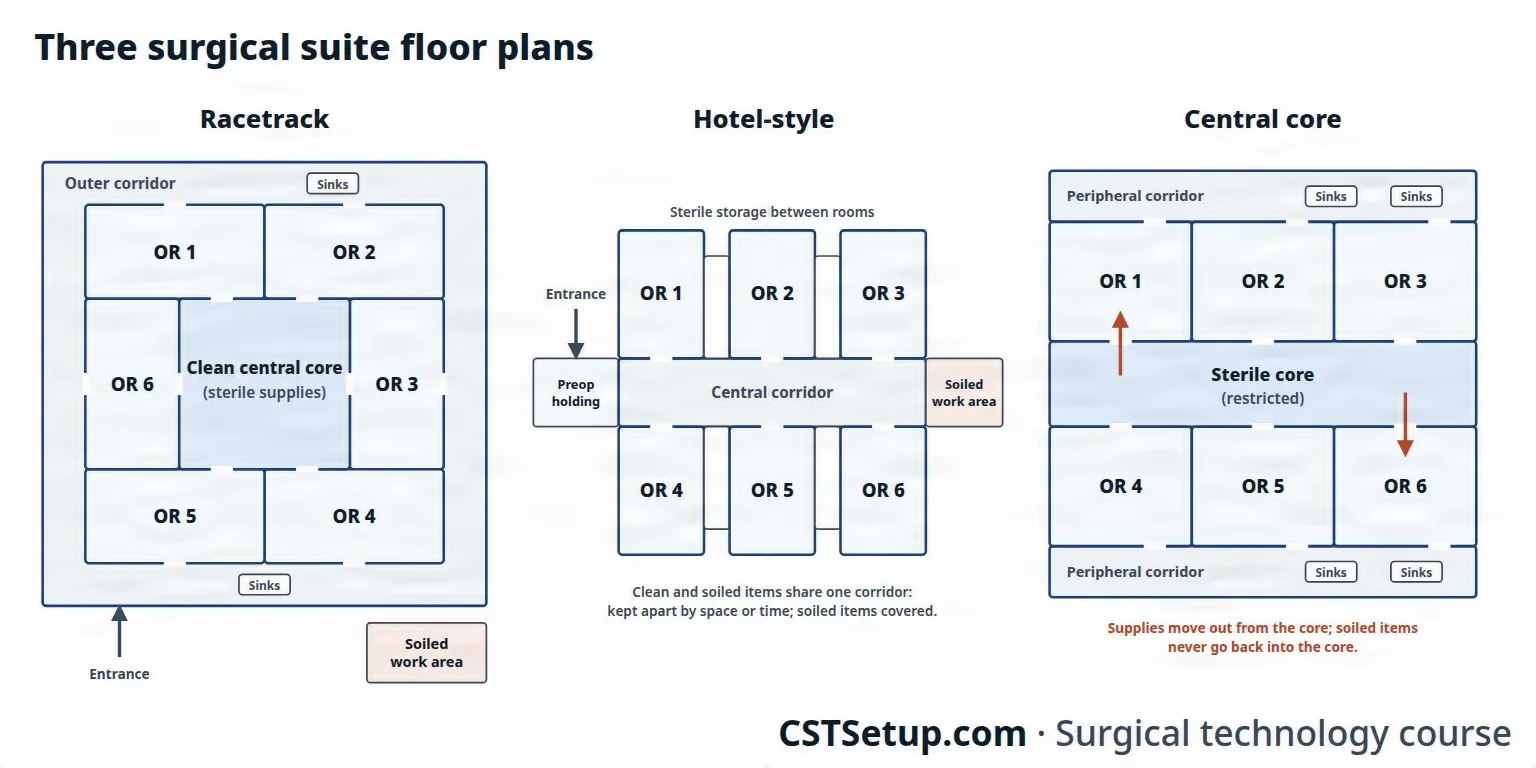
Floor plans
Surgical departments come in several basic designs, chosen with the age of the building and the space around it in mind. Every one aims to control traffic, get supplies to each operating room quickly, and keep clean and contaminated traffic apart. The Core Curriculum names three.
- Racetrack: a series of operating rooms set around a clean central core. Each room's front door opens onto the outer corridor, where the scrub sinks are, and supplies come in through a rear door from the core's storage and work areas. Soiled areas sit outside the core, so clean and dirty traffic stay apart. One reference notes that many facilities have favored this plan.
- Hotel-style: the operating rooms line a central corridor, like rooms in a hotel, with separate clean storage and soiled work areas. All traffic enters and leaves the department through one entrance, or through a main entrance and a holding area entrance on the same corridor. In this single-corridor design, sterile and contaminated items share the corridor, so they are kept apart by space or by time, and soiled items pass sterile ones only when covered or contained.
- Central core: the operating rooms are grouped around one or more central cores, each room with its own door into the core. The core is a restricted area that stores sterile supplies, and a peripheral corridor runs along the outer side of the rooms. Scrub sinks stay out of the core, because splashing could contaminate the sterile items stored there.
The racetrack and central-core plans share the same idea, a clean core with the operating rooms around it. A variation on the hotel or racetrack plan groups the rooms by specialty, such as neurosurgery or general surgery, each group with its own clean storage nearby.
The three zones
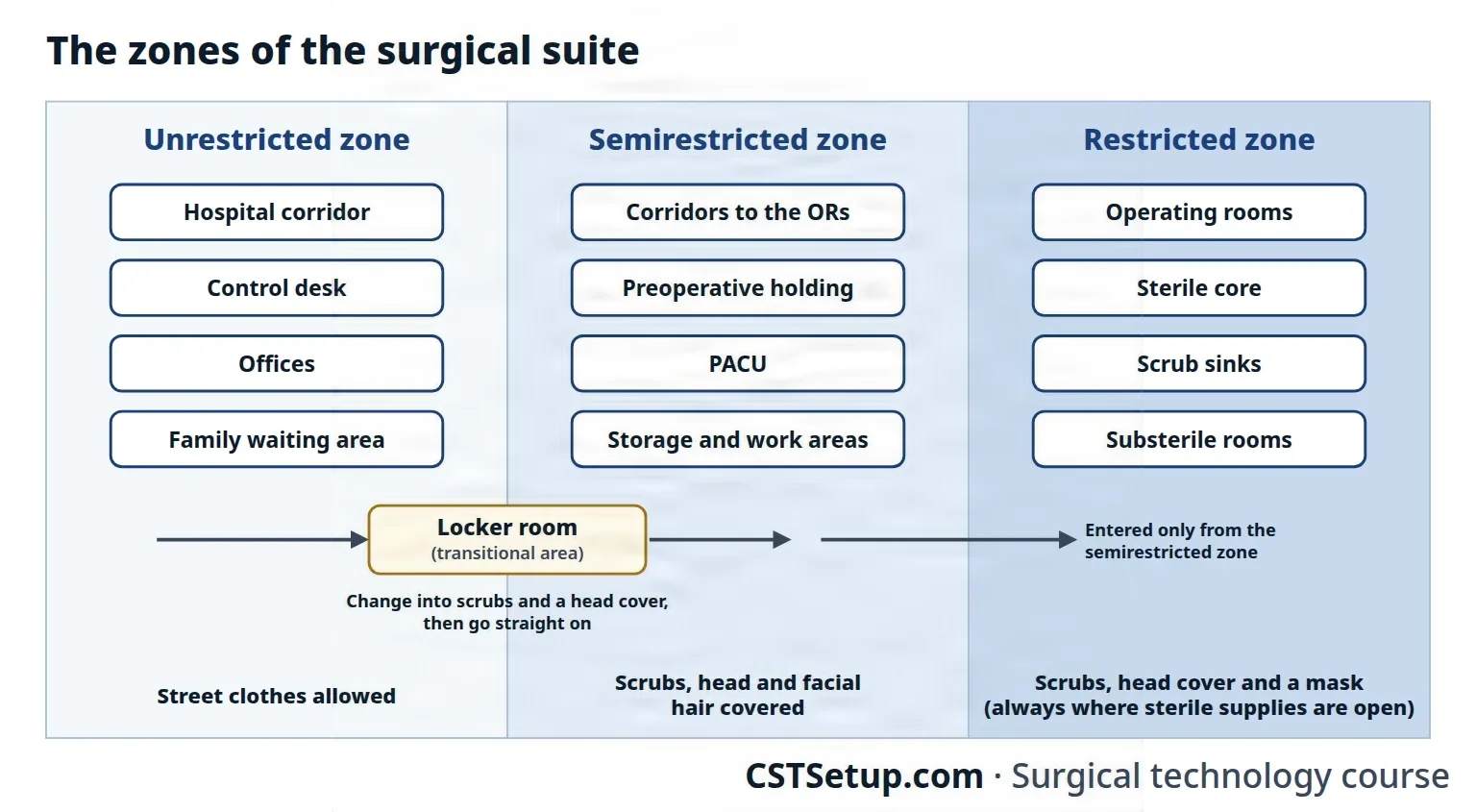
The suite is divided into three zones. Each is defined by the work done there, the attire it requires, how you get in and out, its heating, ventilationven-tuh-LAY-shunAir moving in and out of the lungs as a person breathes.Full entry and air conditioning (HVAC), and how its surfaces are cleaned. The restrictions build from one zone to the next, so the restricted zone has the highest level of asepsisay-SEP-sisThe state of being free of germs that cause disease, and the practices used to keep things that way.a- withoutsep- decay or infection-sis conditionFull entry .
- Unrestricted zone: reached from outside the building, from other unrestricted areas and from the semirestricted zone. Street clothes are allowed and traffic is not limited. It includes the areas outside the suite, offices, the public waiting areas, and a control desk where staff watch who and what comes in.
- Semirestricted zone: reached from the unrestricted zone and from other semirestricted and restricted areas. Only people in surgical attire, with head and facial hair covered, and patients may enter. Patients wear clean hospital attire and a hair cover, under clean linens. It holds the peripheral support areas: storage and work areas, the corridors that lead to the restricted zone, and the preoperative holding area and PACU.
- Restricted zone: reached only from the semirestricted zone. It holds the operating rooms, procedure rooms, the sterile core, the substerile rooms and the scrub sink areas. Surgical attire is required, and a mask is added. Visitors must wear clean surgical attire or a single-use jumpsuit over their clothes.
Both inner zones must be protected from personal items such as backpacks, briefcases and phones, which carry germs. Many hospitals mark the start of the semirestricted zone with signs or a red line on the floor: anyone who crosses it must be in OR attire and follow that zone's rules.
The references do not always agree on which room belongs to which zone, or on exactly when a mask is required in the restricted zone, so follow your facility's policy. You will meet the mask rule in chapter 28: always where sterile supplies are open, and in the restricted zone. Chapters 26 and 28 teach the attire and conduct for each zone.
Traffic patterns
Traffic patterns are the rules for how people, patients and supplies move between the zones. They set boundaries between the areas with the most sources of infection and the cleanest ones, and they apply to everyone.
- Staff: enter the locker room from the unrestricted zone, change into clean surgical attire, and go straight into the suite without walking back through the unrestricted area.
- Doors: stay closed except when patients, staff, supplies or equipment must pass. Every opening disturbs the room's positive pressure and can interrupt its laminar airflow.
- Movement: the more the team moves, the more germs fill the air, so movement during the operation is kept to a minimum.
- Clean and sterile supplies: are kept apart from soiled items by space, time or traffic patterns. Outer shipping boxes collect dust, debris and insects, so supplies come out of them in the unrestricted zone before they go into the suite. Inside, supplies move from the clean core or storage, through the operating room, and out to the semirestricted corridor.
- Soiled items: never go back into the clean core. For the trip to the decontamination area they are covered or contained, in a closed cart or container that carries a biohazard label, and that area is kept apart from the paths patients and staff use.
Work areas
- Surgical offices and the control desk: the front office near the main doors receives calls and watches who enters the department; the supervisor's and other managers' offices are nearby.
- Locker rooms and lounge: a transitional area where you change from street clothes into surgical attire. Clean scrub attire is kept outside the locker room, and surgical attire is never stored in a locker with street clothes. The lounge is kept separate from street-clothes traffic.
- Preoperative care (holding) area: where patients wait for surgery, and where the surgeon, anesthesia provideran-us-THEE-zhuh pruh-VY-derThe licensed professional who gives anesthesia and watches over the client's breathing and vital functions during a procedure.Full entry and circulator confirm that the lab results and preoperative documents are in order.
- Scrub sinks: just outside the operating rooms, often one area serving two rooms, so you go straight into the room after hand antisepsis. They are stocked with surgical soap, antiseptic hand rub, brushes, masks and eye protection, and the area around them is kept clean and dry.
- Sterile storage and the instrument room: sterile wrapped supplies are stored in restricted areas next to the operating rooms; specialty rooms, such as orthopedicor-thuh-PEE-dikHaving to do with the bones, joints, muscles, ligaments and tendons, and the branch of medicine that treats them.orth/o straightped/o child (the field began with straightening children's bones)-ic relating toFull entry , often have their own. Most facilities use case carts, so fewer instrument sets are stored in the suite.
- Equipment storage: clean rooms for large equipment such as microscopes and table attachments, arranged so equipment is not damaged going in and out.
- Utility workroom and decontamination area: where soiled instruments and equipment are cleaned of gross soil and decontaminated, away from the restricted areas. A decontamination area is any room or department where this is done.
- Clean processing area: where instruments are assembled after decontamination, usually with at least one sterilizerSTAIR-uh-ly-zerA machine that kills all germs, including spores, on instruments and supplies.Full entry .
- anesthesiaan-us-THEE-zhuhLoss of feeling or sensation, often brought on by drugs so that surgery or a procedure can be done without pain.an- withoutesthesi/o feeling, sensation-ia conditionFull entry workroom: a semirestricted area holding clean respiratory equipment, anesthetican-us-THET-ikA drug that causes loss of feeling, with or without loss of consciousness.an- withoutesthesi/o feeling, sensation-ic relating toFull entry agents and drugs.
- PACU: patients go straight from surgery to the postanesthesia care unit, where critical care nurses watch them recover from anesthesia.
- Surgery waiting area: where families wait near the department, away from its traffic, and where the surgeon can talk with them.
In the past, steam sterilizers for items needed quickly during surgery stood in small substerile rooms between the operating rooms. Current guidelines place sterilizers in a satellite processing area elsewhere in the suite, not in the substerile rooms.
Some facilities still use a sterilizer in the substerile room between two operating rooms, against current guidelines. Chapter 27 covers when a sterilizer may be used for immediate use.
Communication systems
A central point routes calls and messages to the right person or department. Hands-free intercoms, voice-controlled badges, smartphones and web-based messaging now carry pages, texts and alerts, and an operating room intercom can let the surgeon talk to pathologypuh-THOL-uh-jeeThe study of disease and its causes and effects, or the disease changes found in a person or tissue.path/o disease-logy study ofFull entry without leaving the field. Departments also talk through medical records, requisitions and the computer. A disaster can knock out any of these, which is why the facility's emergency plan includes backup ways to communicate.
9The operating room
Size, surfaces and doors
An operating room has traditionally been at least 400 to 600 square feet, and a room built for trauma may be 800 square feet or more. Imaging and other large equipment keep pushing the size up.
Everything in the room is built to be cleaned and to hold back germs:
- Floors: hard, seamless and joint-free, running continuously into the walls, so there is no sharp corner where bacteria can collect.
- Walls: a hard, easily cleaned surface that can take the bump of equipment. Paint flakes and peels, and a soft, matte color cuts glare. Tile needs smooth grout.
- Doors: swinging or sliding. A sliding door slides over the wall rather than into it, so it can be cleaned.
- Cabinets and shelves: recessed into the wall where possible, stainless steel rather than wood (which cracks under disinfectantdis-in-FEK-tuntA chemical used on objects and surfaces to kill most germs.Full entry ), with open wire shelves that let air move and hold no dust.
What is built in
- Electrical outlets, medical gas outlets and at least two suction outlets, described below.
- Lights, monitors and a computer: the room and surgical lights, image displays the surgeon can see from the table, and a computer for documentation. Chapter 23 teaches the lights and the video monitors, and chapter 19 computers and records.
Each room also has its standard furniture and equipment, each with its own place: the OR table, the instrument tables and ring stands, the anesthesiaan-us-THEE-zhuhLoss of feeling or sensation, often brought on by drugs so that surgery or a procedure can be done without pain.an- withoutesthesi/o feeling, sensation-ia conditionFull entry machine and monitors, the electrosurgeryee-LEK-troh-SUR-jer-eeUsing high-frequency electric current through a handheld tool to cut tissue or seal bleeding vessels during surgery.Full entry and imaging equipment. Sterile supplies are kept in recessed cabinets or in substerile rooms just outside. Chapter 23 teaches the equipment and how to ready the room.
Special rooms
- Special procedure rooms hold the equipment of one specialty, such as a cystoscopy room for urologic procedures with continuous irrigationeer-ih-GAY-shunWashing out a wound, body cavity, tube or eye with a steady flow of liquid.Full entry and its own table, or an endoscopyen-DOS-kuh-peeA procedure that uses a thin, flexible tube with a light and camera to look inside the body.endo- within-scopy looking with an instrumentFull entry room.
- Integrated operating room: the cameras, monitors, lights, table, insufflators and environmental controls are built into the room and controlled from one place, by a sterile remote or by voice, and a nonsterile workstation handles documentation.
- Hybrid operating room: combines a full operating room with the imaging of an interventional suite, so catheter-based and open procedures can be done in one room.
10The room's environmental systems
Medical gases
Oxygen, nitrous oxide, nitrogen and compressed air reach most operating rooms through piped (inline) systems. Each gas line ends at an outlet on the wall or ceiling, or at a hose that drops from an overhead panel, fitted with a safety valve for connecting anesthesiaan-us-THEE-zhuhLoss of feeling or sensation, often brought on by drugs so that surgery or a procedure can be done without pain.an- withoutesthesi/o feeling, sensation-ia conditionFull entry or surgical equipment.
- Oxygen is given with anesthesia and in patient care. It is an oxidizer, a gas that supports fire: the more oxygen in the air, the faster things catch fire and the longer and hotter they burnBURNAn injury to the skin or deeper tissues caused by heat, chemicals, electricity, radiation or friction.Full entry , and items that would not burn in normal air burn easily.
- Nitrous oxide is an anesthetican-us-THET-ikA drug that causes loss of feeling, with or without loss of consciousness.an- withoutesthesi/o feeling, sensation-ic relating toFull entry gas, and an oxidizer too.
- Nitrogen and compressed air power pneumatic instruments such as drills and saws; medical air is also used in anesthesia.
The hoses and outlets are color coded in the United States: green for oxygen, blue for nitrous oxide and yellow for medical air. Each connector is made for one gas only, so the hoses cannot be swapped. Emergency shut-off valves for the room's gases are in the corridor outside.
Gas also comes in cylinders: portable oxygen for transport and as a backup, and cylinders of other gases where there is no piped supply. carbon dioxideKAR-bun dy-OK-sideA gas made by the body's cells as waste, carried in the blood to the lungs and breathed out.Full entry for insufflationin-suh-FLAY-shunBlowing a gas into a body cavity, such as carbon dioxide into the abdomen during laparoscopic surgery.Full entry in laparoscopylap-uh-ROS-kuh-peeSurgery or an exam done through small cuts in the belly, using a thin, lighted tube with a camera.lapar/o abdomen-scopy looking with an instrumentFull entry is another. A cylinder's color is never proof of what is inside, because colors vary from maker to maker; read its label, stamp or tag. The cylinder rules are later in this chapter.
Suction
Suction pulls blood and fluid from the incision and clears the patient's airway during anesthesia. Like the gases, it comes through a piped system that ends at outlets with safety valves, and its strength can be adjusted. Every room has at least two suction outlets: one for the sterile fieldSTAIR-ul feeldAn area set up with sterile drapes and supplies, kept free of all germs, for a sterile procedure.Full entry and one for anesthesia. Chapter 23 teaches setting it up.
Electrical outlets
Most operating rooms have both 110-volt and 220-volt outlets, mounted well above the floor on a monitored electrical system, and their circuits are built to national engineering standards.
- Red outlets are connected to the hospital's backup generator, so they keep working when the power fails. Plug into them the anesthesia machine and the other equipment the patient's life and safety depend on.
- Standard outlets serve the rest of the room's equipment.
Facilities maintenance keeps both the normal and the emergency power supplies running. Chapter 20 teaches electrical safety.
Temperature
Temperature affects how fast germs grow and how comfortable the people in the room are. The operating room is kept cool on purpose: the scrubbed team works under warm surgical lights in a cap, mask, gown and double gloves, sometimes with a lead apron underneath. AORN sets the range at 68 to 75°F (20 to 24°C).
Some references give 68 to 73°F (20 to 23°C).
The temperature may be adjusted for the patient's needs and the team's comfort. For the patient, it is warmed, along with other warming methods, to prevent hypothermiahy-poh-THER-mee-uhA body temperature that has fallen below the normal range.hypo- belowtherm/o heat-ia conditionFull entry , or cooled when the case requires lowering the patient's temperature on purpose; chapter 13 covers hypothermia.
Humidity
Relative humidity is the amount of water vapor in the air, as a share of the most it could hold at that temperature. In the operating room it is kept between 20 and 60 percent.
- Too dry, and static electricity builds up. A static spark can damage electronic equipment, and it can be an ignition source for fire.
- Too damp, and moisture condenses on surfaces and supplies, and fungi and waterborne bacteria grow and spread.
The floor was 30 percent until a 2008 engineering standard (ASHRAE) lowered it to 20 percent, and CMSsee-em-ES (said as letters)An abbreviation for the Centers for Medicare & Medicaid Services, the US agency that runs Medicare, or for a circulation, motor and sensation check.Full entry followed in 2013; AST's 2017 guideline has each facility set its own level by a risk assessmentRISK uh-SES-mentA structured check of how likely a client is to suffer a certain harm, such as a fall, pressure injury or suicide.Full entry , following the makers' instructions.
The same guideline expects CSTs to check and record the operating rooms' humidity as their facility's policy sets out, and the surgery department to review that policy every year.
If the room's temperature or humidity stays out of range, report it at once. Never ignore a system that is not working, and never try to repair it yourself; maintenance is on call at all times.
Ventilation
The air in the operating room is controlled to cut down the particles that carry germs. In HVAC, air conditioning means more than cooling: it covers temperature and humidity, how the air moves, how often it is exchanged and how it is filtered.
- Positive pressure: the air pressure in the operating room is kept higher than in the spaces around it, including the corridor and storage areas. When a door opens, air flows out of the room rather than in. That is why the doors stay closed.
- negative pressureNEG-uh-tiv PRESH-erPressure that is lower than the pressure around it, so air or fluid is drawn in.Full entry : the air pressure is kept lower than in the spaces around it, so air flows in and contaminated air does not escape. decontaminationdee-kun-tam-ih-NAY-shunRemoving or destroying germs, chemicals or radioactive material from a person, surface or object to make it safe.de- removecontamination being made uncleanFull entry rooms and soiled workrooms are kept at negative pressure, and so is the room for a patient with an airborne infectionAIR-born in-FEK-shunAn infection that spreads through tiny germ-carrying particles that stay floating in the air and can travel some distance.Full entry . Chapter 10 covers the extra steps when such a patient needs surgery in a positive-pressure operating room.
- Air exchange rate: the number of times the room's air is replaced each hour. An operating room has at least 20 air exchanges an hour, at least 4 of them with outside air. The fresh air removes particles without stirring up the air. Fans, room humidifiers and dehumidifiers are never brought in, because they churn the air and lift settled bacteria.
- Filtering: high-efficiency particulate air (HEPA) filters remove bacteria, mold and even smaller virus particles.
- Laminar air flow (laminar airflow): a system that moves ultraclean air in one direction, in straight lines, making a curtain of clean air around the sterile field. The whole sterile field, instrument tables included, goes inside the curtain, and no one walks or stands between the curtain and the field. orthopedicor-thuh-PEE-dikHaving to do with the bones, joints, muscles, ligaments and tendons, and the branch of medicine that treats them.orth/o straightped/o child (the field began with straightening children's bones)-ic relating toFull entry operations are often done in rooms with laminar air flow.
Positive pressure means air flows out of the room. It works only while the doors stay closed.
11Safety in the OR environment
Risk and a culture of safety
Risk is the probability of a harmful event: how often it actually happens in a given group over a given time. People often ignore risk because they think harm will happen to someone else. Taking a risk does not change the odds, and in the OR a risk you take for yourself often puts the patient and your teammates at risk too.
Human factors add to risk: fatigue, rushing, a culture that cares more about getting the job done than doing it safely, not knowing the risks, and stress. A culture of safety means everyone knows the risks, accepts responsibility for reducing harm and acts to prevent it. Agencies such as Occupational Safety and Health AdministrationOH-shuh (said as a word)The US federal agency, part of the Department of Labor, that sets and enforces rules to keep workplaces safe.Full entry , the CDC, the FDA, the EPAee-pee-ay (said as letters)Environmental Protection Agency: the US agency that registers disinfectants; also eicosapentaenoic acid, an omega-3 fat.Full entry , The Joint Commissionthuh JOYNT kuh-MISH-unAn independent US organization that inspects and accredits hospitals and other health care organizations against safety and quality standards.Full entry and the ECRI Institute publish standards for safety, and they change as technology changes, so you keep learning.
The CSTsee-es-tee (said as letters)Certified Surgical Technologist, a credential for surgical technologists; in maternity care, contraction stress test.Full entry exam outline expects you to take preventive actions whenever a situation could cause harm: notice the hazard, act to prevent the harm, such as routing a cord out of a walkway or taking a faulty device out of use, and report it, before anyone is hurt. Chapter 15 covers reporting unsafe conditions with risk management.
The risks in the OR fall into three groups:
- Technical: medical devices and energy sources
- Chemical: liquid, gas and solid chemicals
- Biological: the spread of infectious disease
The hazards, and where each is taught
The Core Curriculum's list of environmental safety topics, and where each is taught in full:
- Electrical hazards and fire safety at the field: chapter 20. The facility's fire plan, RACE and PASS, is below.
- radiationray-dee-AY-shunEnergy that travels as waves or particles, such as X-rays, used to make images or treat cancer; also pain that spreads from its starting point.radi/o rays, radiation-ation processFull entry precautionprih-KAW-shunA step taken ahead of time to prevent harm, such as the infection-control practices used with every client.Full entry : chapter 22.
- Surgical plume: the smoke made when an electrosurgeryee-LEK-troh-SUR-jer-eeUsing high-frequency electric current through a handheld tool to cut tissue or seal bleeding vessels during surgery.Full entry or laser burns tissue; chapter 20 teaches what is in it, smoke evacuation and the respiratorRES-pih-ray-terA close-fitting mask or hood that filters the air a person breathes to protect them from germs or harmful particles.Full entry .
- OSHA guidelines: the SDSes-dee-ES (said as letters)Safety Data Sheet: a document that describes a chemical product's hazards and how to handle it safely.Full entry is below; Standard Precautions are in chapter 10.
- CDC guidelines: the postexposurePOST-ek-SPOE-zherHappening after a person has been exposed to an infection, poison or other hazard.post- afterexposure coming in contactFull entry protocol, in chapter 10.
Fire: the facility's plan
All accredited facilities must train employees and students in fire safety, the use of fire extinguishers and the evacuation routes, and fire drills are held regularly. Know your facility's fire plan and your own role in it, where the extinguishers and exits are, and how to set off the fire alarm. Many hospitals call a fire "code red".
A fire on or around the patient is handled at the field first (chapter 20). If a fire spreads beyond the patient, the team activates the hospital's fire plan, remembered as RACE:
- Rescue the patients in the immediate area of the fire.
- Alert others, so they can help move patients and respond, and set off the fire alarm.
- Contain the fire: close all doors to slow the smoke and flames, and shut off the zone valves for the room's piped gases, because the gas feeds the fire. Know where those valves are before you need them.
- Evacuate the people in the areas around the fire.
A small fire may be put out with an extinguisher. carbon dioxideKAR-bun dy-OK-sideA gas made by the body's cells as waste, carried in the blood to the lungs and breathed out.Full entry extinguishers are preferred for OR fires. To use one, remember PASS:
- Pull the pin, by the ring on the handle.
- Aim the nozzle at the base of the fire.
- Squeeze the handle.
- Sweep the spray over the fire.
let a fire come between you and the exit.
Compressed gas cylinders
Cylinders are made of heavy steel, and their gas is under very high pressure: about 2,200 pounds per square inch in a large cylinder. If a cylinder ruptures, or its valve breaks off, it can fly like a missile, through walls and into people, or burst and throw metal like shrapnel. Oxygen and nitrous oxide add the risk of fire.
Storing and moving cylinders
- Store every cylinder upright, empty or full, secured on its own by a chain, cable or strap at about two thirds of its height, in a rack or holder made for it. Never leave one standing unsupported.
- Move a cylinder only secured on a cart, with its protective cap on. Never roll, drag or slide it, drop it, or let cylinders strike each other.
- Store cylinders in a labeled, well-mechanical ventilationmeh-KAN-ih-kul ven-tuh-LAY-shunBreathing support from a machine, a ventilator, that pushes air into the lungs through a tube or a mask.Full entry room, never in a public hallway, and away from heat and electricity. Keep oxygen away from flammable gases, and keep grease and oil off oxygen cylinders.
- Use only a cylinder that is labeled, and read the label every time. Never rely on its color.
- Never repair or tamper with a cylinder or valve; send it to bioengineering or the supplier. Open a valve only with the wheel or the key that stays with the cylinder, never with pliers or a wrench.
Using a cylinder for a pneumatic instrument
- The cylinder has two valves: the tank valve on top, and the regulator, which controls the flow to the hose. One gauge shows the pressure left in the tank, the other the pressure going to the instrument. Regulators are made for one gas and are never changed to fit another.
- Crack the tank valve open slowly, then open it fully, and read the tank pressure.
- Do not use a tank with less than 500 psi: the last of the gas keeps rust and dust out of the hose, so a tank is never run dry. Do not put one back in storage below 500 psi either; it is replaced.
- Attach the hose firmly and set the pressure the instrument's maker calls for.
- When you finish, close the tank valve, bleed the gas left in the hose by running the instrument, and close the regulator until it reads zero.
Toxic chemicals
You meet many chemicals in the surgical department: disinfectantdis-in-FEK-tuntA chemical used on objects and surfaces to kill most germs.Full entry and sterilantSTAIR-uh-luntA chemical that kills all forms of microbial life, including bacterial spores.Full entry such as glutaraldehydegloo-tuh-RAL-duh-hideA liquid chemical used for high-level disinfection, or sterilization with longer soaking, of heat-sensitive medical devices.Full entry , ethylene oxideETH-ih-leen OK-sideA gas used at low temperature to sterilize medical items that heat or moisture would damage.Full entry , hydrogen peroxide and peracetic acid; tissue preservatives such as formalinFOR-muh-linA solution of formaldehyde in water used to preserve tissue specimens for the pathology lab.Full entry ; antiseptics for hand hygiene and skin prep; and methyl methacrylate bone cement. Many are hazardous: they can harm the lungs or skin, damage genes, or injure a developing baby. One exposure may be small, but exposures add up over a day and a career, and some chemicals worsen each other's effects.
Chemicals enter the body by breathing, by skin or splash contact, or by swallowing. Acute toxicitytok-SIS-ih-teeThe harm a substance does to the body, or a state in which a drug has built up to a harmful level.tox/o poison-icity state or quality ofFull entry usually comes from a sudden accident, such as a spill, and is an emergency. Chronic toxicity builds from small exposures repeated over a long time. Every chemical used in health care has a safe exposure limit set by government agencies, measured in parts per million or milligrams per cubic meter of air.
Safety Data Sheets. OSHA's Hazard Communication Standard requires the maker or importer of every hazardous chemical to write a Safety Data Sheet (SDS) for it, and requires your employer to keep the sheets where every worker who could be exposed can read them. Older references call it the Material Safety Data Sheet (MSDS). An SDS tells you:
- what the chemical is and what is in it, including any ingredient that can cause cancer (a carcinogenkar-SIN-uh-jenAnything that can cause cancer, such as tobacco smoke, asbestos, UV light or certain chemicals and viruses.carcin/o cancer-gen something that producesFull entry )
- its physical, chemical and health hazards, sudden and long term, how it enters the body, and the organs it can damage
- the exposure limits
- the precautions and protective equipment for handling it safely
- first aid and emergency steps, firefighting information, and how to clean up a leak or spill
- who wrote the sheet, its date, and an emergency phone number
The standard also requires the employer to keep a written hazard communication program and a list of the hazardous chemicals in use, to label every container, and to train workers when they start and whenever a new chemical hazard arrives, in a language they understand. Labels and sheets are in English, and the employer may add other languages.
Labels. Learn to read the label on every chemical you use. One common label is the National Fire Protection Association's diamond, which scores four hazards from 0 (minimal) to 4 (extreme): blue for health, red for flammability, yellow for reactivity and white for other hazards.
Preventing harm
- Use the right concentration and the right procedure for each chemical, as its label and SDS say. Glutaraldehyde, for example, is used under a hood to keep its fumes out of your lungs.
- Wear the protective equipment the SDS calls for, such as goggles, gloves and a splash apron.
- Use ventilationven-tuh-LAY-shunAir moving in and out of the lungs as a person breathes.Full entry and other controls, and choose a product that is not hazardous when one will do the job.
- Mix methyl methacrylate only in a closed system.
- Know where the eyewash and drench shower are. Wherever corrosive chemicals could reach someone's eyes or body, OSHA requires a place to flush them right in the work area.
- Handle a spill as its SDS and your facility's policy direct. Chapter 30 covers spills of blood and chemicals, and chapters 27 and 29 cover the sterilants and formalin.
Waste anesthetican-us-THET-ikA drug that causes loss of feeling, with or without loss of consciousness.an- withoutesthesi/o feeling, sensation-ic relating toFull entry gases that leak into the room are another chemical hazard. Exposure must be measured, and kept below 25 parts per million for nitrous oxide and 2 for the halogenated agents; chapter 13 covers scavenging, which carries them away.
Hazardous drugs
Some drugs used in surgery can harm the people who handle them, most of all antineoplastican-tee-nee-oh-PLAS-tikA drug used to treat cancer by killing cancer cells or stopping them from growing and dividing.anti- againstneo- newplas growth, formation-tic relating toFull entry (chemotherapy) drugs. NIOSH counts a drug as hazardous if it can cause cancer, cause birth defects or other harm to a developing baby (a teratogentuh-RAT-uh-jenAnything a pregnant person is exposed to that can cause birth defects in the developing baby.terat/o malformation-gen producingFull entry ), harm fertility, damage organs at low doses, or damage genes. Besides chemotherapy, the list takes in some antiviralan-tee-VY-rulA drug that treats or prevents infection by a virus, usually by stopping the virus from making copies of itself.anti- againstvir virus-al relating toFull entry and seizureSEE-zherA sudden burst of abnormal electrical activity in the brain that changes movement, feeling, behavior or awareness.Full entry drugs and some hormones. Exposure can come from handling the drug or from working nearby: it can be in the air, on surfaces and equipment, or in the patient's urine and feces.
AORN's safety measures for hazardous drugs:
- Store and handle them according to USP 800, the other regulations and the maker's instructions.
- Choose protective equipment for the risk and the task.
- Wear two pairs of powder-free chemotherapy gloves, or the gloves the maker's instructions name, and inspect them for defects before use. Change them every 30 minutes, unless the glove maker's instructions say otherwise.
- Wear a single-use chemotherapy gown: sterile at the sterile fieldSTAIR-ul feeldAn area set up with sterile drapes and supplies, kept free of all germs, for a sterile procedure.Full entry , nonsterile away from it.
- Wear goggles, or goggles with a full face shield.
- Use single-use instruments to give the drug when they are available.
- For heated chemotherapy put into the abdomen during surgery (HIPEC), wear two pairs of sterile chemotherapy gloves and a sterile chemotherapy gown, avoid splashing, wear an N95en-NINE-tee-fiveA close-fitting respirator mask that filters at least 95% of tiny particles from the air the wearer breathes.Full entry or better respirator, and use infusion bags instead of syringes.
- Wear protective equipment when handling the urine, stool or other excreta of a patient who received a hazardous drug in the last 48 hours.
- Dispose of the protective equipment in a hazardous waste container, and contain a spill and clean surfaces as the drug's SDS directs.
Lifting, standing and moving equipment
Musculoskeletal injury threatens everyone who works in the OR, most of all the lower back, wrists, shoulders and neck. The risk comes from how hard you exert yourself, your posture (twisting, bending, kneeling, reaching overhead, holding one position a long time), repeated motions, and pressure against hard edges.
Injuries happen most often when staff:
- lift, position, move or transfer patients
- take heavy trays down from high shelves or up from near the floor
- move heavy equipment such as the OR table, the microscope or imaging equipment
- catch a falling item, or trip over tubing and cords
- balance a heavy tray in one hand while opening it onto the field
- reach up to plug into a wall socket or an overhead gas connection
- climb over clutter to reach a heavy item
Use equipment and help before muscle. Lifting devices and assistive equipment prevent injury far better than technique alone. NIOSH's lifting equation generally gives about 35 pounds as the most one person should lift; above that, lead aprons, sterile packs, positioning devices and instrument trays call for an assistive device. AORN's guidance: one person may push light wheeled loads, such as a portable x-ray machine, an empty case cart or an occupied stretcher; two people move an occupied hospital bed or an empty specialty OR bed; and a powered transport device moves OR beds and occupied specialty beds. Chapter 31 covers moving patients.
Good body mechanics for the loads you do handle:
- Hold the load close to your body.
- Bend at your knees, never at the waist with your knees locked, keep your back straight, and stand with your feet wide apart and flat on the floor.
- Tighten your abdominal muscles as you lift, so they carry part of the weight instead of your lower back.
- Push a cart rather than pull it, and make sure you can see what is in your path. Start with one foot behind the other and push off from the back foot as your weight moves forward. To pull, use the same stance and pull with the front leg.
- Never twist or balance on one foot to reach an outlet or a gas connection overhead.
Store and work smart. Store heavy trays at elbow height, with lighter items above and below, never overhead or on the floor. Bring in only what the case needs, and keep cords off furniture and out of walkways. When you stand for a long time, keep your feet shoulder width apart and shift your weight; a standing platform should be wide enough for that stance, and two platforms can save you stepping up and down between the patient and the back table. Supportive shoes and support stockings help. If you are hurt at work, get care right away.
Slips, trips and falls are a leading cause of serious injury to health care workers. Wipe up spills promptly and mark a wet floor, route and bundle cords out of the paths people walk, keep pathways clear and lighting good, and wear closed-toe, closed-back shoes with low heels and nonskid soles.
12Disasters and emergencies
Disaster preparednessprih-PAIR-id-nesBeing ready ahead of time, especially with plans, training and supplies for a disaster or emergency.Full entry training is expected of every health professional, allied health included. Most of what follows is what the whole hospital does; your own part comes near the end of the chapter.
The words
- Emergency: an event, such as a car crash or a house fire, that is limited to one place and can be handled by the local ambulances, fire department and paramedics.
- Disaster: a catastrophic event that affects a large part of the population and threatens many lives and much property. It overwhelms local resources, so outside help is needed, and it disrupts the whole community.
- Mass casualty event (MCE): a local emergency, such as a plane crash, an explosion or a building collapse, with more victims than the local health care services can handle. It may not be a large-scale disaster that needs federal help.
- Declared state of emergency: a status the state's governor, or the president for a federal declaration, gives a disaster. It allows the state to receive federal aid through FEMA.
- Surge capacity: the number of patients a facility can manage in an emergency, and its ability to quickly increase that number.
- Vulnerability: exposure to the risk of harm. Vulnerable populations have a higher than normal risk in a disaster, because of age, disability, illness, poverty, isolation or anything else that makes help hard to reach.
Disasters are also ranked by the response they need: at level I, local teams can manage; at level II, help comes from the surrounding communities; at level III, the state and the federal government step in because local and regional resources are overwhelmed.
Types of disasters
The Core Curriculum sorts disasters into three groups: manmade, natural, and a mix of the two. FEMA groups hazards as natural, technological or accidental, pandemicpan-DEM-ikAn outbreak of disease that spreads across several countries or continents and affects very many people.pan- alldem/o people-ic relating toFull entry , and terrorist. The lines blur: a flood may come from a storm, from farming that stripped the soil, or from a poorly built levee.
Natural disasters are caused by the forces of nature.
- Weather: hurricanes, tornadoes, floods, blizzards and ice storms, wildfires, drought and extreme heat. Heat waves kill more people in the United States than any other weather disaster, and older adults, poor and homeless people are the most at risk.
- Earth: earthquakes, tsunamis, volcanoes, landslides, mudslides and avalanches.
Human-made disasters come from human action, accidental or on purpose.
- Technological or accidental: explosions, hazardous materials and chemical releases, radiationray-dee-AY-shunEnergy that travels as waves or particles, such as X-rays, used to make images or treat cancer; also pain that spreads from its starting point.radi/o rays, radiation-ation processFull entry accidents, transportation accidents, and infrastructure failures, the collapse of roads, bridges and buildings from poor maintenance or construction. Their dangers are often hidden, which makes them especially frightening, and their effects can last for decades.
- Terrorism: the unlawful use of violence, or the threat of it, to frighten and coerce a government or a society, often for political, religious or other ideological goals. Terrorists may use chemical, biological, radiological, nuclear or explosive weapons.
Natural and manmade together: a natural event can set off a human-made disaster, as when an earthquake breaks gas lines and starts fires, or damages a nuclear power plant. The Core Curriculum's example is a dam that fails because of a defect. Human activity, such as clearing forests or building on flood plains, is often the root cause of disasters we call natural.
The injuries you see in surgery depend on the disaster, such as crush injuries after a building collapse or blast injuries and burns after an explosion; chapter 11 teaches trauma.
Emerging infectious diseases
An epidemicep-ih-DEM-ikA rise in cases of a disease in a community or region well above what is normally expected.epi- upondem/o people-ic relating toFull entry is an outbreak limited to a certain population or area; a pandemic is a rapidly contagious disease that spreads across a large population, often across international borders. HIV/AIDSaych-eye-vee aydzHuman immunodeficiency virus infection and acquired immunodeficiency syndrome, its most advanced stage, written together.Full entry , influenza and coronaviruskuh-ROH-nuh-vy-rusOne of a family of viruses with crown-like spikes on their surface that infect the airways.Full entry have caused the major pandemics of recent years. Chapter 10 teaches how epidemics start and spread.
An epidemic or pandemic can overwhelm the health care system and leave it short of workers, who fall ill themselves, and of equipment such as mechanical ventilationmeh-KAN-ih-kul ven-tuh-LAY-shunBreathing support from a machine, a ventilator, that pushes air into the lungs through a tube or a mask.Full entry . Disease also spreads fast among displaced people crowded into shelters or camps with poor sanitation, so outbreaks often follow other disasters. The community responds with immunization, health education and testing; in the facility, it means isolation, strict hand washing, and careful disinfectiondis-in-FEK-shunCleaning a surface or object with chemicals or heat to kill most germs, though not always all bacterial spores.Full entry and sterilizationstair-uh-luh-ZAY-shunA process that destroys all microorganisms, including spores, on an item; also a permanent birth control procedure.Full entry .
Bioterrorism is the deliberate release of germs or their toxinTOK-sinA poison made by a living thing, such as a bacterium, plant or animal.Full entry to cause illness and death in people, animals or the environment, spread through air, water or food. The CDC ranks anthraxAN-thraksA serious infection caused by the spore-forming bacterium Bacillus anthracis.Full entry , botulism, plague, smallpox, tularemia and the viral hemorrhageHEM-uh-rijA large loss of blood from a blood vessel, inside the body or out of it.hem/o blood-rrhage bursting forthFull entry fevers as the highest-risk agents, and names anthrax and smallpox the two most likely to be used as weapons. An attack may be hidden: the first sign is often many patients arriving with the same signs and symptoms.
What disasters have in common
Every disaster is different, but many bring the same problems: loss of shelter, broken communication and transport, power and water lost or contaminated, a sudden need for health care and for moving patients, medical supplies running out, food scarce, and too few workers, many of them in new roles. The harm falls hardest on vulnerable people.
The basic human needs in a disaster:
- Shelter and evacuation: shelter protects people from weather and further harm, and escaping harm is often the most urgent need. Evacuation moves people away from the danger; its alternative is shelter-in-place, staying where you are, in a safe part of a building, until it is safe or rescuers arrive.
- Water, sanitation and food: food supplies may fail days after the disaster, once supply lines break down.
- Medical aid, in existing facilities or mobile clinics, with each facility given a role in the plan according to what it can do.
- Infection control in shelters, camps and hospitals.
- Mental health care: keeping families and communities together helps people cope, and mental health workers are needed early.
- Protection from crime when resources are scarce and police are busy with rescue.
- Help for vulnerable people, who may not understand the danger or be able to follow an evacuation order.
- Reunification of separated families; the American Red Cross leads this work.
Health in a disaster: water, air and waste
Water. Floods and storms can contaminate drinking water and make sewage overflow, and water-borne diseases such as cholera often break out where sanitation fails after a disaster. Safe water and sanitation are among the first needs: purified drinking water, sewage treatment, clean supplies for cooking, and the collection of garbage and control of animal and insect pests. Keep water purification tablets with your home supplies, and when there is nowhere to wash your hands, use bottled water or an alcohol-based hand rub.
Contaminated air. Smoke from wildfires, toxicitytok-SIS-ih-teeThe harm a substance does to the body, or a state in which a drug has built up to a harmful level.tox/o poison-icity state or quality ofFull entry gas from a chemical release, or a biological agent can make the outside air dangerous. There are two ways to protect people:
- The building: shelter-in-place in a safe room, which may be fitted to keep outside air from getting in. After a chemical release or a bioterrorism attack, staying inside may be the safest choice.
- Protective equipment: respiratorRES-pih-ray-terA close-fitting mask or hood that filters the air a person breathes to protect them from germs or harmful particles.Full entry , protective clothing and eye protection for the people nearest the source. Respirators are worn at a scene where airborne contamination is above Occupational Safety and Health AdministrationOH-shuh (said as a word)The US federal agency, part of the Department of Labor, that sets and enforces rules to keep workplaces safe.Full entry 's permissible exposure limit, and each one must be fit-tested to seal.
Waste. A facility in a disaster must still dispose of medical waste safely and collect and destroy its garbage; with pest control in crowded areas, this is part of preventing disease. Hazardous waste, such as sharps and waste soiled with antineoplastican-tee-nee-oh-PLAS-tikA drug used to treat cancer by killing cancer cells or stopping them from growing and dividing.anti- againstneo- newplas growth, formation-tic relating toFull entry drugs, still goes into labeled containers at the point of use. The facility's plan works out how long it can sustain itself, up to 96 hours, and how to stretch its resources.
13Who runs a disaster
The all-hazards approach and the disaster cycle
Every disaster is different, but the responses to them have much in common: the systems that respond, how people communicate and evacuate, how special-needs patients are cared for. So planning and training take an all-hazards approach: one plan built on what all disasters share, adjusted for each one, instead of a separate plan for each kind of disaster.
The all-hazards approach works through four phases, the disaster cycle. The Core Curriculum calls them the four responses that fit every kind of disaster, and the phases can overlap or run at the same time.
- Mitigation: anything that reduces a disaster's harm to people, buildings and the environment. Examples are building codes and earthquake-resistant buildings, dams and seawalls, early warning systems, and isolating patients with a contagious disease. Mitigation is sometimes listed first, sometimes with preparednessprih-PAIR-id-nesBeing ready ahead of time, especially with plans, training and supplies for a disaster or emergency.Full entry , and it can be part of the response too.
- Preparedness: the planning, training and exercises that let people, communities and governments respond well. Without a plan that is ready to carry out, the scene of a disaster falls apart quickly.
- Response: putting the plan into action, to save lives, prevent injuries and protect property. It is stressful and demanding work, and even the best plan meets surprises.
- Recovery: the community's return to a level at which it can cope. It has no set length, may take years, and covers rebuilding, the economy and people's emotional health as well as buildings.
The federal level
- The Department of Homeland Security (DHS) carries out the federal framework for managing disasters.
- The National Response Framework (NRF) is the federal guide to how the nation responds. It sets out the roles and responsibilities, actions, organization, planning and resources of a response. Its principles are engaged partnership, a tiered response, capabilities that are scalable, flexible and adaptable, unity of effort through unified command, and readiness to act. It can be put into action in part or in full when a threat is seen, when a major event is expected, or when an incident happens.
- The Federal Emergency Management Agency (FEMA), part of DHS, coordinates and manages the response to nationally declared disasters and trains professionals and the public. Federal help comes only after the state's governor declares a state of emergency and requests it, leading to a presidential declaration. Even then, local officials should not expect federal help for up to 3 days, or longer.
- The National Incident Management System (NIMS) is the system FEMA uses for its work. It sets the management structure, objectives, chain of commandCHAYN uv kuh-MANDThe order of authority in an organization: who reports to whom, from staff up through managers to leaders.Full entry and procedures for coordinating a response, so every responder, at every level of government and in private groups, works the same way and uses the same terms. Agencies must use NIMS to receive federal preparedness money.
- Its current edition (2017) has three components: resource management; command and coordination; and communications and information management. Older references list five, adding preparedness and ongoing management and maintenance.
- The National Disaster Medical System (NDMS) sends medical teams, equipment and supplies to a disaster and moves patients to registered hospitals. Its teams include the Disaster Medical Assistance Teams (DMATs), mortuary teams that help identify victims, and pharmacy teams that hand out drugs and vaccines.
- The CDC educates the public about health threats, guides the response to bioterrorism, outbreaks and other public health emergencies, and trains health workers and the public.
- The Strategic National Stockpile holds the federal government's supply of drugs, vaccines and medical supplies for a terrorist attack, an outbreak or another public health emergency. "Push packs" of antibiotics, emergency medicines, airway equipment, IV fluids and dressings can be shipped fast to the scene.
- AHRQ provides disaster research, resources, training and recommendations for facilities and communities.
- HRSA, the Health Resources and Services Administration, is another agency of the Department of Health and Human Services, beside AHRQ, the CDC and CMSsee-em-ES (said as letters)An abbreviation for the Centers for Medicare & Medicaid Services, the US agency that runs Medicare, or for a circulation, motor and sensation check.Full entry . One reference places AHRQ and the NDMS under HRSA.
The state and local levels
Each state has an emergency management agency (EMA) that works closely with FEMA and with the local emergency management agencies. Local government carries the first responsibility for the response.
The local emergency management agency (LEMA) leads and coordinates the local response of fire, police, EMS, public health and the other agencies, and it writes the community's emergency response planih-MUR-jen-see rih-SPONS planA facility's written plan for what each person does in a disaster or emergency.Full entry (EOP): who is in charge of what, an inventory of equipment and supplies, training, and a list of responders, community healthkuh-MYOO-nih-tee helthThe health of the people who live in a certain area or share something in common, and the work done to improve it.Full entry professionals included. When a disaster is coming or has hit, the head of the LEMA opens the emergency operations center (EOC), a place set in the plan where every responding agency meets to run the response.
The incident command system
The incident command system (ICS) is the on-site management system used in every disaster. It is designed during preparedness and put to work during the response. It solves the problems that plague disasters: agencies with competing goals, responders without tasks, poor communication, no clear chain of command, and no overall plan. Decisions come from the top, from experienced managers, so they can be made fast.
The ICS has one person in charge, the incident commander, who gets things done by giving assignments. When a disaster needs many agencies, their leaders may form a unified command. The work is divided into sections that report to command:
- Operations: carries out the plan's goals, such as treating victims at the scene
- Planning: gathers, records and reports information on how the response is going
- Logistics: provides what the response needs: transportation, supplies, food, communications, equipment and power
- Finance and administration: keeps track of the costs
The Hospital Incident Command System (HICS) is the same system for a single health care facility. It follows NIMS, mirrors the local ICS and uses the same terms, so the hospital can work smoothly with other facilities and agencies. Its chain of command sets each person's role, written ahead of time on job action sheets, and the facility's CEO is usually the incident commander. The Joint Commissionthuh JOYNT kuh-MISH-unAn independent US organization that inspects and accredits hospitals and other health care organizations against safety and quality standards.Full entry requires every hospital to have an incident command structure that can grow or shrink with the emergency, to name who can activate it, and to have a main and a backup site for running it. Note that incident command is a management system: the hands-on work is assigned through it according to the facility's plan.
In a disaster, everyone works inside one chain of command, from the incident commander down. You report where the plan sends you and take your assignment from your section leader.
Volunteering
You can help your community outside your job too:
- The American Red Cross gives humanitarian aid and technical support in disasters, leads family reunification, and through its local chapters trains health professionals and the public. Disaster volunteers register through the state EMA.
- Disaster Medical Assistance Teams are on-call teams of health professionals who deploy quickly to support local providers. surgical technologistSUR-jih-kul tek-NOL-uh-jistA member of the operating room team who prepares the sterile field and instruments and hands them to the surgeon.Full entry serve on many DMATs, especially those with extra training in first aid such as dressings and splints, and some on a DMAT's specialty surgical team, such as a burnBURNAn injury to the skin or deeper tissues caused by heat, chemicals, electricity, radiation or friction.Full entry or orthopedicor-thuh-PEE-dikHaving to do with the bones, joints, muscles, ligaments and tendons, and the branch of medicine that treats them.orth/o straightped/o child (the field began with straightening children's bones)-ic relating toFull entry team. Apply through your state or local DMAT.
- The Medical Reserve Corps is a national network that organizes medical, public health and other volunteers to improve their communities' health and safety.
- ESAR-VHP, the Emergency System for Advance Registration of Volunteer Health Professionals: each state keeps a system to register and check health professional volunteers ahead of time, so they can be sent quickly within the state or to another one. The Core Curriculum and one textbook call it the Emergency Services Advanced Registry for Volunteer Health Professionals.
- Community Emergency Response Teams (CERT) train members of the public, through agencies such as the fire department, in basic response skills such as fire safety, first aid and search and rescue.
14Planning for a disaster
The community's plan
A community builds its plan in steps:
- Build the team, with leaders from law enforcement, fire, emergency medical services, public health, public works, water and sanitation, search and rescue, mental health, structural engineering and health care facility management, and support from utilities and transportation.
- Analyze the risks: find the hazards most likely in that community, such as a nearby chemical or nuclear plant or a flood plain, and design a plan to reduce them.
- Assess the resources: communications, supplies and transport, and people.
- Write the response plan: what triggers it, who does what and how, and in what order. Its main objectives are activating the responders, a command post or EOC, public announcements, managing resources, and restoring vital services such as power, fuel, sewers and roads. States also require specific plans, a hospital disaster plan among them.
- Coordinate: groups that act on their own become a burden, so every responder follows one plan and one way of communicating.
- Plan the supply chain: the logistics supply chain carries goods from purchase to the person who needs them. Normal supply lines break in a disaster, so supplies may be stockpiled ahead of time, and points of distribution are planned in advance.
- Practice: emergency exercises, dry runs of a disaster, reveal the gaps in a plan so they can be fixed before a real one.
Your own plan
When disaster strikes, the first question most people ask is whether their family is safe, and a worker who cannot answer it may be unable to come to work or to focus once there. Your response starts at home. The CDC, FEMA and the American Red Cross publish guides for making a family plan.
- Know the emergencies likely where you live, and the steps your local agencies recommend for each.
- Make a family plan for each type: how you will evacuate, where you will meet, and how you will reach each other when phones and the internet fail, such as through a relative out of town. Plan for your pets too.
- Keep supplies to shelter in place at home: water and food that will not spoil, medicines, a first aid kit, a flashlight, a batteryBAT-uh-reeIn law, touching a person on purpose without their consent.Full entry radio and batteries.
- Pack a "go bag" with a 3-day supply of personal and survival items, your wallet, copies of your identification and your contact list, and keep it ready, because you may be called in to work.
- Learn basic life support and first aid, and practice the plan.
The facility's emergency operations plan
Every health care facility, from the hospital to the ambulateAM-byuh-laytTo walk, or to help a client walk.Full entry surgery center, has an emergency response planih-MUR-jen-see rih-SPONS planA facility's written plan for what each person does in a disaster or emergency.Full entry that follows the community's plan and the state and federal guidelines. The Joint Commissionthuh JOYNT kuh-MISH-unAn independent US organization that inspects and accredits hospitals and other health care organizations against safety and quality standards.Full entry requires it to keep accreditation, and Medicare requires it too. Occupational Safety and Health AdministrationOH-shuh (said as a word)The US federal agency, part of the Department of Labor, that sets and enforces rules to keep workplaces safe.Full entry requires every business with more than 10 employees, health care facilities included, to have its emergency action plan in writing.
The Joint Commission's 2026 goals require each hospital to run an emergency management program:
- a qualified leader and a committee that oversee it, covering the four phases of emergency management and six critical areas: communications, staffing, patient care and clinical support, safety and security, resources and assets, and utilities
- a hazard vulnerability analysis, which finds and ranks the hazards the hospital is most likely to face
- an all-hazards emergency operations plan with its incident command structure
- a communications plan for reaching staff, patients and families (people with disabilities included), community partners, the authorities and the media, with its own warning and alert signals
- a staffing plan, including how volunteer practitioners are checked and superviseSOO-per-vyzeTo guide, watch over and check the work of another staff member who is doing a task.Full entry , and support for staff, such as housing, transportation, child care and mental health care
- plans for patient care, for visitors who need no care, for many deaths, and for security with the police and other agencies
- a plan for sustaining the hospital's resources for up to 96 hours, such as how much fuel the generators have and which noncritical procedures can be canceled
- a recovery plan, for assessing damage, restoring critical systems and returning to full operations, and for reuniting families, unaccompanied children included
- training, exercises to test the plan, and after-action reports that find what needs to improve
Hospitals are required to test the plan with drills twice a year. The Joint Commission's 2026 goals require each hospital to plan and run exercises that test its plan, and each freestanding outpatient building it accredits to run at least one exercise a year of its own, unless it takes part in the hospital's. One reference gives at least once a year for the hospital, and an older one adds that when the hospital has an emergency department, one of the drills brings volunteer patients into it.
The Core Curriculum names the plan's components as mitigation, a response that is scalable to a patient surge, and recovery, along with plans for evacuating the facility. A plan that is scalable can grow from a small emergency, such as a three-car crash, to a community disaster.
15When the plan is activated
Your responsibilities
Every health care worker should know:
- The chain of commandCHAYN uv kuh-MANDThe order of authority in an organization: who reports to whom, from staff up through managers to leaders.Full entry : who is in charge in an emergency, and whom you report to.
- Your department's role in the plan.
- Your personal responsibilities: what you are expected to do, where you report, and how you will be called in.
- How the department will communicate, by electronic and nonelectronic means: phone alerts, texts, email and radio, and runners and written messages when the systems fail. At least three systems are activated, so one can back up another.
- The facility's signals and codes for each kind of emergency.
Emergency codes
Hospitals announce emergencies with codes, so staff know what is happening and what to do. The codes differ from one facility to the next, and you learn yours in your first week. Common examples:
| Emergency | Common codes |
|---|---|
| Fire in the facility | Code Red |
| An adult who needs life support | Code Blue, Code 99 |
| Infant abductionab-DUK-shunMoving a limb or part away from the midline of the body, such as raising an arm out to the side.ab- away fromduct to lead-ion actionFull entry | Code Stork, sometimes Code Pink |
| An infant who needs life support | Code Pink |
| Bomb threat | Code Black, Code Yellow, Code 10 |
| A possibly violent person on the premises | Code Strong, Code Silver |
| Multiple casualty incident | Code triageTREE-ahzhSorting clients by how urgently they need care, to decide who is seen first.Full entry , Code Amber |
The Core Curriculum asks you to know the codes for these events:
- Abduction: the code for an infant or child taken from the facility puts the facility's abduction plan into action. Learn what your department does when it is called.
- Active shooter: rare in health care, but it happens. These events move fast and can be over within 15 minutes, before the police arrive.
- Bomb threat: the bomb threat code puts the facility's plan for it into action.
- Severe weather: a tornado warning means moving people to a safe shelter; a hurricane, which usually comes with an early warning, may mean evacuating; a winter storm may mean sheltering in place, and staff may have to stay at the hospital to cover every shift.
- Shelter-in-place: staying inside, in the safest part of the building, until the danger passes, as during a tornado or a chemical release outside. For a hospital, it can mean moving patients to the area the plan names as most secure.
If there is an active shooter, the Department of Homeland Security advises:
- Know your surroundings, and note the two nearest exits wherever you are.
- If the shooter is near you and you can get out, evacuate, and help others out.
- If you cannot escape, hide out of the shooter's view. In a room, lock or block the door with furniture, silence your phone, turn off anything that makes noise, hide behind large objects and stay silent.
- Only as a last resort, when the shooter is close and you cannot flee, try to stop the shooter.
- Call 911 when it is safe. If you cannot speak, leave the line open so the dispatcher can listen.
The OR team may choose to stay with a patient who cannot be moved, so the plan should provide for their security. Police should be told where the medical gases, the labs and the magnetic resonance imagingmag-NET-ik REZ-uh-nunts IM-uh-jingAn imaging test that uses a strong magnet and radio waves to make detailed pictures of the inside of the body.Full entry machine are, because the MRI's magnet can affectAF-ekt (stress on the first syllable)In mental health, the outward expression of a person's emotions, as seen in the face, voice and body language.Full entry firearms.
Inside the hospital
- Staff call-in: the plan sets how staff are called in, usually by someone in the hospital incident command system. You report to your incident command station or your usual area, or wherever you are assigned, and your role is set on a job action sheet: the position (which may not be your usual one), whom you report to, its purpose, and its tasks in order.
- Surge capacity: to make room, the hospital discharges patients who can safely go, stops admitting nonemergency patients and turns nonpatient areas into makeshift wards. Reaching surge capacity often means calling in staff from other facilities, and it takes working space, supplies, drugs and equipment as well. To save resources, the hospital may also cancel noncritical procedures.
- Supplies and drugs: supplies are still accounted for, so a quick inventory can show what is running out and request more from a regional stockpile. The pharmacy tracks every drug it sends out. Items that must stay cold run on the emergency generator or are kept in cold packs.
- Morgue: if more room is needed, an extra morgue goes in the rear of the building, out of visitors' sight, usually run by pathologypuh-THOL-uh-jeeThe study of disease and its causes and effects, or the disease changes found in a person or tissue.path/o disease-logy study ofFull entry , with a tag and forms for every body. The hospital works with the medical examinerMED-ih-kul eg-ZAM-ih-nerA doctor, appointed by the government, who investigates deaths that are sudden, unexpected, violent or unexplained.Full entry when deaths outnumber its space.
- Records: patients may be moved far away, so records stored electronically off site, and sent with each patient who is moved, protect their care.
Evacuating the facility
Evacuating patients is a serious decision, weighing the risks of moving them against the risks of staying, usually after facility engineers judge the building's safety. The destination must be safer, and care must be able to continue there. When the threat is immediate and undeniable, such as a fire out of control, people are moved away from it as fast as possible. A partial evacuation moves patients to another part of the building or outside; a complete evacuation moves them to another facility. Not evacuating when it is needed can be deadly.
The evacuation plan covers:
- agreements with other facilities that can receive and care for each kind of patient
- a stagingSTAY-jingWorking out how large a cancer is and how far it has spread in the body.Full entry area, the safest place where patients wait for transport, and an accounting of every patient and staff member
- a tracking form for each patient: where they went and when, the medications, equipment and record sent with them, and which relative or friend and which physician were told
- moving blood, medications and supplies, including those that must stay cold
Methods of moving patients depend on each patient's condition: whether they can walk (with a staff member close by), need a wheelchair or a stretcher, need a mechanical ventilationmeh-KAN-ih-kul ven-tuh-LAY-shunBreathing support from a machine, a ventilator, that pushes air into the lungs through a tube or a mask.Full entry or other equipment moved with them, have had surgery that day, or have a disability. surgical technologistSUR-jih-kul tek-NOL-uh-jistA member of the operating room team who prepares the sterile field and instruments and hands them to the surgeon.Full entry know how to position and move patients safely, which makes them valuable on evacuation teams.
16The immediate response
Make the scene safe
The first rule of a disaster scene: no health care responder goes in until it is safe, so the rescuers do not become casualties too. Specialists such as electricians and firefighters may have to remove hazards first, and a damaged building is entered only after it is declared structurally sound. Chemical, biological, radiological and nuclear events are handled by responders trained for them.
The Core Curriculum's hazards, and how each is mitigated:
- Biological: early recognition of an outbreak or attack, surveillance, isolation and protective equipment
- Chemical: early detection and identification of the agent, protective equipment, shelter-in-place, and decontaminationdee-kun-tam-ih-NAY-shunRemoving or destroying germs, chemicals or radioactive material from a person, surface or object to make it safe.de- removecontamination being made uncleanFull entry areas
- Electrical: stay clear of downed power lines until specialists make them safe
- Explosive: safety standards and training at work, and health care facilities prepared for mass casualties
- Fire: evacuation plans, fire breaks and community awareness
- Infrastructure: structural assessment before anyone enters, and buildings made to resist collapse
- Radiological: protection from fallout and contamination, safe food and water, and monitoring and treating victims
Responders then create a safe zone for triageTREE-ahzhSorting clients by how urgently they need care, to decide who is seen first.Full entry and first treatment as soon as they can, with police keeping the public out, and communication is set up between the safe zone and the EOC. Evacuation orders move people away from danger, usually announced on local radio and other media.
In a chemical or radiological event, the scene is divided into zones to keep the contamination in: the hot zone, where the event happened, where responders wear the highest level of protection and check victims only for an open airway and severe bleeding; the warm zone, at least 300 feet from the hot zone, where victims are triaged into the four categories; and the cold zone, near the warm zone, where victims are checked for other injuries and sent on for care.
Set up the key areas
- Decontamination area: a separate shelter from the main treatment area, for removing chemical or radiological contamination before treatment (see Infection control in a disaster, below).
- Incident command site: the command post where responders meet to run the response, which may be the EOC.
- Triage area: a separate area where victims are sorted and tagged, with an ambulance loading area beside it, whose coordinator keeps in touch with incident command and the receiving hospitals.
- Communication: a public information officer answers the media and the public, because normal channels may be down. Messages may go out by radio, door to door, or in writing, with care for people who face barriers, such as a different language, hearing loss, or old or young age.
- Point of distribution (POD): a temporary site that gives vaccines or medicines to a large population at once, called mass prophylaxisproh-fuh-LAK-sisTreatment given to prevent a disease or problem, rather than to treat one that is already present.pro- beforephylax guardFull entry , stocked from the Strategic National Stockpile. Medicines reach people when they come to the POD ("pull") or are delivered to their homes ("push").
- Special needs patients: people who cannot walk, see or hear well, or understand the danger, and people who depend on equipment or care, are planned for ahead of time. Life goes on during a disaster: patients still need cesarean birthsih-ZAIR-ee-un berthBirth of a baby through surgical cuts in the belly and the uterus.Full entry , myocardial infarctionmy-oh-KAR-dee-ul in-FARK-shunDeath of part of the heart muscle because its blood supply is blocked; a heart attack.my/o musclecardi/o heart-al having to do withinfarct area of dead tissueFull entry care and treatment for chronic disease.
- Patient surge: the hospital readies its surge plan for the wave of patients to come.
17Triage
triageTREE-ahzhSorting clients by how urgently they need care, to decide who is seen first.Full entry sorts victims by how badly they are hurt and how likely they are to survive, so the care available does the greatest good for the greatest number. It is needed whenever there are more victims than the services can treat at once. Triage may happen at the scene, on the way, and again at the hospital, and each victim is tagged with a colored tag that every responder can read.
The person doing triage does not stop to treat anyone, because every other victim would wait. Each assessment takes no more than about a minute, and victims are reassessed often, because a patient who seemed stable can get worse and need a new category.
START
Simple triage and rapid treatment (START) was developed in 1983 in Newport Beach, California, for rescuers with basic first aid skills, and it is the most widely used mass casualty triagemas KAZH-oo-ul-tee TREE-ahzhSorting many injured people quickly by need when there are more victims than staff and supplies can treat at once.Full entry system in the United States. It is used when there are too many victims to assess each one fully, and it checks four things: whether the victim can walk, their breathing, their perfusionper-FYOO-zhunThe flow of blood through the body's tissues, bringing them oxygen and nutrients.per- throughfus pour-ion processFull entry (blood flow), and their mental statusMEN-tul STAT-usA person's state of mind at a given time: how alert they are, what they know and how they think, speak and behave.Full entry .
- Can the victim walk? Everyone who can walk is tagged minor and directed away for a second look later.
- Is the victim breathing? If not, position the airway. If breathing starts, tag immediate; if it does not, tag expectant.
- Respiratory rate: more than 30 breaths a minute is immediate.
- Perfusion: no radial pulse, or a capillary refill longer than 2 seconds, is immediate.
- Mental status: a victim who does not obey commands is immediate; one who obeys commands is delayed.
| Category | Tag | Who belongs here |
|---|---|---|
| Immediate | Red | Life-threatening problems with the airway, breathing or circulation; needs care within minutes, up to about an hour, and a quick intervention, such as opening the airway or controlling bleeding, may save them |
| Delayed | Yellow | Serious, possibly life-threatening injuries, but stable and not expected to get much worse for several hours, so transport can wait |
| Minor | Green | Minor injuries, such as sprains and small cuts; the "walking wounded", who can often help with their own care |
| Expectant | Black | Dead, or so badly hurt that survival is unlikely with the care available; kept as comfortable as possible, with pain relief |
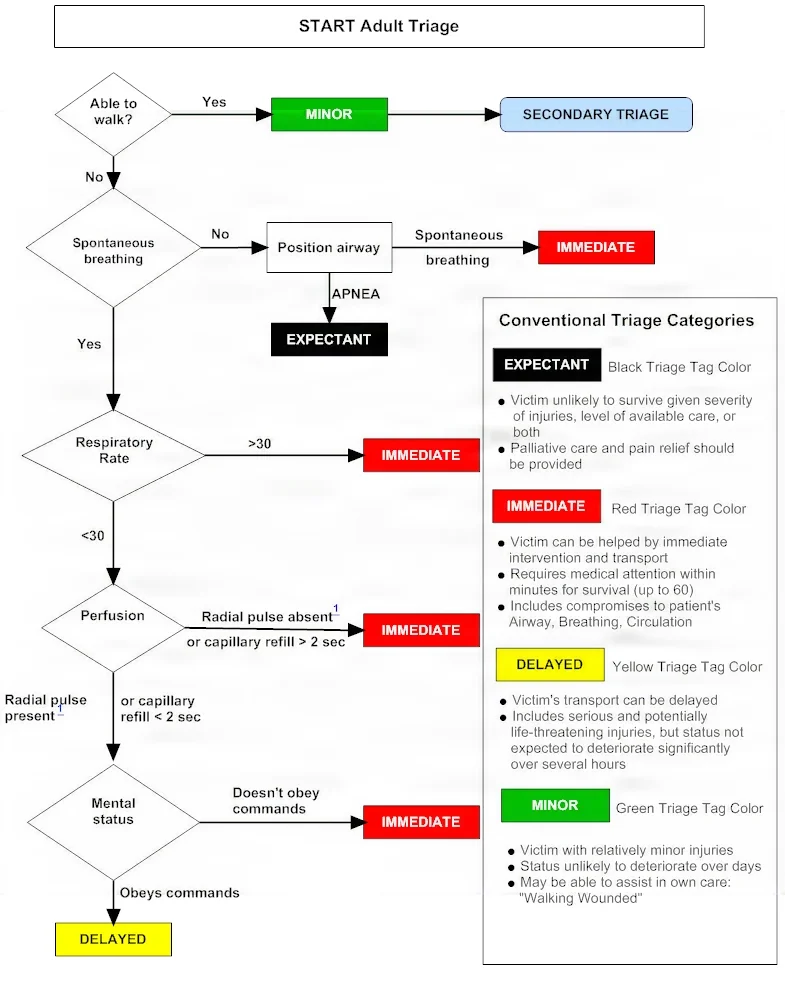
Children are triaged with a version made for them, JumpSTART.
Triage aims to save the most lives. The patient who can be saved with an opened airway comes before the patient who cannot be saved at all.
Your part in triage
Emergency medical technicians and emergency physicians usually have the most triage training. A surgical technologistSUR-jih-kul tek-NOL-uh-jistA member of the operating room team who prepares the sterile field and instruments and hands them to the surgeon.Full entry may train in triage, and supports it with patient care:
- Basic lifesaving: CPR and basic life support. AST's position is that every CSTsee-es-tee (said as letters)Certified Surgical Technologist, a credential for surgical technologists; in maternity care, contraction stress test.Full entry completes a health care provider BLS course and keeps those skills current, because the public can reasonably expect a CST to give lifesaving help in an emergency, in or out of the hospital.
- First aid: such as dressings and splints.
- Transporting patients to treatment, surgery and the loading area.
18Infection control in a disaster
Preventing the spread of disease is one of the main goals in a disaster. Follow your infection control practices as closely as conditions allow, and treat every victim as possibly infectious.
- Standard Precautions, the same as in the hospital (chapter 10).
- Personal protective equipment: eye and face protection, such as goggles, hand protection (exam gloves, latexLAY-teksNatural rubber made from the sap of the rubber tree, used in some gloves, catheters and other medical supplies.Full entry or nonlatex), medical masks over the mouth and nose, protective clothing such as gowns and aprons, and respiratorRES-pih-ray-terA close-fitting mask or hood that filters the air a person breathes to protect them from germs or harmful particles.Full entry where the air is contaminated, fit-tested to seal. Responders' protection comes in four levels, A to D, and the incident commander decides which one the scene needs: level A, the highest, is a fully enclosed suit, as for a chemical spill, and level D is basic protection.
- Waterless hand hygiene: there may be no sink, but hands must still be cleaned between patients, with alcohol-based rubs, foams or wipes.
- decontaminationdee-kun-tam-ih-NAY-shunRemoving or destroying germs, chemicals or radioactive material from a person, surface or object to make it safe.de- removecontamination being made uncleanFull entry , which matters most after a chemical or radiological event.
Decontamination is done in its own area, apart from the treatment area, by teams trained for it, and the facility sets it up where it has the equipment and supplies. Anyone who helped a contaminated victim goes through it too.
- Remove the clothing as soon as possible. After a radiological event this alone removes up to 90 percent of the contamination. Seal the clothing in a waterproof bag.
- Treat wounds first: irrigationeer-ih-GAY-shunWashing out a wound, body cavity, tube or eye with a steady flow of liquid.Full entry them thoroughly with normal saline.
- Wash the skin and hair: with warm water and soap after a radiological event; after a chemical one, with the solution the decontamination protocol names for the agent.
- Use disposable sponges and towels, and give the person a gown or clothing, to keep them from getting cold.
19Your support roles
In a disaster, the surgical technologistSUR-jih-kul tek-NOL-uh-jistA member of the operating room team who prepares the sterile field and instruments and hands them to the surgeon.Full entry 's role is most likely the usual one in the operating room, setting up rooms for emergency surgery and scrubbing the cases, which may include helping to reprocessingree-PROS-es-ingThe steps that make a used reusable medical device safe to use on the next patient.Full entry instruments and equipment. The specific role may be set only at the time of the disaster, and you may do tasks outside your usual job description, but never outside your legal and ethicalETH-ih-kulHaving to do with what is morally right, or acting in line with accepted moral principles.Full entry scope of practiceSKOHP uv PRAK-tisThe actions and duties a licensed professional is legally allowed to perform.Full entry .
The Core Curriculum's support roles for the surgical technologist:
- Evacuation teams, where your skill at positioning and moving patients counts.
- Specialty surgical teams, such as a burnBURNAn injury to the skin or deeper tissues caused by heat, chemicals, electricity, radiation or friction.Full entry or orthopedicor-thuh-PEE-dikHaving to do with the bones, joints, muscles, ligaments and tendons, and the branch of medicine that treats them.orth/o straightped/o child (the field began with straightening children's bones)-ic relating toFull entry team, including on a DMAT.
- Transporting patients, inside the hospital and to the loading area.
When other departments are short of staff, AST's position is that a CSTsee-es-tee (said as letters)Certified Surgical Technologist, a credential for surgical technologists; in maternity care, contraction stress test.Full entry can fill roles that use the skills of the OR, such as processing instruments, inserting urinary catheters, taking vital signs or changing dressings, and can train for other duties; chapter 14 covers the CST as an expert in surgical asepsisSUR-jih-kul ay-SEP-sisPractices that keep an area or object completely free of microorganisms; also called sterile technique.a- withoutsepsis decay, infectionFull entry for other departments.
Surgical technologists may also work in international disaster relief, which calls for extensive experience and training, because each person may do the work of several.
Look after yourself, too. The work is stressful and can be disturbing. Stay calm, cooperate, keep track of your own physical and mental health, and use the support your facility offers its staff.
20Moral and ethical issues
A disaster brings out the best in people and some of the hardest choices in health care.
- Who gets care first, and who gets scarce resources? In triageTREE-ahzhSorting clients by how urgently they need care, to decide who is seen first.Full entry , an unresponsive patient with a severe head injury may be tagged expectant, while one who needs only an opened airway is treated at once. When mechanical ventilationmeh-KAN-ih-kul ven-tuh-LAY-shunBreathing support from a machine, a ventilator, that pushes air into the lungs through a tube or a mask.Full entry run short, who receives one, and should it depend on age, other illnesses or ability to pay? There is no time to debate at the scene, so these questions are best decided before a disaster.
- Altered care. To save as many people as possible, normal standards may have to bend, for example by limiting some supplies to certain patients, or even operating on two patients in one room.
- Health services for all populations. Poor, older, disabled and chronically ill people are often invisible in a disaster and cannot always speak up for themselves; they may be forgotten unless their needs were planned for. People who can reach help are helped first. The plan must reach people with disabilities, language barriers and other access needs, and reunite families, including children found alone.
- Different needs. What one person thinks is essential may be far more or less than the situation can provide, and responders must also decide what priority to give animals.
- Legal questions: whether responders from another state are protected by its laws, and whether responders should be shielded from lawsuits over the quick decisions they must make.
Think these questions through now, with your classmates, so you understand your own convictions, and other people's, before a disaster forces a choice.
What to take from this chapter
- The sterile team (the scrub, the first assistant and the surgeon) performs the operation; the nonsterile team (the RN circulator, the assistant circulator and the anesthesia provider) supports it, with support personnel from the anesthesia technician to the perfusionist.
- The chain of command sets who reports to whom, from the board and CEO down to you. Report through your line manager, and in an emergency follow the chain the plan sets.
- The OR depends on the departments that give direct care (blood bank, labs, imaging, nursing units, pathology) and those that support it (biomedical engineering, environmental services, facilities, security, nutrition, pharmacy, sterile processing).
- Care is paid for by private insurance, HMOs and PPOs, Medicare and Medicaid. A DRG pays a set amount for a case whatever it costs, which is why every scrub practices cost containment.
- The suite is designed for infection control, environmental safety and efficiency, in a racetrack, hotel-style or central core plan, with unrestricted, semirestricted and restricted zones. Clean and soiled traffic are kept apart.
- The OR is kept at positive pressure with at least 20 air exchanges an hour, 68 to 75°F (20 to 24°C) and 20 to 60 percent humidity, doors closed and no fans. Red outlets run on the generator; read a cylinder's label, never its color.
- Read the SDS for every hazardous chemical, secure every gas cylinder upright, double-glove with chemotherapy gloves for hazardous drugs, use lifting equipment for heavy loads, and know RACE and PASS.
- Disasters are met with an all-hazards plan through four phases (mitigation, preparedness, response, recovery), run through NIMS and the incident command system, HICS in the hospital. START sorts victims as immediate, delayed, minor or expectant, and in a disaster you do your usual work and support roles, never outside your scope of practice.
Check yourself5 quick questions
Free for everyone. Pick an answer for each, then check them all at once.
In the ORWhere you'll use this
The chapter's whole question pool in sets of 10, with the answer explained after each one.
Part of the educators programThe chapter's words on spaced cards: the ones you miss come back sooner.
Part of the educators programGiven by your class's teacher. Each class draws its own 25 from the chapter's pool.
Part of the educators program
Suggest a fix
Something wrong, unclear or out of date in this chapter? Tell us and we will fix it for everyone. Your email is only used to reply.