The patient as a person
Every patient brings fears, a family, a culture and a life to the operating room. How you meet those needs, protect their dignity, care for the patients who need more, and care for the patient, the family and the team when death comes.
1Why it matters
The patient on the table is a person before they are a procedure. They bring a body that needs care, and they also bring fears, a family, a culture, a faith and plans for their life. Every patient is unique, and a good outcome depends on care built around all of those needs, which is called holistic, patient-centered carePAY-shunt SEN-terd KAIRCare planned around the client's own needs, values and choices, with the client as a full partner in decisions.Full entry .
Most surgical patients feel anxious, and many are afraid. They worry about the outcome, and about everything they cannot control once they enter the hospital. You may spend only a few minutes with a patient, in the holding area or on the stretcher, or much longer in an outpatient center. Either way, you can read a patient's needs from what they say and from what their face and body show you, and every contact, however brief, is a chance to help.
Once anesthesiaan-us-THEE-zhuhLoss of feeling or sensation, often brought on by drugs so that surgery or a procedure can be done without pain.an- withoutesthesi/o feeling, sensation-ia conditionFull entry begins, the patient cannot see, speak or protect themselves. They depend on the team to respect their body, to uncover only what the procedure needs, and to act as they would ask if they could.
Some patients die. A death in the operating room is rare, but every surgical technologistSUR-jih-kul tek-NOL-uh-jistA member of the operating room team who prepares the sterile field and instruments and hands them to the surgeon.Full entry needs to know how to care for the patient, the family and the team when it happens, and how organ and tissue donation can give life to others.
This chapter teaches the patient's needs, the patients who need extra care, and death and dying. Other chapters hold the pieces around it: communication itself, listening and speaking up in chapter 16; consent, advance directivead-VANS dih-REK-tivA legal document in which a person states their wishes for medical care, for a time when they cannot speak for themselves.Full entry , living willLIV-ing WILA written legal document that says which medical treatments a person does or does not want if they cannot speak for themselves.Full entry , the do-not-resuscitate orderdoo-not-rih-SUS-ih-tayt OR-derA provider's order that CPR will not be started if the client's heart or breathing stops.Full entry choices in the OR, the right to refuse blood and the patient rights The Joint Commissionthuh JOYNT kuh-MISH-unAn independent US organization that inspects and accredits hospitals and other health care organizations against safety and quality standards.Full entry requires in chapter 15; a child's temperature, fluids, airway and drug doses, parents at inductionin-DUK-shunThe starting of a process on purpose, such as bringing on labor or putting a client under anesthesia.Full entry , and the PACU in chapter 13; congenitalkun-JEN-ih-tulPresent at birth.con- withgen birth, origin-al relating toFull entry defects in chapter 11; diabetes and other gland disease in chapter 9; isolation precautionseye-suh-LAY-shun prih-KAW-shunzExtra infection-control measures, added to standard precautions, for clients known or thought to have certain contagious infections.Full entry and latex allergyLAY-teks AL-er-jeeAn allergic reaction to proteins in natural rubber latex, found in some gloves, catheters and other products.Full entry in chapter 10; communication barriers, transport, transfer and positioning as steps in chapter 31; radiationray-dee-AY-shunEnergy that travels as waves or particles, such as X-rays, used to make images or treat cancer; also pain that spreads from its starting point.radi/o rays, radiation-ation processFull entry safety in chapter 22; the steps of the organ recovery operation on the Organ Procurement card; and the transplant operations in their procedure chapters.
2The whole patient
Holistic care
holistic carehoh-LIS-tik kairCare that looks after the whole person: body, mind, emotions, relationships and spiritual needs.Full entry treats the whole person: the body, the mind, the person's place among family and friends, and their spirit. A patient facing the loss of a leg may wonder whether they will walk again (a physical question), whether they are still the same person (a psychological one), who will care for their children and how others will see them (social ones), and why this happened to them (a spiritual one). Each of those questions is a need.
patient-centered carePAY-shunt SEN-terd KAIRCare planned around the client's own needs, values and choices, with the client as a full partner in decisions.Full entry is care, communication and intervention planned around the unique needs of this patient. The team learns those needs from other caregivers, from the chart, from careful observation, and from talking with the patient.
perioperativepair-ee-OP-er-uh-tivRelating to the whole time around a surgery: before, during and after it.peri- aroundoperative relating to surgeryFull entry care is also outcome oriented: the team names a desired result for the patient that can be measured, such as "the patient says their anxiety is under control" or "the patient stays free of infection," and then checks whether the care achieved it.
Carl Rogers, a psychologist who worked with Maslow, developed the person-centered approach. Rogers held that every person can grow toward good health in mind and body, and that love, empathy, unconditional acceptance and genuineness from others help a person get there.
Start with yourself
Before you can support patients, look at your own attitudes, because they can get in the way of honest, caring communication. Many people are surprised to find biases they did not know they had. Ask yourself questions such as these:
- How do I feel about faiths other than my own, or about people with no faith?
- How do I act around people with a severe physical disability, a mental illness or a very large body?
- How do I usually treat older adults, children and immigrants?
- What do I believe about people who have been through trauma, and how much of it comes from television and movies?
- How would I cope with a life-threatening illness of my own?
Stepping outside your own beliefs to see through someone else's eyes is hard, and in health care it is required. Attitudes that are stereotyped or prejudiced end up harming care, so this reflection never really ends.
You cannot meet a need you have not noticed. Watch, listen and ask, and treat the person in front of you as an individual, never as "the hysterectomyhis-tuh-REK-tuh-meeSurgery to remove the uterus.hyster/o uterus-ectomy surgical removalFull entry in Room 5."
3Maslow's hierarchy of needs
The psychologist Abraham Maslow described human needs as a pyramid of five levels, now called Maslow hierarchy of needsMAZ-loh HY-er-ar-kee uv needzA theory that ranks human needs in five levels, from basic body needs at the bottom to self-fulfillment at the top.Full entry . The most basic needs sit at the bottom. In Maslow's model, the needs of one level must be met before a person can turn to the level above it. Health care uses the model to understand patients and to decide which needs come first.
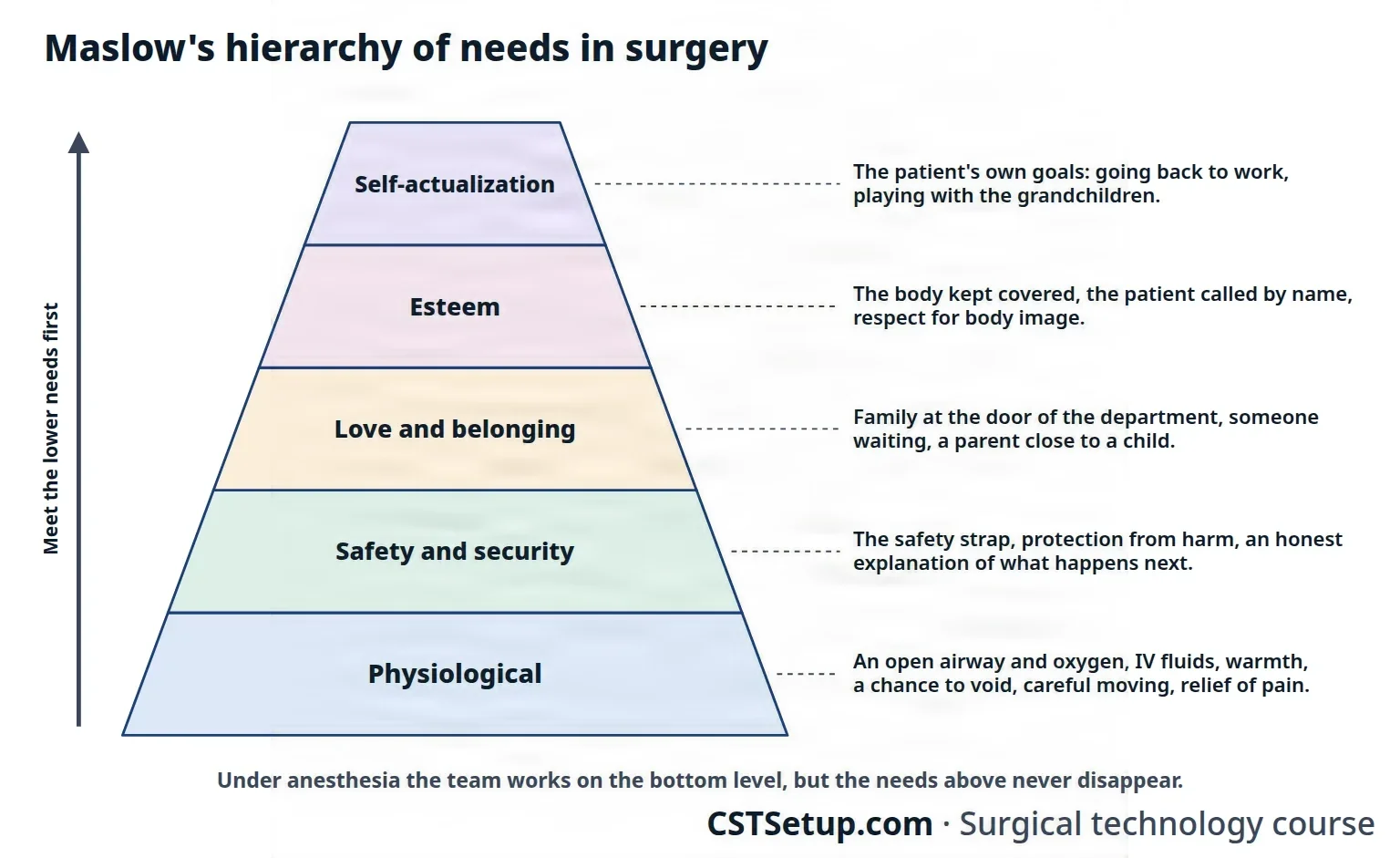
Level 1: Physiological needs
The most basic needs keep the body alive: air and oxygen, water and food, warmth, rest, elimination, movement and freedom from pain. In surgery, the team meets them by keeping the airway open and giving the right mix of oxygen, giving IV fluids, controlling the patient's temperature with blankets and warming devices, protecting the patient from noise, bright light and cold, giving a chance to void or placing a catheter, moving the patient with care, and watching for and treating pain.
Level 2: Safety and security
Safety means freedom from real or feared harm to the body or the mind, and security includes the ability to care for oneself and one's family. When people cannot feel safe, they become anxious and even afraid. Most surgical patients are anxious, about the operation itself but also about their independence, their income and the people who depend on them.
Level 3: Love and belonging
Family, friends and the groups people belong to give them a sense of being accepted and needed. Social support seems to help the immune system and to lower stress. Family members often come with the patient, wait during the operation and stay through recovery, and the moment of separation at the door can be very emotional. A caring, professional attitude toward the family matters as much as toward the patient.
Level 4: Esteem
Esteem is respect: how others see a person shapes how that person sees and cares for themselves. People who are disrespected for their culture, income, faith or other traits often develop low self-esteem. body imageBOD-ee IM-ijHow a person sees, thinks and feels about their own body and its appearance and function.Full entry , the way a person believes others see their body, is closely tied to esteem. A sudden change, or a feared change, such as an amputationam-pyoo-TAY-shunThe removal of all or part of a limb or other body part, by surgery or by injury.Full entry or a large scar, can bring embarrassment, a feeling of rejection and isolation, and some patients need counseling or a support group to adjust.
Level 5: Self-actualization
Self-actualization is a person's ability to plan for and reach their own life goals. Illness and surgery can threaten those goals, through a lost function or a changed body, and the grief many patients feel can come from that loss. You help by acknowledging the patient's feeling of loss.
Using the pyramid in the OR
The pyramid tells you what comes first. Under anesthesiaan-us-THEE-zhuhLoss of feeling or sensation, often brought on by drugs so that surgery or a procedure can be done without pain.an- withoutesthesi/o feeling, sensation-ia conditionFull entry , the physiologicfiz-ee-uh-LOJ-ikRelating to the normal working of the body.physi/o nature, body function-logic relating to the study ofFull entry level takes priority: airway, breathing, circulation, blood volume and pain. But the higher needs do not disappear while the team works. A patient waiting for a mastectomyma-STEK-tuh-meeSurgery to remove all or part of a breast.mast/o breast-ectomy surgical removalFull entry who asks you twice whether they could "wake up during it" has warm blankets, an IV and oxygen; the need still unmet is safety, and an honest, calm answer, with the anesthesia provideran-us-THEE-zhuh pruh-VY-derThe licensed professional who gives anesthesia and watches over the client's breathing and vital functions during a procedure.Full entry called to explain further, meets it.
4Fear and anxiety
What patients fear
These fears are common in surgical patients:
- anesthesiaan-us-THEE-zhuhLoss of feeling or sensation, often brought on by drugs so that surgery or a procedure can be done without pain.an- withoutesthesi/o feeling, sensation-ia conditionFull entry : not waking up, or feeling pain while paralysispuh-RAL-uh-sisLoss of the ability to move a part of the body, and sometimes loss of feeling in it.para- beside, abnormal-lysis looseningFull entry . Anesthesia awareness, in which a patient under general anesthesiaJEN-er-ul an-es-THEE-zhuhDrug-induced loss of consciousness and feeling over the whole body, so a person feels nothing and is not aware during surgery.an- withoutesthesi/o feeling, sensation-ia conditionFull entry hears and feels the surgery and remembers it, is real but rare, and films and news stories have made the public far more afraid of it than the risk warrants. The anesthesia provideran-us-THEE-zhuh pruh-VY-derThe licensed professional who gives anesthesia and watches over the client's breathing and vital functions during a procedure.Full entry explains the anesthetican-us-THET-ikA drug that causes loss of feeling, with or without loss of consciousness.an- withoutesthesi/o feeling, sensation-ic relating toFull entry before surgery, and a patient at high risk can have their brain activity monitored. Chapter 13 covers depth of anesthesia.
- Death: often greater before a general anesthetic or radical cancer surgery, because being unconscious and in someone else's control feels close to dying.
- Pain: a normal, protective fear, made worse by unanswered questions or a bad experience after an earlier operation.
- Disfigurement: a realistic fear before radical or reconstructive surgery, because the body is part of a person's identity and a changed appearance can bring stigmaSTIG-muhNegative beliefs and labels that society attaches to a condition or group of people, leading to shame and unfair treatment.Full entry and rejection.
- Loss of control: patients often feel they have lost their rights and their say once they enter the hospital, and anesthesia makes it worse. Some stay calm; others regress and act helpless or childlike.
- Physical exposure: the fear of being uncovered and losing dignity is strong in many patients, especially adolescents.
- Loss of privacy: fear that their health information will leak out and cost them a job or a relationship.
- The unknown: not knowing what will happen, and expecting the worst.
Why anxiety matters
Fear is more than discomfort. Severe anxiety before surgery changes the way the body works, and with it the way the body responds to anesthesia. A very anxious patient is more prone to deliriumdih-LEER-ee-umA sudden state of confusion and poor attention that comes and goes over hours or days.Full entry while waking from a general anesthetic, needs more pain medicine afterward, and communicates less well with the team. High anxiety can also raise the blood pressure and the heart's workload, and it is linked to depression, fear and anger after surgery.
Watch for the signs: crying, withdrawing, biting fingernails, talking a lot, or avoiding eye contact. Report a very anxious patient to the circulator and the anesthesia provider. An anxiolyticang-zee-oh-LIT-ikA drug that relieves anxiety.anxi/o anxiety-lytic breaking down, relievingFull entry , a drug that relieves anxiety, is often given before surgery to a patient who is highly anxious.
Supportive communication
Supportive communication is a deliberate way of talking with patients that responds to what they need, whether they say it or only show it. Listening comes first. Then you acknowledge the concern and show empathy. Chapter 16 teaches communication skills; here is how they meet a patient's fear:
- Listen. Make eye contact as the patient's culture allows, and give the patient your full attention. Divided attention looks like a lack of concern. People need time to say what worries them.
- Give information, honestly. Most patients want to understand what is happening around them, explained without jargon. Say so when you do not know. If a question is medical, or needs an assessment, refer it to the surgeon or the nurse: a delayed answer is better than a wrong one.
- Reassure by thinking ahead. Tell patients what will happen to the things that worry them, such as where their glasses or hearing aids will be when they wake.
- Clarify. Repeat back what you heard and ask what they meant, so the patient knows you are really listening.
- Never dismiss or joke about a fear. Explain instead. If a patient tenses when the safety strap goes across their thighs, tell them what it is for: the table is narrow, and the strap keeps them safe on it.
Some patients feel calmer with a loved one beside them before surgery; others would rather be alone. Ask, and follow facility policy. Some facilities also offer calming measures such as music, which has been studied for preoperative anxiety.
Calming the frightened or confused patient
Fear can overwhelm a patient who does not understand where they are, cannot cope, or cannot say what they need, such as a person with dementiadih-MEN-shuhA long-term, usually worsening decline in memory and thinking that is serious enough to affect daily life.de- away fromment mind-ia conditionFull entry or a severe developmental disabilitydih-vel-up-MEN-tul dis-uh-BIL-ih-teeA lifelong condition, starting in childhood, that limits a person's physical, learning, language or behavior skills.Full entry . The anesthesia team and the circulator usually manage these patients, often with an anxiolytic. You help by keeping the room calm:
- Keep the room quiet; soft music may help, if facility policy allows it.
- Speak in short, direct sentences, in a calm voice, to the patient and to the team. Long explanations and chatter usually make things worse.
- Touch with confidence when you place the safety strap or the electrocardiogramih-lek-troh-KAR-dee-oh-gramA test that records the heart's electrical activity as waves on paper or a screen.electr/o electricitycardi/o heart-gram recordFull entry leads, never hesitantly.
- Watch for growing agitation and tell the anesthesia provider.
- Cover the patient with a warm blanket, which feels secure, unless there is a risk of overheating.
How patients cope
Under stress, patients use coping mechanisms, ways of handling a threat until they can face it. Some common ones:
- denialdih-NY-ulRefusing to accept or believe a painful fact or situation, often without being aware of doing so.Full entry : refusing to accept what is happening.
- Rationalization: explaining it away, such as blaming an illness on "bad genes" rather than facing a needed change.
- Regression: going back to the behavior of an earlier age, such as curling up, crying hard or pouting, and leaning on others.
- Repression: pushing the thoughts away and refusing to talk about the illness at all.
Positive or negative, these are the patient's ways of working toward accepting what is happening and, in time, making decisions about their care. Recognize them for what they are.
5Dignity and privacy
Keep the body covered
Cover the patient's body at all times, uncovering only what the procedure needs, and only when it needs it. Protect the patient's modesty and dignity even after anesthesiaan-us-THEE-zhuhLoss of feeling or sensation, often brought on by drugs so that surgery or a procedure can be done without pain.an- withoutesthesi/o feeling, sensation-ia conditionFull entry , when they cannot protect it themselves, such as when the legs are raised into stirrups. Sheets and blankets, and closed blinds on any window, protect privacy.
A patient who is sedationsih-DAY-shunA calm, relaxed or sleepy state brought on by drugs, or the use of drugs to cause it.sed calm, settle-ation processFull entry or asleep is trusting every member of the team to protect their dignity, show them respect and behave professionally for the whole case.
Watch what you say
The team was once reminded that hearing is the last sense to go under anesthesia and the first to come back, and many took that to mean what was said during surgery did not matter. Today we know that some patients remember what they heard. Never assume a patient is unaffected by the conversation and comments in the room.
A patient under local or regional anesthesia, even when sedated, may be awake enough to hear. Keep talk of the diagnosis and idle conversation to a minimum: a personal conversation the patient overhears can be misunderstood and cause needless worry. Hearing also seems to last late into the dying process, so speak to and around a dying patient as though they can hear you.
Names and respect
Call patients by their proper names. Words such as "sweetie" or "honey" offend many patients and sound disrespectful. In some regions staff use first names freely; use discretion, and ask what the patient prefers.
Patients also fear for the privacy of their information. Holding everything you learn about a patient in strict confidence is an ethicalETH-ih-kulHaving to do with what is morally right, or acting in line with accepted moral principles.Full entry duty; chapter 15 covers HIPAA and confidentiality. The Joint Commissionthuh JOYNT kuh-MISH-unAn independent US organization that inspects and accredits hospitals and other health care organizations against safety and quality standards.Full entry requires hospitals to treat every patient with dignity and respect.
6Culture, faith and spirituality
Culture shapes care
Culture is the beliefs, values, practices and preferences a person learns from the people they grow up with. Knowing a patient's background improves communication, builds trust and leads to better outcomes. cultural competenceKUL-cher-ul KOM-puh-tensThe ability to give care that respects and fits a client's culture, values, beliefs and language.Full entry is the ability to support and care for people whose culture and beliefs differ from your own. It begins with acceptance and respect, and it is learned through experience and active study. cultural humilityKUL-chur-ul hyoo-MIL-ih-teeA lifelong habit of self-reflection and learning in which the nurse treats each client as the expert on their own culture.Full entry goes with it: admitting that you cannot know everything about another culture, and making learning about other cultures a lifelong goal.
Culture is never a rule that tells you what one person wants. Two people from the same country, or the same faith, may want very different things. Never look at another culture through the lens of your own, and never guess: ask the patient, and the family if the patient wishes, what they prefer.
What a patient may ask for
These are some of the requests patients make for reasons of culture, faith or identity. Treat each as a question to raise with the patient, never as a rule for a group:
- Language: a medically trained interpreter for consent and teaching, and written material in the language the patient reads (see Communication barriers, below).
- Modesty: a gown or drape that covers more, and positioning and draping that respect the patient's norms.
- Gender: caregivers of the same gender, when that can be arranged.
- Name and pronouns: a patient, such as an LGBTQIA+el-jee-bee-tee-kyoo-eye-ay-PLUS (said as letters)A short form for sexual and gender minority groups: L lesbian, G gay, B bisexual, T transgender, Q queer or questioning, I intersex, A asexual, + others.Full entry + patient, may have a preferred name and pronouns. Ask what the patient prefers, use them every time, record them, and pass them on to everyone who cares for them.
- Touch: for some people a hand on the arm is a comfort; for others, touch from a stranger is offensive. Some patients consider the top of the head sacred and would rather put on their own surgical cap.
- Eye contact: avoiding eye contact may be a sign of respect, never proof of fear or dishonesty. Silence does not always mean agreement or understanding, either.
- Who speaks: in some families another member answers questions for the patient or helps make decisions. Ask the patient how they want decisions made.
- Food and fasting: religious fasting periods and diet rules can affectAF-ekt (stress on the first syllable)In mental health, the outward expression of a person's emotions, as seen in the face, voice and body language.Full entry the instructions before and after surgery.
- Traditional remedies: ask about herbs, supplements and traditional healing practices, because some interact with anesthesiaan-us-THEE-zhuhLoss of feeling or sensation, often brought on by drugs so that surgery or a procedure can be done without pain.an- withoutesthesi/o feeling, sensation-ia conditionFull entry or raise the risk of bleeding.
When a belief cannot be honored because it would harm the patient, explain why and offer an alternative if there is one.
Spirituality and religion
Spirituality is a sense of something greater than humankind, beyond the physical senses. It is not the same as religion, though the two are often joined. A patient may call that power the creator, spirit or God, or have no name for it. Religions express spiritual life through rituals, practices with special meaning, such as prayer. For many patients faith is a major source of healing, as important to their well-being as the operation itself.
Faiths often have rules that touch health care. Topics they commonly cover include:
- blood and blood productBLUD PROD-uktAny part of donated blood prepared for transfusion, such as red cells, plasma or platelets.Full entry , and medicines made from blood
- organ donation, autopsyAW-top-seeAn exam of a body after death to find the cause of death or to study a disease.Full entry , and donating the body after death
- amputationam-pyoo-TAY-shunThe removal of all or part of a limb or other body part, by surgery or by injury.Full entry , and burial of an amputated limb or the placentapluh-SEN-tuhThe organ that grows in the uterus during pregnancy and passes oxygen and food from the parent's blood to the fetus.Full entry
- cutting body hair, and spiritual objects worn on the body
- diet, opioid analgesicOH-pee-oyd an-ul-JEE-zikA strong drug that relieves moderate to severe pain by acting on the brain and spinal cord.Full entry and other drugs, and alternative remedies
- embalming, cremation, and anointing with oil during sickness and death
A practice may be followed strictly even when religious law does not require it, so the patient's own wishes are what count. Refusal of blood is covered in chapter 15.
Patients may bring religious items, such as prayer beads, icons, religious jewelry or a prayer book, that give them strength. Safeguard them so they are never lost. Jewelry cannot be worn in surgery, so if a patient does not want to take an item off, explain the risk carefully; when possible, a family member keeps it until the patient returns.
Every facility has rules for what happens to body parts removed in surgery, including the placenta. When a patient asks to take one home, for burial or another rite, follow your facility's policy.
Learn where your facility's chapel or prayer room is and how to reach the chaplain. Chaplains are trained to support patients and families, and they can find a leader of a faith that has none on staff. A patient may ask for a visit from clergy before surgery.
The Joint Commissionthuh JOYNT kuh-MISH-unAn independent US organization that inspects and accredits hospitals and other health care organizations against safety and quality standards.Full entry requires hospitals to respect each patient's cultural and personal values, beliefs and preferences, and to make room for religious and spiritual services.
Culture and faith tell you which questions to ask, never what the answer is. Ask each patient what they need, and honor it as far as safety allows.
7Patients who need more
Every patient needs support through surgery, but some need more: patients who cannot easily understand or cope with the surgical setting, and patients whose bodies face extra risk. The Core Curriculum calls them susceptible populations. Their physical care is taught with anesthesiaan-us-THEE-zhuhLoss of feeling or sensation, often brought on by drugs so that surgery or a procedure can be done without pain.an- withoutesthesi/o feeling, sensation-ia conditionFull entry , transport and positioning; this section is about what each one needs from you as a person.
Every patient also needs their allergies known. Allergies to drugs, latexLAY-teksNatural rubber made from the sap of the rubber tree, used in some gloves, catheters and other medical supplies.Full entry , foods, blood productBLUD PROD-uktAny part of donated blood prepared for transfusion, such as red cells, plasma or platelets.Full entry and contrastKON-trastA dye or other substance given before an imaging test so body parts show up more clearly.Full entry are found before surgery, recorded in the chart, and shown on an allergy band placed on a limb that is out of the way of the operation. Chapter 10 covers latex allergyLAY-teks AL-er-jeeAn allergic reaction to proteins in natural rubber latex, found in some gloves, catheters and other products.Full entry and chapter 12 drug reactions.
Communication barriers
Some patients cannot easily understand you, or tell you what they need. The barrier may be physical, such as hearing, sight or speech loss, or nonphysical, such as a different language or a cognitive impairmentKOG-nih-tiv im-PAIR-muntTrouble with thinking, memory, learning, attention or making decisions that is more than expected for the person's age.cognit- knowing-ive relating toFull entry . A patient with a severe hearing loss or a language barrier needs an interpreter to understand the operation and what it means for them.
Hearing loss. Nearly a quarter of adults aged 65 to 74, and half of those 75 and older, have disabling hearing loss. Hearing loss says nothing about intelligence, and not every patient with hearing loss can lip-read or sign. Only about 20 to 30 percent of words can be read on the lips, and a mask hides the mouth entirely.
- Ask how the patient prefers to communicate: hearing aids, lip-reading, sign language, writing, or a picture or word board.
- Keep hearing aids in as long as possible. A visit before surgery, while the hearing aids are still in, lets you explain what will happen.
- Get the patient's attention before you speak. Face them, in good light, in a quiet spot, and speak slowly and clearly in few words.
- A patient who is deaf needs an interpreter, such as one fluent in American Sign Language.
Sight loss. Introduce yourself, explain each event before it happens, such as the move to the OR bed, describe the room and who is in it, and stay in contact. Return glasses as soon as possible after surgery.
Speech loss. Patients who cannot speak may use alphabet or picture boards, speech-generating devices or speaking valves. These aids, and the help the patient needs, are noted in the record and passed on to everyone caring for them.
A different language. Use a trained medical interpreter, in person, by video or by phone. Using a trained interpreter is linked to fewer errors, shorter stays and more satisfied patients. Do not use family members, or staff who are not trained interpreters, to interpret: family may not know medical words, and a patient may hold back private information in front of them. The Joint Commissionthuh JOYNT kuh-MISH-unAn independent US organization that inspects and accredits hospitals and other health care organizations against safety and quality standards.Full entry accepts trained bilingual staff, contracted services or employed interpreters. When the topic is sensitive, an interpreter of the same gender may spare the patient embarrassment.
Cognitive impairment. Meet the patient at their level of understanding, with simple words and pictures or short videos. A caregiver or advocateAD-vuh-kayt (verb), AD-vuh-kit (noun)To speak up and act for a client's rights, safety and wishes; also, a person who does this.Full entry can help, but never talk over the patient as if they were not there.
The Joint Commission requires hospitals to give patients information in a way they understand, with interpreters as needed. Chapter 31 covers how to work with these patients during preparation and transport.
Children
In children's surgery, the patient and the family cannot be separated: both need the same care in communication and support. A child's understanding depends on their developmental age, which does not always match their age in years.
The greatest fears of young children in surgery are fear of the unknown, fear of being separated from their parents or caregivers, and fear of being hurt or cut apart (mutilation). Trust begins with honest, careful descriptions of what will happen.
A child life specialist is trained to support children and families and to explain surgery to a child at their own level. Many hospitals offer a visit before surgery, a tour, or child-friendly videos and other age-appropriate tools, so the child can see the place and ask questions before the day comes.
| Age | What the child is like | What helps |
|---|---|---|
| Infant, birth to 12 months | Learning to trust. Needs touch and is upset by loud noise and sudden change. From about 7 months, fears separation and strangers | Holding, a parent close by as long as policy allows, a familiar blanket or soft toy (labeled and returned to the parent) |
| Toddler, 13 months to 2 years | Wants to do things alone, has a short attention span, and understands more than they can say. Separation brings anxiety, the OR can be terrifying, and more restraintrih-STRAYNTAny device, drug or method used to limit a person's movement or behavior that they cannot easily remove or refuse.Full entry brings more fear | A favorite toy, patience, and short, truthful explanations without details |
| Preschooler, 3 to 5 years | Fears the unknown, takes words literally, and may see surgery as a punishment. Uses magical thinking | Simple, factual words that never sound like harm; letting the child touch and play with the mask, such as putting a small one on a teddy bear; a bandage over the wound |
| Middle childhood, 6 to 11 years | Thinks in concrete terms and is curious. Fears harm and pain, but can follow simple cause and effect. Very sensitive about being uncovered | Telling the child what to expect, simple choices, privacy |
| Early adolescence, 12 to 14 years | Thinks ahead. Worries most about friends, body imageBOD-ee IM-ijHow a person sees, thinks and feels about their own body and its appearance and function.Full entry and losing mobility. Values privacy and independence, and may hide fear and pain | Straight, no-nonsense explanations; privacy; respect for independence |
| Late adolescence, 15 to 17 years | Strongly independent, resents being confined, and values time with friends. Understands illness | Concrete explanations, privacy and choices |
The age lines differ a little between references, so use them as a guide and watch the child in front of you.
Magical thinking is the belief that objects have intentions of their own, or that something happens because one wished it. It is a normal stage in young children. A toddler may believe the blood pressure cuff squeezing their arm is angry with them, or that their skin holds their body together, so any break in the skin is frightening and a bandage over it matters.
Words matter. Use simple words without double meanings, and avoid words that sound like harm. Say "a pinch" rather than "a stick" or "a poke," and avoid "put to sleep." Be honest about pain: a child who is lied to stops trusting. Get down to the child's eye level, speak softly, and do not assume you were understood.
In the room. Keep frightening instruments out of sight and the room quiet, and bring a toddler in only when the room and the team are completely ready, so inductionin-DUK-shunThe starting of a process on purpose, such as bringing on labor or putting a client under anesthesia.Full entry is quick. Someone stays with the child until they are asleep, and a security object stays until induction is over. Accept crying: it is how a child shows fear. A child who goes to sleep calm usually wakes up calm.
Adolescents need as much privacy and choice as possible. A teen who is not sedationsih-DAY-shunA calm, relaxed or sleepy state brought on by drugs, or the use of drugs to cause it.sed calm, settle-ation processFull entry may walk into the OR. They may not answer some questions in front of a parent. Procedures that expose them, such as hair removal, the skin prep or placing a urinary catheter, are done after they are asleep, and they stay covered as much as the procedure allows.
Chapter 13 covers a child's temperature, fluids, airway and drug doses, and parents at induction; chapter 28 covers planning the case and the setup for a child; chapter 31 covers transport and positioning; chapter 11 covers the congenitalkun-JEN-ih-tulPresent at birth.con- withgen birth, origin-al relating toFull entry defects that much of children's surgery corrects, and the operations are in their specialty chapters.
Older adults
Older adults are usually defined as people 65 and older, but age alone says little about risk: many older people are healthier than some young adults. Most, though, bring at least one chronic condition, and their organs have less reserve, so they recover more slowly and are more sensitive to anesthetican-us-THET-ikA drug that causes loss of feeling, with or without loss of consciousness.an- withoutesthesi/o feeling, sensation-ic relating toFull entry and pain drugs.
Older patients are often stereotyped. Speaking to them like small children, in short, simple sentences, a high-pitched voice and "we" in place of "you," is called infantilizing, and it is linked to poorer outcomes. Speak to an older patient as you would to any adult. Listen and acknowledge a worry rather than brushing it off with a cliché, and use the patient's proper name, never "sweetie."
Never assume an older patient is confused. dementiadih-MEN-shuhA long-term, usually worsening decline in memory and thinking that is serious enough to affect daily life.de- away fromment mind-ia conditionFull entry is not part of normal aging. A patient who seems disoriented may simply not see or hear well, and moving from a dim holding area into the bright lights of the OR can leave them blinded for a moment. Orient them: tell them where they are, who is there and what is happening.
Older adults want a voice in their own care, and being independent matters to them a great deal. A patient with declining cognitionkog-NISH-unThe mental processes of thinking, knowing, remembering, judging and solving problems.Full entry may struggle with consent, with the site check and with describing pain, and deliriumdih-LEER-ee-umA sudden state of confusion and poor attention that comes and goes over hours or days.Full entry is one of the most common complications after surgery in patients over 65. Returning glasses, hearing aids and dentures early, frequent reorienting, and familiar people and objects help prevent it.
Their skin is thin and fragile, joints are often stiff, and they lose heat easily, so they need gentle handling, careful padding and warmth (chapters 13 and 31). While helping to position an older patient, the team may see signs of abuse or neglectnih-GLEKTFailure to give a child or dependent adult the food, shelter, care, safety or medical help they need.Full entry , which are reported according to facility policy and the law.
Pregnant patients
A pregnant patient may need surgery related to the pregnancy or unrelated to it. Either way, the team cares for two patients, and the patient's obstetric care provider helps plan the operation. Many pregnant patients worry that anesthesia or the operation will harm the baby, and those worries deserve full, honest answers.
Elective surgery is put off until after delivery when it can be. When surgery cannot wait, the team watches the fetus as well as the patient, often with a fetal heart monitor, and works to prevent preterm laborPREE-turm LAY-berLabor that begins after 20 weeks and before 37 weeks of pregnancy.Full entry and blood clots. Pregnancy changes the vital signs, so a pregnant patient may lose a large amount of blood before the usual signs of shockshokA life-threatening state in which blood flow is too low to bring enough oxygen to the body's tissues.Full entry appear.
Lying flat, the pregnant uterus can squeeze the vena cavaVEE-nuh KAY-vuhOne of the two large veins that return oxygen-poor blood from the body to the right atrium of the heart.Full entry and aorta, which drops the blood pressure and the blood flow to the baby. A wedge under the right hip, or tilting the table about 15 degrees to the left, relieves it. Anesthetic drugs cross the placentapluh-SEN-tuhThe organ that grows in the uterus during pregnancy and passes oxygen and food from the parent's blood to the fetus.Full entry to the baby. Chapter 31 covers positioning, chapter 12 drugs in pregnancy, and chapter 22 radiationray-dee-AY-shunEnergy that travels as waves or particles, such as X-rays, used to make images or treat cancer; also pain that spreads from its starting point.radi/o rays, radiation-ation processFull entry safety.
Immunocompromised patients
An immunocompromisedim-yoo-noh-KOM-pruh-myzdHaving an immune system that is weaker than normal at fighting infection.immun/o immune, protectioncompromised weakenedFull entry patient's immune system is weakened, so they fight infection poorly. The very young and the very old are often affected. So are patients with diseases that weaken the immune system, such as AIDSAYDZAcquired immunodeficiency syndrome: the most advanced stage of HIV infection, when the immune system is badly damaged.Full entry , diabetes or overwhelming sepsisSEP-sisA severe whole-body response to an infection that damages the body's own organs.Full entry , and patients whose immune systems are suppressed by treatment: corticosteroidkor-tih-koh-STER-oydA drug that acts like the hormones of the adrenal glands, used mainly to calm inflammation and the immune system.cortic/o cortex (the outer layer of the adrenal gland)-oid likeFull entry , cancer antineoplastican-tee-nee-oh-PLAS-tikA drug used to treat cancer by killing cancer cells or stopping them from growing and dividing.anti- againstneo- newplas growth, formation-tic relating toFull entry , radiation, and the drugs that stop the body from rejecting a transplanted organ. A sign of infection before surgery is reported, because an infection may mean the operation should wait.
For these patients, strict surgical asepsisSUR-jih-kul ay-SEP-sisPractices that keep an area or object completely free of microorganisms; also called sterile technique.a- withoutsepsis decay, infectionFull entry is even more vital (chapter 26). They may also have skin lesionLEE-zhunAn area of tissue that has been damaged or has changed from normal, such as a sore, wound, lump or spot.Full entry , poor nutrition, painful joints and weakness, so extra people may be needed to move them, padding goes over wasted tissue and bony areas, and blankets and drapes are placed gently over painful sores.
AST's position is that every patient, including a patient with AIDS, receives safe, high-quality, individual care, with the CDC's precautionprih-KAW-shunA step taken ahead of time to prevent harm, such as the infection-control practices used with every client.Full entry protecting both the patient and the team. Show compassion and professionalism, and never let a disease's stigmaSTIG-muhNegative beliefs and labels that society attaches to a condition or group of people, leading to shame and unfair treatment.Full entry change your care. Keep the patient's diagnosis confidential, as for every patient.
Patients in isolation
A patient on isolation precautionseye-suh-LAY-shun prih-KAW-shunzExtra infection-control measures, added to standard precautions, for clients known or thought to have certain contagious infections.Full entry (chapter 10) is often lonely. Isolation cuts the patient off from visitors and from ordinary contact with caregivers. Some patients feel unclean, rejected or guilty, and studies link isolation to more depression and anxiety, and it is especially hard on children. Gowns, gloves and respiratorRES-pih-ray-terA close-fitting mask or hood that filters the air a person breathes to protect them from germs or harmful particles.Full entry can make care feel cold and impersonal.
So make the extra effort. Explain why the precautions are needed, take time to listen, and never rush care in a way that tells the patient they are unwanted. In surgery, communicate and reassure, so the patient knows they are still cared for.
Patients with diabetes
A hyperglycemiahy-per-gly-SEE-mee-uhA blood glucose level above normal, over 100 mg/dL when fasting.hyper- aboveglyc/o sugar-emia in the bloodFull entry slows healing and raises the risk of a surgical site infection, so the blood sugar is checked before, during and after surgery. Surgery upsets the patient's meals and insulinIN-suh-linA hormone made by the pancreas that lets the body's cells take in glucose, also made as a medicine.Full entry , so a patient with diabetes is best scheduled as the first case of the day. Poor circulation and lost feeling put the skin at risk, so padding over bony areas matters, especially in a long case. Chapter 9 teaches diabetes and its care around surgery.
An unhealthy body weight
The body mass index (BMI) compares weight with height. For adults, the CDC's categories are: a BMI under 18.5 is underweight, 18.5 to 24.9 healthy weight, and 25 to 29.9 overweight; 30 or more is obesity, and 40 or more severe obesity (class III, also called morbid obesity).
Patients with obesity face higher risks of airway trouble, breathing problems, blood clots, pressure injuryPRESH-er IN-juh-reeDamage to the skin and the tissue beneath it from pressure, or pressure with shear, usually over a bony area or under a device.Full entry , wound infection and a wound that opens, and many also have diabetes or heart disease. The bariatric table, positioning aids, long safety straps and transfer devices are ready before the patient arrives (chapter 31).
Moving and handling a patient with obesity takes planning to prevent injury to the patient and the staff, and it must also protect the patient's dignity and give emotional support. Check your own attitude: a remark or a look about a patient's size wounds their esteem.
An underweight or malnourished patient heals poorly, and with little padding over the bones is at higher risk of a positioning injury.
Intellectual and developmental disability
developmental disabilitydih-vel-up-MEN-tul dis-uh-BIL-ih-teeA lifelong condition, starting in childhood, that limits a person's physical, learning, language or behavior skills.Full entry are a large group of conditions that affectAF-ekt (stress on the first syllable)In mental health, the outward expression of a person's emotions, as seen in the face, voice and body language.Full entry movement, posture, thinking and behavior, such as cognitive and learning disabilities and autism spectrum disorderAW-tiz-um SPEK-trum dis-OR-derA lifelong difference in brain development that shapes how a person communicates, relates to others and experiences the world.Full entry . An intellectual disabilityin-tuh-LEK-choo-ul dis-uh-BIL-ih-teeA condition that starts in childhood with limits in thinking and learning and in everyday living skills.Full entry limits thinking and everyday adaptive skills, and it shows itself during childhood. Each person expresses their condition in their own way, shaped by their personality, their surroundings and their past experience of health care.
The person comes first. Use words that respect the person: "a person with a disability," "a child with autism," "a patient who had a stroke," never "a stroke victim" or someone "afflicted with" a condition. Such phrases make the person into the disease.
Many of these patients need nothing more than empathetic, safety-minded care. A patient with a cognitive impairment may find every part of surgery frightening, and their cooperation may be hard to get, so speak to the patient at their level of understanding, and involve the parent, legal guardian or caregiver, especially about the consent. Never talk over the patient as if they were not there. When a patient is agitated, the anesthesia team guides the team to keep them from injury.
Down syndromeDOWN SIN-drohmA genetic condition in which a person has a third copy of chromosome 21.Full entry is one example. A patient with Down syndrome may understand more than they can say, and early surgery can be very frightening. Patience builds trust: slow, deliberate movements, a parent or guardian nearby, a quiet room (the scrub may pause the setup until the patient is asleep), a calm voice and a held hand. Low muscle tone, loose joints, a large tongue and a short neck matter for the airway and for positioning.
Autism spectrum disorder. Bright lights, loud noises and strong smells can overwhelm a patient with autism, and changes in routine are very hard for them. An individual plan, built with the family before the day of surgery, helps. It may include:
- the patient's own way of communicating, simple slow requests, and time to respond
- a first case of the day, short waits and as few moves between rooms as possible
- comfort and sensory items, such as a weighted blanket or headphones, and a visit to the OR beforehand
- few staff, the same people before and after surgery, low noise and dim light
- letting the patient keep their own clothes, and placing the IDeye-DEE (said as letters)An abbreviation that can mean intradermal, identification, infectious disease or intellectual disability.Full entry band after they are asleep
Physical disability
A physical impairmentim-PAIR-mentA loss or weakening of a body function or ability, such as sight, hearing, movement or thinking.Full entry may be structural, a problem with a part of the body, such as a missing limb, or functional, a limit on what the body can do. Ask the patient which tasks they need help with and which they can manage, and respect their independence.
An absent limb, severe arthritis, contracturekun-TRAK-cherA lasting shortening and tightening of muscle, tendon, skin or joint tissue that keeps a joint from moving through its full range.Full entry , deformity, paralysispuh-RAL-uh-sisLoss of the ability to move a part of the body, and sometimes loss of feeling in it.para- beside, abnormal-lysis looseningFull entry or tremorTREM-erShaking of a part of the body, such as the hands, in small rhythmic movements that the person cannot control.Full entry call for extra people and padding when the patient is moved to the table and positioned. A paralyzed patient's wasted muscles leave the skin, nerves and vessels open to pressure injury. Record the patient's assistive devices, such as a wheelchair, walker or prosthesispros-THEE-sisAn artificial body part that replaces one that is missing or does not work, such as an artificial leg, joint, eye or heart valve.Full entry , and where they were put, so they come back to the patient after surgery, and pass on what help the patient needs when you hand off their care.
Physical or mental trauma
Physical trauma. An injured patient often arrives with little information and little time to prepare, may need several operations at once, and is usually afraid and in pain. Chapter 11 covers trauma itself and chapter 28 the trauma setup.
When a patient may be the victim of a crime, evidence is preserved for the police, by facility policy:
- Cut clothing along the seams, around bullet or knife holes, and put it in a paper bag or a clean sheet.
- Bag the hands, if they need no surgery, to keep any residue on them.
- Never handle a bullet with metal instruments, which scratch the markings. Place it on a gauze sponge and pass it to the circulator for a dry container.
- Document the chain of custody: who handled each item, in what order, where on the body it came from, and when.
Abuse. Some injuries come from abuse. Child abuse often shows as several injuries of different ages, such as old and new fractures. Older adults may be abused or neglected too. The Joint Commission requires hospitals to identify possible victims of abuse, neglect and exploitation and to teach staff the signs; report what you see, by facility policy and the law.
Mental trauma. post-traumatic stress disorderpohst-truh-MAT-ik STRES dis-OR-derA mental health condition that develops after a person lives through or sees a terrifying event.Full entry (PTSD) follows exposure to trauma and brings lasting emotional, psychological and social problems, such as flashbacks, avoiding people and poor sleep. It is often linked with military service, but survivors of rape and young people exposed to violence suffer it too. Surgery, with its cutting, can recall the violence a patient lived through. Patients with PTSD may startle easily, so:
- keep the holding area quiet, and pause the work on your back table and Mayo standMAY-oh standA small tray on an adjustable stand placed over or beside the patient during surgery to hold the instruments used most often.Full entry while the patient is awake in the room
- keep sharps out of sight and out of reach, and approach the patient slowly
- expect that a mask over the face may feel confining
- tell the anesthesia provideran-us-THEE-zhuh pruh-VY-derThe licensed professional who gives anesthesia and watches over the client's breathing and vital functions during a procedure.Full entry the medicines the patient takes, and include the patient's counselor when possible
- know that many patients with PTSD feel hopeless and some have thoughts of suicide: take seriously a patient who says they will die today, and tell the nurse and the anesthesia provider at once (see Suicide, below)
Trauma-informed care is an approach that recognizes how past trauma shapes a person's reactions to health care, and aims above all to avoid traumatizing them again.
A mental health history
A mental health disorder becomes a disability when a person cannot manage its symptoms well enough to keep up daily life. Stigma, the negative attitudes and discrimination around mental illness, is still found among health workers. Treat a patient with a mental health history with the same respect as any other, and listen to what they need: a trusting relationship protects their dignity.
A patient with an anxiety disorderang-ZY-uh-tee dis-OR-derA mental health condition in which anxiety is excessive, lasting and hard to control, and gets in the way of daily life.Full entry may need extra calming (see Fear and anxiety). The anesthesia provider needs to know every medicine the patient takes for their mental health. Older adults are often screened for depression before surgery, because depression and a lack of social support are linked to poorer outcomes.
A substance use history
Alcohol and drugs change how a patient responds to anesthesia. Heavy drinkers may need more anesthetic, and some drugs deepen the sedation and can cause respiratory failureRES-pur-uh-tor-ee FAYL-yerA state in which the lungs cannot put enough oxygen into the blood, or cannot remove enough carbon dioxide from it.Full entry or heart problems. Patients may not answer honestly, so questions are asked directly, in a caring, nonjudgmental way, and daily drinking is reported to the anesthesia provider. substance useSUB-stuns YOOSThe use of alcohol, tobacco, drugs or medicines not as prescribed; when it causes harm, it is called substance use disorder.Full entry also raises the risk of a poor outcome, readmission and another operation.
A patient who arrives under the influence for planned surgery usually has it cancelled; in an emergency the team takes special precautions. After surgery, a patient may go into withdrawalwith-DRAW-ulThe physical and mental symptoms that occur when a person stops or cuts down a substance the body has come to depend on.Full entry ; suddenly stopping alcohol can bring seizureSEE-zherA sudden burst of abnormal electrical activity in the brain that changes movement, feeling, behavior or awareness.Full entry , delirium or even death, so they are watched closely.
A patient's behavior can range from violent to calm, depending on what they took and how much, and many also have a mental health disorder. A counselor or social worker can help the team and the patient, and a family member or counselor can tell the team ahead of time what mood to expect. AST supports surgical technologistSUR-jih-kul tek-NOL-uh-jistA member of the operating room team who prepares the sterile field and instruments and hands them to the surgeon.Full entry in helping to prevent opioid analgesicOH-pee-oyd an-ul-JEE-zikA strong drug that relieves moderate to severe pain by acting on the brain and spinal cord.Full entry misuse and in helping people with addictionuh-DIK-shunA long-term condition in which a person keeps using a substance or doing a behavior despite the harm it causes.Full entry find treatment. Chapter 15 covers substance abuseSUB-stuns uh-BYOOSAn older term for using alcohol or drugs in a harmful way; today it is usually called substance use disorder.Full entry in a coworker and in yourself.
8How people see death
Death is the end of the body's life functions, but what death means differs with each person's culture and spiritual beliefs. A person's feelings about dying can move between fear and peace and change over time.
Caregivers
How health workers react to a death depends on their past experience with death, the support around them, their beliefs and values, what they know about dying, and their own emotional health. Many find caring for the dying deeply rewarding. Others are troubled by it, especially when a death stirs up an old loss.
Health workers sometimes judge a patient's faith against their own. By definition, a spiritual belief is valid for the person who holds it, and it needs no one else's approval.
Families
Families react to dying and death in many ways. Grief may come with anger and frustration aimed at the health care system, at each other, even at the person who is dying. At the same time, families must make hard decisions, about palliative carePAL-ee-uh-tiv KAIRCare that relieves pain, other symptoms and stress for people with serious illness, at any stage and alongside other treatment.Full entry or do-not-resuscitate orderdoo-not-rih-SUS-ih-tayt OR-derA provider's order that CPR will not be started if the client's heart or breathing stops.Full entry status, and handle forms and funeral plans that can feel cold in the middle of grief. A death can also bring money worries and shift responsibilities to others in the family.
How a family copes depends on how close it is, how its members talk and show feeling, and the support around them. Some people want to be alone at the time of a death; others want their whole community around them. When you are not sure what a family member wants, ask a simple question and offer help.
Culture, ethnicity and religion
Across cultures, death is often defined by spiritual beliefs, and meaning in life and death is often tied to spiritual hope. The rituals families observe help them fulfill their duty to the person who is dying, and they comfort the living; in many cultures they are believed to comfort the dead as well. In many cultures death is seen as a natural end to a serious illness, rather than a battle that was lost. People who follow no religion have their own views of death, and those deserve the same respect.
Groups differ in how they see end-of-life careEND-uv-LYF KAIRThe care given to a person and their family in the last days, weeks or months of life.Full entry . Some families believe treatment should go on as long as possible and that only God decides when a person dies; others are uncomfortable talking about death or being near the body. Never assume which a family is: ask.
Questions like these help you learn what a family needs at a death:
- Should a religious leader come to pray or give a blessing, such as anointing?
- Does the family want to stay with the person who is dying, and with the body afterward, until transport?
- Does the family want to wash and dress the body, or have only people of the same gender care for it?
- Should the body lie facing a certain direction, or wear special clothing or a religious item?
- Are there wishes about autopsyAW-top-seeAn exam of a body after death to find the cause of death or to study a disease.Full entry , organ donation, embalming, cremation or shaving?
As long as a practice does not conflict with health and safety standards, it is carried out with dignity and respect. postmortem carepohst-MOR-tum KAIRThe care given to a person's body after death, preparing it with respect for the family and for transport.Full entry that conflicts with the patient's religion is not performed.
9Causes and definitions of death
Causes of death
The Core Curriculum sorts causes of death into five kinds, and the kind of death shapes how the family and the community respond:
- Accidental: an event caused by the person who died or by others, such as a vehicle crash, an accident at work, violence, or a natural disaster. Accidental deaths may lead to lawsuits, and evidence may need to be preserved.
- Prolonged (chronic): death from a long-term condition, one that lasts more than a few weeks, often for life, and is managed over the long term, such as kidney disease.
- Sudden: death without warning, such as cardiac arrestKAR-dee-ak uh-RESTThe sudden stop of the heart's pumping, so blood no longer reaches the brain and body.Full entry or sudden infant death syndromeSUD-un IN-fent DETH SIN-drohmThe sudden, unexplained death of a baby under 1 year old, usually during sleep, where no cause is found after full investigation.Full entry (SIDS). In the United States, cardiovascular disease is the most common cause of sudden death. Sudden death is often the hardest for families, because nothing prepared them.
- Suicide: death caused by intentionally harming oneself (see Suicide, below).
- Terminal: death from a disease that cannot be cured and keeps progressing, such as cancer that has spread or end-stageEND-stayjDescribes the last stage of a long-term disease, when an organ has almost stopped working.Full entry liver diseaseLIV-er dih-ZEEZAny condition that damages the liver or keeps it from working normally.hepat/o liverFull entry . Families usually expect it.
The death certificate records both the underlying cause and the direct cause: a patient's underlying cause may be kidney disease while the direct cause is cardiac arrest.
When does life end?
The end-of-life careEND-uv-LYF KAIRThe care given to a person and their family in the last days, weeks or months of life.Full entry is the time in which a patient is expected to die, usually within days, weeks or months. It begins when attempts to prolong life stop or can no longer help. comfort careKUM-fert KAIRCare that aims to relieve pain and distress and give the best quality of life, rather than to cure, usually near the end of life.Full entry goes on: the end of life only means that death can no longer be avoided.
The Core Curriculum names three definitions of death:
- Cardiac death, also called circulatory death: the irreversible loss of heart and lung function, so that the heartbeat and breathing stop for good.
- Whole-brain death: the permanent loss of every function of the whole brain, the brain stemBRAYN STEMThe lowest part of the brain, which connects it to the spinal cord and controls breathing, heart rate and other automatic functions.Full entry included. Machines can keep the heart beating and the lungs breathing, but the person has died. In the United States, brain death is death, legally and medically.
- Higher-brain death: the irreversible loss of the higher brain's functions, such as awareness and thought, while the brain stem still runs breathing, blood pressure and the heartbeat without a mechanical ventilationmeh-KAN-ih-kul ven-tuh-LAY-shunBreathing support from a machine, a ventilator, that pushes air into the lungs through a tube or a mask.Full entry .
In the United States, the Uniform Determination of Death Act (1981) says that a person who has suffered either the irreversible loss of circulatory and respiratory function, or the permanent loss of every function of the whole brain, brain stem included, is dead. Higher-brain death alone is not legal death, because the brain stem still works. States word their definitions somewhat differently, and each hospital sets its criteria for declaring death, so learn yours.
A comaKOH-muhA deep state of unconsciousness in which a person cannot be woken and does not respond with purpose.Full entry is not brain death.
Determining death
Determination of death is the formal medical process of deciding that a person has died. It follows set medical criteria, because the decision has legal consequences. When a patient dies in surgery, the surgeon and the anesthesia provideran-us-THEE-zhuh pruh-VY-derThe licensed professional who gives anesthesia and watches over the client's breathing and vital functions during a procedure.Full entry determine death.
To determine brain death, physicians look for no response to any stimulus, no cranial nerveKRAY-nee-ul NERVOne of the 12 pairs of nerves that come straight from the brain and brainstem rather than the spinal cord.Full entry reflexREE-fleksAn automatic body response to something that stimulates it, which happens without thought, such as the knee jerk.Full entry , and no breathing on an apneaAP-nee-uhA pause in breathing, or breathing that has stopped.a- without-pnea breathingFull entry test, after ruling out drugs and a low body temperature as the cause. A neurologist usually examines the patient, and two physicians generally do so, with set time between the exams. Further tests, such as an electroencephalogramih-lek-troh-en-SEF-uh-loh-gramA test that records the electrical activity of the brain through small sensors placed on the scalp.electr/o electricityencephal/o brain-gram recordFull entry of the brain's electrical activity or a radionuclide (nuclear medicine) scan of the brain, are used when needed, but they are not required. Brain death is not diagnosed in a premature newborn. Physicians involved with transplants do not take part.
10Grief and loss
Grief is the emotional response to a loss. Mourning is the outward expression of grief, much of it shaped by culture, and bereavementbih-REEV-mentThe period of grief and mourning after the death of someone close.Full entry is the period of sadness after a death. Everyone grieves differently and at their own pace.
The Kübler-Ross stages
In the 1960s the Swiss psychiatrist Elisabeth Kübler-Ross described five stages that people facing death, and people grieving a loss, may pass through. They are not separate steps, and they do not come in a fixed order: a person may move back and forth, repeat a stage or skip one.
- denialdih-NY-ulRefusing to accept or believe a painful fact or situation, often without being aware of doing so.Full entry : "This cannot be happening." Denial protects the mind from the full shockshokA life-threatening state in which blood flow is too low to bring enough oxygen to the body's tissues.Full entry until it is ready.
- Anger: at oneself, the family, the staff or a higher power. A grieving person's anger may land on you. It is not a personal attack: give them a safe place to say it, while keeping professional boundariespruh-FESH-uh-nul BOWN-duh-reezThe limits that keep the nurse-client relationship focused on the client's needs and not on the nurse's own.Full entry .
- Bargaining: trying to make a deal to change or delay the outcome, such as "If I pray every day, maybe I will live."
- Depression: deep sadness that makes everyday tasks hard. True clinical depression may develop, and today it is treated rather than accepted as part of dying.
- Acceptance: the person understands the loss and can cope with it. Acceptance does not mean the sadness is gone.
Critics say the stages are too rigid for something so personal, and newer work stresses that each person's response to death is their own. The Kübler-Ross model is still often cited as a basic study, and it is the one the Core Curriculum names.
Other kinds of grief
- normal griefNOR-mul GREEFThe usual feelings, thoughts and behaviors that follow a loss, such as a death.Full entry includes disbelief, yearning, anger and sadness, and most people recover enough within about a year.
- Anticipatory grief comes before a loss, such as while a family cares for someone with dementiadih-MEN-shuhA long-term, usually worsening decline in memory and thinking that is serious enough to affect daily life.de- away fromment mind-ia conditionFull entry or a terminal illnessTUR-mih-nul IL-nisAn illness that cannot be cured and is expected to lead to death.Full entry .
- Complicated grief is grief that is prolonged, delayed or exaggerated, so the person cannot cope or move through it. It is more common after a traumatic, violent or sudden death, the death of a partner, and the death of a child. Signs include long-lasting anxiety, symptoms of post-traumatic stress disorderpohst-truh-MAT-ik STRES dis-OR-derA mental health condition that develops after a person lives through or sees a terrifying event.Full entry , survivor guilt, substance misuseSUB-stuns mis-YOOSUsing alcohol, drugs or medicines in a way that can cause harm, or using a medicine other than as prescribed.Full entry , sleep problems and an inability to manage daily tasks; a grief therapist may be needed.
- Disenfranchised grief is grief that others do not acknowledge or support, so the person feels they cannot grieve openly. Examples include the death of a former spouse, a death by suicide or homicide, a spontaneous abortionspon-TAY-nee-us uh-BOR-shunThe loss of a pregnancy on its own, before the fetus can live outside the uterus, usually before 20 weeks; a miscarriage.Full entry or ended pregnancy, and a death from a stigmatized illness such as AIDSAYDZAcquired immunodeficiency syndrome: the most advanced stage of HIV infection, when the immune system is badly damaged.Full entry .
Children grieve too. Young children may not understand that death is permanent, and through magical thinking may believe a death was their fault. Use the word "death," never "went to sleep" or "went away."
Comforting the dying patient
Your contact with a dying patient in surgery may be brief, but every encounter is a chance to support them.
- Listen and watch. Notice facial expressions, gestures, changes in mood, and signs of fear or loneliness. Listening is often the greatest comfort, though not the easiest. A reply is not always needed, so do not force one.
- Acknowledge death. Never try to minimize, explain away or deny it, but never be blunt or careless either.
- Follow the patient's lead. Let their words and cueKYOOA piece of information about a client, such as a sign, symptom, lab value or remark, that the nurse notices and uses to make a judgment.Full entry guide you, rather than your guesses about what they feel.
- Never promise a cure. An operation on a dying patient may aim to shrink a tumor or relieve pain. You can speak of the hope of a good outcome, a longer or more comfortable life, without implying the surgery will cure them.
Supporting the family
Families often need help from health professionals, especially after a sudden death. Recognize when tension is building, accept strong emotions as normal, and point the family toward help that brings some order to the experience, such as a support group, the chaplain or counseling.
After a sudden, unexpected death, families first want to know what happened, and they need privacy. Only the physicians and nurses give information about the patient's condition. If a family member asks you, acknowledge the loss with a few kind words, offer to bring the surgeon or the nurse, and help in practical ways: show the way to a private consultation room and make sure it is ready.
Some family members want to touch or hold the person who has died; others do not. Let them choose, and give them the time with their loved one that facility policy allows.
11Quality and quantity of life
Medicine can now keep many people alive who would once have died. Whether to use that power is a personal decision, guided by each person's culture, faith and values: for some, a longer life comes first, and for others the quality of the life that remains matters more.
Self-determination
self-determinationself-dih-ter-mih-NAY-shunA person's right to make their own choices about their life and health care.Full entry is every person's right to make decisions about how they live and how they die. A patient may refuse treatment at any point, and may choose which comfort careKUM-fert KAIRCare that aims to relieve pain and distress and give the best quality of life, rather than to cure, usually near the end of life.Full entry they accept. When a patient can no longer speak for themselves, the decisions fall to the family or a chosen representative, and conflicts that the family and the team cannot settle may go to the hospital's ethics committeeETH-iks kuh-MIT-eeA group in a health care facility that helps staff, clients and families work through difficult moral questions about care.Full entry .
Advance directives and DNR
Chapter 15 teaches the law of advance directivead-VANS dih-REK-tivA legal document in which a person states their wishes for medical care, for a time when they cannot speak for themselves.Full entry , living willLIV-ing WILA written legal document that says which medical treatments a person does or does not want if they cannot speak for themselves.Full entry and the health care proxyHELTH KAIR PROK-seeA person a client chooses in a legal document to make health care decisions for them if they cannot decide for themselves.Full entry , and the three choices for a do-not-resuscitate orderdoo-not-rih-SUS-ih-tayt OR-derA provider's order that CPR will not be started if the client's heart or breathing stops.Full entry order in the OR. In brief:
- An advance health care directive is a document in which a person gives instructions about their medical care in case they become unable to speak for themselves. The names of these documents differ by state.
- A living will states what end-of-life careEND-uv-LYF KAIRThe care given to a person and their family in the last days, weeks or months of life.Full entry the person wants or refuses, such as whether to be endotracheal intubationen-doh-TRAY-kee-ul in-too-BAY-shunPutting a breathing tube through the mouth or nose into the windpipe (trachea).endo- withintrache/o windpipe-al relating toFull entry , put on a mechanical ventilationmeh-KAN-ih-kul ven-tuh-LAY-shunBreathing support from a machine, a ventilator, that pushes air into the lungs through a tube or a mask.Full entry , given drugs to support the blood pressure, shocked for a dangerous heart rhythm, or fed by tube or IV. It is written while the person is still competent.
- A DNR ("do not resuscitate") order is an official request to withhold certain kinds of resuscitationrih-sus-ih-TAY-shunEmergency treatment to restore breathing, heartbeat or blood circulation.Full entry , usually CPR. DNAR ("do not attempt resuscitation") says the same thing while stressing that the patient chooses to refuse the attempt. Neither means "no treatment": the patient still receives care for their condition. The order is signed and charted, and because a patient may change their wishes, DNR status is checked throughout care and always on admission for surgery.
- A DNIdee-en-eye (said as letters)Do not intubate: an order that a breathing tube must not be placed, even if breathing fails.Full entry ("do not intubate") order refuses a breathing tube, and AND ("allow natural death") focuses on comfort while letting death come naturally.
- A POLSTPOHLSTA medical order form, signed by a provider and the client, that states the client's wishes about life-sustaining treatment.Full entry (Physician Orders for Life-Sustaining Treatment) is a medical order, completed by a health care professional with a seriously ill or frail patient, that travels with the patient and is followed wherever they are. An advance directive, by contrastKON-trastA dye or other substance given before an imaging test so body parts show up more clearly.Full entry , is a legal document any adult can write.
Palliative and therapeutic care
Therapeutic procedures treat or manage a disease, whether elective, such as a pacemakerPAYS-may-kerA small device that sends electrical pulses to the heart to keep it beating at a set rate; also the heart's own natural rhythm center.Full entry , or urgent. palliativePAL-ee-uh-tivDescribing care that eases symptoms and improves comfort and quality of life rather than curing the disease.Full entry care relieves symptoms and suffering, to improve the quality of life, and it is not only for the dying. Palliative operations include shrinking (debulking) a tumor, debridementdih-BREED-muntThe removal of dead, damaged or infected tissue from a wound so it can heal.Full entry a pressure wound, placing a enteral feeding tubeEN-ter-ul FEE-ding toobA tube placed into the stomach or small intestine to give liquid food, water and drugs to a person who cannot eat enough by mouth.Full entry or dialysisdy-AL-ih-sisA treatment that removes wastes and extra fluid from the blood when the kidneys can no longer do it.dia- through, apart-lysis separation, looseningFull entry access, and placing a stentstentA small tube, often of metal mesh, placed inside a vessel or duct to hold it open.Full entry to reopen a blocked bile ductbyle duktOne of the tubes that carry bile from the liver and gallbladder to the small intestine.Full entry .
hospiceHOS-pisCare for people expected to live about six months or less, focused on comfort and quality of life rather than cure.Full entry is comfort care at the end of life, for patients expected to live six months or less, with no treatment aimed at a cure. palliative carePAL-ee-uh-tiv KAIRCare that relieves pain, other symptoms and stress for people with serious illness, at any stage and alongside other treatment.Full entry , by contrast, can begin at any stage of a serious illness and can go on alongside curative treatment.
Life support and life-sustaining therapy
Life-support systems and life-sustaining therapy keep a patient alive when the body cannot: mechanical ventilation, feeding tubes, IV fluids and IV nutrition, dialysis, drugs to support failing organs, defibrillationdee-fib-ruh-LAY-shunAn electric shock given to the heart to stop a chaotic, life-threatening rhythm so a normal rhythm can return.Full entry and heart-lung bypass. Care that adds no undue burden is sometimes called "ordinary" means, and care whose burdens outweigh its benefits, or that is simply futile, "extraordinary" means.
Families find it very hard to decide when to continue life support and when to stop it, and stopping fluids and feeding is often the most painful choice. The team explains what withdrawing care will mean without taking away the family's right to decide. Removing a ventilator or other life support when it can no longer help, and only prolongs dying, is sometimes called terminal weaning.
The right to die and euthanasia
Some people believe they have a right to die, and they may refuse treatment to claim it. Not treating a dying patient is very different from acting to cause death.
- Euthanasia is helping a person die. Active euthanasia is a deliberate act that ends the life of someone who is suffering, such as giving a lethal dose of a drug. Passive euthanasia is withholding or withdrawing life-sustaining treatment so the patient dies of their disease.
- Voluntary euthanasia is done at the clear request of the person; involuntary euthanasia violates the person's own right to decide.
- In medical aid in dying (provider-assisted death, also called assisted suicide), a provider prescribes the means and a terminally ill, mentally competent patient takes it themselves. It is legal only where a law allows it, under strict conditions: in the District of Columbia and a number of states, and in some other countries. The US Supreme Court has left the question to the states, and the list changes, so know your own state's law.
When you disagree
Health workers often disagree, privately, with the choices patients and families make. You are still obliged to honor them. In an extreme conflict you may ask to be excused from the patient's care; chapter 15 covers when and how you may step aside. In the end, every health professional has to settle their own ethicsETH-iksThe study of right and wrong, and the principles that guide good conduct and decisions.eth/o custom, character-ics the study ofFull entry and accept that others see things differently.
The patient decides, while they can; then their directive, or their chosen representative, speaks for them. Your job is to honor the decision, whatever you would have chosen.
12A death in the operating room
A patient's death in surgery is rare. When it happens, the team follows set steps. They can feel clinical, but they protect the patient's dignity, keep order and meet the law. Every facility writes its own protocol, built on state and federal law, and the details differ between states, hospitals and organ procurement organizations, so learn your facility's before you need it.
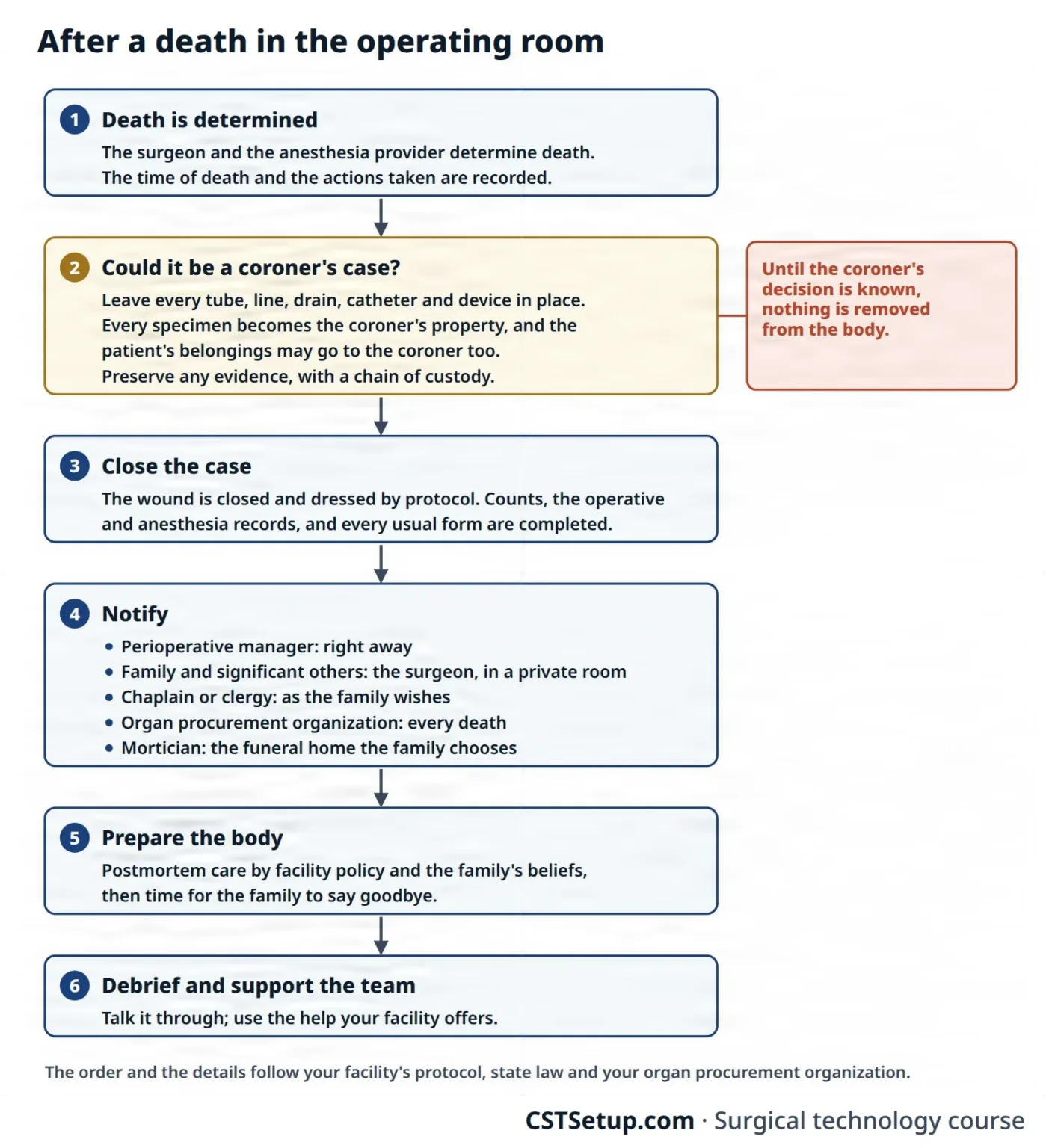
Determining death
When a patient dies in surgery, the surgeon and the anesthesia provideran-us-THEE-zhuh pruh-VY-derThe licensed professional who gives anesthesia and watches over the client's breathing and vital functions during a procedure.Full entry determine death, and the time of death and the actions taken are recorded.
Under The Joint Commissionthuh JOYNT kuh-MISH-unAn independent US organization that inspects and accredits hospitals and other health care organizations against safety and quality standards.Full entry policy, a sentinel eventSEN-tih-nul ee-VENTAn unexpected event in health care that causes a client's death, permanent harm or severe temporary harm.Full entry is a patient safety event, not mainly due to the natural course of the patient's illness or condition, that reaches the patient and causes death, permanent harm or severe harm. So a death in the OR is a sentinel event only when a patient safety event, not the patient's illness or injury, led to it. After a sentinel event the hospital must carry out a comprehensive analysis, such as a root cause analysisroot kawz uh-NAL-uh-sisA structured review after a serious error or harmful event that looks for the underlying system problems that let it happen.Full entry ; reporting the event to The Joint Commission's Sentinel Event Database is voluntary. Your facility's policy sets how each death is reviewed, and chapter 15 covers incident reportIN-sih-dent rih-PORTA written record of an unexpected event in a health care setting that caused or could have caused harm.Full entry and sentinel events. One reference calls every death in the OR a sentinel event.
Is it a coroner's case?
A coroner is an official who investigates deaths from unknown or violent causes; depending on the state, the coroner may or may not be a physician. A medical examinerMED-ih-kul eg-ZAM-ih-nerA doctor, appointed by the government, who investigates deaths that are sudden, unexpected, violent or unexplained.Full entry is a physician trained in pathologypuh-THOL-uh-jeeThe study of disease and its causes and effects, or the disease changes found in a person or tissue.path/o disease-logy study ofFull entry and forensic medicine who investigates the cause and circumstances of a death on behalf of the government.
A coroner's case is a death that the coroner or medical examiner must investigate, with an autopsyAW-top-seeAn exam of a body after death to find the cause of death or to study a disease.Full entry . State law sets the criteria, and they are much alike from state to state. They may include:
- a death in the operating room or the emergency department
- an unwitnessed death, a death soon after admission, or a death after transfer from another facility
- a death in which a crime is suspected, whether the patient was the victim or the offender, such as a homicide
- a suicide, an accident such as a crash or a fall, or a drug overdose
- the death of a person in custody
- a death from an infectious disease that may threaten public health
A coroner's case needs the body exactly as it was at death: every tube, line, drain, catheter and implanted or invasive device stays in place. In some facilities the body stays on the OR table, untouched, until the decision about the coroner is made.
Every specimen taken during the operation becomes the coroner's property. Identify each one with special care and send it straight from the OR as hospital protocol directs, with Standard Precautions. The patient's belongings may also go to the coroner instead of the family. If a crime may be involved, preserve and document the evidence as described under Physical or mental trauma, above, and follow the procedures of the police and the facility.
Finishing the case
The surgeon closes the wound as the facility's protocol directs, and it is dressed. The drapes come off, unless they were already removed during resuscitationrih-sus-ih-TAY-shunEmergency treatment to restore breathing, heartbeat or blood circulation.Full entry , and the instruments and supplies are handled as at the end of any case (chapter 30).
A sudden death shakes everyone in the room, and it will shake you. You still have duties to finish: keep your attention on the counts, the specimens and the field until they are done, then let yourself feel what happened (see When death touches the team, below).
Documentation
The records of the operation are completed as for any case, with an accurate account of the chain of events: the operative record, the anesthesiaan-us-THEE-zhuhLoss of feeling or sensation, often brought on by drugs so that surgery or a procedure can be done without pain.an- withoutesthesi/o feeling, sensation-ia conditionFull entry record, the counts and every usual form. The attending physician and the anesthesia provider document the death itself, and the death is registered on a separate legal document, the death certificate, completed by the attending physician or the coroner or medical examiner. When death is pronounced in the OR, the members of the team are named in the documentation.
The records of a death also show who was told and when, any tubes and lines left in the body, the belongings and who received them, and where the identification tags were placed.
Who is told
The Core Curriculum names four groups to notify, and federal rules add a fifth:
- The perioperativepair-ee-OP-er-uh-tivRelating to the whole time around a surgery: before, during and after it.peri- aroundoperative relating to surgeryFull entry manager. The OR supervisor is told right away and calls the people who must act, alerting the morgue, the coroner or the PACU.
- The family and significant others. The surgeon tells them, in a quiet, private room near the department or the PACU.
- The chaplain and clergy. Calling the family's own clergy is usually left to the family. Hospital staff call the chaplain, or the patient's religious leader if the family has not already.
- The organ procurement organization. Federal rules require the hospital to report every death, and every death expected soon, to the organ procurement organization (see Organ and tissue donation, below).
- The mortician. The family chooses a funeral home, often with the staff's help, and the funeral director takes the body once any examination or donation is complete.
If a patient dies in the PACU instead, the family is told, the surgeon meets with them, and a staff member stays with them for support.
Preparing the body
postmortem carepohst-MOR-tum KAIRThe care given to a person's body after death, preparing it with respect for the family and for transport.Full entry is the physical care of the body that prepares it for the family to view and for the mortuary. Every facility defines exactly how it is done, a coroner's case has its own protocol, and everyone who does it must know the protocol well. The patient may be moved to the PACU or another room for it, and the surgical team may do the first steps of preparing the body for the family.
Changes in the body after death. Death brings changes you will see:
- The body begins to cool (algor mortis).
- The sphincterSFINGK-terA ring of muscle that tightens to close an opening or passage in the body and relaxes to open it.Full entry relax, so urine and stool may pass. The eyes stay open and the jaw drops.
- Blood pools in the lowest parts of the body and colors the skin purple or red (livor mortis). The color cannot be reversed by embalming, and the face is protected from it by raising the head. Areas under pressure, such as over the sacrumSAY-krumThe large, triangle-shaped bone at the base of the spine, between the two hip bones.sacr/o sacrumFull entry , fill with fluid, and the tissue can break down.
- The muscles stiffen (rigor mortis). It begins about 3 to 4 hours after death, lasts about 24 hours, and then fades as enzymeEN-zimeA protein that speeds up a chemical reaction in the body without being used up.Full entry break down the cross-bridges in the muscle. It starts at the head, at the eyelids, and moves down to the feet. References give different times: one says it begins about 15 minutes after death, another that it peaks at 12 to 18 hours and is gone by 48.
Postmortem care, when it is allowed. Use the facility's postmortempohst-MOR-temAfter death.post- aftermortem deathFull entry kit and follow its protocol. Typical steps:
- Confirm that the provider has pronounced death, and find out whether an autopsy, a coroner's investigation or a donation is planned, because each one limits what you may remove.
- Identify the patient with two identifiers. Wear gloves, and a gown if body fluids may splash.
- Handle the body gently and with respect at all times.
- Raise the head on a pillow as soon as you can, so blood does not pool in the face and discolor it.
- Gently close the eyes, and leave dentures in the mouth to keep the shape of the face.
- Remove tubes and lines only as the policy allows, and never in a coroner's case, before an autopsy or for a donation unless you are told to.
- Clean any soiled areas, put on clean linen, comb the hair, and cover any wounds or signs of trauma. Ask whether the family wants to help, or has requests, such as special clothing or a religious item.
- Make the space clean, quiet and private, with soft light, and offer the family the chance to view the body and say goodbye in their own way.
- Keep the belongings that stay with the body, such as a wedding ring, give the rest to the family, and document who received what. Attach the identification tags and the shroud as policy directs, and cover the body for transport.
Law and policy
State laws define death, set what makes a coroner's case, and govern autopsy; federal rules require every death to be referred to the organ procurement organization; and hospital policy turns these into the steps you follow. Know the conditions for a coroner's case in your own state.
13Organ and tissue donation
Organ recovery is the removal, preservation and use of organs and tissues from a person who has just died, for transplant into a living person. One donor can help many people, and every day patients suffer or die because no organ or tissue is available for them. AST fully supports organ donor programs.
What can be given
- Organs: the heart, lungs, liver, kidneys, pancreasPAN-kree-usA long, flat gland behind the stomach that makes digestive enzymes and the hormones insulin and glucagon.pan- allcreas fleshFull entry and intestine, most often the kidneys, liver, heart and lungs. Even hands and faces can be transplanted.
- Tissues: the corneaKOR-nee-uhThe clear, dome-shaped layer at the front of the eye, over the iris and pupil.Full entry , skin, bone, cartilageKAR-tih-lijFirm, smooth, rubbery tissue that cushions joints and gives shape to parts such as the ear, nose and windpipe.chondr/o cartilageFull entry , tendons and ligaments, heart valves, blood vessels and the small bones of the middle ear.
- From a living donor: most often a kidney, or part of a liver or a lung, given with informed consentin-FORMD kun-SENTA person's agreement to a treatment or procedure, given freely after the risks, benefits and other choices have been explained to them.Full entry .
Death comes first
- The dead donor rule: no vital organ is removed until the patient has been declared dead.
- The first priority is always to save the patient's life. Donation is never a reason to give up on a patient or to withdraw care.
- The patient's own care team declares death. The recovery surgeons and the transplant team take no part in declaring death, or in a decision to withdraw care, because their interest in the organs would be a conflict of interest.
- When life support is to be withdrawn, that decision is made before donation is discussed.
Consent
A person can decide ahead of time to be a donor, usually by joining their state's donor registry, often when they get a driver's license, or in an advance directivead-VANS dih-REK-tivA legal document in which a person states their wishes for medical care, for a time when they cannot speak for themselves.Full entry . That is called first-person consent.
When the person left no decision, the family is asked. The organ procurement coordinator contacts the spouse or domestic partner, an adult child, a parent, an adult sibling, a legal guardian or another person allowed to decide, and the consent form is signed by the authorized next of kin and a representative of the hospital.
Patients have the right to refuse donation after their death, and that wish is written in the chart. Some faiths and cultures forbid or limit donation, and some people refuse because they fear their organs could be taken before they are truly dead. Most religions support donation.
Since the Omnibus Budget Reconciliation Act of 1986, federal law has required hospitals to have organ procurement protocols to receive Medicare and Medicaid funds. Today federal rules require every hospital to report every death, and every death expected soon, to its organ procurement organization (OPO), and the family of every potential donor learns that donation is possible. A specially trained person, such as an OPO nurse or a transplant coordinator, makes the request to the family; other staff do not raise donation themselves, and most hospitals have staff nurses wait for the OPO. If a family member asks you about donation, bring the nurse; never start that conversation on your own.
Some references still say the attending physician must, by law, ask the family about donation, and some states have required request laws that direct medical staff to ask. Under federal rules, the request is now made by a specially trained person, and most hospitals leave it to the organ procurement organization's staff.
Donation costs the family nothing from the time of death, and recovery does not disfigure the body in a way that interferes with viewing or funeral rituals.
Types of recovery
The Core Curriculum names two kinds of recovery, with and without life support. A donor who dies after circulatory death can give organs too, if life support is withdrawn in a planned way:
- Recovery on life support: donation after brain death. A patient declared dead by brain criteria stays on a mechanical ventilationmeh-KAN-ih-kul ven-tuh-LAY-shunBreathing support from a machine, a ventilator, that pushes air into the lungs through a tube or a mask.Full entry , with drugs and fluids, so blood and oxygen keep reaching the organs. The donor arrives in the OR with the heart beating, and the ventilator is turned off as the organs are flushed with cold preservation solution. The body can look alive, which confuses many families: the machines only keep the organs alive. Most organ donors in the United States donate after brain death. Older references call this donor a heart-beating cadaver.
- Recovery after circulatory death: donation after circulatory death (DCD). A patient who is not brain dead, most often after a brain injury they cannot survive, may have life support withdrawn, by their own directive or their family's decision. withdrawalwith-DRAW-ulThe physical and mental symptoms that occur when a person stops or cuts down a substance the body has come to depend on.Full entry is planned, in the ICU or the OR by hospital policy. When the heart and breathing stop, the team waits, usually 5 minutes, without touching the patient, to be sure the heart does not start again on its own, and then the patient's care team declares death. Only then does the recovery team begin, and it works fast, because organs are damaged without blood flow. The protocol sets how long the team waits for death after life support is withdrawn, usually about 60 minutes (one reference gives 90): if the heart has not stopped by then, organ recovery is called off, which happens in about 1 in 5 cases. Because the death is anticipated and planned, this is called controlled donation after circulatory death. When the heart stops without warning, as in a patient who arrives dead in the emergency department, donation is uncontrolled, and organ damage usually limits it to the kidneys, or rules it out. About a third of deceased donors give after circulatory death. Older references call it donation after cardiac death, and some call this donor a non-heart-beating donor.
- Tissue recovery without life support. After a death without support, the organs cannot be used, but tissues that do not need blood flow can be: the corneas, skin, bone, heart valves and blood vessels. They are recovered as soon as possible after death, some in the OR and some in the morgue. One reference calls this donor a non-heart-beating cadaver.
The recovery team and your part
The process runs through organ procurement organizations and tissue banks, which find donors, register the people waiting, and organize each recovery, on call around the clock. A transplant coordinator manages the donor's care until the recovery teams arrive and finds recipients during the procedure.
The OPO brings the recovery surgeons, and a team from a transplant center may travel to recover an organ for its own patient. The hospital may supply scrub and circulating staff, and the recovery can take several hours. You keep strict surgical asepsisSUR-jih-kul ay-SEP-sisPractices that keep an area or object completely free of microorganisms; also called sterile technique.a- withoutsepsis decay, infectionFull entry , as for any operation, and traffic in the room is limited to essential people.
Ice-cold preservation solution to flush each organ, and sterile containers to receive them, are ready before the first cut; the steps of the operation itself are on the Organ Procurement card.
For eye donation, the donor's head is raised on a pillow to limit swelling near the eyes, and the procurement team recovers the eyes within several hours of death.
The donor's body deserves the same respect and dignity as a living patient's. Some perioperativepair-ee-OP-er-uh-tivRelating to the whole time around a surgery: before, during and after it.peri- aroundoperative relating to surgeryFull entry staff find donation after circulatory death an ethical dilemmaETH-ih-kul dih-LEM-uhA situation in which a person must choose between two or more actions that each have moral reasons for and against them.Full entry ; a staff member whose beliefs forbid taking part may decline, and that choice is respected, but it must never stand in the way of the patient's own decision. Many agencies later tell the hospital how the gifts helped their recipients.
Transplantation and its ethics
Organs from deceased donors are allocated by the policies of the national Organ Procurement and Transplantation Network, never swayed by money, political influence, national origin, ethnicity, gender, religion, or citizenship or residency.
Transplantation raises hard ethicalETH-ih-kulHaving to do with what is morally right, or acting in line with accepted moral principles.Full entry questions:
- When is a person dead? Law and medicine set criteria for death, yet some people still question them, and donation after circulatory death keeps the question alive.
- Who decides? When the person left no clear wishes, family members may disagree, and some ask whether the family should decide for the person at all.
- Who receives a scarce organ? For example, alcohol-related liver diseaseLIV-er dih-ZEEZAny condition that damages the liver or keeps it from working normally.hepat/o liverFull entry is the leading reason for liver transplant in the United States, and it is debated whether people with a recent history of alcohol or drug use should receive organs.
- What does a living donor risk? The donor accepts the risks of an operation, such as bleeding, infection and even death, to help someone else.
Chapter 15 teaches the ethical principles behind these questions, and the transplant operations are taught in their procedure chapters.
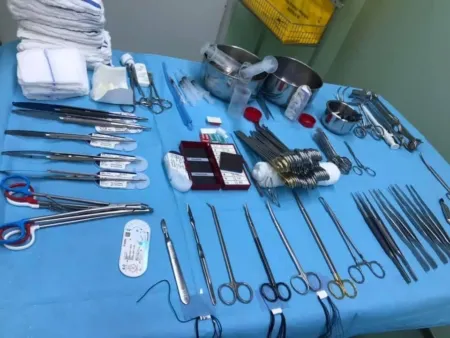
14Suicide
Suicide is causing one's own death on purpose, by self-inflicted injury, with the intent to die. Depression, abuse, emotional trauma and other mental health disorders are closely tied to it.
What suicide means in surgery
- For the patient. A patient may come to surgery after a suicide attempt, with an injury or an overdose; attempted suicide is considered in every drug overdose, and suicide precautionsSOO-ih-side prih-KAW-shunzThe safety measures used to protect a client who is at risk of harming or killing themselves.Full entry protect the patient from harming themselves again. Care for them with the same respect as any patient, without judgment; follow the facility's suicide precautions, and never leave a patient at risk alone.
- For the law. A death by suicide is usually a coroner's case. A suicide in a health care setting, or within 7 days of leaving inpatient care, the emergency department or certain behavioral health programs, is a sentinel eventSEN-tih-nul ee-VENTAn unexpected event in health care that causes a client's death, permanent harm or severe temporary harm.Full entry under The Joint Commissionthuh JOYNT kuh-MISH-unAn independent US organization that inspects and accredits hospitals and other health care organizations against safety and quality standards.Full entry policy.
- For the family. A suicide is sudden and often traumatic, and it leaves families with questions that cannot be answered, along with hurt, anger and deep sadness. Many feel they cannot grieve openly because of how the person died, so the grief is often disenfranchised, and it can become complicated grief.
- For the team. Like any sudden or violent death, a patient's suicide can hit the team hard, with shockshokA life-threatening state in which blood flow is too low to bring enough oxygen to the body's tissues.Full entry and denialdih-NY-ulRefusing to accept or believe a painful fact or situation, often without being aware of doing so.Full entry (see When death touches the team, below).
Medical aid in dying, sometimes called assisted suicide, is a separate legal and ethicalETH-ih-kulHaving to do with what is morally right, or acting in line with accepted moral principles.Full entry question, covered under Quality and quantity of life, above.
Warning signs
These raise the risk that a person will consider or attempt suicide: a mental health condition, a substance use disorderSUB-stuns yoos dis-OR-derA condition in which a person keeps using alcohol or another drug even though it is causing them harm.Full entry , hopelessnessHOPE-less-nessA feeling that things will not get better and that nothing a person does can change that.Full entry , impulsiveness, isolation, a past attempt or a family history of suicide, the loss of a job, money or a relationship, access to lethal means, and exposure to someone else's suicide.
Warning signs that a person may be about to attempt it include:
- talking about wanting to die, or having no reason to live
- looking for a way to do it
- talking about feeling trapped, or being a burden to others
- drinking or using drugs more
- acting anxious, agitated or reckless, sleeping too much, talking about revenge, or having extreme mood swings
- pulling away from other people
What to do
Whether the person is a patient, a coworker, a friend or a member of your family:
- Take it seriously, and get help now. For a patient, tell the patient's nurse or the anesthesia provideran-us-THEE-zhuh pruh-VY-derThe licensed professional who gives anesthesia and watches over the client's breathing and vital functions during a procedure.Full entry at once. If the danger seems immediate, call 911.
- Ask directly whether they are thinking about killing themselves. Asking does not put the idea into a person's head; many people feel relief at being able to talk about it.
- Listen without judging, and show that you care.
- Stay with them, or make sure another caring person does, and remove anything that could be used for self-harmself-HARMHurting one's own body on purpose, such as by cutting, burning or hitting oneself.Full entry .
- Connect them with help, such as the crisisKRY-sisA time when a person's usual ways of coping fail and they cannot manage a stressful event.Full entry line below.
Never keep a person's talk of suicide secret, and never leave a person at risk alone. In the United States, call or text 988, the Suicide & Crisis Lifeline, any hour of any day, or text HOME to 741741 for the Crisis Text Line. If someone is in immediate danger, call 911.
The same help is there for you. Caring for patients who die, or who try to die, wears on health workers, and many employers offer confidential counseling through an employee assistance program. If you are struggling, reach out.
15When death touches the team
Health workers react to a patient's death in different ways, shaped by their past experience with death, the support around them, their beliefs and values, what they know about dying, and their own emotional health. They may feel what the family feels: shockshokA life-threatening state in which blood flow is too low to bring enough oxygen to the body's tissues.Full entry and denialdih-NY-ulRefusing to accept or believe a painful fact or situation, often without being aware of doing so.Full entry are common after a sudden death, especially when the patient was young or the death was violent.
Sadness, a sense of loss and even frustration are normal parts of caring for the dying. But for some health workers, a death stirs up an old, unresolved loss or a clash of values, and it leads to depression or another serious reaction that affects their life and their ability to cope with stress at work. The emotional toll of caring for others is called compassion fatigue.
So the team needs a structured way to cope: a planned debriefing after the death, spontaneous support from teammates, and organized support groups. Chapter 16 covers the debriefing as a team habit, and chapter 30 as a step at the end of a case.
Coping skills that other health workers have found helpful:
- Talk it through. Going over exactly what happened and why helps the team see the limits of medicine: people cannot control every outcome, especially in the face of a death that could not be prevented.
- Acknowledge your feelings. It often helps to say out loud the sadness, shock or anger you feel, so others can understand and comfort you. Some people prefer to keep their feelings private, and that is respected: no one is pushed to share.
- Take a break from it. The effects of a tragic death in the OR can last for weeks. Lighter talk, or plans that have nothing to do with the death, give the team time to step away, without making the death matter less.
- Look after yourself. Ask yourself whether your coping is keeping up with the stress of the work, and talk with someone you trust, such as a mentor, a counselor or a religious leader.
- Use the help offered. Counseling services, peer support groups, stress management programs and employee assistance programs are there for you.
In a disaster with many deaths, keep working for the patients who can still be saved; chapter 17 covers disaster planning, including support for the staff.
For many health workers, caring for the dying turns out to be deeply rewarding: it teaches them what they value, and it shows them a gift for comforting others that is often why they chose health care in the first place.
What to take from this chapter
- Care for the whole patient: body, mind, family and spirit. Patient-centered care is built around this patient's own needs, and it starts with knowing your own biases.
- Maslow's hierarchy sets priorities: physiological needs first (airway, oxygen, warmth, pain), then safety, love and belonging, esteem and self-actualization. Under anesthesia the body comes first, but the higher needs never disappear.
- Patients fear anesthesia, death, pain, disfigurement, loss of control, exposure and loss of privacy. Listen, explain honestly, refer medical questions, never joke about a fear, keep the body covered, and watch what you say in the room.
- Culture and faith tell you which questions to ask, never the answer: ask each patient what they need, use a trained interpreter, and honor requests as far as safety allows.
- The susceptible populations each need something more, from people-first language and an autism plan to a wedge under a pregnant patient's right hip, strict asepsis for the immunocompromised, and dignity for a patient of any size.
- Death is cardiac (circulatory) or whole-brain death in US law; higher-brain death is not legal death. Grief has no fixed path: know the five Kübler-Ross stages and complicated and disenfranchised grief.
- After a death in the OR, treat it as a possible coroner's case: leave every tube and line in place, keep the specimens for the coroner, finish the counts and records, and leave medical information to the surgeon. The OPO hears about every death, and only trained staff raise donation with the family.
- Take every sign of suicide seriously: ask, stay, and get help; in the United States call or text 988. And look after yourself and your team after a death.
Check yourself5 quick questions
Free for everyone. Pick an answer for each, then check them all at once.
In the ORWhere you'll use this
The chapter's whole question pool in sets of 10, with the answer explained after each one.
Part of the educators programThe chapter's words on spaced cards: the ones you miss come back sooner.
Part of the educators programGiven by your class's teacher. Each class draws its own 25 from the chapter's pool.
Part of the educators program
Suggest a fix
Something wrong, unclear or out of date in this chapter? Tell us and we will fix it for everyone. Your email is only used to reply.