Cerebral Oximeter
Cerebral Oximetry · NIRS Monitor · Near-Infrared Spectroscopy Monitor · Regional Oximeter · Brain Oxygen Monitor · Invos
A small bedside monitor with a screen, connected by cables to sensors that stick on the patient's skin. It shows a regional saturationsach-uh-RAY-shunHow full something is; in nursing, usually the percentage of hemoglobin in the blood that is carrying oxygen.Full entry number (rSO2) and its trend.
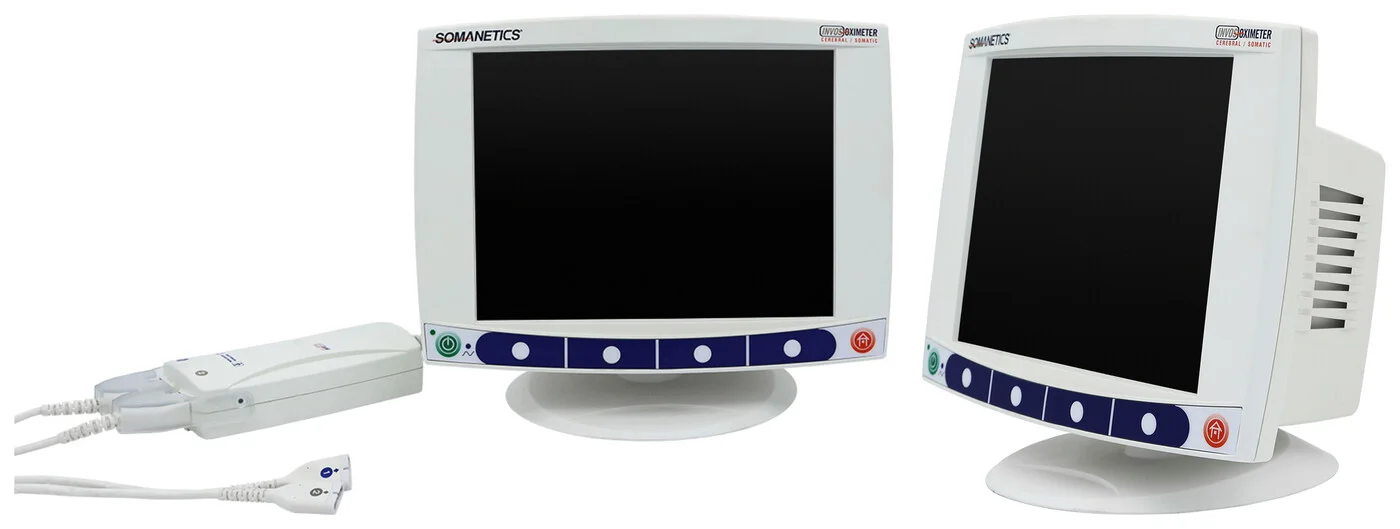
On the table
What it does and the lengths it comes in.
What it’s for
Watches the oxygen level in the brain tissue without needles, using near-infrared light that oxygenationok-sih-juh-NAY-shunThe process of getting oxygen into the blood and delivering it to the body's tissues.Full entry and deoxygenated hemoglobin absorptionub-ZORP-shunThe taking in of a substance, such as a drug or a nutrient, into the bloodstream.Full entry differently. Used during cardiopulmonarykar-dee-oh-PUL-muh-nair-eeRelating to the heart and lungs together.cardi/o heartpulmon/o lung-ary relating toFull entry bypass and aortic arch surgery (AmSECT guidelines say it should be used during bypass), in pediatric and congenitalkun-JEN-ih-tulPresent at birth.con- withgen birth, origin-al relating toFull entry bypass (where AmSECT lists it among the things the perfusionist tracks), and in TEVAR when stentstentA small tube, often of metal mesh, placed inside a vessel or duct to hold it open.Full entry graftGRAFTTissue or a man-made material moved into place in surgery to replace or repair a damaged part.Full entry cover the openings of the carotidkuh-ROT-idHaving to do with the carotid arteries, the two large arteries on each side of the neck that carry blood to the head and brain.Full entry or brachiocephalic arteries. A drop in the reading during surgery can be linked to brain injury after surgery, so the team acts on it.
Lengths and variants
Adult, pediatric and neonatal sensors. Some units also monitor somaticsoh-MAT-ikRelating to the body, as opposed to the mind.somat/o body-ic relating toFull entry (body) sites as well as the brain.
Know it on sight.
With Pro, for every instrument in the library. Cancel any time.
Or scrub in free: 5 questions a day.
On 4 setups
Every setup it is laid out on.
Every setup this instrument is laid out on, with photos of each table.
See ProKnow this instrument?
Send a clearer photo, another name it goes by, or a fix for this page.
5 sources
- Wahba A, et al. 2024 EACTS/EACTAIC/EBCP Guidelines on cardiopulmonary bypass in adult cardiac surgery. Section 10.2.1 (Neuromonitoring)
- AmSECT. Standards and Guidelines for Perfusion Practice. Guideline 7.5, p. 13
- AmSECT. Standards and Guidelines for Pediatric and Congenital Perfusion Practice. Standard 9, p. 13
- TEVAR open-access review (PMC9807668), Section 5.3 (Cerebral oximetry)
- somatechnology.com
The rest of this card is Pro.
The photos, the description, the uses and the lengths stay free. Pro opens the rest on every instrument: the 3D model, the notes from the table, where it is kept, every setup it is on, and practice.
Free, for good. No card.
- All 3,323 instrument cards
- Every General setup in full
- 5 exam questions a day
- Your own preference cards
Pass your exam. Know every case.
Everything in Free, plus:
- All 298 setups in every specialty: back table, Mayo and every step
- Practice that never runs out and full timed exams for the CST, TS-C, CRCST, CSPDT and CSFA, with the why behind every answer
- Flashcards on any tray, timed to come back before you forget
- Every instrument card in full: the 3D model, cautions, inspection, how to pass it
Cancel any time from your account. Not worth it? Email us within 30 days of a charge for a refund, one per customer. Refund policy
Pro is also in the CSTSetup app, on the same account. Already have Pro? Log in
Send a photo or a fix
A photo of it on your tray, a name your OR calls it, or anything wrong on this page. Your email is only used to credit you. Submissions stay private and are reviewed by our team; accepted ones earn a Contributor credit here.