Pacemaker Generator and Leads
Permanent Pacemaker · Pulse Generator · Pacemaker Generator · Pacing Lead · Pacing Electrode · Transvenous Pacing Lead · Endocardial Pacemaker
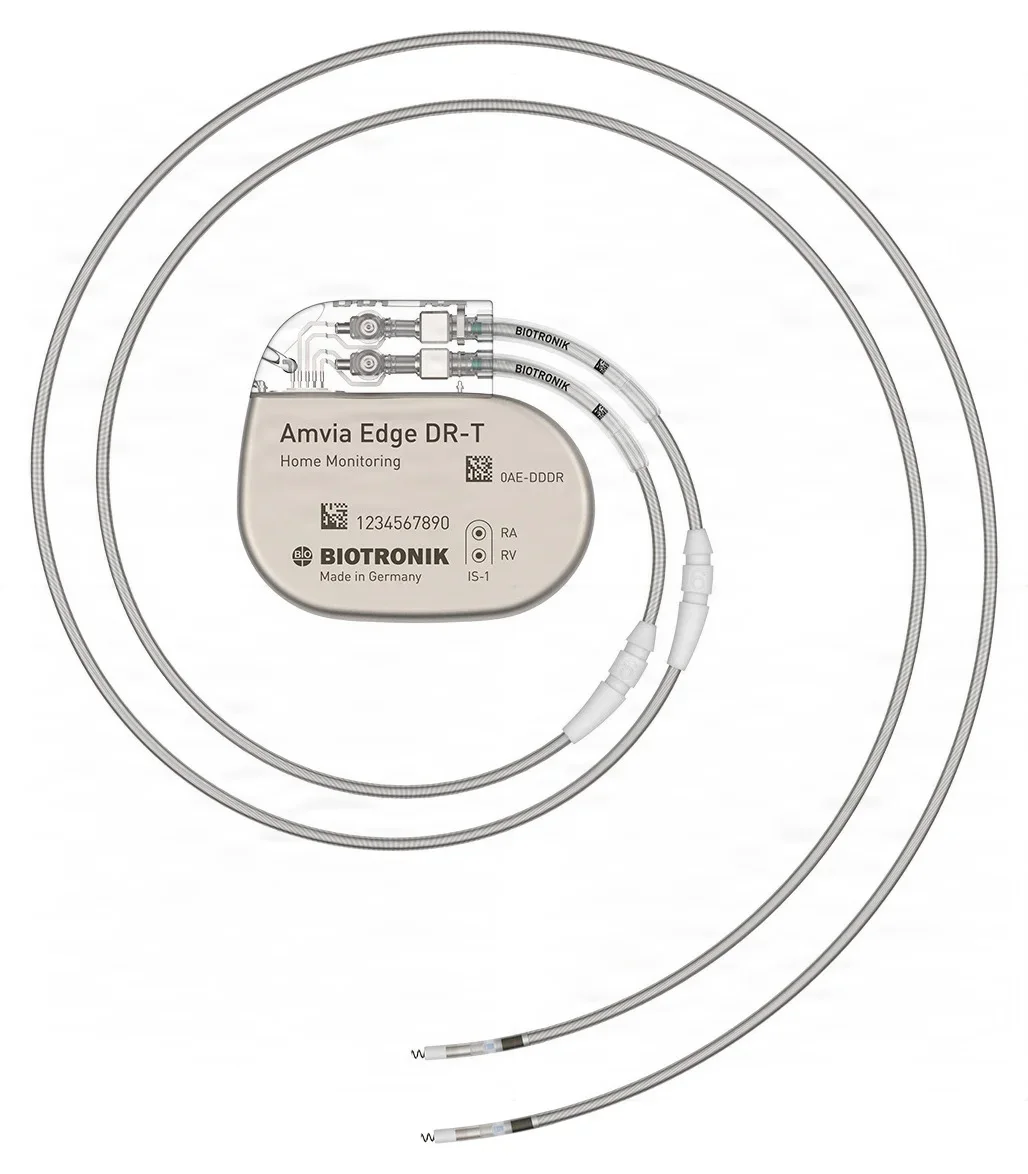
A small, flat, rounded metal case (the pulse generator, lithiumLITH-ee-umA mood-stabilizing drug used mainly to treat and prevent the mood episodes of bipolar disorder.Full entry batteryBAT-uh-reeIn law, touching a person on purpose without their consent.Full entry powered) with a clear plastic header on top where the leads plug in, and one or more long, thin insulated wire leads. Each lead has a connector pin at one end and an electrode tip at the other, either a small screw that turns into the heart wall (active fixation) or a tip that lodges in the muscle ridges (passive fixation).
On the table
What it does, the lengths it comes in and what experienced techs know about it.
What it’s for
The permanent pacemakerPAYS-may-kerA small device that sends electrical pulses to the heart to keep it beating at a set rate; also the heart's own natural rhythm center.Full entry implant for slow heart rates and heart blockHART blokA delay or break in the heart's electrical signal on its way from the atria to the ventricles, most often at the AV node.Full entry . Through a vein (subclavian, cephalic, axillary or jugularJUG-yuh-lerRelating to the neck, especially the large veins in the neck.Full entry ), each lead is passed on a styletSTY-letA thin rod or wire placed inside a tube, catheter or needle to stiffen or shape it while it is passed, then pulled out.Full entry through an introducer sheathSHEETHA covering that wraps around a structure; in procedures, a short hollow tube left in a blood vessel to pass catheters through.Full entry under fluoroscopyfloo-ROS-kuh-peeAn x-ray method that shows moving pictures of the inside of the body in real time.fluor/o glowing (from the fluorescent screen)-scopy looking, viewingFull entry into the right ventriclerite VEN-trih-kulThe lower right chamber of the heart, which pumps blood to the lungs.Full entry and, for a dual-chamber system, the right atriumAY-tree-umOne of the two upper chambers of the heart, which receive blood coming back to the heart.atri/o atrium-um noun endingFull entry . The tip is screwed or lodged into the heart wall, the stylet is pulled, and the lead is tested with alligator cables and a pacing system analyzer, then sutureSOO-cherA stitch, or the thread used to stitch, that holds the edges of a wound or incision together.Full entry to the muscle. The surgeon makes a pocket under the skin of the upper chest, connects the leads to the generator and places it in the pocket.
Lengths and variants
Single chamber (one lead, right atriumAY-tree-umOne of the two upper chambers of the heart, which receive blood coming back to the heart.atri/o atrium-um noun endingFull entry or ventricleVEN-trih-kulOne of the two lower chambers of the heart, or one of the fluid-filled spaces inside the brain.Full entry ), dual chamber (atrialAY-tree-ulRelating to an atrium, one of the two upper chambers of the heart.atri/o atrium-al relating toFull entry and ventricular leads) and biventricular for cardiac resynchronization (adds a coronary sinusSY-nusA hollow space in the body, most often one of the air-filled spaces in the skull bones around the nose.Full entry lead for the left ventricleLEFT VEN-trih-kulThe heart's lower left chamber, which pumps oxygen-rich blood into the aorta and out to the body.Full entry ). Leads may be unipolar or bipolarby-POH-lerHaving two poles or two opposite ends; most often used as a short form of bipolar disorder.bi- twopolar having polesFull entry . Leadless pacemakerPAYS-may-kerA small device that sends electrical pulses to the heart to keep it beating at a set rate; also the heart's own natural rhythm center.Full entry combine the electrode and generator in one small device placed inside the right ventriclerite VEN-trih-kulThe lower right chamber of the heart, which pumps blood to the lungs.Full entry by catheter, with no lead or pocket. As an example, BIOTRONIK Solia leads have a 5.6 F body and pass through a 6 F introducer.
What experienced techs know
What techs who reach for it every day know about it.Pro
Through the case
In the order you meet it: before, during and after the case.
- Before the case
Inspection and testing
What to check before it reaches the field.Pro
- During the case
Caution
What not to do with it, and why.Pro
- After the case
Care and reprocessing
How it is cleaned, checked and sent back to sterile.Pro
Know it on sight.
With Pro, for every instrument in the library. Cancel any time.
Or scrub in free: 5 questions a day.
On 1 setup
Every setup it is laid out on.
Every setup this instrument is laid out on, with photos of each table.
See ProWhich instrument is this?
Could you name it on exam day?
Surgical tech and sterile processing cert exams ask about instruments by name, use and care. Practice free: five exam questions a day, every answer explained.
Know this instrument?
Send a clearer photo, another name it goes by, or a fix for this page.
5 sources
- Goldman MA. Pocket Guide to the Operating Room. 3rd ed. Chapter 20 (Thoracic Surgery), p. 463-466
- Fuller JK. Surgical Technology: Principles and Practice. 8th ed. Chapter 32 (Cardiac Surgery), p. 926
- Cohn LH, ed. Cardiac Surgery in the Adult. 3rd ed. Chapter 60 (Surgical Implantation of Pacemakers and Automatic Defibrillators), p. 1405-1407
- Rothrock JC. Alexander's Care of the Patient in Surgery. 17th ed. Chapter 25 (Cardiac Surgery), p. 992
- biotronik.com
The rest of this card is Pro.
The photos, the description, the uses and the lengths stay free. Pro opens the rest on every instrument: the 3D model, the notes from the table, where it is kept, every setup it is on, and practice.
Free, for good. No card.
- All 3,342 instrument cards
- Every General setup in full
- 5 exam questions a day
- Your own preference cards
Pass your exam. Know every case.
Everything in Free, plus:
- All 372 setups in every specialty: back table, Mayo and every step
- Practice that never runs out and full timed exams for the CST, TS-C, CRCST, CSPDT, CSFA, NCLEX-RN and NCLEX-PN, with the why behind every answer
- Flashcards on any tray, timed to come back before you forget
- Every instrument card in full: the 3D model, cautions, inspection, how to pass it
Cancel any time from your account. Not worth it? Email us within 30 days of a charge for a refund, one per customer. Refund policy
Pro is also in the CSTSetup app, on the same account. Already have Pro? Log in
Send a photo or a fix
A photo of it on your tray, a name your OR calls it, or anything wrong on this page. Your email is only used to credit you. Submissions stay private and are reviewed by our team; accepted ones earn a Contributor credit here.