Hormones: the endocrine system
The glands that send chemical messages through the blood, how the body keeps each message in balance, and what surgery on the neck, the adrenal glands and the pituitary can do to them.
1Why it matters
Your body has two systems that carry messages. The nervous system sends fast electrical signals along nerves, and its effects are over quickly. The endocrine system sends chemical messengers, called hormones, through the blood. Hormones take longer to work, but their effects usually last longer.
Hormones run growth, metabolismmuh-TAB-uh-liz-umAll the chemical processes in the body's cells that make energy, build tissue and break substances down.Full entry , the balance of water and salts, the body's answer to stress, and reproduction. Each one acts on particular cells, and each one is kept within a narrow range, because too much or too little causes disease.
You meet this system at the surgical field in four ways.
- Surgeons operate on the glands. They remove all or part of the thyroid, the parathyroid glandpair-uh-THY-royd glandOne of four small glands behind the thyroid that control the amount of calcium in the blood.para- besidethyr/o thyroid gland-oid likeFull entry , the adrenal glanduh-DREE-nul GLANDOne of two small glands that sit on top of the kidneys and make hormones such as cortisol, aldosterone and epinephrine.ad- toward, nearren/o kidney-al relating toFull entry , the pituitary and the thymusTHY-musA small gland in the upper chest, behind the breastbone, where T cells (a kind of white blood cell) mature.Full entry . These glands sit close to nerves and vessels that must be protected, such as the nerve that moves the vocal cords.
- Every operation is a stress, and the body answers it with hormones. cortisolKOR-tih-solA steroid hormone made by the adrenal glands that helps control blood sugar, blood pressure, stress and inflammation.Full entry and epinephrineep-ih-NEF-rinA hormone and drug, also called adrenaline, that raises heart rate and blood pressure and opens the airways.Full entry pour out, the heart speeds up and the blood sugar rises, even in a patient without diabetes.
- Many patients live with a gland disorder. Diabetes, thyroid disease and long-term steroidSTAIR-oydA fat-based chemical built from cholesterol; the group includes hormones such as cortisol and estrogen, and many drugs.ster/o solid-oid likeFull entry use change how a patient heals, how well they fight infection and how they handle the stress of surgery.
- Some hormones are drugs on the field. The hormones most often given in surgery are epinephrine, oxytocinok-sih-TOH-sinA hormone that makes the uterus contract and releases breast milk; also given by IV to start or strengthen labor and control bleeding after birth.Full entry and the steroids called corticosteroidkor-tih-koh-STER-oydA drug that acts like the hormones of the adrenal glands, used mainly to calm inflammation and the immune system.cortic/o cortex (the outer layer of the adrenal gland)-oid likeFull entry .
This chapter explains how hormones work and how the body keeps them in balance, then goes gland by gland, and ends with what surgery and gland disease mean for the patient on the table. Other chapters teach what it leaves out: the hypothalamushy-poh-THAL-uh-musA small area at the base of the brain that controls body temperature, hunger, thirst, sleep and many hormones.hypo- belowthalamus inner chamber (a part of the brain)Full entry as part of the brain in chapter 4; the thymus as lymphoid tissue in chapter 5; the pancreasPAN-kree-usA long, flat gland behind the stomach that makes digestive enzymes and the hormones insulin and glucagon.pan- allcreas fleshFull entry as a digestive organ, with its enzymeEN-zimeA protein that speeds up a chemical reaction in the body without being used up.Full entry , in chapter 7; the ovaries and testes and the kidneys' own hormones in chapter 8; immunityih-MYOO-nih-teeThe body's ability to resist or fight off a particular infection or disease.immun/o protection-ity stateFull entry in chapter 10; diabetes as it affects wound healingwoond HEE-lingThe body's process of repairing damaged skin and tissue.Full entry and infection in chapter 11; insulinIN-suh-linA hormone made by the pancreas that lets the body's cells take in glucose, also made as a medicine.Full entry , steroids and other hormone drugs in chapter 12; blood sugar, temperature and malignant hyperthermiamuh-LIG-nunt hy-per-THER-mee-uhA rare inherited reaction to certain general anesthesia drugs in which the muscles' metabolism speeds up out of control.mal- badhyper- above normaltherm heat-ia conditionFull entry under anesthesiaan-us-THEE-zhuhLoss of feeling or sensation, often brought on by drugs so that surgery or a procedure can be done without pain.an- withoutesthesi/o feeling, sensation-ia conditionFull entry in chapter 13; the thyroid and parathyroid operations and the Whipple procedure in chapter 32; adrenaluh-DREE-nulHaving to do with the adrenal glands, the two small glands that sit on top of the kidneys.ad- nearren/o kidney-al relating toFull entry surgery in chapter 34; the thymectomy in chapter 41; and pituitary surgery in chapter 42.
2How hormones work
Endocrine and exocrine glands
A gland is one cell or a group of cells that makes and releases a chemical substance. Glands come in two kinds.
- endocrine glandEN-doh-krin GLANDA gland that releases hormones straight into the blood instead of through a tube or duct.endo- within-crine to secreteFull entry have no ducts. They release their hormones into the fluid around their cells, and the blood carries the hormones through the body.
- Exocrine glands release their products through ducts, onto a surface or into a cavity. Sweat glands and the oil (sebaceous) glands of the skin are exocrine glands.
The pancreasPAN-kree-usA long, flat gland behind the stomach that makes digestive enzymes and the hormones insulin and glucagon.pan- allcreas fleshFull entry is both. Most of it is exocrine and sends digestive juice down a duct into the small intestine, but small clusters of cells scattered through it, the islets, release hormones into the blood.
The main endocrine glands are the pituitary, pineal, thyroid, parathyroid glandpair-uh-THY-royd glandOne of four small glands behind the thyroid that control the amount of calcium in the blood.para- besidethyr/o thyroid gland-oid likeFull entry and adrenal glanduh-DREE-nul GLANDOne of two small glands that sit on top of the kidneys and make hormones such as cortisol, aldosterone and epinephrine.ad- toward, nearren/o kidney-al relating toFull entry , the islets of the pancreas, the thymusTHY-musA small gland in the upper chest, behind the breastbone, where T cells (a kind of white blood cell) mature.Full entry , and the ovaries and testes. Many other organs also have cells that make hormones, including the hypothalamushy-poh-THAL-uh-musA small area at the base of the brain that controls body temperature, hunger, thirst, sleep and many hormones.hypo- belowthalamus inner chamber (a part of the brain)Full entry , the heart, the kidneys, the stomach and small intestine, the liver, the skin and fat tissue.
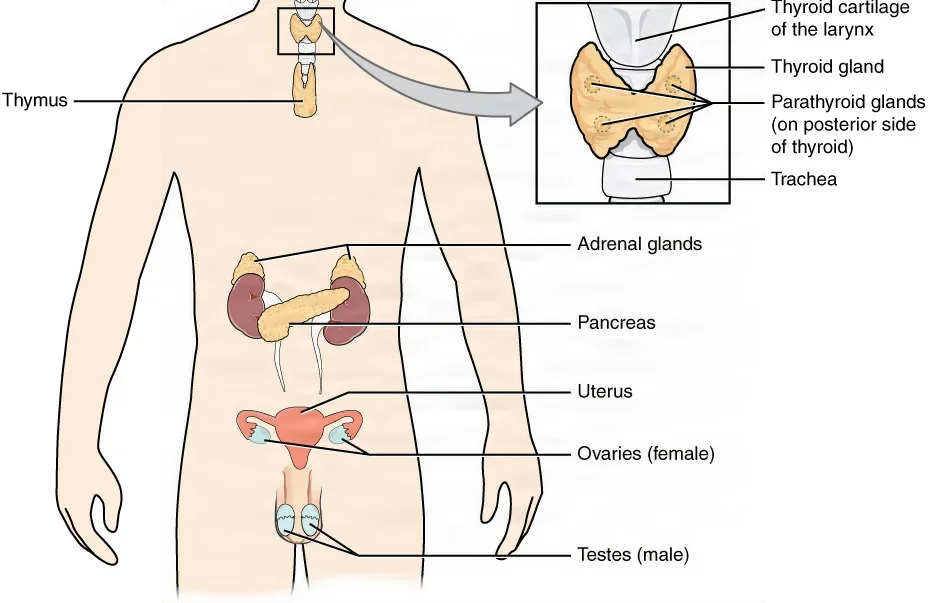
Target cells and receptors
A hormone travels everywhere the blood goes, but it acts only on its target cells: the cells that carry a receptorrih-SEP-terA structure on or in a cell that a specific chemical, such as a hormone or drug, attaches to in order to act.Full entry for it. A receptor is a protein shaped to fit one hormone, the way a lock fits one key. When the hormone binds, the cell changes what it is doing, for example by making a new protein, changing how it uses nutrients, or making a hormone or other product of its own.
Hormones fall into two chemical groups, and the group decides how a hormone works.
- steroidSTAIR-oydA fat-based chemical built from cholesterol; the group includes hormones such as cortisol and estrogen, and many drugs.ster/o solid-oid likeFull entry hormones are made from cholesterol. cortisolKOR-tih-solA steroid hormone made by the adrenal glands that helps control blood sugar, blood pressure, stress and inflammation.Full entry , aldosteroneal-DOS-tuh-rohnA hormone from the adrenal glands that makes the kidneys keep sodium and water and get rid of potassium.aldo- from aldehyde (a chemical group)-sterone steroid hormoneFull entry , estrogenES-truh-jenA female sex hormone, made mainly by the ovaries, and the group of drugs that act like it.Full entry , progesteroneproh-JES-tuh-rohnA female sex hormone that prepares the lining of the uterus for pregnancy and helps keep a pregnancy going, also given as a drug.Full entry and testosteronetes-TOS-tuh-rohnThe main male sex hormone, made mostly in the testes and in small amounts by the ovaries and adrenal glands.test/o testis-sterone steroid hormoneFull entry are steroids. They dissolve in fat, not water, so they ride in the blood on carrier proteins. They pass straight through the cell membrane to a receptor inside the cell and switch genes on. Riding on their carriers, they last much longer in the blood than most other hormones.
- Nonsteroid hormones are built from amino aciduh-MEE-noh AS-idOne of the small building blocks that join together in chains to make proteins.Full entry . The smallest are amines, made from a single amino acid, such as epinephrineep-ih-NEF-rinA hormone and drug, also called adrenaline, that raises heart rate and blood pressure and opens the airways.Full entry , norepinephrinenor-ep-ih-NEF-rinA hormone and nerve messenger that narrows blood vessels and raises blood pressure, also given as an IV drug.Full entry and the thyroid hormoneTHY-royd HOR-mohnA hormone made by the thyroid gland that controls how fast the body uses energy.Full entry . Peptides, such as antidiuretic hormonean-tee-dy-yoo-RET-ik HOR-mohnA hormone from the pituitary gland that tells the kidneys to hold on to water, making the urine more concentrated.anti- againstdiuretic making urineFull entry and oxytocinok-sih-TOH-sinA hormone that makes the uterus contract and releases breast milk; also given by IV to start or strengthen labor and control bleeding after birth.Full entry , are short chains of amino acids, and proteins, such as growth hormoneGROHTH HOR-mohnA hormone from the pituitary gland that drives growth in children and helps control body build and metabolism in adults.Full entry , insulinIN-suh-linA hormone made by the pancreas that lets the body's cells take in glucose, also made as a medicine.Full entry and glucagonGLOO-kuh-gonA hormone made by the pancreas that raises blood sugar; also given as a drug for severe low blood sugar.Full entry , are longer chains. Most of them cannot cross the cell membrane, so they bind a receptor on the cell's surface, which sets off a chain of signals inside. The thyroid hormones are the exception: they enter the cell.
The difference shows in how long a hormone lasts. Half of a dose of cortisol is gone from the blood in about 60 to 90 minutes, but half of a dose of epinephrine is gone in about a minute.
Hormones also work on each other. Some pairs are antagonistan-TAG-uh-nistA drug that attaches to a receptor and blocks it, so the body's own chemicals or other drugs cannot act there.ant- againstagon struggle-ist one whoFull entry , with opposite effects: insulin lowers the blood sugar and glucagon raises it. Others are synergists, which together give a stronger effect than either alone.
Negative feedback keeps levels in range
Chapter 2 introduced negative feedbackFEED-bakInformation about a result that is sent back to change what happens next, in the body or between people.Full entry , the body's main way of keeping a value steady. Most hormones are controlled this way: once the blood holds enough of a hormone, its release slows, so the level stays in a narrow range.
Three kinds of trigger start a gland releasing its hormone.
- A change in the blood: a rise in blood sugar makes the pancreas release insulin, and blood that is too concentrated makes the pituitary release antidiuretic hormone.
- Another hormone: the hypothalamus releases hormones that control the pituitary, and the pituitary releases hormones that control other glands.
- A nerve signal: in danger, sympathetic nerves make the adrenal glands release epinephrine and norepinephrine within seconds.
Positive feedback, which pushes a change further, is rare. During labor, oxytocin makes the uterus contract, the baby's head stretches the cervix, and the stretch brings out more oxytocin, until the baby is born.
The hypothalamus and the pituitary: the command center
The hypothalamus, part of the brain (chapter 4), and the pituitary glandpih-TOO-ih-tair-ee glandA gland the size of a pea, hanging below the brain, whose hormones control many other glands.Full entry hanging below it work together as the command center of the endocrine system. Many signals that reach the nervous system pass through them and are turned into hormones.
The hypothalamus controls the pituitary in two ways.
- The anterior pituitary answers to releasing hormones and inhibiting hormones made by the hypothalamus. They travel down the pituitary stalk in a short chain of vessels, the hypophyseal portal system, which carries them straight to the anterior pituitary before they reach the rest of the body.
- The posterior pituitary is wired to the hypothalamus. neuronNOOR-onA nerve cell: a cell that carries electrical and chemical signals through the nervous system.neur/o nerveFull entry in the hypothalamus make two hormones, send them down their axonAK-sonThe long, thin part of a nerve cell that carries electrical signals away from the cell body.Full entry in the stalk, and store them in the posterior pituitary until they are released.
Many glands sit at the bottom of a chain of three. The hypothalamus releases a hormone that tells the anterior pituitary to release a second hormone, which tells a target gland to release a third. As the third hormone rises in the blood, it slows the hypothalamus and the pituitary, and the chain winds down. The thyroid is the classic example, and the adrenal cortexuh-DREE-nul KOR-teksThe outer layer of each adrenal gland, which makes the steroid hormones cortisol and aldosterone.ad- nearren kidney-al relating tocortex outer layer (Latin, bark)Full entry works the same way.
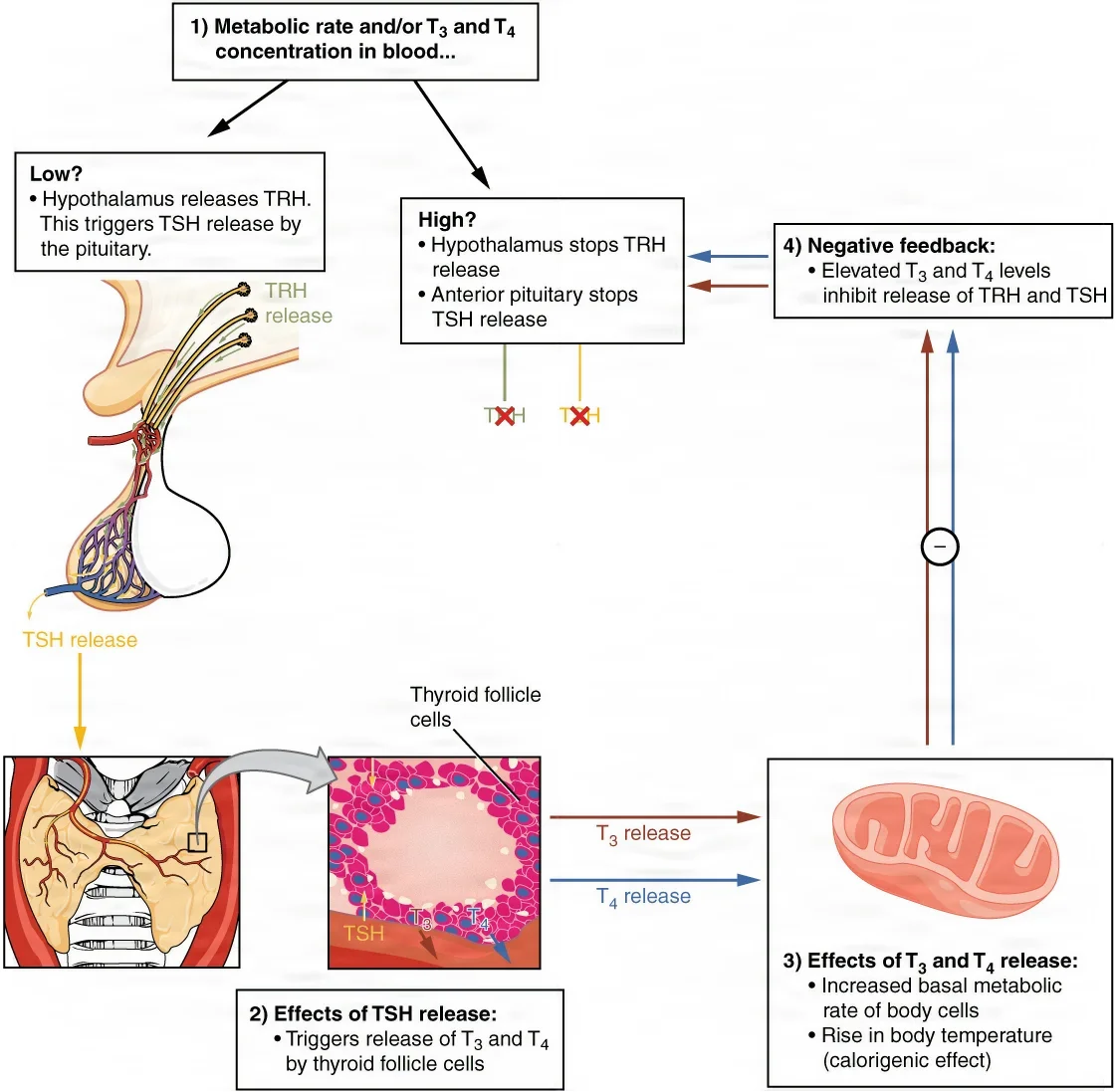
Hypothalamus, then pituitary, then gland, then hormone in the blood. When the gland's hormone runs high, it switches off the hypothalamus and the pituitary; when it runs low, they switch back on.
3The pituitary gland
Where it sits
The pituitary glandpih-TOO-ih-tair-ee glandA gland the size of a pea, hanging below the brain, whose hormones control many other glands.Full entry , or hypophysis, is about the size of a pea. It hangs from the underside of the hypothalamushy-poh-THAL-uh-musA small area at the base of the brain that controls body temperature, hunger, thirst, sleep and many hormones.hypo- belowthalamus inner chamber (a part of the brain)Full entry on a stalk called the infundibulum, and it sits in a small hollow on top of the sphenoid bone in the floor of the skull, the sella turcica.
Its neighbors explain how a pituitary tumor shows itself and how surgeons reach it.
- The optic chiasm, where the two optic nerveOP-tik nervThe nerve that carries visual signals from the back of the eye to the brain; the second cranial nerve.Full entry cross, lies just above it. A tumor that presses up on the chiasm changes the field of vision, classically taking away the outer half of what each eye sees.
- The cavernous sinusSY-nusA hollow space in the body, most often one of the air-filled spaces in the skull bones around the nose.Full entry lie on each side, holding cranial nerveKRAY-nee-ul NERVOne of the 12 pairs of nerves that come straight from the brain and brainstem rather than the spinal cord.Full entry III to VI and the internal carotidkuh-ROT-idHaving to do with the carotid arteries, the two large arteries on each side of the neck that carry blood to the head and brain.Full entry arteries.
- The sphenoid sinus lies in front of and below it, so surgeons can reach the gland through the nose and the sinus (chapter 6).
The pituitary is often called the master gland, because its hormones control the thyroid, the adrenal cortexuh-DREE-nul KOR-teksThe outer layer of each adrenal gland, which makes the steroid hormones cortisol and aldosterone.ad- nearren kidney-al relating tocortex outer layer (Latin, bark)Full entry and the ovaries and testes.
It has two lobes, which grow from different tissue before birth and work differently.
- The anterior lobe, or adenohypophysis, is glandular tissue. It makes its own hormones.
- The posterior lobe, or neurohypophysis, is nerve tissue. It makes no hormones; it stores and releases two hormones made in the hypothalamus.
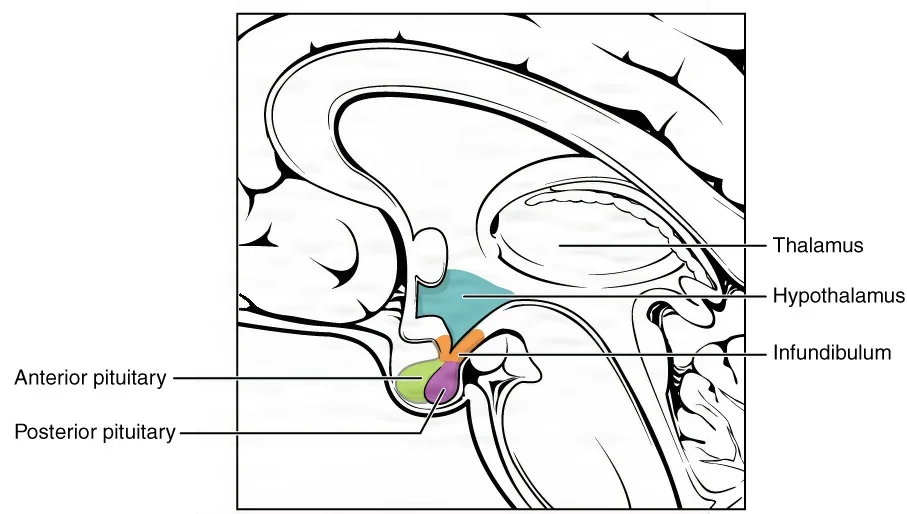
Anterior lobe hormones
The anterior lobe makes six hormones that you need to know.
| Hormone | Target | What it does |
|---|---|---|
| growth hormoneGROHTH HOR-mohnA hormone from the pituitary gland that drives growth in children and helps control body build and metabolism in adults.Full entry (GH), also called somatotropin | Most tissues, especially muscle, bone and cartilageKAR-tih-lijFirm, smooth, rubbery tissue that cushions joints and gives shape to parts such as the ear, nose and windpipe.chondr/o cartilageFull entry ; it also makes the liver release growth factors | Builds protein and tissue; frees fat for fuel and raises the blood sugar |
| thyroid-stimulating hormoneTHY-royd STIM-yuh-lay-ting HOR-mohnA hormone from the pituitary gland that tells the thyroid to make thyroid hormone; its blood level is the main thyroid test.Full entry (TSH), also called thyrotropin | The thyroid gland | Makes the thyroid release its hormones, T4 and T3tee-THREETriiodothyronine: the more active of the two main thyroid hormones, or the blood test that measures it.Full entry |
| adrenocorticotropic hormoneuh-dree-noh-kor-tih-koh-TROH-pik HOR-mohnA hormone from the pituitary gland that tells the adrenal glands to make cortisol.adren/o adrenal glandcortic/o cortex, outer layer-tropic stimulatingFull entry (ACTH), also called corticotropin | The adrenal cortex | Makes the adrenal cortex release cortisolKOR-tih-solA steroid hormone made by the adrenal glands that helps control blood sugar, blood pressure, stress and inflammation.Full entry and its other steroidSTAIR-oydA fat-based chemical built from cholesterol; the group includes hormones such as cortisol and estrogen, and many drugs.ster/o solid-oid likeFull entry |
| FSHef-es-AYCH (said as letters)Follicle-stimulating hormone: a pituitary hormone that helps control the ovaries and testes.Full entry (FSH) | The ovaries and testes | Makes eggs and sperm develop; in the ovaries, makes follicleFOL-ih-kulA small sac or cavity in the body, such as the pocket a hair grows from or the sac in the ovary that holds an egg.Full entry grow and release estrogenES-truh-jenA female sex hormone, made mainly by the ovaries, and the group of drugs that act like it.Full entry |
| luteinizing hormoneLOO-tee-uh-ny-zing HOR-mohnA hormone from the pituitary gland that triggers ovulation in women and testosterone production in men.Full entry (LH) | The ovaries and testes | Triggers ovulationov-yuh-LAY-shunThe release of a mature egg from an ovary, usually once in each menstrual cycle.Full entry and the ovaries' release of estrogens and progesteroneproh-JES-tuh-rohnA female sex hormone that prepares the lining of the uterus for pregnancy and helps keep a pregnancy going, also given as a drug.Full entry ; makes the testes release testosteronetes-TOS-tuh-rohnThe main male sex hormone, made mostly in the testes and in small amounts by the ovaries and adrenal glands.test/o testis-sterone steroid hormoneFull entry |
| prolactinproh-LAK-tinA hormone made by the pituitary gland that tells the breasts to make milk.pro- forlact/o milk-in substanceFull entry (PRL) | The breasts | Builds the milk glands in pregnancy and makes milk after birth |
TSH, ACTH, FSH and LH are called tropic hormones ("turning" hormones), because they turn other glands on and off. Some references spell the word "trophic," and the Core Curriculum lists them that way. FSH and LH together are the gonadotropins, the hormones that run the ovaries and testes; chapter 8 shows where the surge of LH falls in the menstrual cycle.
The hypothalamus has a releasing hormone for each one: TRH brings out TSH, CRHsee-ar-aych (said as letters)Corticotropin-releasing hormone: a hormone from the hypothalamus that signals the pituitary gland to release ACTH.Full entry brings out ACTH, GnRH brings out FSH and LH, and GHRH brings out growth hormone. Growth hormone also has an inhibiting hormone, GHIH, also called somatostatin.
The anterior lobe also releases beta endorphinen-DOR-finA natural chemical made in the brain that eases pain and creates a sense of well-being.Full entry , one of the brain's own painkilling chemicals, and cells between the two lobes release melanocytemuh-LAN-uh-syteA cell in the bottom layer of the skin's outer layer that makes melanin, the pigment that gives skin and hair their color.melan/o black-cyte cellFull entry -stimulating hormone, which can darken the skin.
When growth hormone is out of balance, the signs depend on age. Too much in a child, before the bones stop growing, causes gigantism. Too much in an adult, once growth has stopped, causes acromegalyak-roh-MEG-uh-leeA rare hormone disorder in adults in which the body makes too much growth hormone.acr/o extremities (hands and feet)-megaly enlargementFull entry : the bones of the face, hands and feet grow larger. Too little in a child stunts growth (pituitary dwarfism, or growth hormone deficiency).
Posterior lobe hormones
The posterior lobe is really an extension of the brain. neuronNOOR-onA nerve cell: a cell that carries electrical and chemical signals through the nervous system.neur/o nerveFull entry in the hypothalamus make antidiuretic hormonean-tee-dy-yoo-RET-ik HOR-mohnA hormone from the pituitary gland that tells the kidneys to hold on to water, making the urine more concentrated.anti- againstdiuretic making urineFull entry and oxytocinok-sih-TOH-sinA hormone that makes the uterus contract and releases breast milk; also given by IV to start or strengthen labor and control bleeding after birth.Full entry , pass them down their axonAK-sonThe long, thin part of a nerve cell that carries electrical signals away from the cell body.Full entry , store them in their endings in the posterior lobe, and release them into the blood when the cells fire. That is the "production of neural transmitter" in the Core Curriculum's list: hormones made and released by nerve cells.
Antidiuretic hormone (ADH), also called vasopressinvay-zoh-PRES-inA man-made form of antidiuretic hormone, given by IV mainly to raise blood pressure in shock.Full entry , saves water.
- Sensors in the hypothalamus watch how concentrated the blood is. When it is too concentrated, as in dehydration or after a salty meal, the posterior lobe releases ADH.
- ADH makes the tubuleTOO-byoolA very small tube in the body, most often one of the tiny tubes in the kidney that turn filtered fluid into urine.Full entry of the kidneys take back more water, so less urine is made and the blood is diluted back to normal. Then the release slows, by negative feedbackFEED-bakInformation about a result that is sent back to change what happens next, in the body or between people.Full entry .
- At high levels, ADH also narrows blood vessels and raises the blood pressure, which is where the name vasopressin comes from.
- Alcohol blocks its release, which is why drinking alcohol makes you pass more urine.
Oxytocin acts on the uterus and the breasts. It makes the uterus contract during childbirth, through the positive feedback loop above, and it makes the milk ducts squeeze milk out when a baby nurses (the letdownLET-downThe reflex that pushes milk out of the breast's milk glands toward the nipple during breastfeeding.Full entry ). It also seems to play a part in bonding.
Too little ADH causes diabetes insipidusdy-uh-BEE-teez in-SIP-ih-dusA disorder of antidiuretic hormone: the body makes too little of it, or the kidneys do not respond to it.Full entry : the kidneys cannot hold on to water, so the patient passes large amounts of dilute urine, is always thirsty, and can become dehydrated. It is treated with a drug form of vasopressin.
At the field, oxytocin is also a drug. After a cesarean birthsih-ZAIR-ee-un berthBirth of a baby through surgical cuts in the belly and the uterus.Full entry , the anesthesia provideran-us-THEE-zhuh pruh-VY-derThe licensed professional who gives anesthesia and watches over the client's breathing and vital functions during a procedure.Full entry gives it into the vein to help the uterus contract and slow the bleeding, and the surgeon may ask for it to be injected straight into the uterine muscle. The scrub draws it up from a vial held by the circulator and labels the syringe before passing it. Chapter 12 teaches drugs on the field.
4The pineal gland
The pineal glandPIN-ee-ul GLANDA small gland deep in the brain that makes melatonin, the hormone that helps control sleep.Full entry is a tiny gland deep in the brain, below and behind the thalamusTHAL-uh-musA pair of egg-shaped masses deep in the brain that relay sensory signals to the cerebral cortex.thalam/o thalamus (from the Greek for inner chamber)Full entry . It lies behind the pituitary.
Its cells make the hormone melatoninmel-uh-TOH-ninA hormone made by the pineal gland in the brain, mostly at night, that helps control the sleep-wake cycle.Full entry , built from serotoninser-uh-TOH-ninA chemical messenger in the brain, gut and blood that helps control mood, sleep, appetite and other functions.Full entry . Light controls how much they make.
- In daylight, light striking the retinaRET-ih-nuhThe thin layer of light-sensing tissue at the back of the inside of the eye.Full entry sends signals through the hypothalamushy-poh-THAL-uh-musA small area at the base of the brain that controls body temperature, hunger, thirst, sleep and many hormones.hypo- belowthalamus inner chamber (a part of the brain)Full entry to the pineal gland, which then makes less melatonin, and you stay awake.
- As darkness falls, the pineal gland makes more melatonin, and you grow drowsy.
So melatonin helps set the body's daily sleep and wake cycle, its circadian rhythm, which also shapes appetite and body temperature. Jet lag comes from crossing time zones faster than melatonin can reset, and some travelers take melatonin pills to sleep. Children have higher levels than adults, which may help hold back puberty.
A tumor in the region of the pineal gland often causes hydrocephalushy-droh-SEF-uh-lusA buildup of too much cerebrospinal fluid inside the spaces (ventricles) of the brain.hydr/o watercephal/o head-us noun endingFull entry , a buildup of cerebrospinal fluidser-uh-broh-SPY-nul FLOO-idThe clear, watery fluid that bathes and cushions the brain and spinal cord.cerebr/o brainspin spine-al relating toFull entry in the brain (chapter 4).
5The thyroid gland
Its shape and its neighbors
The thyroid gland is shaped like a butterfly. It lies low in the front of the neck, on the front of the tracheaTRAY-kee-uhThe windpipe: the tube that carries air from the throat to the lungs.Full entry , just under the larynxLAIR-inksThe voice box: the part of the airway in the neck, above the windpipe, that holds the vocal cords.laryng/o larynxFull entry . Its right and left lobes are joined by a narrow middle band, the isthmus, which crosses the trachea between the second and fourth tracheal rings. It weighs about 20 grams and is the largest of the endocrine glandEN-doh-krin GLANDA gland that releases hormones straight into the blood instead of through a tube or duct.endo- within-crine to secreteFull entry . It has a very rich blood supply.
About 30 percent of patients have a pyramidal lobe, a thin strip of thyroid tissue that runs upward from the isthmus. It is left over from the duct along which the thyroid moved down from the base of the tongue before birth.
The thyroid is crowded by structures the surgeon must protect.
- It lies under the thin strap muscles of the neck, on the trachea, and its lobes rest against the larynx, the trachea and the esophagusih-SOF-uh-gusThe muscular tube that carries food and liquid from the throat to the stomach.esophag/o esophagusFull entry . A band of tissue, the ligament of Berry, fixes it to the cricoid cartilageKAR-tih-lijFirm, smooth, rubbery tissue that cushions joints and gives shape to parts such as the ear, nose and windpipe.chondr/o cartilageFull entry and the trachea.
- The common carotidkuh-ROT-idHaving to do with the carotid arteries, the two large arteries on each side of the neck that carry blood to the head and brain.Full entry artery, the internal jugular veinin-TUR-nul JUG-yuh-ler vaynA large vein deep on each side of the neck that carries blood from the brain, face and neck back toward the heart.Full entry and the vagus nerveVAY-gus nervThe 10th cranial nerve, which runs from the brain stem to the chest and belly and slows the heart and helps digestion.Full entry run up the neck beside each lobe.
- Two pairs of arteries feed it: the superior thyroid arteries, from the external carotid arteries, enter the upper poles, and the inferior thyroid arteries, from the thyrocervical trunks of the subclavian arteries, enter the lower part of the gland. Now and then a single extra artery, the thyroidea ima, rises from the aortic arch or the brachiocephalic artery to the bottom of the isthmus. Three pairs of veins drain it.
- The recurrent laryngeal nerve, a branch of the vagus nerve, runs up in the groove between the trachea and the esophagus, behind the thyroid, and works the muscles that move the vocal cords. Cutting one nerve leaves the voice hoarse; injuring both can close the airway.
- The external branch of the superior laryngeal nerve runs near the superior thyroid artery and works one small muscle of the larynx, the cricothyroid. Injury to it makes it hard to shout or to sing high notes.
- The parathyroid glandpair-uh-THY-royd glandOne of four small glands behind the thyroid that control the amount of calcium in the blood.para- besidethyr/o thyroid gland-oid likeFull entry lie on the back of the lobes.
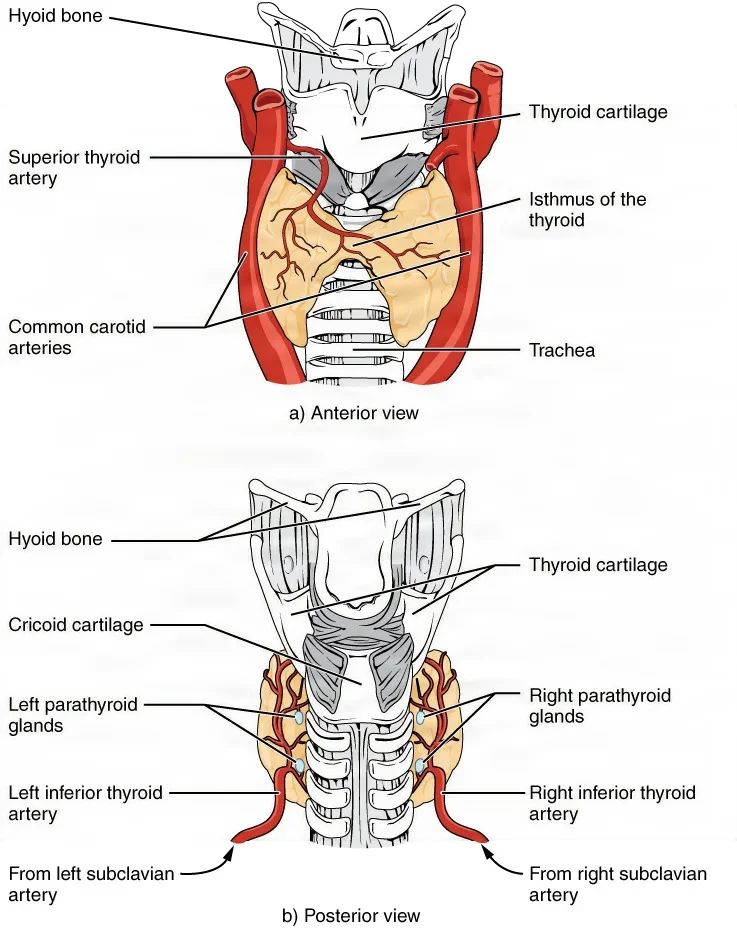
Thyroid hormones and metabolism
The thyroid is built of tiny hollow sacs, the follicleFOL-ih-kulA small sac or cavity in the body, such as the pocket a hair grows from or the sac in the ovary that holds an egg.Full entry , each full of a thick fluid, the colloid. The cells lining each follicle build the thyroid hormoneTHY-royd HOR-mohnA hormone made by the thyroid gland that controls how fast the body uses energy.Full entry in the colloid, and they need iodineEYE-uh-dyneA mineral the thyroid gland uses to make thyroid hormone; it is also used to kill germs on the skin and in some contrast dyes.Full entry from food to do it. That is why iodine is added to table salt.
- Thyroxine (T4) carries four iodine atoms. It is the main hormone the gland makes.
- T3tee-THREETriiodothyronine: the more active of the two main thyroid hormones, or the blood test that measures it.Full entry (T3) carries three. It is the stronger of the two, and many body cells turn T4 into T3 by removing one iodine.
The hormones wait in the colloid until thyroid-stimulating hormoneTHY-royd STIM-yuh-lay-ting HOR-mohnA hormone from the pituitary gland that tells the thyroid to make thyroid hormone; its blood level is the main thyroid test.Full entry releases them into the blood. There, more than 99 percent of them ride on carrier proteins, and only the small free share enters the cells.
T4 and T3 set the body's metabolismmuh-TAB-uh-liz-umAll the chemical processes in the body's cells that make energy, build tissue and break substances down.Full entry , the pace of the chemical work in its cells.
- They raise the basal metabolicmet-uh-BOL-ikRelating to metabolism, the chemical processes that turn food into energy and build and break down substances in the body.metabol change-ic relating toFull entry rate, the energy the body burns at rest, so cells use more oxygen and fuel and give off more heat.
- They are needed for growth and for the development of the brain and nerves before birth and in childhood.
- They make the heart and blood vessels more sensitive to epinephrineep-ih-NEF-rinA hormone and drug, also called adrenaline, that raises heart rate and blood pressure and opens the airways.Full entry and norepinephrinenor-ep-ih-NEF-rinA hormone and nerve messenger that narrows blood vessels and raises blood pressure, also given as an IV drug.Full entry , so too much thyroid hormone speeds the heart, strengthens the beat and raises the blood pressure.
The TRH, TSH and thyroid chain in the feedbackFEED-bakInformation about a result that is sent back to change what happens next, in the body or between people.Full entry figure controls the output. A blood test for TSH is the single best test of thyroid function. Because of negative feedback, a high TSH means the gland is underactive, and the pituitary is pushing it harder; a low TSH means the gland is overactivityoh-ver-ak-TIV-ih-teeMore activity than normal, in a person, an organ or a body system.Full entry .
When the diet lacks iodine, the thyroid cannot make enough hormone, the pituitary keeps sending more TSH, and the gland swells. An enlarged thyroid is called a goiterGOY-terAn enlarged thyroid gland, seen or felt as a swelling at the front of the neck.Full entry . A goiter can also come with an overactive gland.
Calcitonin
Scattered between the follicles are the parafollicular cells, or C cells. When the blood calcium rises, they release calcitoninkal-sih-TOH-ninA hormone made by the thyroid gland that lowers blood calcium; a lab-made form is used as a drug.Full entry , which lowers it: it slows the bone cells that break down bone (osteoclastOS-tee-oh-klastA bone cell that breaks down and removes old bone tissue.oste/o bone-clast something that breaksFull entry ), cuts the absorptionub-ZORP-shunThe taking in of a substance, such as a drug or a nutrient, into the bloodstream.Full entry of calcium in the gut and increases the calcium lost in the urine.
Calcitonin usually does little to keep the calcium steady; parathyroid hormonepar-uh-THY-royd HOR-mohnA hormone from the parathyroid glands in the neck that raises the calcium level in the blood.para- besidethyr/o thyroid-oid resemblingFull entry does most of that work. A drug form of calcitonin is used for weak, thin bones (osteoporosisos-tee-oh-puh-ROH-sisA condition in which bones lose density and become thin, weak and easy to break.oste/o bonepor/o pore, small opening-osis abnormal conditionFull entry ), and a high blood level can mark a medullamuh-DUL-uhThe inner part of an organ; most often the medulla oblongata, the lowest part of the brainstem.Full entry thyroid cancer.
6The parathyroid glands and calcium
Where they are
The parathyroid glandpair-uh-THY-royd glandOne of four small glands behind the thyroid that control the amount of calcium in the blood.para- besidethyr/o thyroid gland-oid likeFull entry are small, oval, yellow to brownish glands, each about the size of a lentil, on the back of the thyroid lobes. A thick capsule of connective tissuekuh-NEK-tiv TISH-ooBody tissue that supports, binds together and protects other tissues and organs.Full entry separates them from the thyroid, and fat often covers them.
- Most people have four: two upper glands near the upper poles of the thyroid and two lower glands near the lower poles. The lower ones vary more in where they sit.
- Some people have more, and glands can sit away from the thyroid, lower in the neck or in the upper chest (the superior mediastinum). The Core Curriculum lists four to six glands; one reference gives a range of 2 to 12, with about 90 percent of people having four.
- Both the upper and the lower glands get their blood from the inferior thyroid artery.
They are hard to tell apart from a lobule of fat, a lymph nodelimf nohdA small, bean-shaped organ of the immune system that filters lymph fluid and holds white blood cells.Full entry or a small thyroid noduleNOD-yoolA small, firm, rounded lump of tissue that can be felt or seen, in or under the skin or in an organ.Full entry , and during thyroid surgery they can be damaged, removed by accident or cut off from their blood supply.
Parathyroid hormone and blood calcium
Calcium is needed for muscles to contract, for nerves to send signals and for blood to clot, so its level in the blood is held in a narrow range.
When the blood calcium falls, the chief cells of the parathyroid glands release parathyroid hormonepar-uh-THY-royd HOR-mohnA hormone from the parathyroid glands in the neck that raises the calcium level in the blood.para- besidethyr/o thyroid-oid resemblingFull entry (PTH), also called parathormone. It raises the calcium in three ways.
- Bone: it makes osteoclastOS-tee-oh-klastA bone cell that breaks down and removes old bone tissue.oste/o bone-clast something that breaksFull entry break down bone matrix and ionized calciumEYE-uh-nized KAL-see-umA blood test for the free, active form of calcium that is not bound to proteins.Full entry into the blood, and it slows the cells that lay calcium down in bone.
- Kidneys: it makes the kidneys take back more calcium from the urine, and it makes them produce calcitriolkal-sih-TRY-olThe active form of vitamin D, given as a drug to raise calcium absorption or, as an ointment, for psoriasis.Full entry , the active form of vitamin D.
- Gut: calcitriol makes the intestine absorptionub-ZORP-shunThe taking in of a substance, such as a drug or a nutrient, into the bloodstream.Full entry more calcium from food.
As the calcium rises, PTH release slows, by negative feedbackFEED-bakInformation about a result that is sent back to change what happens next, in the body or between people.Full entry . PTH and calcitoninkal-sih-TOH-ninA hormone made by the thyroid gland that lowers blood calcium; a lab-made form is used as a drug.Full entry pull in opposite directions, and together they keep the calcium steady.
| Parathyroid hormone (PTH) | Calcitonin | |
|---|---|---|
| Made by | The chief cells of the parathyroid glands | The C (parafollicular) cells of the thyroid |
| Released when | Blood calcium falls | Blood calcium rises |
| Effect on blood calcium | Raises it | Lowers it |
| Effect on bone | Frees calcium from bone | Slows the release of calcium from bone |
Too much or too little parathyroid hormone
- hyperparathyroidismhy-per-pair-uh-THY-roy-diz-umOveractivity of the parathyroid glands, which make too much parathyroid hormone.hyper- excessivepara- besidethyroid -ism conditionFull entry : when the trouble starts in the glands themselves, it is most often a single benign tumor of one gland, an adenomaad-uh-NOH-muhA tumor of gland tissue that is not cancer.aden/o gland-oma tumorFull entry (80 to 85 percent of these cases), less often an enlargement of all four glands, and rarely a cancer. The high calcium thins the bones so they break easily, forms kidney stoneKID-nee STOHNA hard, pebble-like lump of minerals that forms inside the kidney.Full entry , and causes muscle weakness, tiredness, belly pain and changes in mood.
- hypoparathyroidismhy-poh-pair-uh-THY-royd-iz-umA condition in which the parathyroid glands make too little parathyroid hormone.hypo- below, too littlepara- besidethyr/o thyroid gland-oid like-ism conditionFull entry : most often the result of thyroid surgery that injures the parathyroid glands or cuts off their blood supply. The low calcium makes nerves and muscles fire too easily: numbness and tingling, twitching, cramps and muscle spasmSPAZ-umA sudden, involuntary tightening of a muscle or of the muscle in a hollow organ or tube.Full entry , a state called tetanyTET-uh-neeInvoluntary muscle cramps and spasms that come from nerves firing too easily.Full entry . Severe cases can bring on seizureSEE-zherA sudden burst of abnormal electrical activity in the brain that changes movement, feeling, behavior or awareness.Full entry and spasm of the larynxLAIR-inksThe voice box: the part of the airway in the neck, above the windpipe, that holds the vocal cords.laryng/o larynxFull entry that blocks breathing, and can be fatal.
7The adrenal glands
Where they sit
The two adrenal glanduh-DREE-nul GLANDOne of two small glands that sit on top of the kidneys and make hormones such as cortisol, aldosterone and epinephrine.ad- toward, nearren/o kidney-al relating toFull entry sit on top of the kidneys, which is why they are also called the suprarenal glands. They lie behind the peritoneumpair-ih-toh-NEE-umThe thin membrane that lines the belly cavity and covers most of the organs inside it.peri- aroundton stretched-eum a structureFull entry , under the diaphragmDY-uh-framThe dome-shaped sheet of muscle under the lungs that is the main muscle of breathing; also the flat side of a stethoscope.Full entry , inside the same fasciaFASH-ee-uhA sheet or band of tough connective tissue that covers and separates muscles and organs.fasci/o bandFull entry as the kidneys (Gerota fascia). The right gland is triangular and lies against the inferior vena cavain-FEER-ee-er VEE-nuh KAY-vuhThe large vein that carries blood from the lower body back to the right atrium of the heart.inferior lowervena veincava hollowFull entry . The left gland is crescent-shaped and lies behind the stomach and the pancreasPAN-kree-usA long, flat gland behind the stomach that makes digestive enzymes and the hormones insulin and glucagon.pan- allcreas fleshFull entry .
They have one of the richest blood flows in the body. Arteries reach them from the inferior phrenic arteries, the aorta and the renal arteries. The right adrenaluh-DREE-nulHaving to do with the adrenal glands, the two small glands that sit on top of the kidneys.ad- nearren/o kidney-al relating toFull entry vein is short and drains straight into the inferior vena cava; the left drains into the left renal vein.
Each gland is two glands in one.
- The adrenal cortexuh-DREE-nul KOR-teksThe outer layer of each adrenal gland, which makes the steroid hormones cortisol and aldosterone.ad- nearren kidney-al relating tocortex outer layer (Latin, bark)Full entry , the outer layer, is glandular tissue that makes steroidSTAIR-oydA fat-based chemical built from cholesterol; the group includes hormones such as cortisol and estrogen, and many drugs.ster/o solid-oid likeFull entry hormones.
- The adrenal medullauh-DREE-nul meh-DUL-uhThe inner part of each adrenal gland, which releases epinephrine and norepinephrine.medulla inner part (Latin for marrow)Full entry , the inner core, is modified nerve tissue that makes catecholaminekat-uh-KOH-luh-meenAny of a group of hormones and neurotransmitters, mainly epinephrine, norepinephrine and dopamine, that act in the body's stress response.Full entry .
The adrenal cortex
The cortexKOR-teksThe outer layer of an organ, especially the folded gray outer layer of the brain.cortic/o cortex, outer layerFull entry has three zones, and each makes its own group of steroids.
| Zone, from outside in | Hormone group | Main hormone | What it does |
|---|---|---|---|
| Zona glomerulosa | mineralocorticoidmin-er-uh-loh-KOR-tih-koydA steroid hormone, or a drug that acts like one, that makes the kidneys keep sodium and water and remove potassium.mineral saltscortic/o cortex-oid likeFull entry | aldosteroneal-DOS-tuh-rohnA hormone from the adrenal glands that makes the kidneys keep sodium and water and get rid of potassium.aldo- from aldehyde (a chemical group)-sterone steroid hormoneFull entry | Makes the kidneys keep sodium and let go of potassium; water follows the sodium, so blood volume and blood pressure rise |
| Zona fasciculata | corticosteroidkor-tih-koh-STER-oydA drug that acts like the hormones of the adrenal glands, used mainly to calm inflammation and the immune system.cortic/o cortex (the outer layer of the adrenal gland)-oid likeFull entry | cortisolKOR-tih-solA steroid hormone made by the adrenal glands that helps control blood sugar, blood pressure, stress and inflammation.Full entry | Raises the blood sugar by breaking down stored glycogenGLY-kuh-jenThe stored form of glucose, kept mainly in the liver and muscles.glyc/o sugar-gen producingFull entry , fat and muscle protein for fuel; helps the body through long stress; dampens inflammation and the immune responseih-MYOON rih-SPONSThe way the body recognizes and defends itself against germs and other substances it sees as foreign.Full entry |
| Zona reticularis | androgenAN-druh-jenA male sex hormone, such as testosterone, or a drug that acts like one.andr/o male-gen producingFull entry | Weak sex hormones | Turned into testosteronetes-TOS-tuh-rohnThe main male sex hormone, made mostly in the testes and in small amounts by the ovaries and adrenal glands.test/o testis-sterone steroid hormoneFull entry or estrogenES-truh-jenA female sex hormone, made mainly by the ovaries, and the group of drugs that act like it.Full entry in the tissues; after menopauseMEN-uh-pawzThe time in a woman's life when menstrual periods stop for good, counted once there has been no period for 12 months in a row.men/o month, menstruation-pause stopFull entry they are the main source of estrogens |
adrenocorticotropic hormoneuh-dree-noh-kor-tih-koh-TROH-pik HOR-mohnA hormone from the pituitary gland that tells the adrenal glands to make cortisol.adren/o adrenal glandcortic/o cortex, outer layer-tropic stimulatingFull entry from the anterior pituitary drives the release of cortisol and the androgens. The chain runs CRHsee-ar-aych (said as letters)Corticotropin-releasing hormone: a hormone from the hypothalamus that signals the pituitary gland to release ACTH.Full entry from the hypothalamushy-poh-THAL-uh-musA small area at the base of the brain that controls body temperature, hunger, thirst, sleep and many hormones.hypo- belowthalamus inner chamber (a part of the brain)Full entry , ACTH from the pituitary, then cortisol, and a high cortisol level switches the chain off. Aldosterone is also released when the potassium is high, the sodium is low or the blood pressure falls; a fall in pressure works through a hormone chain that starts in the kidneys (chapter 8).
Steroid drugs such as prednisonePRED-nih-soneA corticosteroid drug taken by mouth to reduce inflammation and calm the immune system.Full entry , dexamethasonedek-suh-METH-uh-zohnA strong, long-acting corticosteroid drug that reduces inflammation and calms the immune system.Full entry and hydrocortisonehy-droh-KOR-tih-soneA corticosteroid drug that is the same as the body's own cortisol, given by mouth, IV, on the skin or rectally.Full entry copy cortisol. They are used to calm inflammation, in a joint, in the lungs or on the skin, and to prevent the rejection of a transplanted organ. Taken for a long time, they shut down the patient's own adrenal cortex, a point that matters on the day of surgery. Chapter 12 teaches them as drugs.
The adrenal medulla
The medullamuh-DUL-uhThe inner part of an organ; most often the medulla oblongata, the lowest part of the brainstem.Full entry is really part of the sympathetic nervous systemsim-puh-THET-ik NER-vus SIS-tumThe branch of the autonomic nervous system that gets the body ready for stress or danger ("fight or flight").Full entry (chapter 4). Its large chromaffin cells release epinephrineep-ih-NEF-rinA hormone and drug, also called adrenaline, that raises heart rate and blood pressure and opens the airways.Full entry (adrenaline) and norepinephrinenor-ep-ih-NEF-rinA hormone and nerve messenger that narrows blood vessels and raises blood pressure, also given as an IV drug.Full entry (noradrenaline) into the blood, about four parts epinephrine to one of norepinephrine. These hormones are catecholamines, a group that also includes dopamineDOH-puh-meenA natural brain chemical, also given as an IV drug that raises blood pressure and makes the heart pump harder.Full entry .
Sympathetic nerves fire the medulla in danger or sudden stress, and the hormones arrive within seconds. This is the fight-or-flight response.
- The heart beats faster and harder, and the blood pressure rises.
- The airways widen, and more blood goes to the muscles, the heart and the brain.
- Blood vessels to the gut, the kidneys and the skin narrow, and digestion slows.
- The liver turns glycogen into glucose, so the blood sugar rises. The pupils widen and the mouth goes dry.
Epinephrine is also a drug you will handle at the field. A little of it is mixed with local anestheticLOH-kul an-es-THET-ikA drug that blocks feeling in one part of the body without making the person unconscious.Full entry such as lidocaineLY-doh-kaynA local anesthetic that numbs an area, also given by IV to treat some fast, abnormal heart rhythms.Full entry ; it narrows the small vessels, so the numbing drug stays where it was injected and lasts longer, and the tissue bleeds less. Chapter 12 teaches its safe use.
8The pancreatic islets and blood sugar
Most of the pancreasPAN-kree-usA long, flat gland behind the stomach that makes digestive enzymes and the hormones insulin and glucagon.pan- allcreas fleshFull entry makes digestive juice (chapter 7). Scattered through it are tiny clusters of hormone-making cells, the pancreatic islets, or islets of Langerhans, which release their hormones into the blood.
Each islet holds four kinds of cells.
- Alpha cells, about 20 percent of the islet, make glucagonGLOO-kuh-gonA hormone made by the pancreas that raises blood sugar; also given as a drug for severe low blood sugar.Full entry .
- beta cellBAY-tuh SELA cell in the pancreas that makes and releases insulin.Full entry , about 75 percent, make insulinIN-suh-linA hormone made by the pancreas that lets the body's cells take in glucose, also made as a medicine.Full entry .
- Delta cells, about 4 percent, make somatostatin, which holds back the release of both insulin and glucagon. The hypothalamushy-poh-THAL-uh-musA small area at the base of the brain that controls body temperature, hunger, thirst, sleep and many hormones.hypo- belowthalamus inner chamber (a part of the brain)Full entry , the stomach and the intestine make somatostatin too.
- PP cells, about 1 percent, make pancreatic polypeptide, which seems to play a part in appetite.
Glucose is the body's preferred fuel, and the brain depends on a steady supply. The body keeps the blood glucose, or blood sugar, at about 70 to 100 mg/dL, and it stores extra glucose in the liver and the muscles as glycogenGLY-kuh-jenThe stored form of glucose, kept mainly in the liver and muscles.glyc/o sugar-gen producingFull entry . Insulin and glucagon work as a seesaw to hold it there.
- When the blood sugar rises, as after a meal, the beta cells release insulin. Insulin lets most body cells, above all muscle and fat cells, take glucose in; it makes the liver store glucose as glycogen; and it helps the body build fat and protein. The blood sugar falls. The brain, the liver, the kidneys and red blood cells take up glucose without needing insulin.
- When the blood sugar falls, as during fasting or hard exercise, the alpha cells release glucagon. Glucagon makes the liver break glycogen back down into glucose and build new glucose from amino aciduh-MEE-noh AS-idOne of the small building blocks that join together in chains to make proteins.Full entry and glycerol. The blood sugar rises.
Each hormone is held in check by negative feedbackFEED-bakInformation about a result that is sent back to change what happens next, in the body or between people.Full entry : a falling blood sugar turns off insulin, and a rising one turns off glucagon. cortisolKOR-tih-solA steroid hormone made by the adrenal glands that helps control blood sugar, blood pressure, stress and inflammation.Full entry , epinephrineep-ih-NEF-rinA hormone and drug, also called adrenaline, that raises heart rate and blood pressure and opens the airways.Full entry and growth hormoneGROHTH HOR-mohnA hormone from the pituitary gland that drives growth in children and helps control body build and metabolism in adults.Full entry also raise the blood sugar, which is why stress pushes it up.
Beta cells make insulin, which lowers the blood sugar. Alpha cells make glucagon, which raises it.
Diabetes mellitus
In diabetes mellitus ("honey-sweet"), the blood sugar stays too high, a state called hyperglycemiahy-per-gly-SEE-mee-uhA blood glucose level above normal, over 100 mg/dL when fasting.hyper- aboveglyc/o sugar-emia in the bloodFull entry , because the body makes too little insulin or its cells do not respond to it.
- Type 1: the immune system destroys the beta cells, so the body makes little or no insulin. The patient needs insulin by injection or pump for life. It usually starts young and makes up a small share of cases.
- Type 2: the cells resist insulin, the pancreas makes more to keep up, and in time the beta cells wear out. It makes up about 90 to 95 percent of cases and is linked to excess weight and too little activity. Diet, exercise and pills often control it, and some patients need insulin.
The early signs are passing large amounts of urine (polyuriapol-ee-YOOR-ee-uhPassing an abnormally large amount of urine, usually more than about 2.5 to 3 liters a day in an adult.poly- many, muchur/o urine-ia conditionFull entry ), great thirst (polydipsiapol-ee-DIP-see-uhExtreme thirst, with drinking much more fluid than usual.poly- many, much-dipsia thirstFull entry ) and hunger (polyphagia): the extra glucose spills into the urine and pulls water with it.
Over the years, a high blood sugar damages blood vessels and nerves. That leads to myocardial infarctionmy-oh-KAR-dee-ul in-FARK-shunDeath of part of the heart muscle because its blood supply is blocked; a heart attack.my/o musclecardi/o heart-al having to do withinfarct area of dead tissueFull entry and strokes, renal failureREE-nul FAYL-yerLoss of the kidneys' ability to filter waste and extra fluid from the blood.ren kidney-al relating toFull entry , blindness, poor blood flow to the legs, and loss of feeling in the feet (neuropathynoo-ROP-uh-theeDamage to or disease of one or more nerves, most often the nerves of the hands and feet.neur/o nerve-pathy diseaseFull entry ). Together these raise the risk of injury, infection and tissue death, and lead to many toe, foot and leg amputationam-pyoo-TAY-shunThe removal of all or part of a limb or other body part, by surgery or by injury.Full entry .
Without insulin, cells burnBURNAn injury to the skin or deeper tissues caused by heat, chemicals, electricity, radiation or friction.Full entry fat for fuel, and acids called ketoneKEE-tohnAn acid made by the liver when the body burns fat for energy instead of glucose.Full entry build up in the blood. This ketoacidosiskee-toh-as-ih-DOH-sisA state in which ketones build up in the blood and make it too acidic.ket/o ketoneacid acid-osis abnormal conditionFull entry can lead to comaKOH-muhA deep state of unconsciousness in which a person cannot be woken and does not respond with purpose.Full entry and death if it is not treated.
The opposite problem, hypoglycemiahy-poh-gly-SEE-mee-uhA blood glucose level below normal, under 70 mg/dL.hypo- belowglyc/o sugar, glucose-emia in the bloodFull entry , a blood sugar that is too low, most often comes from too much insulin. The patient becomes anxious, sweaty, shaky, hungry and weak, with a fast heart rate; as the brain runs short of glucose, they become confused and may have seizureSEE-zherA sudden burst of abnormal electrical activity in the brain that changes movement, feeling, behavior or awareness.Full entry or lose consciousness. A very high and a very low blood sugar can look alike, so the cause is checked quickly and treated.
9The thymus and other hormone makers
The thymus
The thymusTHY-musA small gland in the upper chest, behind the breastbone, where T cells (a kind of white blood cell) mature.Full entry lies in the mediastinum, in the upper front of the chest behind the sternum. It is large and active in infancy and childhood and shrinks with age.
Its hormones, the thymosins, help T lymphocyteLIM-foh-syteA type of white blood cell that targets specific germs and abnormal cells, including T cells, B cells and natural killer cells.Full entry , the immune cells that mature in the thymus, to develop. Chapter 5 teaches the thymus as lymphoid tissue, and chapter 10 teaches immunityih-MYOO-nih-teeThe body's ability to resist or fight off a particular infection or disease.immun/o protection-ity stateFull entry .
A thymectomy removes the thymus. It is done for a tumor of the thymus, a thymoma, and for myasthenia gravismy-us-THEE-nee-uh GRAV-isA long-term autoimmune disease in which antibodies block the signals passing from nerves to muscles.my/o muscle-asthenia weaknessgravis seriousFull entry , an autoimmune diseaseaw-toh-ih-MYOON dih-ZEEZA disease in which the immune system attacks the body's own healthy tissue.auto- selfimmune protectedFull entry that weakens the muscles; thymomas are often found together with it. The classic approach is through the split sternum (a median sternotomy), and less invasive approaches go through a partial sternotomy, through the neck, or through small chest incisions with a thoracoscope or a robot. Chapter 41 teaches it.
Other organs that make hormones
| Organ | Main hormones | What they do |
|---|---|---|
| Ovaries | estrogenES-truh-jenA female sex hormone, made mainly by the ovaries, and the group of drugs that act like it.Full entry and progesteroneproh-JES-tuh-rohnA female sex hormone that prepares the lining of the uterus for pregnancy and helps keep a pregnancy going, also given as a drug.Full entry | Female sex characteristics, the menstrual cycle and pregnancy (chapter 8) |
| Testes | testosteronetes-TOS-tuh-rohnThe main male sex hormone, made mostly in the testes and in small amounts by the ovaries and adrenal glands.test/o testis-sterone steroid hormoneFull entry | Male sex characteristics and sperm production (chapter 8) |
| placentapluh-SEN-tuhThe organ that grows in the uterus during pregnancy and passes oxygen and food from the parent's blood to the fetus.Full entry | human chorionic gonadotropinHYOO-mun kor-ee-ON-ik goh-nad-oh-TROH-pinA hormone made by the placenta during pregnancy, measured in blood or urine as a pregnancy test.Full entry (hCG), estrogens and progesterone | Keep a pregnancy going |
| Heart | atrialAY-tree-ulRelating to an atrium, one of the two upper chambers of the heart.atri/o atrium-al relating toFull entry natriuretic peptidenay-tree-yoo-RET-ik PEP-tydeA hormone released by stretched heart muscle that makes the kidneys remove sodium and water and relaxes the blood vessels.Full entry (ANP), from the walls of the atriumAY-tree-umOne of the two upper chambers of the heart, which receive blood coming back to the heart.atri/o atrium-um noun endingFull entry | Makes the kidneys let go of sodium and water, lowering blood volume and pressure |
| Kidneys | Renin, erythropoietinih-rith-roh-POY-uh-tinA hormone made mainly by the kidneys that tells the bone marrow to make red blood cells.erythr/o red-poietin substance that makesFull entry (EPO) and calcitriolkal-sih-TRY-olThe active form of vitamin D, given as a drug to raise calcium absorption or, as an ointment, for psoriasis.Full entry | Raise blood pressure, drive red blood cell production and help absorptionub-ZORP-shunThe taking in of a substance, such as a drug or a nutrient, into the bloodstream.Full entry calcium (chapter 8) |
| Stomach and small intestine | Gastrin, secretin and cholecystokinin (CCK) | Control the juices of digestion (chapter 7) |
| Fat tissue | Leptin | Gives the feeling of fullness after a meal |
10When glands make too much or too little
Most endocrineEN-doh-krinRelating to the glands that release hormones straight into the blood, or to those hormones.endo- withincrin/o to secreteFull entry diseases come from a gland making too much of its hormone (hypersecretion) or too little (hyposecretion). The prefix "hyper-" means above normal and "hypo-" means below normal, so hyperthyroidismhy-per-THY-roy-diz-umA condition in which the thyroid gland makes too much thyroid hormone.hyper- above, overthyr/o thyroid gland-ism conditionFull entry is an overactive thyroid and hypothyroidismhy-poh-THY-roy-diz-umA condition in which the thyroid gland makes too little thyroid hormone.hypo- below, underthyr/o thyroid gland-ism conditionFull entry an underactive one. Too little is often treated by replacing the hormone; too much, with drugs that lower it or by removing the gland.
| Gland | Too much | Too little |
|---|---|---|
| Anterior pituitary (growth hormoneGROHTH HOR-mohnA hormone from the pituitary gland that drives growth in children and helps control body build and metabolism in adults.Full entry ) | Gigantism in a child; acromegalyak-roh-MEG-uh-leeA rare hormone disorder in adults in which the body makes too much growth hormone.acr/o extremities (hands and feet)-megaly enlargementFull entry in an adult | Stunted growth in a child (pituitary dwarfism) |
| Posterior pituitary (antidiuretic hormonean-tee-dy-yoo-RET-ik HOR-mohnA hormone from the pituitary gland that tells the kidneys to hold on to water, making the urine more concentrated.anti- againstdiuretic making urineFull entry ) | syndrome of inappropriate antidiuretic hormoneSIN-drohm of in-uh-PROH-pree-it an-tee-dy-yoo-RET-ik HOR-mohnA condition in which the body releases more antidiuretic hormone than it needs, so the kidneys hold on to too much water.Full entry (SIADH): the kidneys hold back too much water, so the blood is diluted and its sodium falls | diabetes insipidusdy-uh-BEE-teez in-SIP-ih-dusA disorder of antidiuretic hormone: the body makes too little of it, or the kidneys do not respond to it.Full entry : large amounts of dilute urine, thirst |
| Thyroid | Hyperthyroidism, most often Graves diseaseGRAYVZ dih-ZEEZAn autoimmune disease in which antibodies make the thyroid gland overactive.Full entry , an autoimmune diseaseaw-toh-ih-MYOON dih-ZEEZA disease in which the immune system attacks the body's own healthy tissue.auto- selfimmune protectedFull entry : fast heart rate, heat intolerance, sweating, weight loss, tremorTREM-erShaking of a part of the body, such as the hands, in small rhythmic movements that the person cannot control.Full entry , nervousness, bulging eyes, sometimes a goiterGOY-terAn enlarged thyroid gland, seen or felt as a swelling at the front of the neck.Full entry | Hypothyroidism, most often Hashimoto thyroiditishah-shee-MOH-toh thy-roy-DY-tisAn autoimmune disease in which the immune system attacks the thyroid gland, slowly reducing its hormone output.thyr/o thyroid-itis inflammationFull entry , an autoimmune disease, or after the thyroid is removed: tiredness, feeling cold, weight gain, slow heart rate, constipation, slowed thinking |
| parathyroid glandpair-uh-THY-royd glandOne of four small glands behind the thyroid that control the amount of calcium in the blood.para- besidethyr/o thyroid gland-oid likeFull entry | hyperparathyroidismhy-per-pair-uh-THY-roy-diz-umOveractivity of the parathyroid glands, which make too much parathyroid hormone.hyper- excessivepara- besidethyroid -ism conditionFull entry : high calcium, thin bones, kidney stoneKID-nee STOHNA hard, pebble-like lump of minerals that forms inside the kidney.Full entry | hypoparathyroidismhy-poh-pair-uh-THY-royd-iz-umA condition in which the parathyroid glands make too little parathyroid hormone.hypo- below, too littlepara- besidethyr/o thyroid gland-oid like-ism conditionFull entry : hypocalcemiahy-poh-kal-SEE-mee-uhA blood calcium level below normal.hypo- belowcalc calcium-emia in the bloodFull entry and tetanyTET-uh-neeInvoluntary muscle cramps and spasms that come from nerves firing too easily.Full entry |
| adrenal cortexuh-DREE-nul KOR-teksThe outer layer of each adrenal gland, which makes the steroid hormones cortisol and aldosterone.ad- nearren kidney-al relating tocortex outer layer (Latin, bark)Full entry | Cushing syndromeKUSH-ing SIN-drohmA condition caused by too much cortisol in the body over a long time.Full entry (too much cortisolKOR-tih-solA steroid hormone made by the adrenal glands that helps control blood sugar, blood pressure, stress and inflammation.Full entry ): hyperglycemiahy-per-gly-SEE-mee-uhA blood glucose level above normal, over 100 mg/dL when fasting.hyper- aboveglyc/o sugar-emia in the bloodFull entry , a round "moon" face, a fat pad on the back of the neck, skin that bruises easily, poor wound healingwoond HEE-lingThe body's process of repairing damaged skin and tissue.Full entry , infections; from a pituitary tumor making too much adrenocorticotropic hormoneuh-dree-noh-kor-tih-koh-TROH-pik HOR-mohnA hormone from the pituitary gland that tells the adrenal glands to make cortisol.adren/o adrenal glandcortic/o cortex, outer layer-tropic stimulatingFull entry (Cushing diseaseKUUSH-ing dih-ZEEZA condition in which a pituitary gland tumor makes too much ACTH, which drives the adrenal glands to make too much cortisol.Full entry ), an adrenaluh-DREE-nulHaving to do with the adrenal glands, the two small glands that sit on top of the kidneys.ad- nearren/o kidney-al relating toFull entry tumor, or long-term steroidSTAIR-oydA fat-based chemical built from cholesterol; the group includes hormones such as cortisol and estrogen, and many drugs.ster/o solid-oid likeFull entry drugs | Addison diseaseAD-ih-sun dih-ZEEZA condition in which the adrenal glands do not make enough cortisol and often not enough aldosterone.Full entry (too little cortisol and aldosteroneal-DOS-tuh-rohnA hormone from the adrenal glands that makes the kidneys keep sodium and water and get rid of potassium.aldo- from aldehyde (a chemical group)-sterone steroid hormoneFull entry ): weakness, weight loss, low blood pressure, hypoglycemiahy-poh-gly-SEE-mee-uhA blood glucose level below normal, under 70 mg/dL.hypo- belowglyc/o sugar, glucose-emia in the bloodFull entry and low sodium; most often autoimmuneaw-toh-ih-MYOONDescribing a reaction in which the immune system attacks the body's own healthy cells and tissues.auto- selfimmune protected from diseaseFull entry |
| adrenal medullauh-DREE-nul meh-DUL-uhThe inner part of each adrenal gland, which releases epinephrine and norepinephrine.medulla inner part (Latin for marrow)Full entry | Pheochromocytoma, a tumor of the chromaffin cells: bouts of very high blood pressure, fast heart rate, sweating, anxiety, high blood sugar | |
| pancreasPAN-kree-usA long, flat gland behind the stomach that makes digestive enzymes and the hormones insulin and glucagon.pan- allcreas fleshFull entry islets | Too much insulinIN-suh-linA hormone made by the pancreas that lets the body's cells take in glucose, also made as a medicine.Full entry (most often an insulin overdose): hypoglycemia | Diabetes mellitus: hyperglycemia |
11Hormones and surgery
The stress of surgery
The body treats an operation as an injury. Nerve signals from the cut tissue reach the hypothalamushy-poh-THAL-uh-musA small area at the base of the brain that controls body temperature, hunger, thirst, sleep and many hormones.hypo- belowthalamus inner chamber (a part of the brain)Full entry , which turns on the pituitary and the adrenal glanduh-DREE-nul GLANDOne of two small glands that sit on top of the kidneys and make hormones such as cortisol, aldosterone and epinephrine.ad- toward, nearren/o kidney-al relating toFull entry , and the blood fills with cortisolKOR-tih-solA steroid hormone made by the adrenal glands that helps control blood sugar, blood pressure, stress and inflammation.Full entry , catecholaminekat-uh-KOH-luh-meenAny of a group of hormones and neurotransmitters, mainly epinephrine, norepinephrine and dopamine, that act in the body's stress response.Full entry , glucagonGLOO-kuh-gonA hormone made by the pancreas that raises blood sugar; also given as a drug for severe low blood sugar.Full entry and growth hormoneGROHTH HOR-mohnA hormone from the pituitary gland that drives growth in children and helps control body build and metabolism in adults.Full entry .
The result is the stress response.
- The heart rate and blood pressure rise.
- The liver pours out glucose while the cells respond less to insulinIN-suh-linA hormone made by the pancreas that lets the body's cells take in glucose, also made as a medicine.Full entry , so the blood sugar rises, even in patients without diabetes. The bigger the operation, the greater this insulin resistanceIN-suh-lin rih-ZIS-tunsA state in which the body's cells respond poorly to insulin, so more insulin is needed to move glucose into them.Full entry .
- Muscle protein is broken down for fuel, which can slow healing.
- Cortisol held high for a long time weakens the lymphocyteLIM-foh-syteA type of white blood cell that targets specific germs and abnormal cells, including T cells, B cells and natural killer cells.Full entry that fight infection.
Bleeding adds to it. In a heavy bleed, the autonomic nervous systemaw-tuh-NOM-ik NUR-vus SIS-tumThe part of the nervous system that controls body functions without conscious thought, such as heart rate, breathing and digestion.auto- selfnom/o law, control-ic relating toFull entry releases vasopressinvay-zoh-PRES-inA man-made form of antidiuretic hormone, given by IV mainly to raise blood pressure in shock.Full entry , glucagon, cortisol, epinephrineep-ih-NEF-rinA hormone and drug, also called adrenaline, that raises heart rate and blood pressure and opens the airways.Full entry and norepinephrinenor-ep-ih-NEF-rinA hormone and nerve messenger that narrows blood vessels and raises blood pressure, also given as an IV drug.Full entry . At first they help, by raising the cardiac outputKAR-dee-ak OWT-putThe amount of blood the heart pumps out in one minute.Full entry and narrowing the vessels so blood goes to the heart and brain. Chapter 11 teaches shockshokA life-threatening state in which blood flow is too low to bring enough oxygen to the body's tissues.Full entry .
Enhanced recovery after surgery (ERAS) pathways are built to lower the body's stress response to an operation. The CDC's guideline for preventing surgical site infection calls for controlling the blood sugar around surgery, with a target below 200 mg/dL, in patients with and without diabetes.
A 2022 update from three US infection prevention societies (SHEA, IDSA and APIC) sets a lower target: keep every patient's blood sugar between 110 and 150 mg/dL in the first day or two after surgery, with or without diabetes.
The patient with a gland disorder
Diabetes, thyroid disorders and adrenaluh-DREE-nulHaving to do with the adrenal glands, the two small glands that sit on top of the kidneys.ad- nearren/o kidney-al relating toFull entry insufficiencyin-suh-FISH-un-seeA state in which an organ or part does not work well enough to meet the body's needs.in- notsufficient enoughFull entry (Addison diseaseAD-ih-sun dih-ZEEZA condition in which the adrenal glands do not make enough cortisol and often not enough aldosterone.Full entry ) are among the endocrineEN-doh-krinRelating to the glands that release hormones straight into the blood, or to those hormones.endo- withincrin/o to secreteFull entry disorders that change how a patient goes through surgery.
Diabetes. A hyperglycemiahy-per-gly-SEE-mee-uhA blood glucose level above normal, over 100 mg/dL when fasting.hyper- aboveglyc/o sugar-emia in the bloodFull entry slows wound healingwoond HEE-lingThe body's process of repairing damaged skin and tissue.Full entry and raises the risk of a surgical site infection, so the patient's blood sugar is checked before, during and after surgery. Surgery upsets both the patient's meals and their insulin doses. A patient with diabetes should be the first case of the day, so they can get back to their usual meals as soon as possible. In a long case, the team pads pressure points with extra care, because poor circulation and lost feeling put the skin at risk.
An hyperthyroidismhy-per-THY-roy-diz-umA condition in which the thyroid gland makes too much thyroid hormone.hyper- above, overthyr/o thyroid gland-ism conditionFull entry . Before planned surgery, drugs bring the thyroid hormoneTHY-royd HOR-mohnA hormone made by the thyroid gland that controls how fast the body uses energy.Full entry levels back to normal (a euthyroid state). These patients have a higher risk of heart rhythm problems, such as atrial fibrillationAY-tree-ul fib-rih-LAY-shunAn irregular heart rhythm in which the upper chambers of the heart quiver instead of beating in an organized way.atri/o atrium (upper heart chamber)fibrill/o small fibers, quivering-ation processFull entry .
The danger is thyroid storm (thyrotoxic crisisKRY-sisA time when a person's usual ways of coping fail and they cannot manage a stressful event.Full entry ): a sudden release of a large amount of thyroid hormone, which can be set off by a stress such as surgery. The patient develops a high fever, a very fast heart rate, high blood pressure, vomiting or diarrhea, agitation and confusion, and may have seizureSEE-zherA sudden burst of abnormal electrical activity in the brain that changes movement, feeling, behavior or awareness.Full entry or slip into a comaKOH-muhA deep state of unconsciousness in which a person cannot be woken and does not respond with purpose.Full entry . A calm, quiet room helps prevent it. If it happens, the team gives oxygen, fluids and drugs and cools the patient.
An hypothyroidismhy-poh-THY-roy-diz-umA condition in which the thyroid gland makes too little thyroid hormone.hypo- below, underthyr/o thyroid gland-ism conditionFull entry . These patients are at risk of breathing failure around surgery. A rare and dangerous form, myxedema coma, mostly affects people older than 75.
A large goiterGOY-terAn enlarged thyroid gland, seen or felt as a swelling at the front of the neck.Full entry or thyroid noduleNOD-yoolA small, firm, rounded lump of tissue that can be felt or seen, in or under the skin or in an organ.Full entry can press on the tracheaTRAY-kee-uhThe windpipe: the tube that carries air from the throat to the lungs.Full entry or push it aside and make the breathing tube hard to place, so the difficult airway cart is brought into the room before inductionin-DUK-shunThe starting of a process on purpose, such as bringing on labor or putting a client under anesthesia.Full entry .
Long-term steroidSTAIR-oydA fat-based chemical built from cholesterol; the group includes hormones such as cortisol and estrogen, and many drugs.ster/o solid-oid likeFull entry . A patient who has taken steroid drugs for more than about 3 weeks may have a shut-down adrenal cortexuh-DREE-nul KOR-teksThe outer layer of each adrenal gland, which makes the steroid hormones cortisol and aldosterone.ad- nearren kidney-al relating tocortex outer layer (Latin, bark)Full entry that cannot make the extra cortisol the stress of surgery calls for. The result can be an adrenal crisis, with a dangerous fall in blood pressure. So the patient's steroid use is found out before surgery. The usual dose is kept up, and whether an extra stress dose of steroid is added is decided for each patient, from how much steroid they take and for how long, and from the type and length of the operation. A stress dose for every patient on steroids is no longer the routine.
Thyroid and parathyroid surgery
Surgeons remove all or part of the thyroid for a known or suspected cancer, for a goiter that presses on the airway or the esophagusih-SOF-uh-gusThe muscular tube that carries food and liquid from the throat to the stomach.esophag/o esophagusFull entry , and for some patients with an overactivityoh-ver-ak-TIV-ih-teeMore activity than normal, in a person, an organ or a body system.Full entry gland, such as in Graves diseaseGRAYVZ dih-ZEEZAn autoimmune disease in which antibodies make the thyroid gland overactive.Full entry . parathyroid glandpair-uh-THY-royd glandOne of four small glands behind the thyroid that control the amount of calcium in the blood.para- besidethyr/o thyroid gland-oid likeFull entry tissue is removed for hyperparathyroidismhy-per-pair-uh-THY-roy-diz-umOveractivity of the parathyroid glands, which make too much parathyroid hormone.hyper- excessivepara- besidethyroid -ism conditionFull entry . When the disease starts in the glands themselves, its cause is most often a single adenomaad-uh-NOH-muhA tumor of gland tissue that is not cancer.aden/o gland-oma tumorFull entry .
Chapter 32 teaches the operations: the thyroidectomythy-roy-DEK-tuh-meeSurgery to remove all or part of the thyroid gland in the neck.thyr/o thyroid-ectomy surgical removalFull entry , the hemithyroidectomy, which removes one lobe with the isthmus, and the parathyroidectomy. The anatomy in this chapter explains their three chief complications: injury to the recurrent larynxLAIR-inksThe voice box: the part of the airway in the neck, above the windpipe, that holds the vocal cords.laryng/o larynxFull entry nerve, a low blood calcium and a hematomahee-muh-TOH-muhA collection of blood, often clotted, that has leaked out of the blood vessels into the tissue.hem/o blood (here as hemat-)-oma swelling or massFull entry in the neck.
- The recurrent laryngeal nerve. The surgeon finds the nerve and protects it, often with a nerve monitor built into the breathing tube. Because the nerve controls the voice, the patient's voice is checked before surgery as a baseline. A nerve injured on one side leaves the voice hoarse; injury to both sides can block the airway and call for an emergency tracheotomytray-kee-OT-uh-meeThe surgical cut made into the windpipe through the front of the neck.trache/o windpipe-tomy cutting, incisionFull entry .
- Low calcium. If the parathyroid glands are removed or lose their blood supply, parathyroid hormonepar-uh-THY-royd HOR-mohnA hormone from the parathyroid glands in the neck that raises the calcium level in the blood.para- besidethyr/o thyroid-oid resemblingFull entry falls and so does the blood calcium. After a total thyroidectomyTOE-tul thy-roy-DEK-tuh-meeSurgery to remove the whole thyroid gland.thyroid thyroid gland-ectomy surgical removalFull entry or a parathyroidectomy, the calcium reaches its lowest point 48 to 72 hours after surgery. Early signs are numbness and tingling of the fingers, toes and lips. Tapping over the facial nerveFAY-shul NERVThe seventh cranial nerve, which moves the muscles of the face and carries taste from the front of the tongue.Full entry makes the face muscles twitch (a positive Chvostek signVOS-tek sineA twitch of the muscles of the face when the facial nerve, just in front of the ear, is tapped.Full entry ), and a blood pressure cuff pumped up on the arm makes the hand and wrist spasmSPAZ-umA sudden, involuntary tightening of a muscle or of the muscle in a hollow organ or tube.Full entry (a positive Trousseau signtroo-SOH SINEA spasm of the hand and wrist that appears when a blood pressure cuff on the upper arm is kept inflated for a few minutes.Full entry ). tetanyTET-uh-neeInvoluntary muscle cramps and spasms that come from nerves firing too easily.Full entry can follow, with spasms of the hands and feet, seizures and stridorSTRY-derA high-pitched, harsh sound made while breathing, usually heard when breathing in.Full entry , the harsh, high-pitched sound of a narrowed airway, which can be fatal.
- A neck hematoma. Bleeding under the closed wound can press on the trachea. That is why the back table stays sterile until the patient has been extubated and has left the room, and a tracheotomy tray stays close by.
If a parathyroid gland is found on the removed thyroid, it is saved and reimplanted (chapter 32). A patient whose whole thyroid is removed takes thyroid hormone, levothyroxinelee-voh-thy-ROK-seenA man-made form of the thyroid hormone thyroxine (T4), taken to replace hormone the thyroid does not make.Full entry , for life.
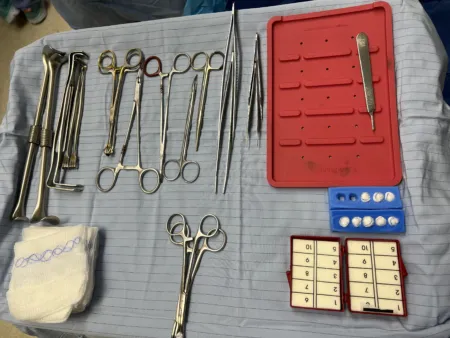
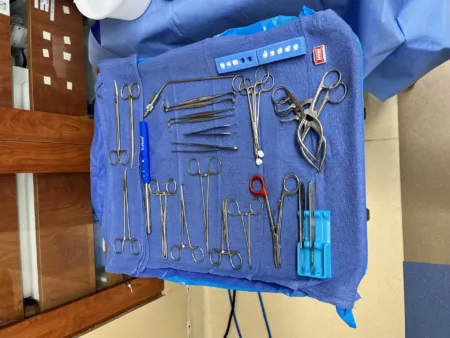
The recurrent laryngeal nerve is the voice; the parathyroids are the calcium. Hoarseness after thyroid surgery points to the nerve; tingling and twitching point to low calcium.
Adrenal surgery
An adrenalectomy removes one or both adrenal glands, for a tumor that makes too much hormone, such as a pheochromocytoma, a tumor making cortisol (Cushing syndromeKUSH-ing SIN-drohmA condition caused by too much cortisol in the body over a long time.Full entry ) or one making aldosteroneal-DOS-tuh-rohnA hormone from the adrenal glands that makes the kidneys keep sodium and water and get rid of potassium.aldo- from aldehyde (a chemical group)-sterone steroid hormoneFull entry , or for cancer. It is usually done laparoscopically, which means less harm and a shorter hospital stay than an open operation; for one gland, the patient lies on the side or on the back. Chapter 34 teaches it.
A pheochromocytoma makes the case dangerous.
- Before surgery, the patient takes drugs that block the effects of the catecholamines, the alpha blockerBLOK-erA drug that stops a receptor or channel in the body from being activated, so the usual effect does not happen.Full entry first and then the beta blockerBAY-tuh BLOK-erA drug that blocks the effects of adrenaline on beta receptors, slowing the heart rate and lowering blood pressure.Full entry .
- During surgery, the anesthesia provideran-us-THEE-zhuh pruh-VY-derThe licensed professional who gives anesthesia and watches over the client's breathing and vital functions during a procedure.Full entry watches the blood pressure continuously through an arterial linear-TEER-ee-ul lineA thin catheter placed in an artery, often in the wrist, to measure blood pressure all the time and draw blood.Full entry . Handling the tumor can release a flood of catecholamines and send the blood pressure soaring, so the surgeon ties off the adrenal vein early.
- Once the tumor is out, the catecholamines fall away. The blood pressure can drop sharply, and so can the blood sugar, so the patient goes to intensive care to be watched.
After a tumor that made too much cortisol is removed, the other adrenal gland may have been shut down and cannot keep up, so steroids are given during and after surgery and tapered slowly. A patient who loses both adrenal glands needs corticosteroidkor-tih-koh-STER-oydA drug that acts like the hormones of the adrenal glands, used mainly to calm inflammation and the immune system.cortic/o cortex (the outer layer of the adrenal gland)-oid likeFull entry and mineralocorticoidmin-er-uh-loh-KOR-tih-koydA steroid hormone, or a drug that acts like one, that makes the kidneys keep sodium and water and remove potassium.mineral saltscortic/o cortex-oid likeFull entry replacement for life.
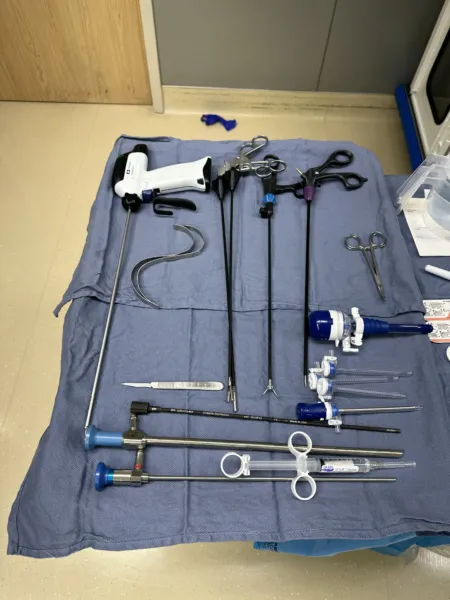
Pituitary surgery
Most pituitary tumors are removed through the nose and the sphenoid sinusSY-nusA hollow space in the body, most often one of the air-filled spaces in the skull bones around the nose.Full entry , a transsphenoidal hypophysectomy, with an endoscopeEN-duh-skohpA thin tube with a light and a camera that is passed into the body to look inside an organ or cavity.endo- within-scope instrument for viewingFull entry or a microscope. A large or complex tumor may need a craniotomykray-nee-OT-uh-meeSurgery in which a piece of the skull is removed to reach the brain, and usually put back at the end.crani/o skull-tomy cutting intoFull entry instead. The sella may be packed with a small graftGRAFTTissue or a man-made material moved into place in surgery to replace or repair a damaged part.Full entry of fat or muscle so cerebrospinal fluidser-uh-broh-SPY-nul FLOO-idThe clear, watery fluid that bathes and cushions the brain and spinal cord.cerebr/o brainspin spine-al relating toFull entry cannot leak. Chapter 42 teaches it.
The gland's work explains what the team watches for afterward.
- diabetes insipidusdy-uh-BEE-teez in-SIP-ih-dusA disorder of antidiuretic hormone: the body makes too little of it, or the kidneys do not respond to it.Full entry : the loss of antidiuretic hormonean-tee-dy-yoo-RET-ik HOR-mohnA hormone from the pituitary gland that tells the kidneys to hold on to water, making the urine more concentrated.anti- againstdiuretic making urineFull entry , or swelling around the gland, can cause a flood of dilute urine.
- Vision: a hematoma can press on the optic nerveOP-tik nervThe nerve that carries visual signals from the back of the eye to the brain; the second cranial nerve.Full entry or the optic chiasm.
- A leak of cerebrospinal fluid.
- Lost hormones: when the whole gland is removed, the patient needs thyroid hormone, sex hormones and glucocorticoids for life.
The pancreas at surgery
Removing part of the pancreasPAN-kree-usA long, flat gland behind the stomach that makes digestive enzymes and the hormones insulin and glucagon.pan- allcreas fleshFull entry , as in a Whipple procedure for pancreatic cancer (chapter 32), can leave the patient making too little insulin, so the blood sugar must be watched. For some patients with type 1 diabetesTYPE WUN dy-uh-BEE-teezA form of diabetes in which the pancreas makes little or no insulin because the immune system has destroyed the cells that make it.Full entry , a pancreas transplant or a transplant of islets alone can let the body make insulin again; during a pancreas transplant, the anesthesia provider checks the blood sugar throughout.
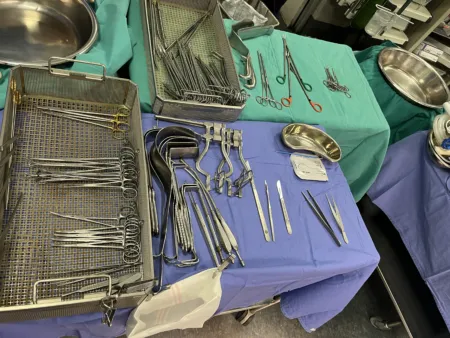
What to take from this chapter
- Endocrine glands are ductless and release hormones into the blood; exocrine glands use ducts. A hormone acts only on target cells with a receptor for it. Steroid hormones, made from cholesterol, enter the cell; most hormones made from amino acids bind a receptor on its surface.
- Most hormones are held in range by negative feedback. The hypothalamus controls the anterior pituitary with releasing and inhibiting hormones, and the pituitary's tropic hormones (TSH, ACTH, FSH, LH) control other glands.
- The pituitary sits in the sella turcica under the optic chiasm. Its anterior lobe (adenohypophysis) makes GH, TSH, ACTH, FSH, LH and prolactin. Its posterior lobe (neurohypophysis) stores and releases ADH (vasopressin) and oxytocin, made in the hypothalamus. Too little ADH is diabetes insipidus. The pineal gland, behind the pituitary, makes melatonin for the sleep and wake cycle.
- The thyroid's two lobes and isthmus lie on the trachea below the larynx, beside the recurrent laryngeal nerves. T4 and T3 need iodine and set the metabolic rate; calcitonin lowers the blood calcium. TSH is the best single test of thyroid function.
- Usually four parathyroid glands sit on the back of the thyroid and get their blood from the inferior thyroid arteries. PTH (parathormone) raises the blood calcium through bone, kidneys and gut.
- The adrenal cortex makes mineralocorticoids (aldosterone), glucocorticoids (cortisol) and androgens; the medulla's chromaffin cells make the catecholamines epinephrine and norepinephrine for fight or flight. In the pancreatic islets, beta cells make insulin, which lowers the blood sugar, alpha cells make glucagon, which raises it, and delta cells make somatostatin. The thymus, in the mediastinum, makes thymosins for T cells.
- Surgery sets off a stress response that raises cortisol, catecholamines and the blood sugar. Patients with diabetes need their blood sugar watched; patients on long-term steroids may need a stress dose; an overactive thyroid can flare into thyroid storm.
- Thyroid and parathyroid surgery risk the recurrent laryngeal nerve (hoarseness), the parathyroids (low calcium, tetany) and a neck hematoma. A pheochromocytoma can swing the blood pressure up during surgery and down after it, and pituitary surgery can cause diabetes insipidus.
Check yourself5 quick questions
Free for everyone. Pick an answer for each, then check them all at once.
In the ORWhere you'll use this
The chapter's whole question pool in sets of 10, with the answer explained after each one.
Part of the educators programThe chapter's words on spaced cards: the ones you miss come back sooner.
Part of the educators programGiven by your class's teacher. Each class draws its own 25 from the chapter's pool.
Part of the educators program
Suggest a fix
Something wrong, unclear or out of date in this chapter? Tell us and we will fix it for everyone. Your email is only used to reply.