Instruments
How surgical instruments are made, sorted and named, and how to check, pass and care for the tools you put in a surgeon's hand again and again through every case.
1Why instruments matter
A surgeon reaches out without looking away from the wound, and a second later the right instrument lands in their palm, turned the right way and ready to use. That moment is the heart of your job as a scrub, and it happens many times in a case.
To make it happen you need to know what each instrument does, what it is called and how it is built. Knowing how it is built lets you spot one that is dirty, damaged or about to fail before it reaches the patient.
There are thousands of instruments, but nearly every one belongs to a family with a job: cutting, grasping, clamping, holding tissue back, sewing, suctioningSUK-shun-ingRemoving mucus, saliva or other secretions from the mouth, nose or airway with a tube connected to a suction source.Full entry , stretching, probing or viewing. Learn the job first, then the names in each family, then the small differences between look-alikes. Learn them in the surgeries they belong to, too. An instrument you have seen at work in a real case sticks far better than one on a flash card.
2How instruments are made
The metals
Most instruments are stainless steel: iron mixed with carbon, chromium and small amounts of other metals. The chromium forms a thin, invisible oxide layer on the surface that resists rust. Stainless steel can still stain, pit and rust when it is mistreated, so think of it as stain resistant.
- 400 series steel can be hardened with heat. It holds a sharp edge and a firm grip, so it makes scissors, clamps, needle holders, forcepsFOR-sepsA hand instrument with two blades or arms used to grasp, hold or pull tissue or objects.Full entry , osteotomes and rongeurron-ZHURA strong surgical instrument with sharp, cup-shaped jaws used to bite away small pieces of bone.Full entry . It is magnetic.
- 300 series steel is softer, bends without breaking and resists corrosion even better. It makes retractorrih-TRAK-terA surgical instrument that holds back tissue or organs so the surgeon can see and reach the operative site.Full entry , suction tubes, cannulaKAN-yoo-luhA thin tube placed into the body or a body opening to deliver or remove fluid or air.Full entry and probes. It is not magnetic.
Titanium is lighter than steel, very strong, highly resistant to corrosion and nonmagnetic, but it costs more. You see it in microsurgery instruments, implants such as plates and screws, and ligating clips.
From steel bar to instrument
A heated bar of steel is forged into the rough shape of each half. The halves are ground and milled to cut the jaws, teeth, grooves and ratchet. For a ringed instrument, one half passes through a slot in the other and is fixed with a pin, which forms the box lock. Heat treatment sets the hardness and spring, and the instrument is polished.
Last comes passivation: a nitric acid bath strips loose iron from the surface and builds up the protective chromium oxide layer. The maker etches its name and catalog number and tests every working part.
That protective layer keeps building over the instrument's life, but saline, harsh chemicals and abrasive cleaners wear it away. Most instrument care rules exist to protect it.
Grades
- Surgical grade instruments are made to be cleaned and steam sterilizationstair-uh-luh-ZAY-shunA process that destroys all microorganisms, including spores, on an item; also a permanent birth control procedure.Full entry again and again for years. They are the only grade that belongs in surgical sets.
- Floor grade instruments are cheaper and made for clinics and labs. Some are plated over a lower-quality metal. They bend, stain and chip, and they are never mixed into surgical sets or processed with them.
- Disposable (single-use) instruments, such as many suction tips and skin staplers, are used on one patient and thrown away. The surgical team never reprocesses them; only an FDA-regulated reprocessingree-PROS-es-ingThe steps that make a used reusable medical device safe to use on the next patient.Full entry program may reprocess some of them.
Finishes and inserts
- Polished (mirror) finish resists stains but reflects the OR lights into the team's eyes.
- Satin (matte) finish is a dull gray that cuts glare.
- Black ebonized finish reflects almost no light. It is used in laser surgery, so the beam cannot bounce off an instrument onto healthy tissue.
Harder materials at the working end are marked so you can tell at a glance:
- Gold finger rings mean tungsten carbide inserts, a metal far harder than steel. In needle holder jaws, its cross-hatched surface keeps the needle from twisting or slipping. On scissor edges, it keeps them sharp longer. Worn inserts can be replaced, which saves the instrument.
- Black finger rings on scissors usually mark super cut scissors, with one blade ground razor sharp. They are made for cutting tissue. An instrument that is black all over is ebonized for laser use instead.
- Diamond-dusted jaws or tips have tiny diamond particles bonded to them for a nonslip grip on fine needles and tissue, often in heart and vessel sets.
- Diamond knives have a real diamond edge for precise cuts in eye surgery. The edge chips easily, so the knife is handled alone and kept guarded.
3The parts of an instrument
Most instruments you pass have finger rings. Learn this one design and you can name the parts of hundreds of instruments. From the working end back to your hand:
- Tips: fine or blunt, straight or curved, smooth or toothed.
- Jaws: the working surfaces. The pattern cut into them is the best clue to the instrument's job.
- Box lock: the joint in the middle where the two halves cross and pivot. It keeps the jaws lined up as they close.
- Shanks: the arms between the box lock and the rings. The length of each shank sets the length of the instrument, and a deep wound needs long shanks.
- Ratchet: the interlocking teeth just below the rings that lock the jaws closed. It has several steps, each a little tighter.
- Finger rings: for the user's thumb and ring finger.
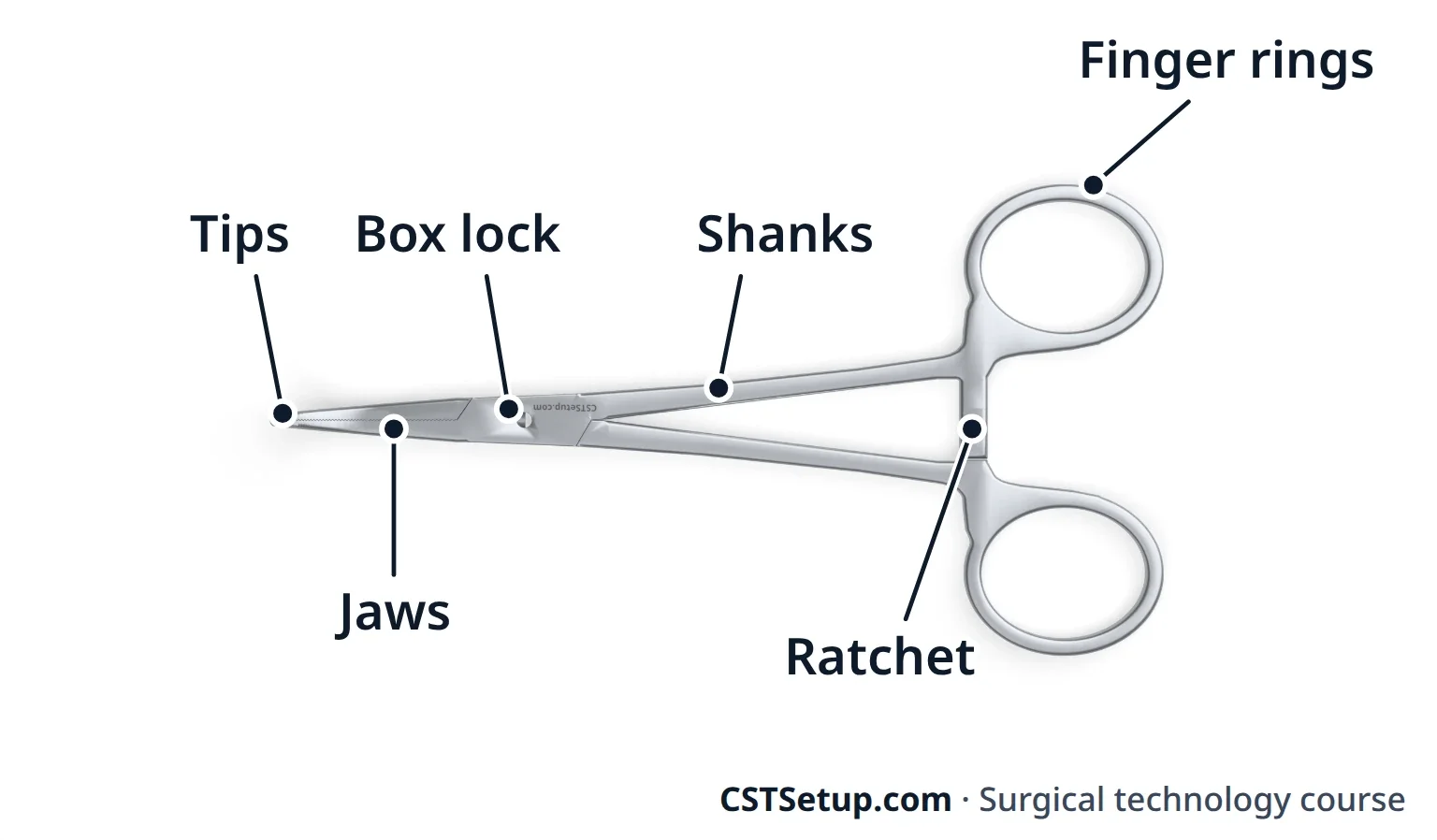
The box lock is the hinge in the middle. The ratchet is the lock by your fingers.
Scissors have a screw joint in place of a box lock. Thumb forcepsFOR-sepsA hand instrument with two blades or arms used to grasp, hold or pull tissue or objects.Full entry have no rings and no lock: two springy arms joined at one end stay open until squeezed. retractorrih-TRAK-terA surgical instrument that holds back tissue or organs so the surgeon can see and reach the operative site.Full entry have a blade, a shank and a handle. Handles come as finger rings, as spring handles that close with light pressure (ideal for fine work), or as pistol grips that add leverage on long shafts, as on rongeurron-ZHURA strong surgical instrument with sharp, cup-shaped jaws used to bite away small pieces of bone.Full entry and laparoscopiclap-uh-roh-SKOP-ikDone through a few small cuts in the abdomen with a thin camera and long instruments, instead of one large opening.lapar/o abdomen-scopic viewingFull entry instruments. Heavy bone cutters and rongeurs use a double-action joint, a second hinge that multiplies the force of the squeeze.
Reading the jaws
- A serrationsair-AY-shunA row of small tooth-like ridges, such as the grooves on the jaws of a surgical clamp.Full entry is one of the fine grooves cut into a jaw. Crosswise serrations grip and crush, which is what a clamp needs to stop bleeding.
- Lengthwise serrations in fine rows hold without crushing, as on vessel and bowel clamps.
- A cross-hatched pattern grips metal, as in needle holder jaws.
- Teeth bite in for a firm hold. A 1 x 2 ("one by two") pattern has one tooth on one side fitting between two on the other.
An instrument that holds tissue without crushing or tearing it is atraumatic. Look for smooth or finely grooved jaws, rounded tips and wide blades.
4How instruments get their names
Names follow a few patterns:
- The inventor: Kocher, Mayo, Metzenbaum, DeBakey, Babcock and Allis were surgeons. Specialties have their own famous names, such as DeBakey in heart and vessel sets, Heaney in gynecologygy-nuh-KOL-uh-jeeThe branch of medicine that cares for the female reproductive organs and breasts.gynec/o woman-logy study ofFull entry and Castroviejo in eye surgery.
- What it looks like: mosquito, bulldog, rake, ribbon, right angle.
- What it does or where it goes: needle holder, towel clamp, sponge forcepsFOR-sepsA hand instrument with two blades or arms used to grasp, hold or pull tissue or objects.Full entry , tonsilTON-sulOne of the masses of lymph tissue at the back of the throat that help fight germs entering the mouth and nose.Full entry clamp.
- Combined names: Mayo-Hegar, Rochester-Pean, Potts-Smith.
- Shape and size: curved, angled, bayonet, long, baby, 6-inch. Length is measured in inches from the tips to the end of the rings.
The word forceps covers both thumb forceps (pickups) and some ringed instruments, such as Allis and Kocher forceps. Names also change between regions and hospitals. One OR's "Kelly" is another OR's "hemostatHEE-moe-statA clamp with finger rings and a locking ratchet used in surgery to grasp and close off bleeding vessels.hem/o blood-stat stopping, standing stillFull entry ," "snap" or "stat," and many teams call a Kocher an "Ochsner." Use the name on your facility's count sheet, and ask when you are unsure.
5Cutting, grasping and clamping
Instruments are sorted into classes by what they do. Every set is built from these classes, and the cert exam uses them. This section covers the first three.
Cutting and dissecting
Knife handles hold disposable blades. A #3 handle takes the small blades: #10, #11, #12 and #15. The #7 handle is longer and thinner for deep, narrow spaces and takes the same blades. A #4 handle takes the large blades, #20 to #25. You load and remove blades with a needle holder, never with your fingers.
Three scissors do most of the work:
- Curved Mayo: heavy blades for tough tissue such as fasciaFASH-ee-uhA sheet or band of tough connective tissue that covers and separates muscles and organs.fasci/o bandFull entry and muscle.
- Straight Mayo: for cutting sutureSOO-cherA stitch, or the thread used to stitch, that holds the edges of a wound or incision together.Full entry , so many ORs call them suture scissors.
- Metzenbaum: long handles and short, delicate blades for fine tissue. Never cut suture with them; it dulls the blades.
Stevens tenotomy and iris scissors handle delicate work in eye, hand and plastic surgery, and Potts-Smith scissors have angled blades for opening vessels and ducts. For bone, the rongeurron-ZHURA strong surgical instrument with sharp, cup-shaped jaws used to bite away small pieces of bone.Full entry bites bone away with sharp, cupped jaws, the curettekyoo-RETA surgical instrument with a small spoon- or loop-shaped tip used to scrape tissue.Full entry scrapes with a sharp or blunt rimmed scoop, and the osteotome is a bone chisel beveled on both sides. Blunt dissectiondy-SEK-shunA tear in the inner layer of an artery wall that lets blood split the layers apart; also, the cutting apart of tissue in surgery.Full entry uses closed scissors spread open inside tissue, small sponges on clamps (peanuts and Kittners) or the surgeon's finger.
Grasping and holding
Thumb forcepsFOR-sepsA hand instrument with two blades or arms used to grasp, hold or pull tissue or objects.Full entry (pickups) are held like a pencil, usually in the surgeon's other hand while the dominant hand cuts or sews.
- Adson: short and fine. The toothed kind is the standard pickup for closing skin.
- DeBakey: long, fine, atraumatic grooves for vessels, bowel and other delicate tissue.
- Russian: broad, round, ridged tips for heavier tissue.
- Plain toothed (rat tooth) forceps hold tough tissue. Smooth forceps hold dressings and delicate tissue.
Ringed graspers lock with a ratchet. Learn these three from roughest to gentlest:
- Kocher: heavy, with crosswise serrationsair-AY-shunA row of small tooth-like ridges, such as the grooves on the jaws of a surgical clamp.Full entry and 1 x 2 teeth at the tip, for tough tissue such as fascia.
- Allis: rows of short, interlocking teeth. A firm grip for tough tissue or tissue being removed, but not as gentle as a Babcock.
- Babcock: smooth, rounded, open jaws that cradle the appendixuh-PEN-diksA small, finger-shaped pouch attached to the first part of the large intestine, in the lower right abdomen.Full entry , fallopian tubefuh-LOH-pee-un TOOBOne of the two tubes that carry an egg from the ovary to the uterus, where fertilization usually happens.Full entry , ureterYOOR-uh-terOne of the two tubes that carry urine from the kidneys down to the bladder.Full entry and bowel without crushing them.
Foerster sponge forceps hold a folded x-ray detectable sponge to make a sponge stick for blotting or pushing tissue aside. A tenaculum has sharp teeth for a pincer hold on tough tissue such as the cervix. Towel clamps hold drapes, cords and tubing. Perforating ones such as the Backhaus pierce whatever they hold, so many facilities use non-penetrating towel clamps on drapes.
Clamping and occluding
hemostasishee-moh-STAY-sisThe stopping of bleeding, either by the body's own clotting process or by medical or surgical methods.hem/o blood-stasis stopping, standing stillFull entry means stopping bleeding, and a hemostatHEE-moe-statA clamp with finger rings and a locking ratchet used in surgery to grasp and close off bleeding vessels.hem/o blood-stat stopping, standing stillFull entry is a clamp made for it: crosswise serrations crush a bleeding vessel shut until it is tied or sealed. occlusionuh-KLOO-zhunA blockage or closing off of a passage, such as a blood vessel, tube or IV line.Full entry means closing off a vessel or other tube.
- Mosquito: the smallest hemostat, about 5 inches, for small bleeders and tagging suture ends.
- Crile (in the library as the Curved Hemostat) and Kelly: the everyday hemostats, about 5 1/2 inches. The Crile has serrations along the whole jaw. The Kelly has them only toward the tip, on about half to two-thirds of the jaw.
- Rochester-Pean: larger and heavier, for big bundles of tissue.
- Right angle (Mixter): jaws bent about 90 degrees, to slip behind a vessel or duct and pull a tie around it.
- tonsilTON-sulOne of the masses of lymph tissue at the back of the throat that help fight germs entering the mouth and nose.Full entry (Schnidt): long, slender and curved, for deep bleeders and carrying ties into deep spaces.
- Vascular clamps, such as DeBakey and Satinsky clamps, have fine lengthwise rows of teeth that stop blood flow without crushing the vessel. Bulldogs are small spring-loaded vessel clamps.
- Intestinal clamps have soft lengthwise grooves, so bowel can be closed off and joined again.
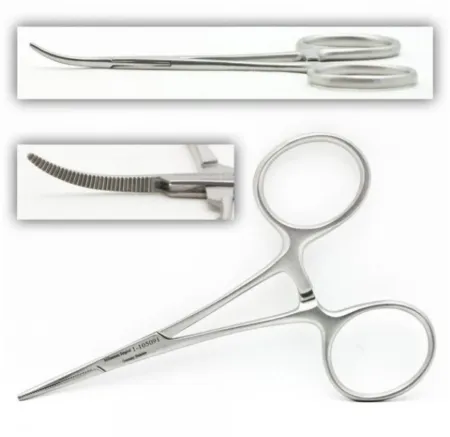 Mosquito Clamp - CurvedOn 168 setups
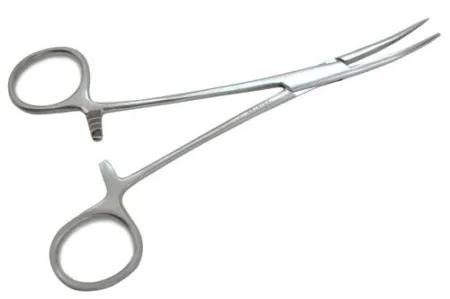 Curved HemostatsOn 312 setups
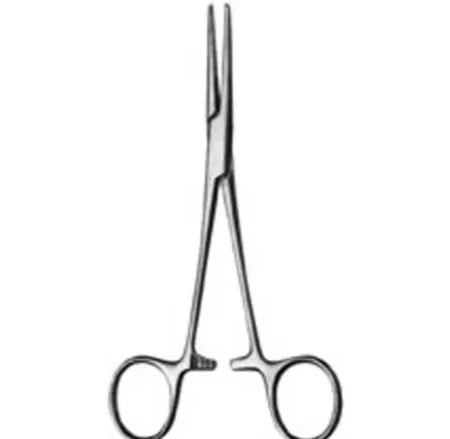 Kelly ForcepsOn 73 setups
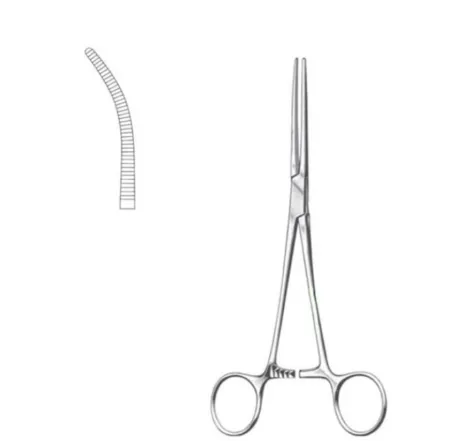 Rochester Pean ForcepsOn 92 setups
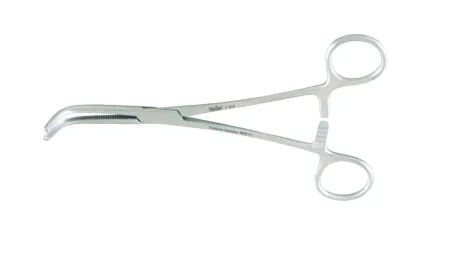 Right Angle ClampOn 102 setups
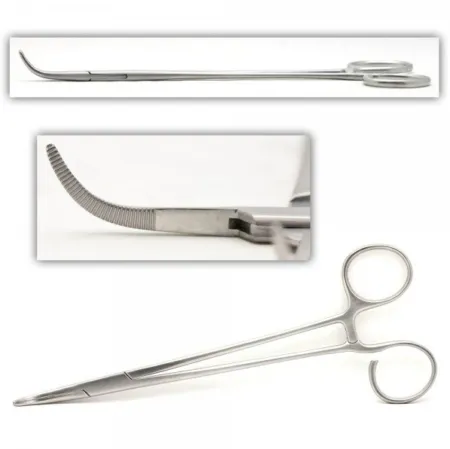 Tonsil ClampOn 117 setups
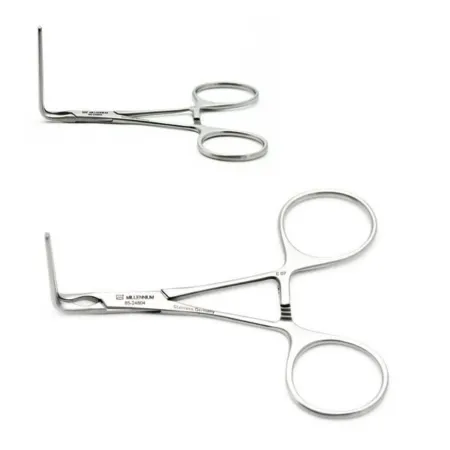 Debakey Bulldog ClampOn 47 setups
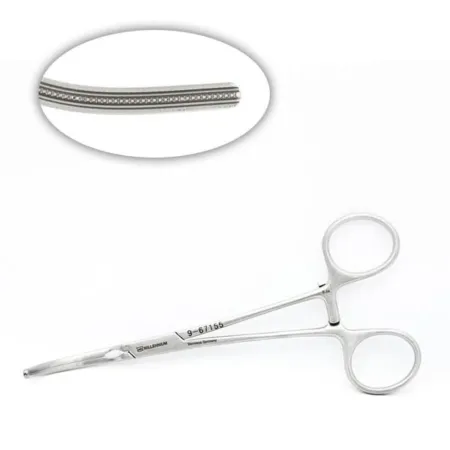 Debakey Vascular ClampOn 6 setups
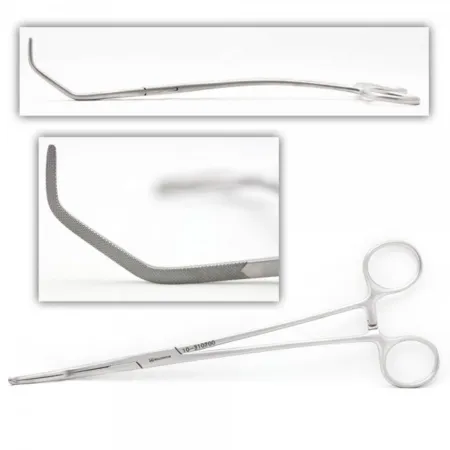 Satinsky Vena Cava ClampOn 9 setups
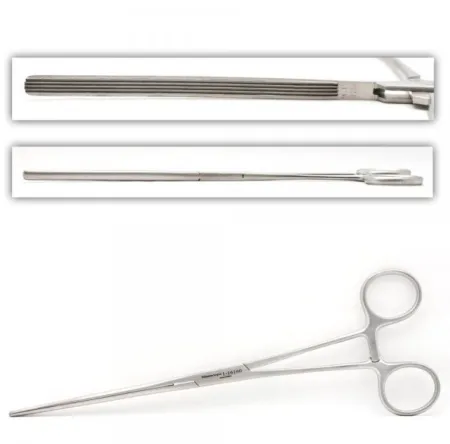 Doyen Intestinal ForcepsOn 4 setups
A crushing clamp is not used on tissue that must be rejoined. Never put a hemostat on tubing or drapes; it can spring or crack the clamp.
6Retracting, suturing, suctioning, probing and viewing
Retracting and exposing
A retractorrih-TRAK-terA surgical instrument that holds back tissue or organs so the surgeon can see and reach the operative site.Full entry holds tissue aside so the team can see. Handheld retractors need a team member to hold them:
- Army-Navy: double-ended, for skin and the layer under it.
- Senn: small and double-ended, with a three-pronged rake on one end and a small blade on the other.
- Richardson: larger, for the abdominal wall and deeper layers.
- Deaver: a wide blade curved like a question mark, for holding organs back deep in the abdomen or chest.
- Ribbon (malleable): a flat strip the surgeon bends to shape. It also guards the bowel while the abdomen is closed.
A self-retaining retractor holds itself open:
- Weitlaner: rake-like prongs with finger rings and a ratchet, for shallow wounds.
- Gelpi: one sharp point on each arm, for small wounds, shallow or deep. Treat the points as sharps.
- Balfour: an abdominal frame with two side blades and a center blade that holds the bladder down.
- Table-mounted retractors, such as the Bookwalter, fix a ring to the operating table and hold many blades steady for hours.
Every piece that comes apart, such as each Balfour blade and wing nut, is counted.
Suturing and stapling
A needle holder grips a curved needle so the surgeon can drive it through tissue. The Mayo-Hegar is the general-purpose needle holder in most sets. Webster needle holders take the small needles used on skin, Heaney needle holders have curved jaws for the deep pelvis, and Castroviejo needle holders have spring handles for microsurgery.
Match the needle holder to the needle. One that is too heavy robs the surgeon of feel. One that is too light lets a heavy needle twist and springs the jaws.
Skin staplers close incisions. Internal staplers fire rows of staples to close or join bowel and other organs, and some cut between the rows. A clip applier squeezes a small V-shaped clip across a vessel or duct, and each clip size needs its matching applier.
Suctioning and aspirating
- Yankauer (tonsilTON-sulOne of the masses of lymph tissue at the back of the throat that help fight germs entering the mouth and nose.Full entry suction): rigid and angled with a rounded tip, for large amounts of fluid in the mouth, the throat or an open wound.
- Frazier (in many sets, the Ferguson-Frazier): narrow and angled, with a thumb hole. Covering the hole strengthens the pull, so the surgeon can protect delicate tissue in brain, spine, ear and nose surgery. Its wire stylet clears clogs during the case and is never a cleaning tool.
- Poole: an abdominal tip inside a sleeve full of small holes, which keeps bowel from being sucked against it.
Dilating and probing
A dilatorDY-lay-terAn instrument used to stretch or widen an opening, canal or passage in the body.Full entry stretches a narrow opening one size at a time, from a graduated set. Hegar dilators open the cervix for a D&C, Van Buren sounds dilate the male urethrayoo-REE-thruhThe tube that carries urine from the bladder out of the body.Full entry , and Bakes dilators open the common bile ductKOM-un BILE DUKTThe tube that carries bile from the liver and gallbladder into the small intestine.Full entry .
A probe is a slender, blunt rod for exploring a tract such as a fistulaFIS-choo-luhAn abnormal passage between two organs or vessels, or between an organ and the skin.Full entry . A uterine sound measures the depth of the uterus.
Viewing and accessory instruments
A speculumSPEK-yoo-lumAn instrument used to open and hold open a body opening, such as the vagina, so the inside can be seen.Full entry holds open a natural opening: the vagina (the hinged Graves or the weighted Auvard), the nose, the ear canal or the eyelids. endoscopeEN-duh-skohpA thin tube with a light and a camera that is passed into the body to look inside an organ or cavity.endo- within-scope instrument for viewingFull entry are viewing instruments too. Accessory instruments fit no other class but have clear jobs: mallets, rulers, calipers, depth gauges that measure a drilled hole for the right screw, implant sizers and screwdrivers.
7Micro, powered, endoscopic and robotic instruments
Microinstruments
Microinstruments are used under a microscope or magnifying loupes in eye, ear, hand, nerve and small-vessel surgery. Many are titanium with a dull or black finish against glare, with round spring handles and a light lock or none at all. Their tips bend if they are dropped, piled under other instruments or used on anything heavier than they were made for. Keep them in their own rack, handle them one at a time, and place each in the surgeon's fingers in the exact position of use, because the surgeon may not look away from the microscope.
Powered instruments
Powered instruments run on electricity, on compressed air or nitrogen (pneumatic), or on batteries.
- Drills make holes for screws and wires.
- Burs shape or remove bone at high speed, as in spine, skull and ear surgery. Diamond burs cut slowly and smoothly near nerves.
- Saws cut bone. A sagittal saw blade swings side to side. A reciprocating saw, such as a sternal saw, moves back and forth.
- Reamers enlarge a canal or socket, such as the hip socket, to fit an implant.
- Dermatomes shave an even layer of skin for a graftGRAFTTissue or a man-made material moved into place in surgery to replace or repair a damaged part.Full entry , at a width and thickness the surgeon sets.
Test power before the patient enters the room. Use safety mode whenever you pass it, set it down or change a bit or blade. Keep irrigationeer-ih-GAY-shunWashing out a wound, body cavity, tube or eye with a steady flow of liquid.Full entry ready so the surgeon can cool bone as it is cut. Never put a handpiece, hose or batteryBAT-uh-reeIn law, touching a person on purpose without their consent.Full entry in water unless the maker's instructions allow it.
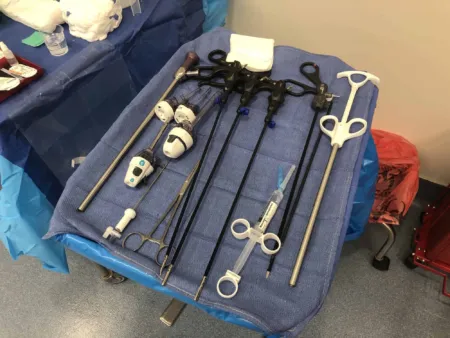
Endoscopic instruments
An endoscopeEN-duh-skohpA thin tube with a light and a camera that is passed into the body to look inside an organ or cavity.endo- within-scope instrument for viewingFull entry is a lighted viewing tube that enters the body through a small incision or a natural opening. Its parts:
- Telescope: the shaft, holding lenses or a video chip plus light fibers.
- Lens: the window at the far end. Rigid scopes look straight ahead (0 degrees) or off to the side (30, 45 or 70 degrees), and the angle is marked on the scope.
- Eyepiece: the near end, where the camera attaches.
- Light post: where the light cord connects.
- Light cord: a cable of glass fibers that carries light from the light source.
- Camera head: clips onto the eyepiece and sends the picture to the monitors.
Rigid scopes, such as laparoscopes and cystoscopes, are straight steel tubes. Flexible scopes bend to follow the airway or the colon. A diagnostic scope looks and takes samples; an operative scope has a working channel or extra ports for instruments.
Never bend a rigid scope or lay anything on it. Loop light cords loosely, because kinks break the fibers. The tip of a lit cord gets hot enough to burnBURNAn injury to the skin or deeper tissues caused by heat, chemicals, electricity, radiation or friction.Full entry drapes and skin, so put the light source on standby whenever the cord is off the scope, and never rest a lit cord on the drapes.
A trocarTROH-karA sharp or bladed instrument inside a tube (cannula), used to pierce a body wall and leave the tube in place as a port.Full entry is a pointed or blunt rod inside a hollow tube called a cannulaKAN-yoo-luhA thin tube placed into the body or a body opening to deliver or remove fluid or air.Full entry . The trocar makes the opening and comes out, and the cannula stays as a port. A Veress needle has a spring-loaded blunt inner tip that pops forward once it is inside the abdomen, so the abdomen can be filled with gas safely. laparoscopiclap-uh-roh-SKOP-ikDone through a few small cuts in the abdomen with a thin camera and long instruments, instead of one large opening.lapar/o abdomen-scopic viewingFull entry instruments that carry electrosurgeryee-LEK-troh-SUR-jer-eeUsing high-frequency electric current through a handheld tool to cut tissue or seal bleeding vessels during surgery.Full entry current are insulated. A crack or pinhole can leak current and burn an organ out of the camera's view, so check the coating closely; sterile processing also tests it with an insulation tester.
Robotic instruments
In robotic surgery the surgeon sits at a console and moves wristed instruments mounted on robotic arms. Multi-port systems use a separate port for each instrument; single-port systems pass everything through one. Each robotic instrument has a set number of uses that the system counts, and an expired one will not work, so keep spares ready. The scrub inspects, loads and exchanges instruments, and keeps open and laparoscopic instruments ready in case the surgeon must convert.
8Instrument sets and specialty trays
Instruments travel in sets (trays): standard groups packed for one kind of procedure. Names vary, but most facilities build on a minor (plastic) set for small procedures, a major (laparotomylap-uh-ROT-uh-meeSurgery that opens the abdomen through a large cut to reach the organs inside.lapar/o abdomen-tomy cutting intoFull entry ) set for the abdomen and a D&C set, often the base for vaginal surgery. Specialty sets such as gallbladder, bowel, vascular and long instrument sets are added, and rarely used instruments come alone in peel packs.
Every set has a count sheet listing each item, signed by the person in sterile processing who built it. The scrub and circulator count from it together, out loud, and never assume the processing count is right. Every loose part, such as a retractorrih-TRAK-terA surgical instrument that holds back tissue or organs so the surgeon can see and reach the operative site.Full entry blade or wing nut, counts. If an instrument breaks, every piece is found, bagged and kept in the room until the final count is right.
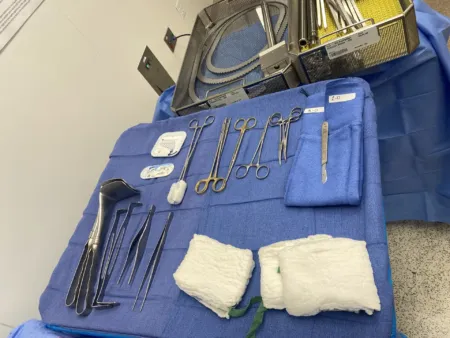
Inside the set, ringed instruments are held open on a stringer, a metal rod or bracket through the finger rings, so steam reaches the box locks. Curves face one way, heavy items sit on the bottom, delicate and sharp items are protected, and a chemical indicator goes on every level. A full set, container included, should weigh no more than 25 pounds.
Loaner (vendor) trays are lent by a company for one case, often for bone and spine implants. They must arrive early enough to be logged, cleaned, inspected and sterilizationstair-uh-luh-ZAY-shunA process that destroys all microorganisms, including spores, on an item; also a permanent birth control procedure.Full entry , and they are decontaminated again before they go back.
Instruments by specialty
- General: the laparotomy set, Balfour or Bookwalter retractors, Babcocks, staplers.
- Obstetrics and gynecologygy-nuh-KOL-uh-jeeThe branch of medicine that cares for the female reproductive organs and breasts.gynec/o woman-logy study ofFull entry : Heaney clamps, dilatorDY-lay-terAn instrument used to stretch or widen an opening, canal or passage in the body.Full entry , tenaculums, uterine sounds, curettekyoo-RETA surgical instrument with a small spoon- or loop-shaped tip used to scrape tissue.Full entry , vaginal speculumSPEK-yoo-lumAn instrument used to open and hold open a body opening, such as the vagina, so the inside can be seen.Full entry .
- genitourinaryjen-ih-toh-YOOR-ih-nair-eeRelating to the genital (reproductive) organs and the urinary organs together.genit/o reproductive organsurin/o urine-ary relating toFull entry : urethrayoo-REE-thruhThe tube that carries urine from the bladder out of the body.Full entry sounds and dilators, kidney clamps, cystoscopes.
- Cardiothoracic: sternal saw, rib spreaders, vascular and bulldog clamps, Potts scissors, wire cutters.
- Peripheral vascular: bulldogs, angled vascular clamps, Potts scissors, graftGRAFTTissue or a man-made material moved into place in surgery to replace or repair a damaged part.Full entry tunnelers.
- Neurosurgery: Kerrison rongeurron-ZHURA strong surgical instrument with sharp, cup-shaped jaws used to bite away small pieces of bone.Full entry , Penfield dissectors, bayonet forcepsFOR-sepsA hand instrument with two blades or arms used to grasp, hold or pull tissue or objects.Full entry , Frazier suctions, high-speed drills.
- orthopedicor-thuh-PEE-dikHaving to do with the bones, joints, muscles, ligaments and tendons, and the branch of medicine that treats them.orth/o straightped/o child (the field began with straightening children's bones)-ic relating toFull entry : drills, saws, reamers, osteotomes and mallets, bone hooks, loaner implant sets.
- Ophthalmology: microinstruments, lid specula, Castroviejo needle holders, diamond knives.
- Ear, nose and throat: nasal and ear specula, bayonet forceps, mouth gags, sinusSY-nusA hollow space in the body, most often one of the air-filled spaces in the skull bones around the nose.Full entry scopes.
- Oral and maxillofacial: elevators, mouth props, plates and screws, wire cutters.
- Plastic and reconstructive: skin hooks, fine scissors, Webster needle holders, dermatomes.
To see the basic set at work from first cut to closure, study an open abdominal case:
9Checking an instrument before you trust it
Instruments are checked when the set is built, when you open it and again as each goes to the Mayo standMAY-oh standA small tray on an adjustable stand placed over or beside the patient during surgery to hold the instruments used most often.Full entry . Each time, ask three questions. Is it clean? Is it whole? Does it work?
When you open the set
A rigid container is opened in a set order. Before it is opened: its plastic locks unbroken (on most containers they are the external indicator too) and its card naming the right set. Then the lid comes straight up and away, and its filters are checked against the light. The scrub reads the internal indicators, which sit in opposite corners of the basket unless the container's maker says otherwise, before the basket comes out. The scrub lifts the basket straight up and holds it while the circulator checks the filters in the bottom of the container and looks for moisture; only then does it go on the back table. Then, inside:
- Confirm the indicator on every level changed correctly.
- Look for bioburden: blood, tissue, bone chips, hair or other debris.
- Make sure every ringed instrument is open. One locked shut on its ratchet kept steam away from the surfaces it was clamping.
- Remove tip guards from the field. They do not show on an x-ray and could be left in a wound.
One dirty instrument, or one instrument locked shut on its ratchet, makes the whole set unusable. Hand the set off and get a new one.
Open a container the way the OR does, then find what is wrong inside before it reaches the field.
This lab runs in the browser with JavaScript on.
This browser could not start the 3D room. Everything the lab practices is in the chapter.
Testing each type
- Clamps and graspers: hold the closed jaws up to the light. The tips meet, the teeth mesh and no light shows (noncrushing vessel and bowel clamps leave a slight gap by design). Check the box lock for cracks and debris, and gently push the open rings in opposite directions; a little play is normal, but a loose box lock needs repair. Close it on the first ratchet and tap the ratchet lightly against a firm surface. If it springs open, the ratchet is worn.
- Scissors: close smoothly without grinding, with tips free of burrs and chips. In sterile processing they must cut test material cleanly at the very tips.
- Needle holders: no cracks, inserts meeting along their whole length, and a clamped needle that does not turn.
- Thumb forcepsFOR-sepsA hand instrument with two blades or arms used to grasp, hold or pull tissue or objects.Full entry : tips meet evenly and teeth drop into their slots.
- retractorrih-TRAK-terA surgical instrument that holds back tissue or organs so the surgeon can see and reach the operative site.Full entry : smooth blades, ratchets that hold, tight screws.
- Insulated and endoscopicen-doh-SKOP-ikDone with an endoscope, a thin tube with a light and camera passed into the body.endo- within-scopic viewingFull entry instruments: no cracks or nicks in the insulation, and straight scopes with a clear picture.
- Hollow instruments: the lumenLOO-menThe open space inside a tube, such as a blood vessel, the intestine or a catheter.Full entry , the channel inside, is clear from end to end.
- Multi-part instruments: every part present, put together and tested.
Stains, rust and damage
Rub a discolored spot with a pencil eraser. If it comes off and the metal underneath is smooth, it was a stain. If the metal is pitted, it is corrosion, and the instrument comes out of service. Pits and cracks hide germs from cleaning and sterilizationstair-uh-luh-ZAY-shunA process that destroys all microorganisms, including spores, on an item; also a permanent birth control procedure.Full entry , and a cracked instrument can break inside the patient.
Hand a damaged instrument to the circulator to be tagged for repair, and ask for the same instrument as a replacement. A counted item stays in the room until the final count. Never use a damaged instrument on a patient.
10Passing instruments and caring for them
Passing
The goal is the right instrument in the surgeon's hand, ready to use, without the surgeon looking away.
- Hold it by its middle (near the box lock on a ringed instrument), never by the tips.
- Turn it for immediate use. Curved clamps and scissors follow the curve of the surgeon's hand. Tissue forcepsFOR-sepsA hand instrument with two blades or arms used to grasp, hold or pull tissue or objects.Full entry go tips down. retractorrih-TRAK-terA surgical instrument that holds back tissue or organs so the surgeon can see and reach the operative site.Full entry go blade down, and self-retaining ones go closed.
- Close ringed instruments on the first ratchet.
- Place it in the palm with a firm, light snap, and let go only once the surgeon has it.
- Pass a needle holder with the needle point up and the sutureSOO-cherA stitch, or the thread used to stitch, that holds the edges of a wound or incision together.Full entry strand clear of the palm, and trade one for one so every needle comes back.
- Pass sharps through the neutral zone, a basin or mat you and the surgeon agree on. Say what you placed there and pull your hand away.
- Put power and stapling instruments in safety mode first.
- Turn everything the other way for a left-handed surgeon.
Many surgeons use hand signals, though they vary:
- Knife: palm down, fingers held as if gripping a pencil.
- Scissors: two fingers opening and closing.
- Clamp: an open hand, palm up.
- Forceps: thumb and index finger pinching together.
- Suture: a closed hand turning at the wrist, as if driving a needle.
Clamp, clamp, cut, tie
Much of open surgery runs on one rhythm. The surgeon places two clamps across a vessel or bundle of tissue, cuts between them, then ties off the tissue held in the clamp that stays with the patient. Know the rhythm and you stay a step ahead: the second clamp ready, then scissors, then the tie, then suture scissors to trim it.
Read the surgeon's signals and pass the next instrument before they ask.
This lab runs in the browser with JavaScript on.
This browser could not start the 3D room. Everything the lab practices is in the chapter.
Care during the case
- Wipe each returned instrument with a sponge wet with sterile water, so blood never dries in the jaws or box lock.
- Flush suction tips and other hollow instruments with sterile water.
- Return each instrument to its place on the Mayo standMAY-oh standA small tray on an adjustable stand placed over or beside the patient during surgery to hold the instruments used most often.Full entry .
- Never leave instruments lying loose on the drapes or resting on the patient.
- Use each instrument only for its own job.
Saline is for the patient, never for instruments. Its chlorideKLOR-ideA negatively charged mineral (electrolyte) in the blood that works with sodium to keep fluid and acid-base balance.Full entry pits and rusts stainless steel. Wipe and flush with sterile water.
Point-of-use care and transport
Cleaning starts in the OR as soon as the case ends, because dried blood is hard to remove and lets germs build a protective film.
- Wear gloves, a fluid-resistant gown, a mask and eye protection.
- Remove disposable sharps first, taking blades off with a blade remover or needle holder, and put them in the sharps container.
- Wipe off visible soil with sterile water and flush every lumenLOO-menThe open space inside a tube, such as a blood vessel, the intestine or a catheter.Full entry .
- Open ringed instruments onto a stringer so the box locks are exposed.
- Take multi-part instruments apart and keep the parts together.
- Put heavy items on the bottom, fragile items such as scopes, cameras and microinstruments in their own trays, and sharp reusable items (trocarTROH-karA sharp or bladed instrument inside a tube (cannula), used to pierce a body wall and leave the tube in place as a port.Full entry , skin hooks, Gelpis) in a separate basin.
- Keep everything moist with enzymeEN-zimeA protein that speeds up a chemical reaction in the body without being used up.Full entry foam or spray or a towel wet with water, without long soaking.
- Tag damaged instruments for repair.
- Send back every instrument that was opened, used or not.
Dirty instruments go to decontaminationdee-kun-tam-ih-NAY-shunRemoving or destroying germs, chemicals or radioactive material from a person, surface or object to make it safe.de- removecontamination being made uncleanFull entry promptly, in a closed case cart or a covered, leak-proof container labeled as biohazard. On an open cart, every item must be inside a closed, labeled container.
What to take from this chapter
- Learn instruments by class first (cutting, grasping, clamping, retracting, suturing, suctioning, dilating, probing, viewing), then by name, then by the small differences between look-alikes, and learn them in the surgeries where they are used.
- Most instruments are stainless steel: hard 400 series for edges and grips, softer 300 series for bendable tools. Titanium is light, strong and nonmagnetic. Passivation gives steel its rust-resistant surface.
- Gold rings mean tungsten carbide inserts. An all-black finish means laser use. Black rings on scissors mark a razor-sharp super cut blade.
- A ringed instrument has tips, jaws, a box lock, shanks, a ratchet and finger rings. The pattern inside the jaws tells you how hard it grips.
- The Crile has full-length serrations and the Kelly's serrations stop short of the box lock. From roughest to gentlest, the ringed graspers run Kocher, Allis, Babcock.
- Check every instrument for cleanliness, damage and function. One dirty instrument, or one locked shut on its ratchet, makes the whole set unusable, and a damaged instrument never touches a patient.
- Pass every instrument ready to use. Sharps go through the neutral zone, and power stays in safety mode until the surgeon is ready.
- Wipe and flush with sterile water, never saline. After the case, open, take apart, sort, keep moist, tag and send everything in a closed container.
Check yourself5 quick questions
Free for everyone. Pick an answer for each, then check them all at once.
In the ORWhere you'll use this
Setups to see it in
The chapter's instruments
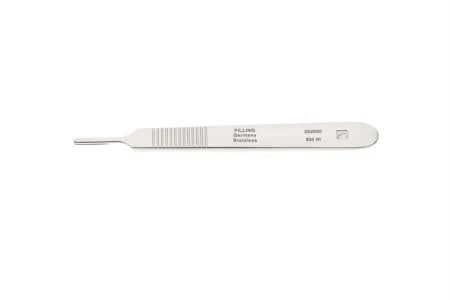 #3 Knife HandleCutting & Dissecting · On 319 setups
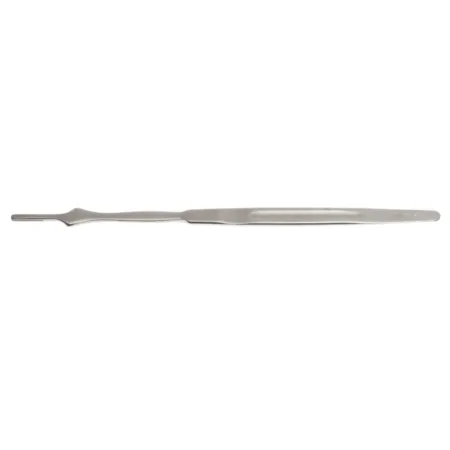 #7 Knife HandleCutting & Dissecting · On 57 setups
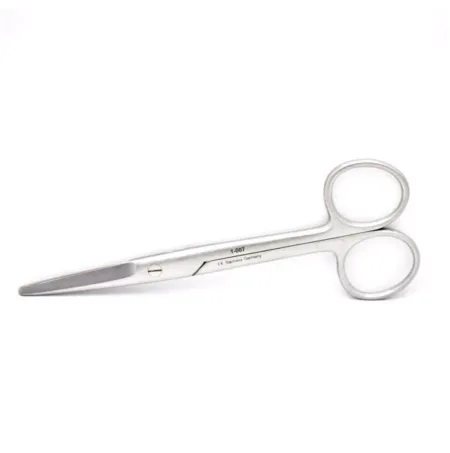 Straight Mayo ScissorCutting & Dissecting · On 321 setups
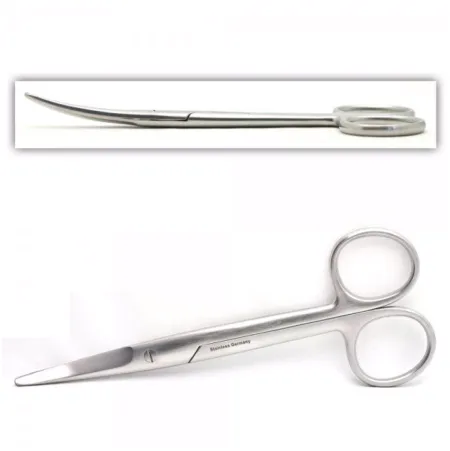 Curved Mayo ScissorCutting & Dissecting · On 121 setups
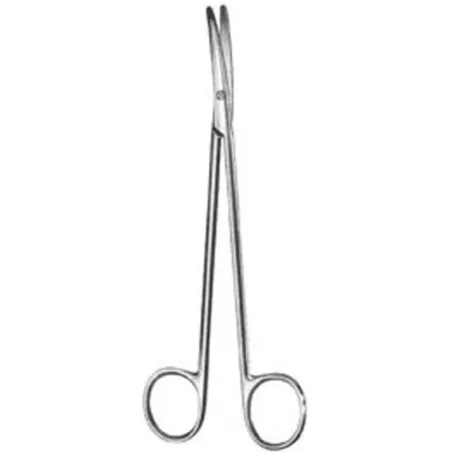 Metzenbaum ScissorCutting & Dissecting · On 271 setups
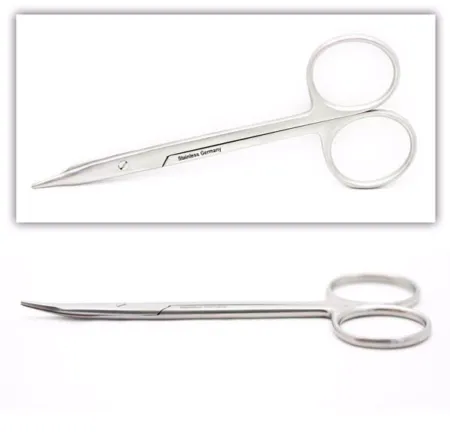 Stevens Tenotomy ScissorCutting & Dissecting · On 94 setups
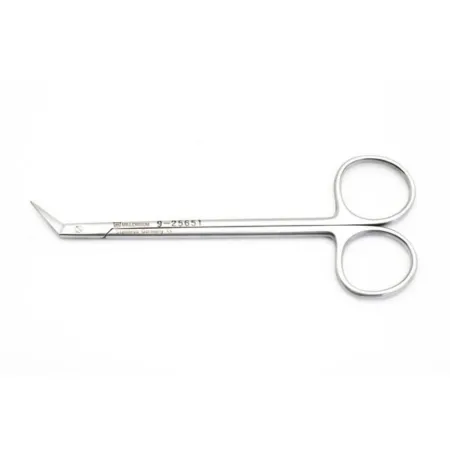 Potts-Smith ScissorsCutting & Dissecting · On 62 setups
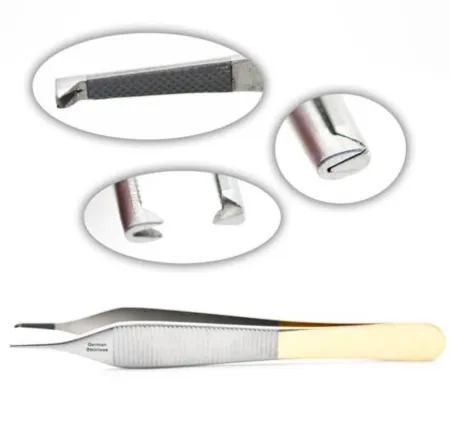 Adson ForcepsGrasping & Holding · On 308 setups
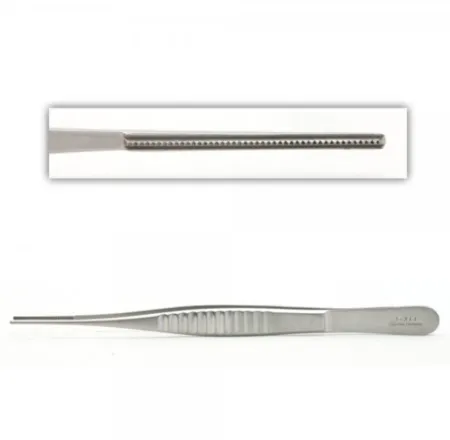 DeBakey ForcepsGrasping & Holding · On 159 setups
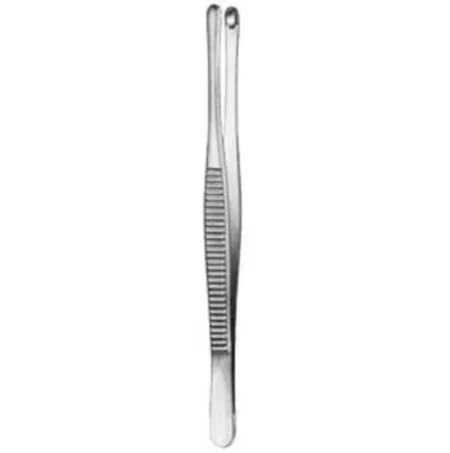 Russian Tissue ForcepsGrasping & Holding · On 77 setups
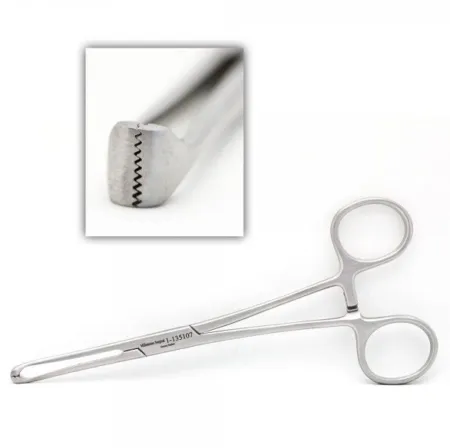 Allis ForcepsGrasping & Holding · On 141 setups
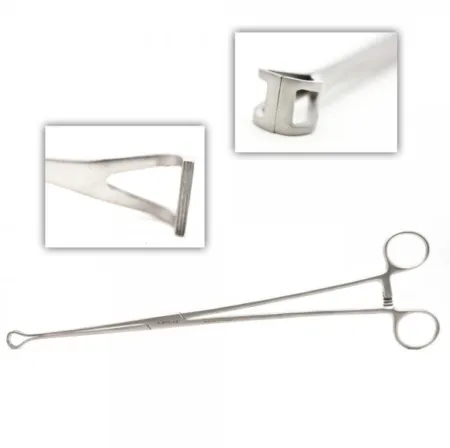 BabcockGrasping & Holding · On 70 setups
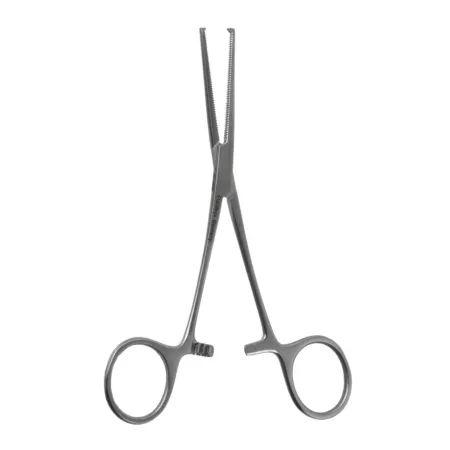 Kocher ForcepsClamping & Occluding · On 137 setups
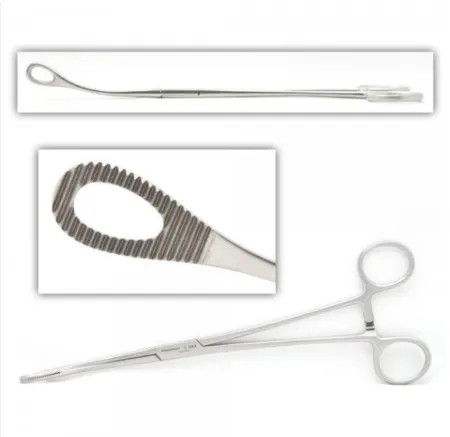 Foerster Sponge ForcepsGrasping & Holding · On 142 setups
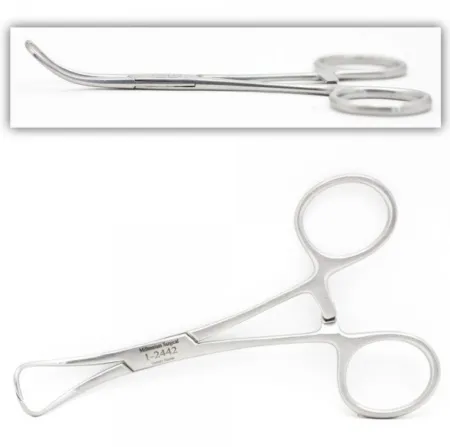 Backhaus Roeder Towel ForcepsGrasping & Holding · On 126 setups Mosquito Clamp - CurvedClamping & Occluding · On 168 setups Curved HemostatsClamping & Occluding · On 312 setups Kelly ForcepsClamping & Occluding · On 73 setups Right Angle ClampClamping & Occluding · On 102 setups Tonsil ClampClamping & Occluding · On 117 setups Rochester Pean ForcepsClamping & Occluding · On 92 setups Debakey Bulldog ClampClamping & Occluding · On 47 setups
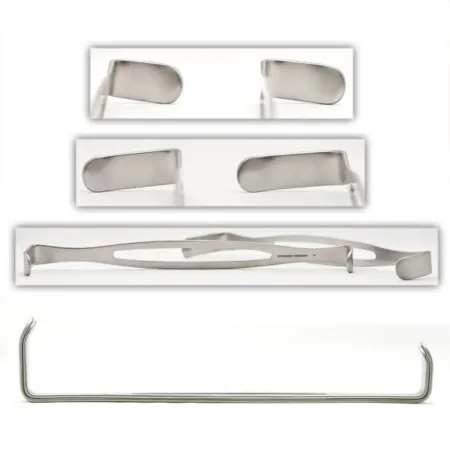 Army-Navy RetractorRetracting & Exposing · On 177 setups
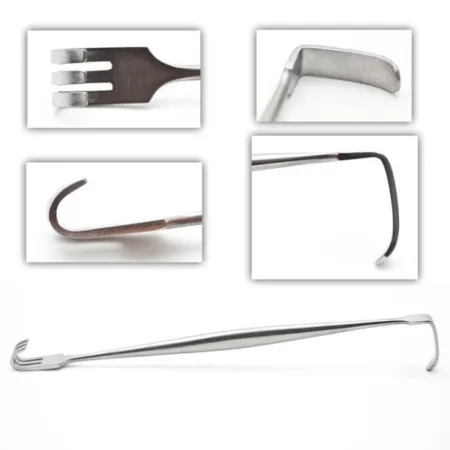 Senn RetractorRetracting & Exposing · On 169 setups
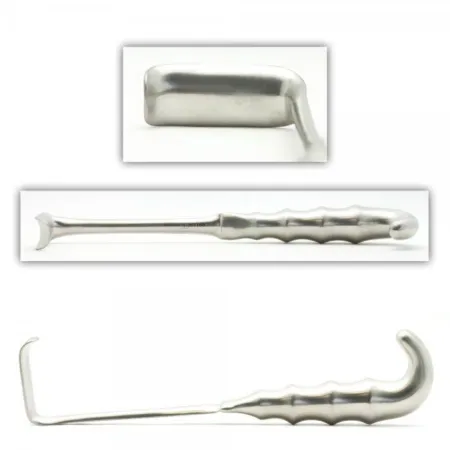 Richardson RetractorRetracting & Exposing · On 110 setups
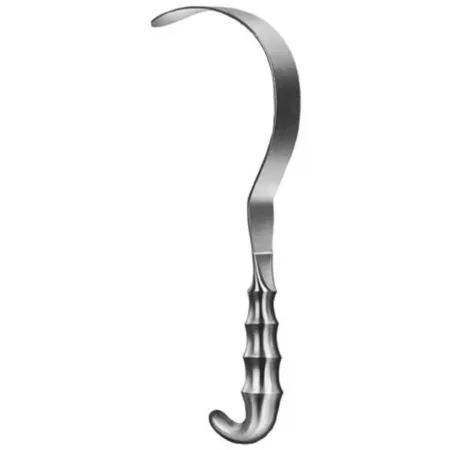 Deaver RetractorRetracting & Exposing · On 55 setups
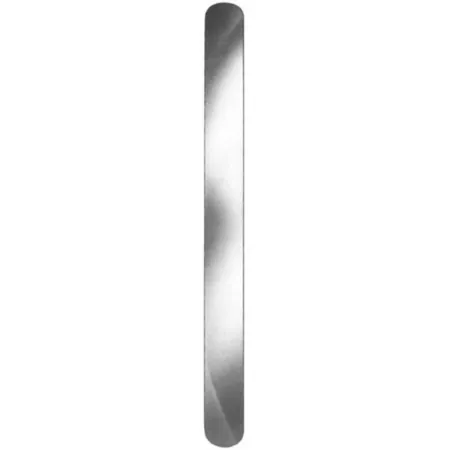 Ribbon RetractorRetracting & Exposing · On 65 setups
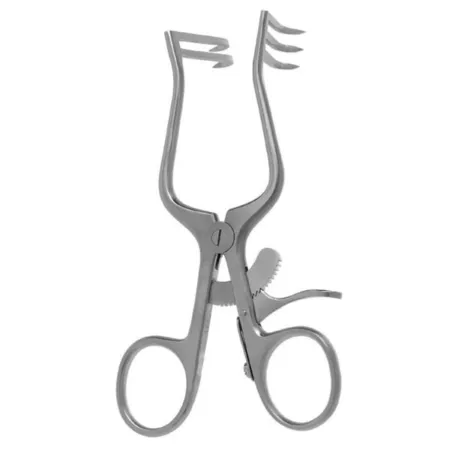 Weitlaner RetractorRetracting & Exposing · On 138 setups
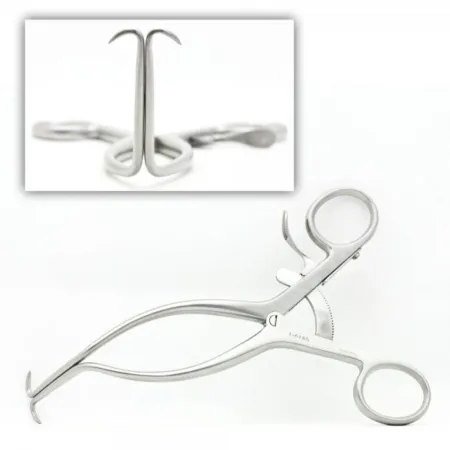 Gelpi RetractorRetracting & Exposing · On 37 setups
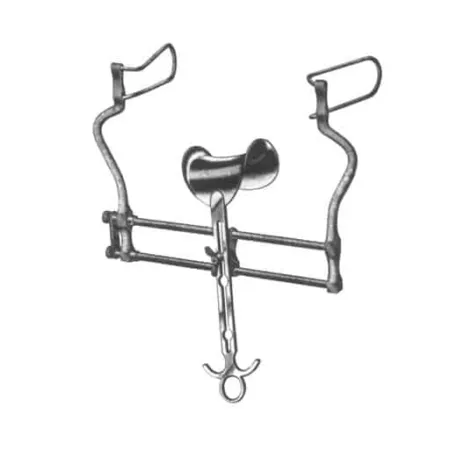 Balfour RetractorRetracting & Exposing · On 27 setups
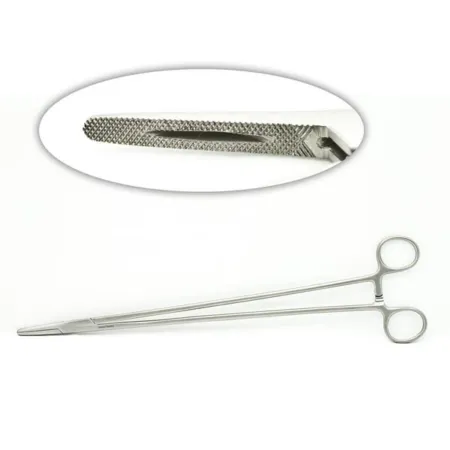 Mayo-Hegar Needle HolderSuturing & Stapling · On 257 setups
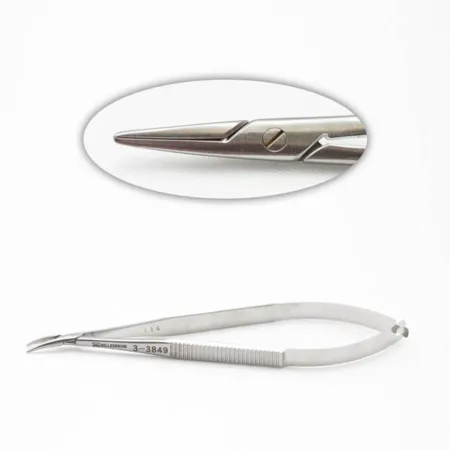 Castroviejo Needle HolderSuturing & Stapling · On 53 setups
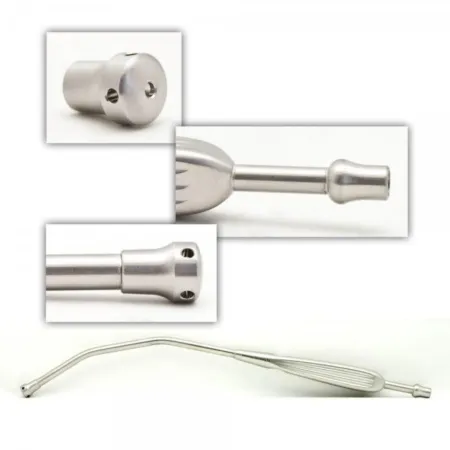 Yankauer SuctionSuctioning · On 228 setups
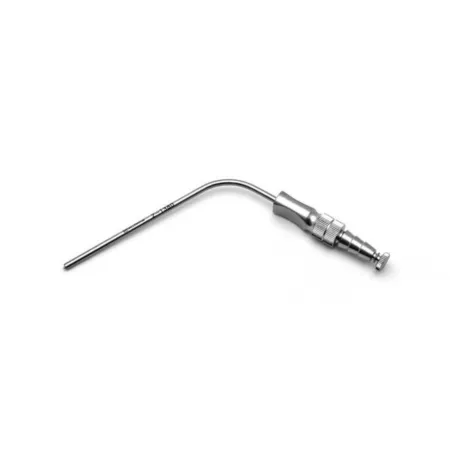 Ferg-Frazier SuctionSuctioning · On 139 setups
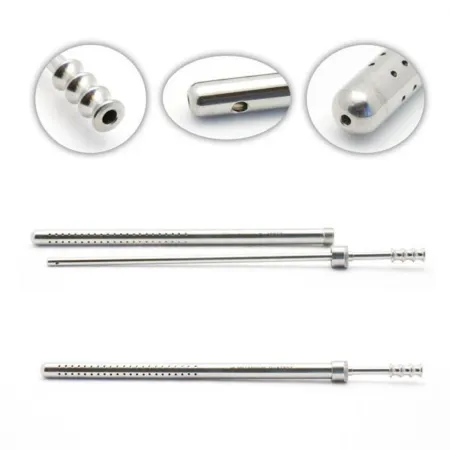 Poole Suction ProbeSuctioning · On 33 setups
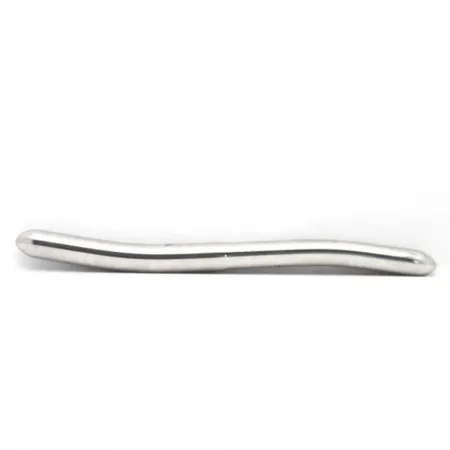 Hegar DilatorSpecialty · On 19 setups
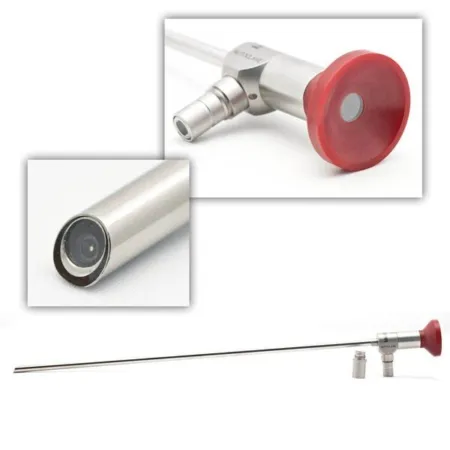 LaparoscopeSpecialty · On 28 setups
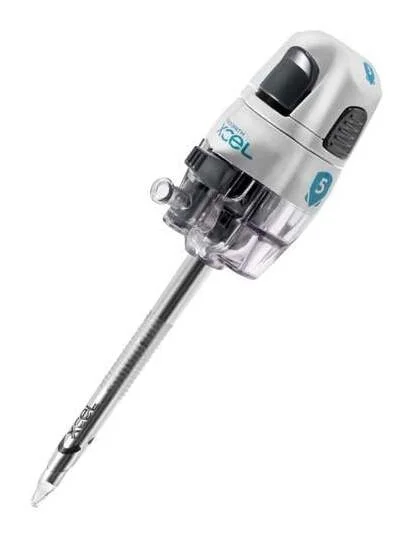 Laparoscopic TrocarSpecialty · On 38 setups
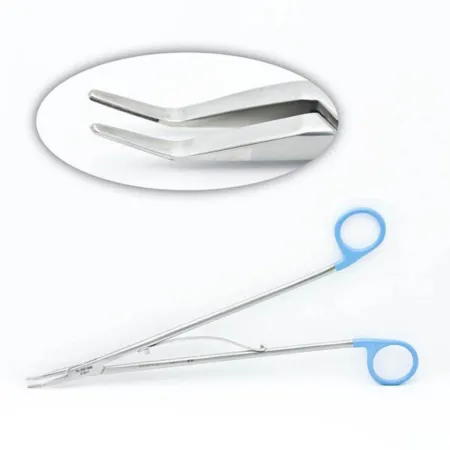 Hemostatic Clip ApplierClamping & Occluding · On 90 setups
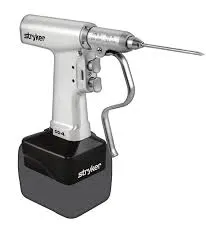 Stryker DrillSpecialty · On 51 setups
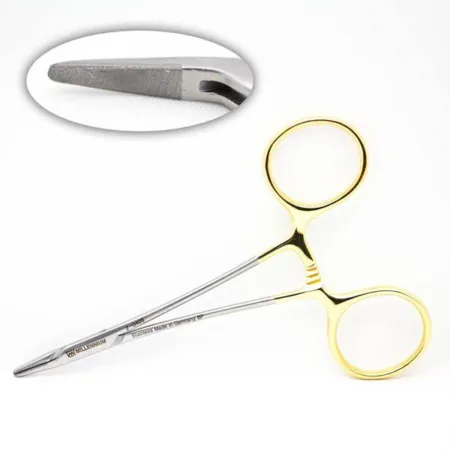 Carbide Webster Needle HolderSuturing & Stapling · On 28 setups
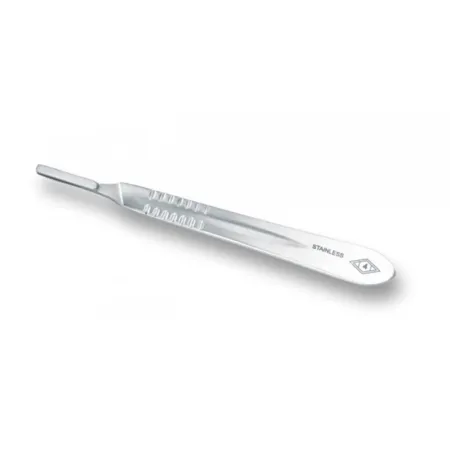 #4 Knife HandleCutting & Dissecting · On 9 setups
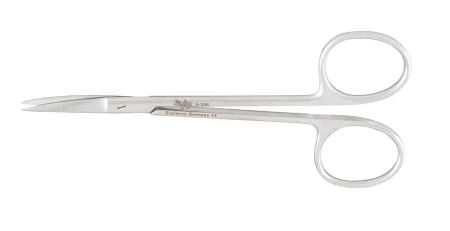 Curved Iris ScissorCutting & Dissecting · On 70 setups
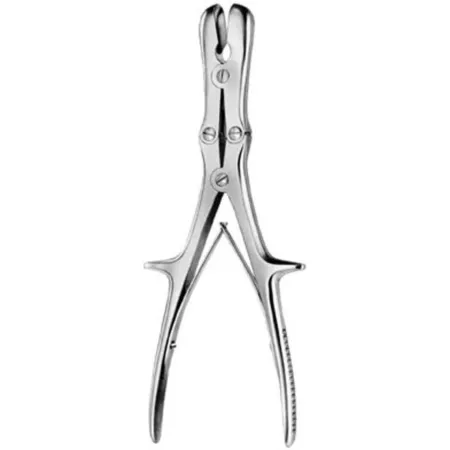 Stille-Luer RongeurCutting & Dissecting · On 3 setups
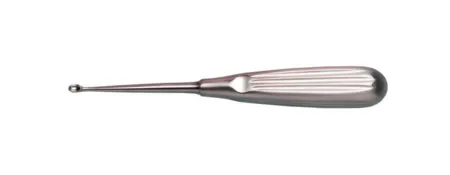 Volkmann Bone CuretteCutting & Dissecting · On 8 setups
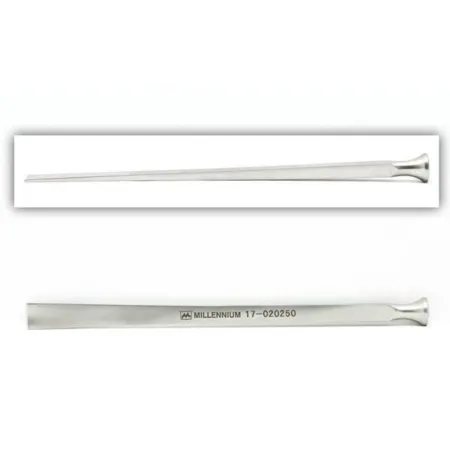 French Pattern OsteotomeCutting & Dissecting · On 1 setup
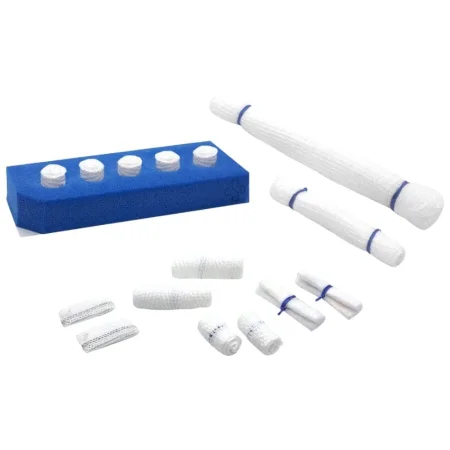 Peanut and Kittner SpongesSupplies · On 38 setups
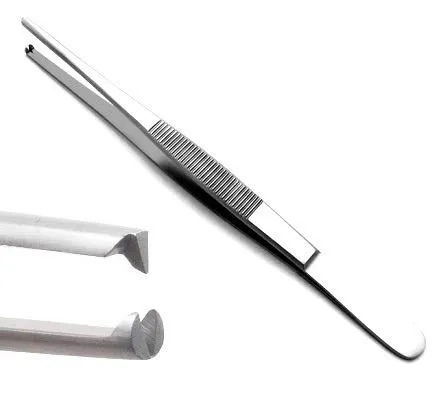 Toothed ForcepsGrasping & Holding · On 216 setups
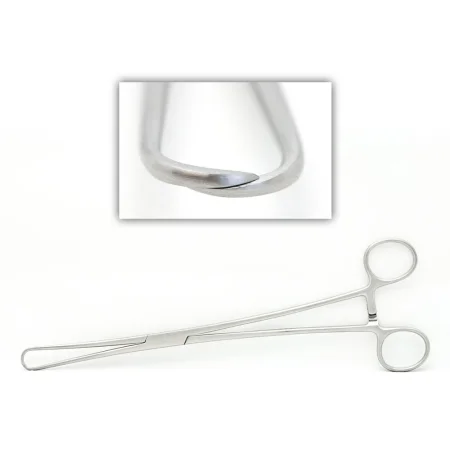 Tenaculum ForcepsGrasping & Holding · On 16 setups
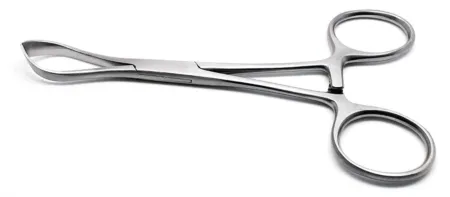 Non-penetrating Towel ClampClamping & Occluding · On 23 setups Debakey Vascular ClampClamping & Occluding · On 6 setups Satinsky Vena Cava ClampClamping & Occluding · On 9 setups Doyen Intestinal ForcepsGrasping & Holding · On 4 setups
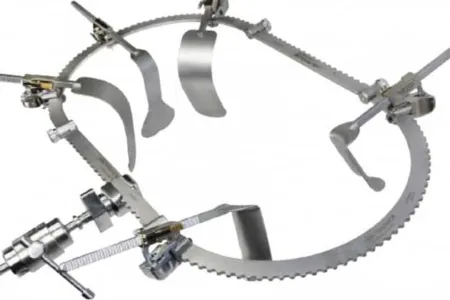 Bookwalter RetractorRetracting & Exposing · On 23 setups
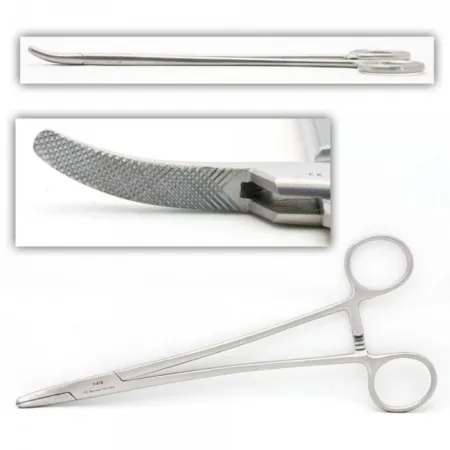 Heaney Needle HolderSuturing & Stapling · On 12 setups
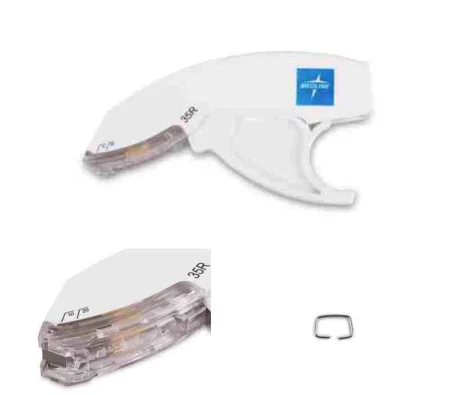 Skin StaplerSuturing & Stapling · On 58 setups
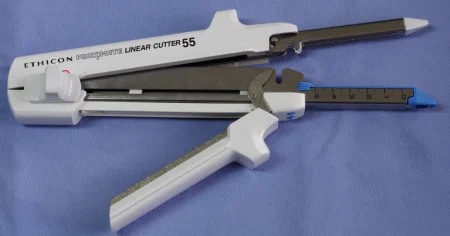 Linear Cutter-StaplerSuturing & Stapling · On 21 setups
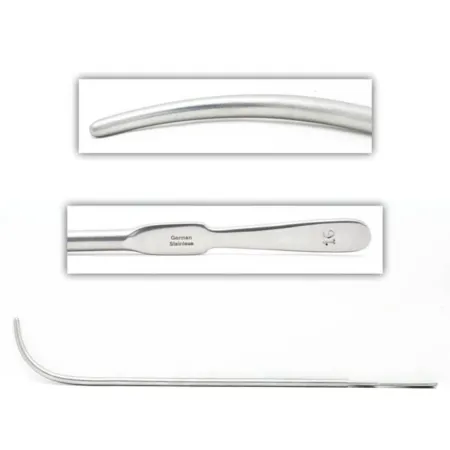 Van Buren Urethral SoundSpecialty · On 5 setups
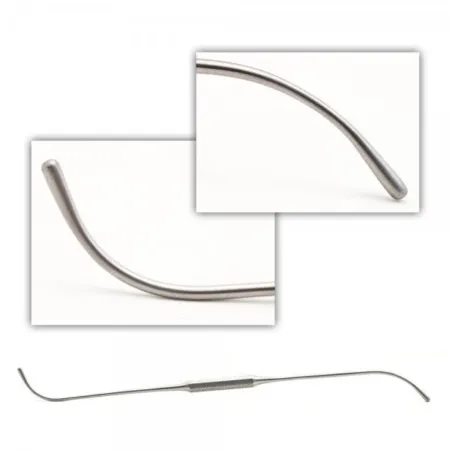 Barr Fistula ProbeSpecialty · On 1 setup
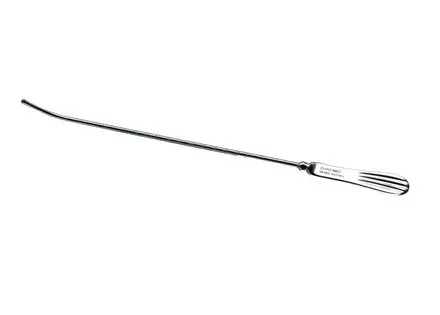 Uterine SoundSpecialty · On 15 setups
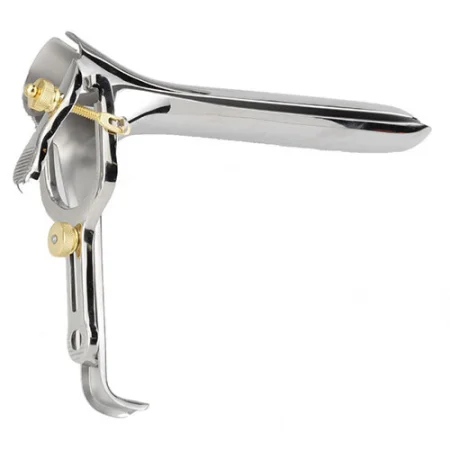 Graves SpeculumRetracting & Exposing · On 4 setups
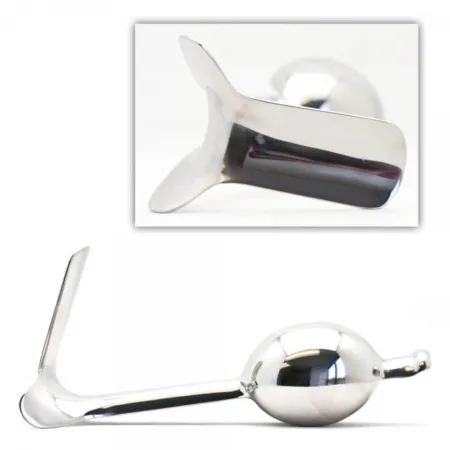 Auvard Vaginal SpeculumRetracting & Exposing · On 23 setups
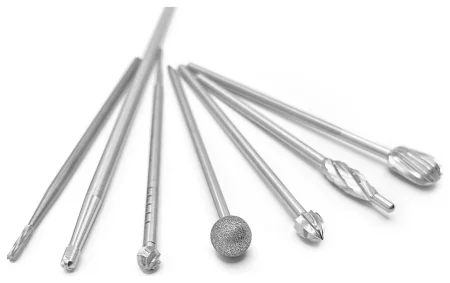 High-Speed Drill BurrCutting & Dissecting · On 17 setups
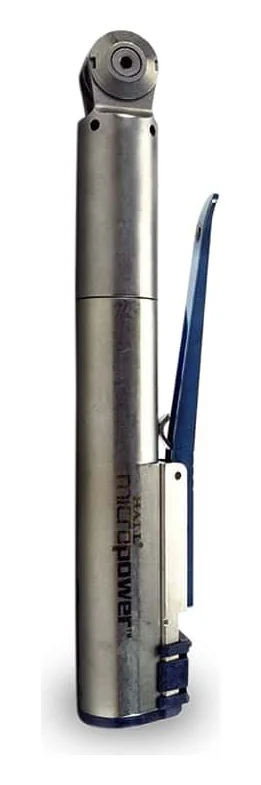 Microsagittal SawCutting & Dissecting · On 10 setups
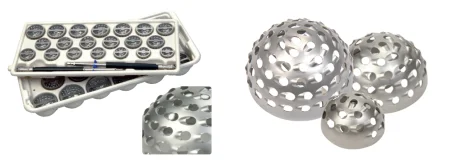 Acetabular ReamerCutting & Dissecting · On 4 setups
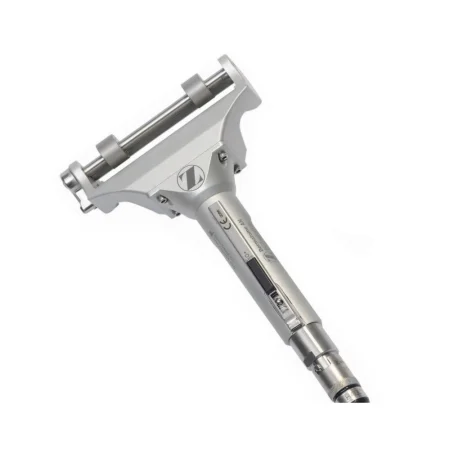 DermatomeCutting & Dissecting · On 8 setups
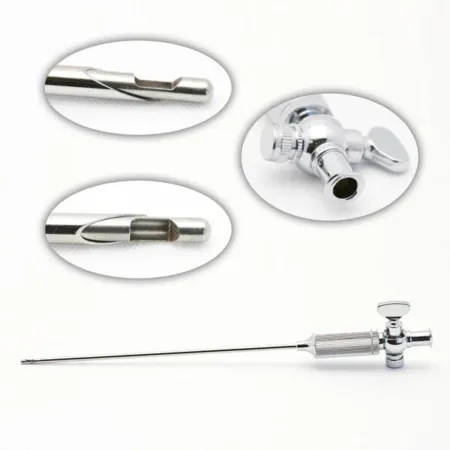 Veress NeedleCutting & Dissecting · On 29 setups
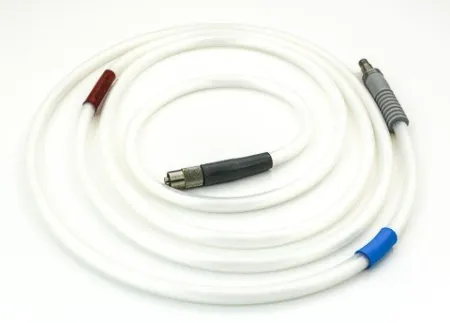 Light CordSpecialty · On 64 setups
The chapter's whole question pool in sets of 10, with the answer explained after each one.
Coming soonThe chapter's words and instruments on spaced cards: the ones you miss come back sooner.
Coming soonGiven by your class's teacher. Each class draws its own 25 from the chapter's pool.
Coming soon
Suggest a fix
Something wrong, unclear or out of date in this chapter? Tell us and we will fix it for everyone. Your email is only used to reply.